

Mental Toughness for Runners: Mastering the Race Day Mindset
Let’s be real for a second… Mental toughness for runners is often the deciding factor between a PR and a DNF. I’ve watched countless races, and I’ve seen the exact moment an athlete’s race falls apart. Sometimes it happens before they reach the starting line. It’s rarely because their legs gave out. It’s almost always because their head did.
We spend hours training energy systems, perfecting splits, and debating spike size. But when the gun goes off, if your mental game isn’t as sharp as your physical one, none of that matters.
Recently, I was listening to the On Track & Field Podcast, where host J.T. Ayers interviewed Shannon Thompson. If you don’t know Shannon, she’s the Mental Performance Coach behind the powerhouse Northern Arizona University (NAU) distance program. She knows a thing or two about getting athletes to perform when the pressure is highest.
The episode was fantastic, not only was there practical advice about what we can do as coaches, but even more useful was advice about what we need to stop doing.
Honest Expectations: Stop Hoping for a Magic Day
The most common trap I see runners fall into? Hoping for a pain-free race day. They fantasize about a magical scenario where the pace feels effortless from start to finish. Shannon refers to this as a failure of “Honest Expectations.”
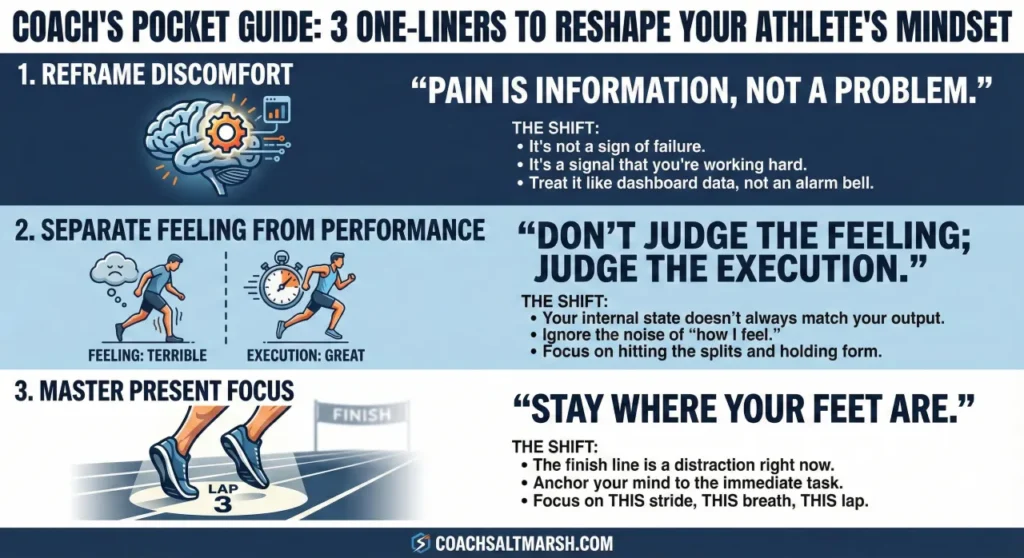
Let’s be clear: If you are racing to your full potential, it is going to hurt. A lot. There is a reason seasoned runners preach the mantra of getting “comfortable being uncomfortable.” If your strategy relies on avoiding pain, you will panic the moment your lungs start to burn. You’ll convince yourself something is wrong. Instead, you need to normalize the suffering. Expect it. Plan for it. When the hurt arrives, don’t retreat—embrace it as proof that you are finally pushing your limits.
Pre-Race Anxiety: Why Nerves Are Trying to Help You
How many times have you stood on a starting line feeling your heart pounding and your hands shaking, thinking, “I’m too nervous. I’m going to blow it”? We need to stop confusing physical arousal with anxiety.
Shannon made a great point that the physical sensations—the adrenaline, the racing heart—are neutral. That’s just your body revving its engine. It’s getting ready to do something difficult. Anxiety is the negative story you tell yourself about those sensations.
Managing Pain: The Dual Arrows Metaphor
In Buddhist literature there is a metaphor about pain that refers to two arrows. The first arrow is the actual physical discomfort of exertion, the natural bodily response to pushing limits. The second arrow is the emotional reaction to that discomfort, often fear or panic about the pain itself. This second arrow, the fear of pain, can sometimes be more intense and debilitating than the physical sensation.
Interpretation for Coaches:
- Acknowledge the first arrow: Validate that pain is a real and expected part of pushing oneself in sports. Don’t dismiss or minimize the athlete’s physical experience.
- Address the second arrow: Help athletes identify and manage their emotional response to pain. Teach them strategies to stay calm and focused, even when they are uncomfortable.
The Transactional Trap vs. The Process
“I trained hard all summer and fall, so I deserve a 2-minute PR today.”
This transactional mindset is a one-way ticket to disappointment. The race doesn’t owe you anything. Too bad, so sad. When you are solely focused on the outcome (the time on the clock), you aren’t focused on the process of running the race. Forget the clock, embrace the competition.
Shannon encourages athletes to enter into a “relationship” with the race. It’s a dynamic challenge. You need to respond to what is happening right now—the weather, the competition, your footing. As she says, “Stay where your feet are.” Focus on executing this mile, this lap, this stride. The finish line will take care of itself.
Mental toughness isn’t about being an emotionless robot who feels no pain. It’s about having the tools to deal with the messy reality of racing.
The Dare State
Thompson often refers to a state of mind she calls “DARE” which encourages athletes to:
- Define the challenge.
- Accept the difficulty (and the pain).
- Respond to the moment.
- Engage with the competition.
I think this is an excellent way to remember what this is all about. To remind our young athletes that the real champions are those who can train hard enough and smart enough to make it to the starting line, embrace the discomfort as reassurance that they are giving it their all, respond to the moment in real time without hesitation and indecision, and never forget that their team depends on them to compete and finish on empty.