

Season over? Week 1 of winter starts the Monday after your last race. Send families the Break Letter that week.
Build the season.
Not the spreadsheet.
Periodization frameworks, workout libraries, and free planning tools for high school cross country and track from a USATF Level 2 coach who’s still on the line in November.
XC to Track Goal Calculator
Enter a championship cross country 5K. Get spring 1600m and 3200m goals from what runners with that 5K actually ran in May.
Built from 1,608 fall-to-spring results.
Starts now · November to March
The Winter Training Block
The season is ending. The next twenty weeks decide your spring. Two paths depending on whether you race indoors, four levels, and every session written out.
Up next · December to January
22-Week XC Season Blueprint
The summer build starts in June. The planning can start tonight. A 10-week summer build, a 12-week season and a championship taper, planned to the day.
Up next · December to March
P-Scale Track Bundle
The Winter Block ends at your first outdoor meet. Spring starts there. Day-by-day plans for the 800, 1600 and 3200, each with the full P-Scale pace calculator.
Up next · April to May
Coach OS Bundle
Have the plan, the parent meeting and the fueling guide ready before June. The five core tools that run a high school season, for $39 less than buying them one at a time.
Up next · June to August
12-Week Middle School XC Plan
Your freshman class is decided three years before it arrives. Twelve weeks for grades 5 through 8, with every workout delivered as a game.
Free tools coaches open before practice
No account, no app. The free tools and guides had more than 55,000 visitors in the past 12 months.
Heat and humidity adjuster
How much to slow down for temperature and dew point so athletes stay at the right effort. The most-used tool on the site.
Open toolTraining paces: LT1 and LT2
VDOT, vVO2max, LT1, LT2 and every training zone from one recent race. For a whole squad, use the XC Training Group Sorter on the Tools page.
Open toolXC summer plan generator
A week-by-week summer base plan for each athlete, built from a starting mileage and a cap.
Open toolRunner nutrition calculator
Daily calorie, carb, protein and fat targets based on weekly mileage. Built for growing distance runners.
Open toolYour entire XC season, planned to the day.
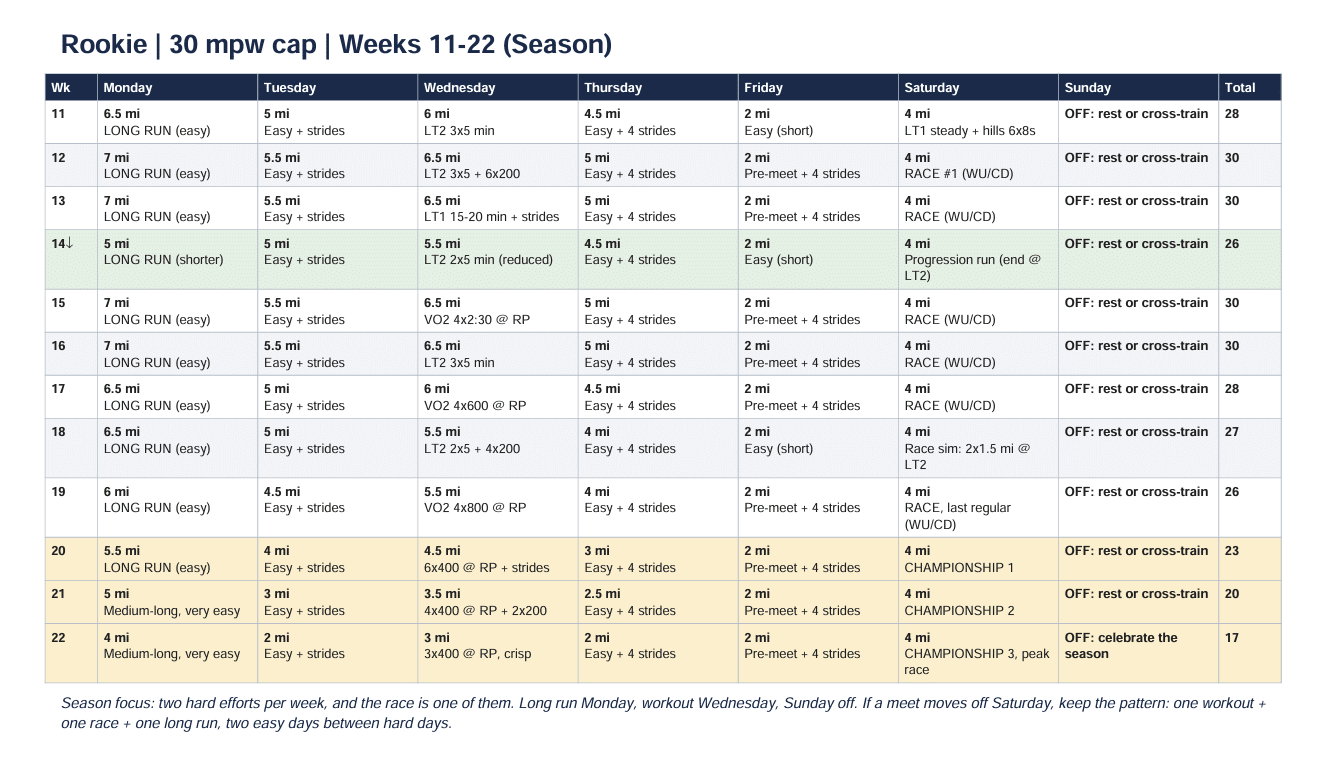
You don’t design a season. You open the page, read the week, and coach. A 10-week summer build, a 12-week season, and a taper timed to your championship weekends, mapped out for every experience level on your roster.
- 154 days planned, with printable, post-on-the-wall schedules
- Rookie (30 mpw), Returner (40) and Veteran (50) groups train together
- Lydiard base, Daniels dosing and Norwegian threshold control
- Coach cue cards: what to say and which red flags to watch for
- Pace charts for any 5K from 16:00 to 28:00
Built over 25 years and 31 state champions. Not theory from a consultant. A framework you can run on Monday.
Less than a single clinic registration. And roughly forty hours you won’t spend building plans in a spreadsheet.
See what’s inside the Blueprint Or see a free sample weekHow they train
Real athletes. Real data. The methods behind podium performances.

Josh Kerr training: the mile world record blueprint
How Josh Kerr broke a 27-year-old world record on 65 to 70 miles a week, why his coach skips lactate testing and double days, and what a simple system teaches every coach.
Read case study
Cooper Lutkenhaus: the 30-mile blueprint for the 800m
How 16-year-old Cooper Lutkenhaus ran 1:42.27 for 800m on just 30 miles per week. Inside the Chris Capeau training system and its progressive step-down lactate clearance.
Read case study
Sean Brosnan’s training system: how Newbury Park built a dynasty
The system that challenges three things coaches believe without questioning: that base training should be slow, that the 7-day week is the natural cycle, and that mileage accumulation is the primary driver.
Read case studyThe cold policy, written before the cold morning.
Write your cold and ice thresholds in November and send them to your athletic director. This is the one-page policy I use. One email with the files, then the occasional coaching note.
- Four wind chill thresholds, with the decision at each one
- The call time and the communication plan
- The wind chill caveat almost nobody publishes
- A print-ready PDF and an editable Word version