
Coaching Girls XC: What Science Says About Training Differences
I stood at the 2.5-mile mark of the NH XC Division 1 championships at the brutal Derryfield Park course a few years back, watching one of my most dedicated varsity runners approach. She should have been surging. Instead, she looked gray. Her form was breaking down, her eyes were glazed, and she was fading fast.
We had done everything “right.” We hit the mileage goals. We did the traditional speed workouts. She was disciplined. Yet, she was falling apart. After dealing with a string of stress reactions and general burnout among the girls’ squad, I’ve come to a hard realization: the comprehensive training blueprint for high schoolers I had used for years—the one largely based on male physiology and decades of old-school running dogma—was failing my female athletes.
We’ve all heard it, but until you really internalize it, it’s just a slogan: Women are not small men.
Recently, at the recommendation of a trusted colleague (and female masters runner), I dove deep into the work of Dr. Stacy Sims, author of ROAR and more recently Next Level, and a leading expert in female athlete physiology. Listening to her break down the science was like having a lightbulb turned on in a dark room. It validated the frustrations I’ve been feeling as a coach and provided a clear, science-backed path forward.
If you coach girls’ cross country, or if you are the parent of a female runner, what follows isn’t just advice; it’s a necessary evolution. Here’s how I’m applying Dr. Sims’ groundbreaking research to build a healthier, faster, and more resilient girls’ cross country team next season.
1. The Fueling Paradigm Shift: The End of Fasted Training
For years, my runners have shown up to our 7AM summer practices after rolling out of bed. Breakfast is usually something they have time for after the run. If they showed up and ran, I was happy. I knew many of them were rolling out of bed and running on nothing but water, but I always told them to grab a healthy breakfast soon after with plenty of carbs and protein. However, I now know this was a much bigger issue than just the inconvenience of making an early breakfast. For many of my athletes this decision not to eat was driven by a misunderstanding of metabolism or, sadly, the aesthetic pressures of looking like a runner. Dr. Sims’ research shows this is perhaps the single most damaging mistake a female athlete can make.
The Science: Unlike men, whose bodies can often handle fasted training, a woman’s brain—specifically the hypothalamus—perceives fasting as a severe existential threat. When a teenage girl runs hard on an empty stomach, her cortisol (stress hormone) skyrockets.
The Consequence: Her body enters survival mode. It immediately starts breaking down lean muscle mass for fuel and signals the body to store more body fat (specifically visceral belly fat) to protect itself for the perceived coming famine. One might think we are training them to be lean machines by running in a fasted state; but we are actually training their bodies to hold onto fat and eat their own muscle. That’s horrifying.
The Fix: Athletes must eat before morning practice. You don’t step on the track until I see you eat half a banana, a yogurt, or drink a small protein shake. It’s not breakfast; it’s the ignition key for your metabolism.
I know the pushback. “Coach, I’ll throw up if I eat before I run,” or “I’m just not hungry.” Dr. Sims emphasizes it doesn’t need to be a meal. Humans need about 15g of protein or some carbohydrates to signal the brain that fuel is available.
Furthermore, the post-run fueling window is tighter for girls. They need to stop that catabolic breakdown process immediately. We now aim for a healthy snack within 30-45 minutes of finishing a hard effort. This is essential for recovery and, crucially, bone health.
2. Rethinking the Weight Room: Strong, Not Jacked
Walk into many high school weight rooms, and you’ll see the boys by the squat racks and benches and the girls holding 5-pound dumbbells doing high-rep “toning” exercises. Most of the girls would rather be anyplace else than in a crowded room with a bunch of sweaty teenage boys trying to impress each other. To add to their discomfort, there is usually misogynistic rap music pounding from the speakers.
Given that environment, many coaches underutilize weight training and instead opt to spend that time running more miles. Dr. Sims says this is a huge mistake. The “low weight, high mileage” training is harmful to most high school cross country runners. Most of them need to build a durable, injury-proof bodies before adding more miles. I encourage my runners to “take up space” in the weight room and work to become stronger versions of themselves. And, when my girls’ team enters the weight room, the music stops unless it’s coach-approved.
The “Bulk” Myth: Often, I have to reassure parents and athletes about this: Teenage girls simply do not have the testosterone profile to accidentally become bodybuilders. What they will get from heavy lifting is usable, explosive power and durability. Dr. Sims calls heavy lifting “internal Spanx”—it tightens the body’s architecture.
Why We Lift Heavy Now:
- Bone Density: This is the big one. The pounding of XC destroys bones if they aren’t fortified. Heavy loading (like squats and deadlifts) is the best insurance policy against stress fractures.
- Power: As women age, they lose power faster than endurance. Even in high school, we need to cultivate explosiveness. We are incorporating heavier lifts with lower reps, and true plyometrics like box jumps.
- Shorter Rests: Another fascinating biological difference—women recover faster between sets than men. We don’t need three minutes of sitting around between squats. Coaches should keep the tempo high in the weight room, which keeps them engaged and gets the work done efficiently.
3. Training Smart: Intensity Over ‘Junk’ Miles
We used to worship weekly mileage. If a girl was struggling, my instinct was often, “She needs a bigger aerobic base.” Sometimes, that just adds more slow, moderate miles that just added fatigue without the fitness stimulus. I see this a lot when they run on their own during the summer. Dr. Sims advocates moving away from chronic, moderate cardio—what I call “junk miles”—and toward polarity in training.
Max Sprint Training: We are incorporating true, max-effort intervals. We’re talking 15-30 seconds all-out, followed by long, full recoveries (1.5 to 2 minutes of standing or walking). This isn’t an aerobic workout; it’s a metabolic shock to the system. This type of training creates a metabolic effect that improves fitness and body composition far more effectively than slogging through endless slow miles.
Stress Resilience: Dr. Sims suggests reframing running not as just a sport, but as a method of teaching “Stress Resilience.” When we send the girls out for a brutal hill workout, we aren’t just building lungs and quads. We are intentionally stressing the body so it learns to recover and come back stronger. By exposing them to controlled physical stress and allowing them to recover, we are training their nervous systems to remain calm during other life stresses—exams, social drama, and race-day anxiety.
4. Nuances in Recovery
Recovery isn’t one-size-fits-all. Dr. Sims highlighted major differences in males and females when it comes to cold and heat.
- The Ice Bath Caution: The night before big meets, I used to suggest the girls sit in freezing ice baths. It turns out, this might have been counterproductive. Women often react with a severe sympathetic (fight or flight) response to near-freezing shock, which can hinder recovery rather than help it. Cool water (around 55-60°F) works even better. They don’t need to shiver to get the benefit.
- Embracing the Heat: Conversely, women generally vasodilate quickly and tolerate heat well. sauna sessions are a great tool for cardiovascular recovery without the impact of running.
5. Culture and Mindset: The “Tend and Befriend” Advantage
Finally, science has validated something I always instinctively knew about girls’ teams but couldn’t articulate. The social aspect isn’t always a distraction; it’s a performance enhancer when everyone is clicking and working towards a common goal.
Men often buffer stress through a “fight or flight” mechanism. Women, biologically, often use a “tend and befriend” mechanism. When my girls are chatting during an easy long run, or laughing together while stretching, they are actively lowering their cortisol levels through community connection. That social bond makes the physical training more effective because their stress baseline is lower.
As a coach, I actively encourage this. It bothers me when an athlete decides to work out independently. More times than not, they are suffering in silence and deep down they’d rather be a part of the group.
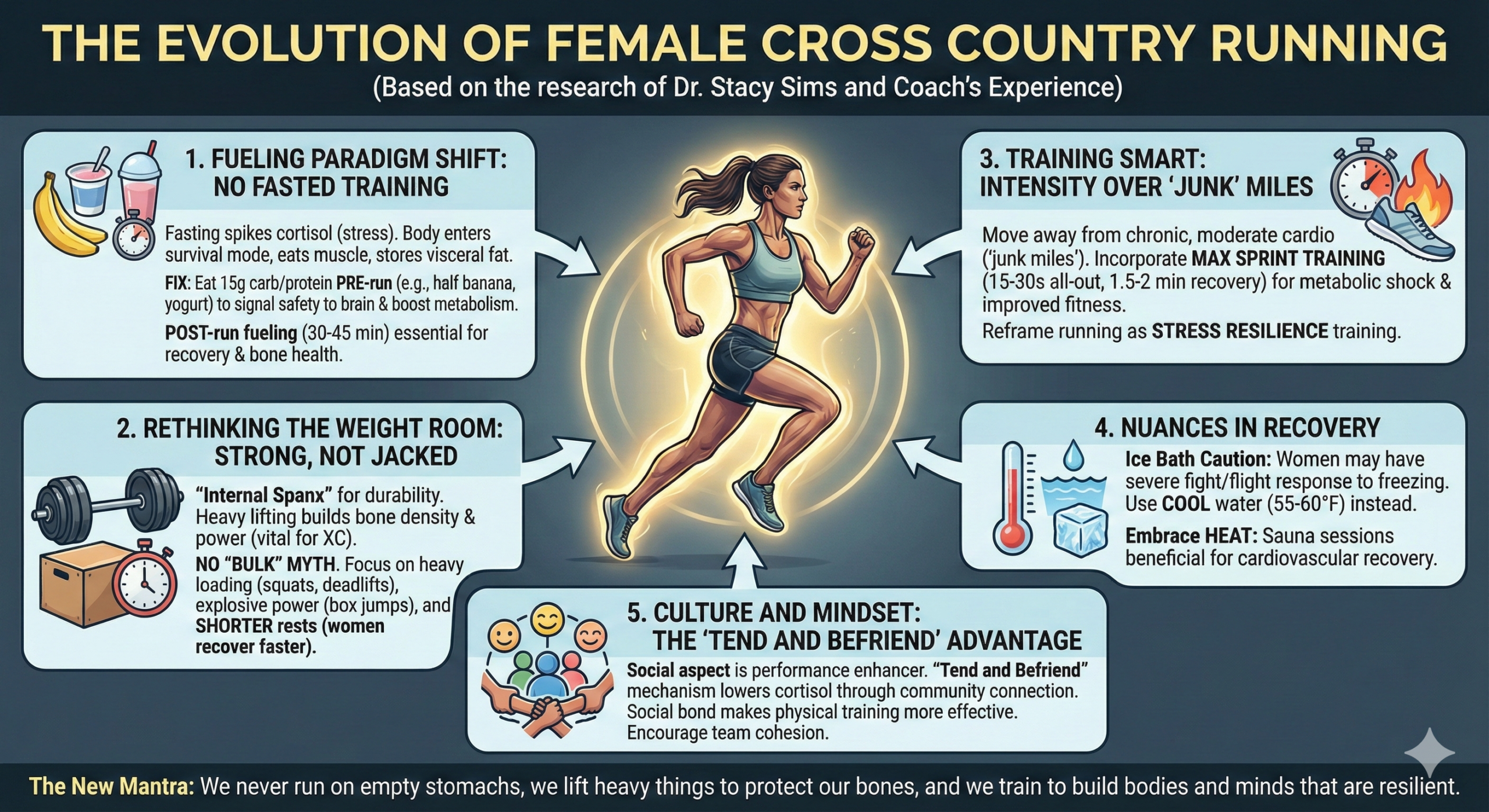
The New Mantra
Changing your coaching philosophy after years of doing it one way is terrifying. It requires admitting you might have been wrong. But when you see the injuries decrease and the joy return to their running, you know it’s the right path.
We are simplifying everything. Workouts and races without watches, running by feel, minutes over miles, sticking to whole foods and not stressing about the details. Our new team philosophy, is simple to understand and powerful in practice:
“We never run on empty stomachs, we lift heavy things to protect our bones, and we train to build bodies and minds that are resilient.”







Wow! Great article!