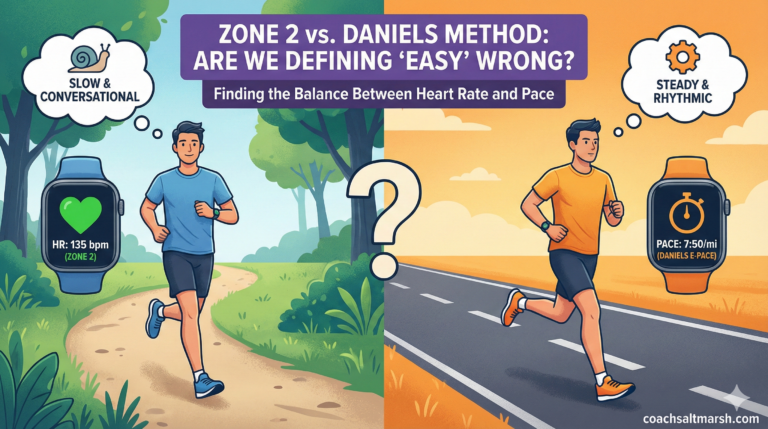
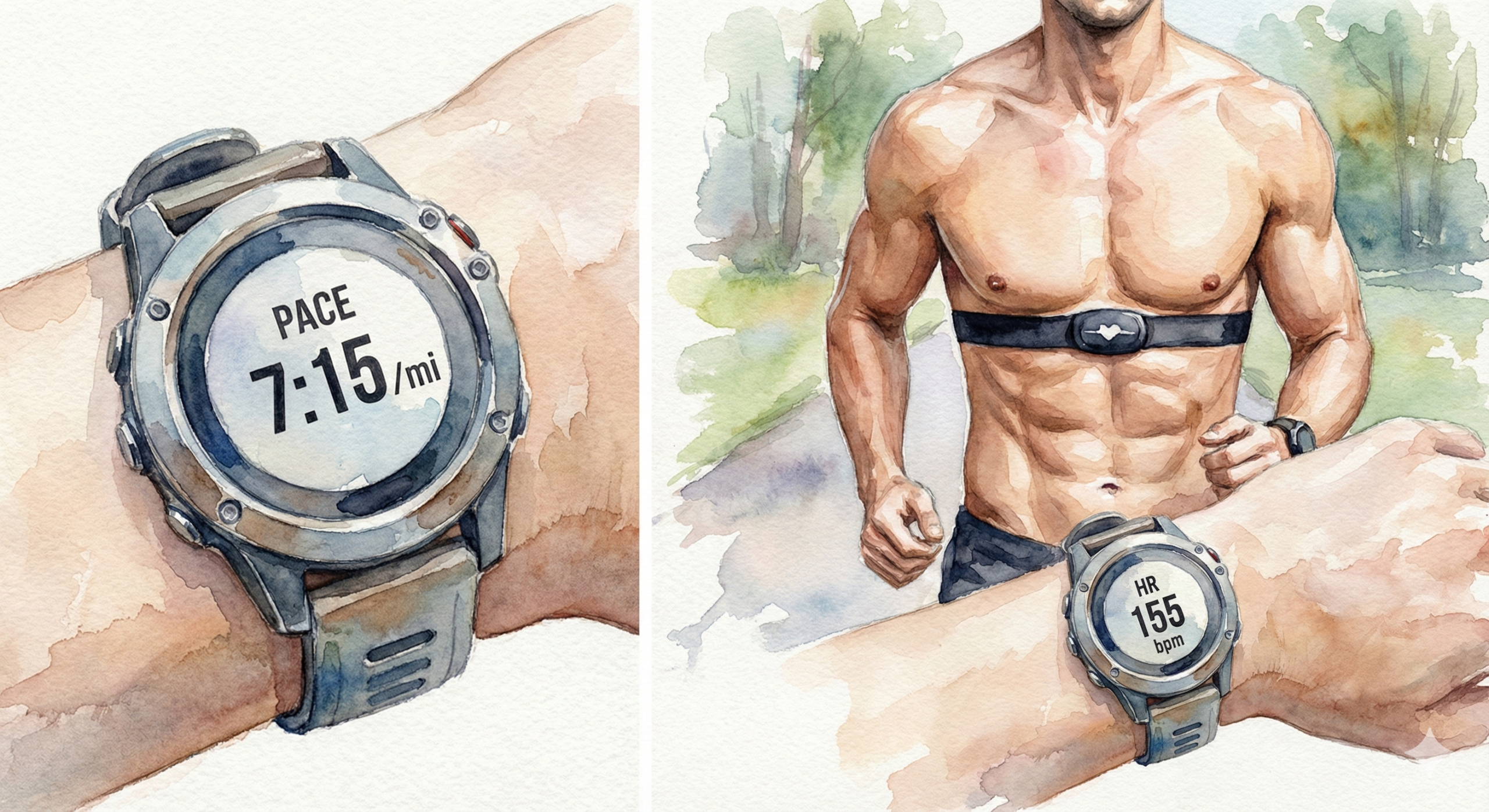
How to Blend Daniels VDOT Paces with Heart Rate Training
Can you still use a pace-based calculator if you prefer training by heart rate? Absolutely. Here is the blueprint for merging two of the most popular training methodologies.
Runners love data, but not all numbers tell the same story. In the endurance world, we speak two primary languages: Pace (the external output) and Heart Rate (the internal cost).
For decades, Dr. Jack Daniels’ VDOT system has reigned as the gold standard for pacing. It is a brilliant calculator that uses your past race performances to prescribe precise future training speeds. Heart Rate (HR) zones, however, care only about the present. They monitor how hard your body’s engine is working right now, regardless of how fast you are moving.
This creates a common dilemma. I often hear from athletes who love the physiological structure of Daniels’ workouts but value the biological feedback of a heart rate monitor. The inevitable question is, “How do I use both?”
The secret is not to treat them as competing systems. Trying to align them perfectly will only lead to frustration. Instead, view them as complementary gauges on the same dashboard.
The Coach’s Reality Check: Why VDOT Often Wins
From a practical coaching standpoint, the VDOT system tends to work better simply because of accessibility—not every athlete owns a reliable heart rate monitor.
Yes, you can teach athletes to calculate their heart rate by taking their manual pulse, but this has not worked well in my own experiments. In a large group or high school setting, asking 30 runners to find their pulse immediately after a chaotic interval often leads to inaccurate data and wasted recovery time. Pace is universal; everyone has a stopwatch.
However, for the individual athlete who does have the tech, ignoring heart rate data is a mistake.
The Analogy: The GPS vs. The Temperature Gauge
To understand how to marry these systems, imagine driving a car.
- VDOT Paces are your GPS. Your GPS tells you exactly how fast you need to travel to reach your destination on time. If your VDOT says your Threshold pace is 7:00/mile, that is the speed required to induce a specific training effect.
- Heart Rate Zones are your Engine Temperature Gauge. The gauge doesn’t care about your speed; it tells you how stressed the engine is. If it’s 90 degrees outside and you’re running uphill, your engine temp (heart rate) will skyrocket, even if you are slowing down.
A smart driver uses both. They follow the GPS plan, but they back off if the engine starts overheating.
The Total Approach: 4 Steps to Integration
If you prefer heart rate feedback, you shouldn’t discard VDOT. Use VDOT as the structural framework of your plan, and heart rate as the governor ensuring appropriate effort.
Here is my four-step approach to blending the methodologies:
Establish a True Max Heart Rate (MHR)
Formulas like “220 minus age” are wildly inaccurate for individuals. To use HR zones effectively, you must perform a field test.
After a thorough warm-up, run a 5K all-out race, sprinting the last 400 meters. Your highest recorded bpm is likely your functional max. Alternatively, run hard up a steep hill three times (2 minutes each). The highest number you see on the third rep is usually your max.
Use VDOT to Set the Schedule
Use a recent race performance to find your VDOT score. Let Daniels’ formulas dictate your training week structure (e.g., a Tuesday Threshold workout and a long Sunday run). You now know the intended paces.
Use HR as the “Ceiling” for Aerobic Runs
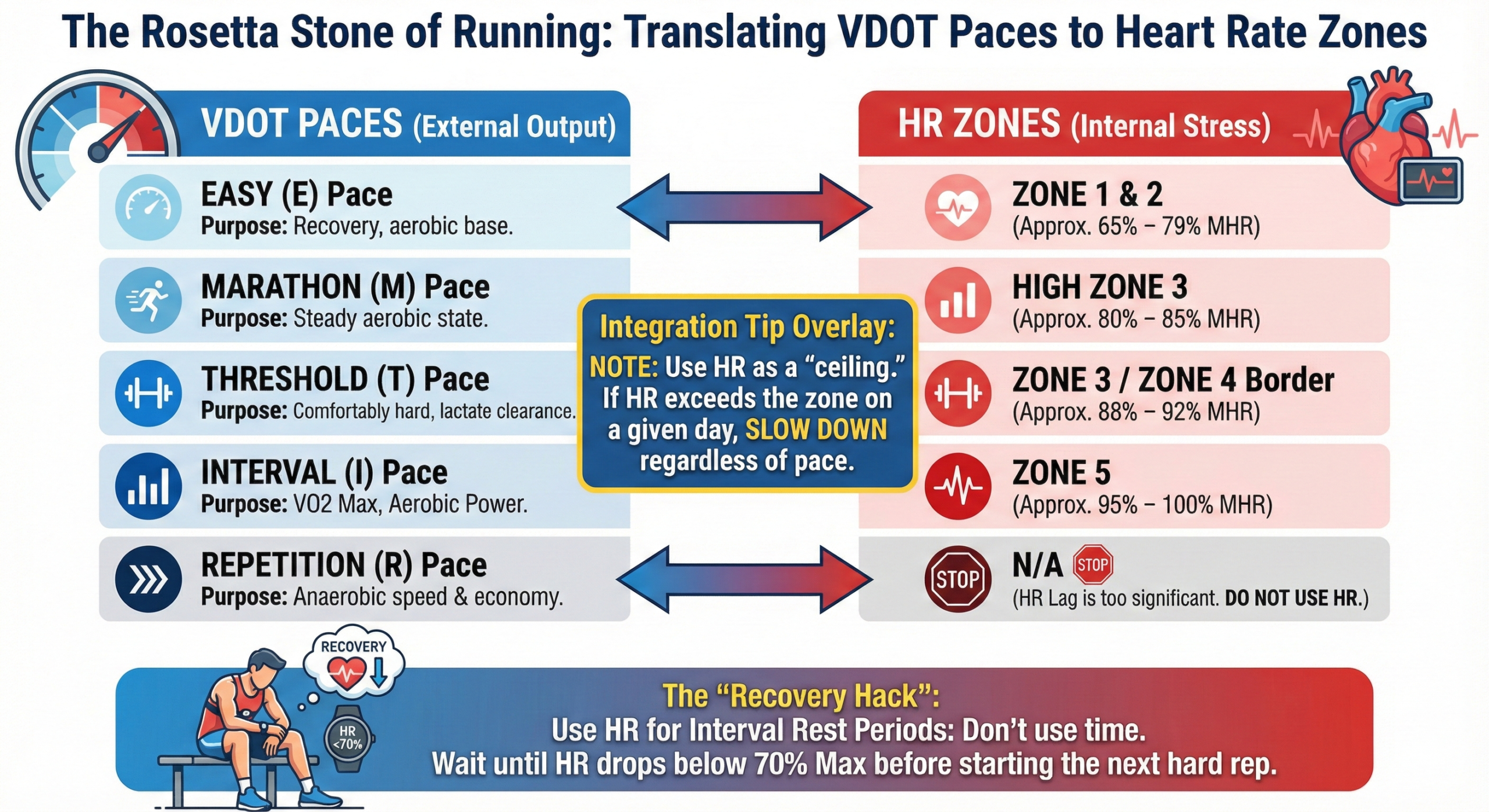
For Easy (E), Marathon (M), and Threshold (T) runs, wear your monitor. Start the run aiming for the VDOT pace.
If your heart rate drifts above the corresponding zone for that workout (e.g., your “Easy” run drifts over 79% MHR), you must slow down, regardless of what the GPS pace says. Your body is telling you that today, that specific pace is too physiologically expensive.
Use HR to Dictate Recovery Intervals
This is perhaps the best use of HR technology. In a VDOT Interval (I) workout, the rest periods are usually fixed time (e.g., “3 minutes hard, 2 minutes jog”).
Instead of a timed recovery, jog until your heart rate drops below a certain recovery threshold (usually roughly 65-70% of MHR). Once it hits that number, start the next repetition. This ensures you are physiologically recovered for the next hard effort.
The Drawbacks of Each System
Why bother blending them? Because relying solely on one has pitfalls.
- Drawbacks of VDOT Paces Only: VDOT is rigid. It assumes perfect weather, flat terrain, and that you are well-rested. It doesn’t know if you didn’t sleep last night or if it’s very humid. Trying to force a VDOT pace on a bad day can lead to overtraining or injury.
- Drawbacks of Heart Rate Zones Only: Heart rate lags. When you start sprinting, it takes 30-60 seconds for your HR to catch up. It is also subject to “cardiac drift”—your HR naturally rises over a long run even if pace remains stable. Furthermore, caffeine, stress, and excitement can artificially inflate your HR before you even start running.
How the Pros Do It
Elite runners rarely rely exclusively on one metric, though different camps lean in different directions.
The “Feel” & Pace Camp (e.g., Eliud Kipchoge) While Kipchoge wears technology, his training group in Kenya relies heavily on perceived effort and hitting very specific paces on known routes. They have run these dirt tracks thousands of times; they know exactly what a 3:00/km pace feels like without looking at a watch. This closely mirrors the VDOT philosophy of pace specificity.
The Physiological Monitoring Camp (e.g., Jakob Ingebrigtsen) The current trend in elite running, popularized by the Norwegians, is obsessive internal monitoring. They don’t just use heart rate; they use portable lactate analyzers during workouts to ensure they are in the exact physiological zone, never running harder than necessary. For them, the pace is irrelevant; the internal physiological cost is everything.
Conclusion
Don’t become a slave to a single number. Use the Daniels VDOT system to build a powerful, logical training structure. Use your heart rate monitor to ensure you are executing that structure at the right internal intensity. When your GPS and your heart rate agree, you are in the sweet spot of training.
And if technology fails you? Fall back on the ultimate low-tech method: Run by feel and trust your body over the data.