

Why Your Deadlift is Helping Your 5k

Deadlifts for 5K Speed
If you walk into a traditional running store or consult a generic marathon plan from the 90s, you’ll hear the same tired advice: “Don’t lift too heavy. You don’t want to carry extra bulk. Just do some lunges and resistance bands.” This advice is not just outdated; it is actively holding you back.
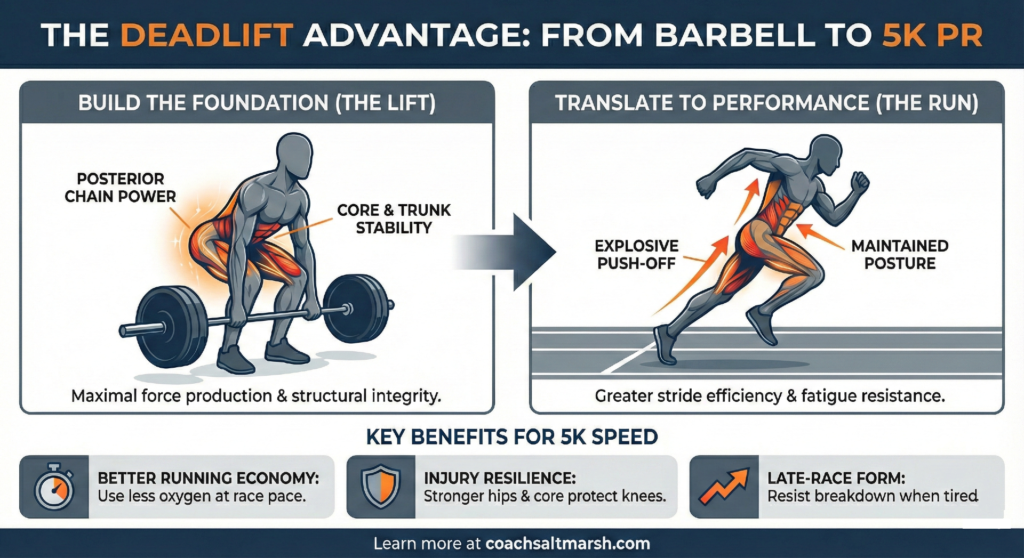
For the hybrid athlete, the barbell is not an obstacle to running speed-it is the engine. And the King of all lifts, the Deadlift, is arguably the single most important movement for lowering your 5k time. Here is the physiology of why pulling heavy iron off the floor makes you faster on the asphalt, track or trails.
1. Speed is Force
There is a common misconception that to run faster, you simply need to move your legs faster (cadence). While cadence matters, the primary differentiator between an elite runner and an amateur is Ground Reaction Force (GRF).
When you run, you are essentially jumping from one leg to the other. The more force you can put into the ground with each step, the farther you travel in the air (stride length) without increasing your metabolic cost.
The deadlift is the purest expression of force production. It teaches your central nervous system to recruit the maximum number of motor units simultaneously. When you increase your deadlift max, you are increasing the potential force you can apply to the pavement.
2. Curing “The Shuffle” (Posterior Chain Activation)
Most high school students and modern workers sit at desks all day. This leads to tight hip flexors and dormant glutes. When these athletes go for a run, they run “quad-dominant.” They rely entirely on their thighs to pull them forward, leading to a short, shuffling stride and inevitable knee pain.
The deadlift forces the Posterior Chain (Glutes and Hamstrings) to do the work. By training the hip hinge pattern heavily, you are wiring your brain to fire the glutes-the largest muscle group in your body. When you transfer this to running, you stop “pulling” with your quads and start “pushing” with your glutes. This is the difference between driving a Honda Civic and a Chevrolet Corvette.
3. Stamina Under Fatigue
We have all felt it: Mile 3 of the 5k, or Mile 20 of the marathon. Your shoulders slump forward, your lower back aches, and your chest collapses. When your posture breaks, your breathing becomes shallow (less oxygen) and your efficiency plummets.
The deadlift is not just a leg exercise; it is an isometric hold for your entire back. It builds a bulletproof core and spinal erectors. A heavy deadlifter has the structural integrity to stay upright and open-chested even when their legs are screaming. Good posture is free speed.
Practical Application
If you are a runner, do not treat deadlifts like cardio. We are not doing sets of 20 reps.
- Frequency: 1x per week (preferably on your “Hard” day, 6+ hours before or after your interval run).
- Volume: Low. 3 to 4 sets.
- Reps: Low. 3 to 4 reps.
- Intensity: High. (Leave 1 rep in the tank, never go to failure on technical lifts).
For a complete framework on how to integrate lifting into your weekly training schedule, check out Strength Training for Distance Runners: The 2-Session Weekly Protocol.
The Bottom Line: Stop avoiding the weight room. If you want to run like a gazelle, you need the engine of a lion. Load the bar, brace your core, and build the force required to smash your PR. Pair this with a smart early season distance training plan and the right injury-prevention footwear, and your athletes will be stronger and faster when it counts. Reducing the risk of breakdown during their transition to college running starts with building that foundation now.