

Managing Parents in HS Sports: A Coach’s Communication Guide
I’ll never forget the text message I received at 10PM on a Tuesday before the first day of school: “Why wasn’t my daughter in the top seven at today’s workout? She ran a 6:45 mile last spring. This doesn’t make sense.”
The workout itself was simple—a light 40-minute run in the second week—but the lesson was familiar. Once again, I realized that the art of managing parents requires just as much attention as the science of planning intervals.
After twenty years of coaching, and working with parents of all kinds, I’ve learned this truth: your relationship with parents will either amplify your program’s success or undermine it, regardless of how brilliant your training philosophy might be. The difference between programs that thrive for decades and those that collapse under the weight of drama often comes down to one thing—proactive, structured communication with parents.
The Foundation: Why Parent Communication Matters
Bill Aris didn’t build F-M into a national dynasty by avoiding parents. In interviews about F-M’s breakthrough 2004 season, Aris emphasizes parent buy-in as foundational: “We had the parents invested, willingly, excited about it.” When parents understand the coach’s philosophy, trust the process, and feel listened to by the coach, they are far more likely to become allies rather than critics.
Research supports what successful coaches intuitively know. The NFHS Learning Center‘s course “Engaging Effectively with Parents” emphasizes that positive parent relationships don’t just reduce drama—they enhance athlete performance. When parents and coaches are aligned, athletes feel supported rather than caught in the middle of conflicting expectations.
Dr. Mike Herbert, Director of Athletics at Southwestern Oregon Community College, frames it perfectly: “The key to a healthy coach-parent relationship is being optimistic about interacting with parents and believing they have good intentions.”
That’s the mindset shift. Parents aren’t the enemy. They’re anxious people trying to protect their children while navigating a sport they often don’t fully understand. Or, they’re parents that want their child to be successful at something they’ve already put so much time, effort and money into long before joining your team. Your job is to give them clarity, boundaries, and a seat at the table—with appropriate limits.
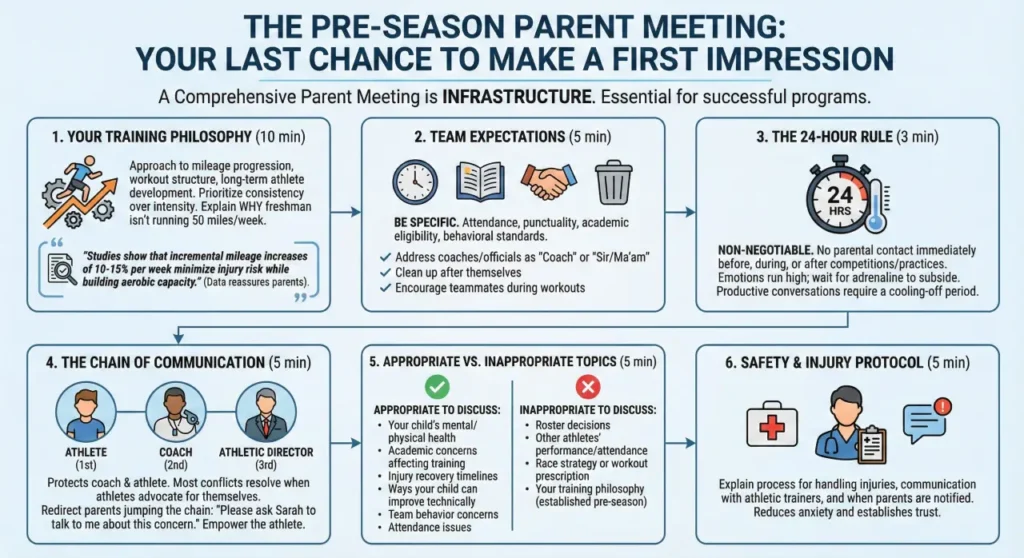
The Pre-Season Parent Meeting: Your LAST CHANCE TO MAKE A FIRST ImpRESSION
Every successful program I’ve studied—from Southlake Carroll to Niwot to F-M—begins with a comprehensive parent meeting before the first workout of the season. This isn’t optional. This is infrastructure.
What to Cover in Your Parent Meeting:
Your Training Philosophy (10 minutes)
Explain your approach to mileage progression, workout structure, and long-term athlete development. Parents need to understand why their freshman isn’t running 50 miles per week and why you prioritize consistency over intensity. Reference the research: “Studies show that incremental mileage increases of 10-15% per week minimize injury risk while building aerobic capacity.” Data reassures anxious parents.
Team Expectations (5 minutes)
Attendance requirements, punctuality standards, academic eligibility, and behavioral expectations. Be specific. Don’t say “be respectful.” Say “Athletes will address coaches and officials as ‘Coach’ or ‘Sir/Ma’am,’ will clean up after themselves, and will encourage teammates during workouts.”
The 24-Hour Rule (3 minutes)
This is non-negotiable. Establish that parents may not contact you immediately before, during, or after competitions or practices. Emotions run high in these moments, and productive conversations don’t happen when adrenaline is elevated. Many successful coaches implement a 24-hour cooling-off period.
The Chain of Communication (5 minutes)
Athlete first, coach second, athletic director third. This protects both you and the athlete. Most conflicts resolve when athletes learn to advocate for themselves. If a parent skips the athlete and comes directly to you, redirect: “I appreciate you bringing this to my attention. Please ask Sarah to talk to me about this concern.” Empower the athlete to initiate the conversation.
Appropriate vs. Inappropriate Topics (5 minutes)
Be explicit. These lists should be printed in your parent handbook.
Appropriate to discuss:
- Your child’s mental or physical health
- Academic concerns affecting training
- Injury recovery timelines
- Ways your child can improve technically
- Team behavior concerns
- Attendance issues
Inappropriate to discuss:
- Roster decisions
- Other athletes’ performance or attendance
- Race strategy or workout prescription
- Your training philosophy (this was established pre-season; now isn’t the time to question it)
Safety and Injury Protocol (5 minutes)
Explain your process for handling injuries, how you communicate with athletic trainers, and when parents will be notified. This reduces anxiety and establishes trust.
The Communication Infrastructure
Here’s what elite programs do that average programs don’t: they organized a system for communication so it’s predictable, consistent, and professional.
Weekly Email Updates
Every Sunday night, send a 3-5 paragraph email covering the week ahead: key workouts, logistical details (early dismissals, meet information), and a brief coaching note (perhaps highlighting an athlete who demonstrated leadership or sharing a relevant training principle). This preempts 90% of logistical questions and keeps parents engaged.
Monthly “Coffee with Coach” Sessions
Once a month, hold an optional 30-minute informal gathering where parents can ask general questions about the program. This gives anxious parents an outlet that doesn’t involve cornering you after practice. Keep it light, focus on program-wide topics, and never discuss individual athletes. Maybe they’ll even spring for the coffee.
Post-Meet Recaps
Within 48 hours of every competition, send a brief recap: team results, individual PRs, and a coaching observation about the team’s performance. Celebrate progress and set context for the next phase of training. Parents crave information; giving it to them proactively prevents them from seeking it through gossip or speculation.
So, that’s potentially 2 emails a week that will help you maintain good relationships with the adults that have the most influence over your athletes. Worth it!
Handling the Difficult Parent: The Tactical Guide
Let’s be honest: some parents can be a real pain in the ass. They question every decision, compare their child to everyone else’s, and undermine your authority at every turn. You can’t avoid them, but you can manage them.
The Helicopter Parent
Profile: Constantly hovers, emails multiple times per week, shows up at practice, tracks their child’s splits obsessively and let’s you know the moment your team ranking moves up or down.
Strategy: Establish boundaries early. At the parent meeting, state: “Parents are welcome to watch practices from the designated viewing area but may not approach athletes or coaches during practice.” Give them a role that channels their energy productively—team photographer, meet coordinator, social media manager. When they email excessively, respond once per week: “I’ve received your messages. I’ll respond to non-urgent items on Sunday.”
The Former Runner Parent
Profile: Ran in high school or college, thinks they know better than you, second-guesses your workouts, tells their child to do supplemental training.
Strategy: Respect their experience but establish your authority. Early in the season, send a message: “I know many of you have running backgrounds. I value that perspective, and I’m always happy to discuss training philosophy during our monthly coffee sessions. However, for athlete safety and team cohesion, ALL training must be prescribed and supervised by me.” If they persist, address it directly and privately: “I respect your running background, but when Sarah does additional mileage beyond the training plan, it compromises her recovery and increases injury risk.”
The Entitled Parent
Profile: Believes their child deserves preferential treatment—whether due to seniority, past performance, or to the parent’s own donor/booster status.
Strategy: Transparent, objective criteria. When roster decisions or lineup selections are made using measurable standards (race times, time trial results, practice consistency), it’s harder to argue favoritism. Document everything. Keep training logs, attendance records, and race results. If challenged, respond with data: “The top seven at championship meets is determined by our three most recent races or time trials. Here’s where Ava ranks currently.”
The Meeting That Solves Nothing
Sometimes you do everything right, and the parent still isn’t satisfied. You set up a meeting and invited your assistant coach to sit in. You held the meeting, you listened, you explained your decision, and they’re still upset.
At this point, bring in the athletic director. There’s no shame in this. Athletic directors exist precisely for these moments. Send an email: “Thank you for meeting with me yesterday. I understand we see this situation differently. If you’d like to continue this conversation, I’d be happy to schedule a follow-up meeting with our athletic director present.”
This accomplishes three things: it shows you’re not dismissing their concern, it adds accountability (you now have a witness), and it signals that the conversation has reached its limit. You should give the AD a heads up before sending this email in case the parent reaches out to him or her directly.
The Three Downloadable Resources You Need
To support your parent communication efforts, I’ve created three essential tools:
The Parent Handbook Template
A comprehensive 4-page document covering your training philosophy, team expectations, communication protocols, safety procedures, and FAQ. Customize it for your program, distribute it at the parent meeting, and reference it throughout the season. When conflicts arise, you can say, “As outlined in our parent handbook…”
The Weekly Email Template
A copy-and-paste structure for your Sunday night updates. Sections include: Week Ahead, Key Workouts, Meet Information, and Coach’s Corner. Consistency is everything—when parents know what to expect and when to expect it, anxiety decreases.
The Conflict Resolution Protocol
A one-page flowchart showing the step-by-step process for addressing concerns: athlete talks to coach → if unresolved, parent contacts coach → if unresolved, meeting scheduled → if unresolved, athletic director involved. Print this, include it in your handbook, and reference it when parents circumvent the process.
The Hard Truth About “Making Varsity”
Here’s the conversation every coach dreads: “Why isn’t my child in the top seven?”
You can’t avoid this conversation, but you can control how it happens. At your parent meeting, state this explicitly:
“Roster decisions for championship meets are based on objective performance data from time trials and recent race results. I will never discuss these decisions publicly or compare athletes to each other. If your child wants to understand how to move up in the lineup, they should schedule a one-on-one meeting with me, and I’ll provide specific, actionable feedback on what they need to improve.”
Then, when the inevitable email arrives, respond with data: “Based on our three most recent time trials and her last two race performances, Emily is currently ranked 9th on the team. Here’s the specific workout data. If she wants to discuss her training plan to close that gap, I’m happy to meet with her.”
You didn’t compare Emily to other athletes by name, you didn’t make excuses, and you didn’t open the door to debate.
When to Stand Your Ground, When to Bend
Coaching requires both conviction and humility. Some situations demand that you hold the line. Others benefit from flexibility. The key distinction: stand firm on principles, bend on preferences.
Stand your ground on:
- Safety decisions (injury protocols, weather cancellations)
- Team behavior standards (respect, work ethic, sportsmanship)
- Training philosophy (mileage progression, workout structure)
- Roster decisions based on objective performance
Be flexible on:
- Logistical accommodations (practice schedule conflicts for school commitments)
- Communication methods (some parents prefer texts, others prefer email, others voice calls)
- Non-essential team traditions (postseason uniform styles, warm-up music choices)
The ‘Gift’ of Difficult Parents
Here’s what I’ve learned after two decades: difficult parents often produce resilient athletes. The kid whose parent questions every decision learns to think critically for themselves. The athlete whose parent hovers excessively often develops independence and rebels against them. And the young runner whose parent pushes too hard sometimes discovers their own intrinsic motivation when they realize they’re running for themselves. (Or they quit when they can, just to send a message.)
Our role as coaches role isn’t to fix parental dysfunction. We attempt to create a team environment so positive, so structured, and so focused on athlete development that kids thrive despite their parents’ anxiety. Our primary relationship is with the athletes. Parents are partners in that mission when possible, but the mission doesn’t change based on parents’ preferences.
The Long Game
Good parent communication isn’t about avoiding conflict—it’s about managing conflict productively when it inevitably arises. After twenty years, I’ve come to appreciate the difficult parent who challenges me to articulate my philosophy more clearly, the anxious parent who pushes me to communicate more proactively, and even the entitled parent who forces me to document my decisions more carefully.
I will reluctantly admit, they’ve made me a better coach. Not because I’ve accommodated their demands, but because I’ve learned to maintain boundaries while showing empathy, to stand firm on principles while remaining flexible on preferences, and to remember that behind every difficult parent is a kid I care about.
Start with the parent meeting. Implement the communication infrastructure. Download the templates. And remember: the parents you’re avoiding today will become the parents praising your program tomorrow—if you give them clarity, respect, and appropriate boundaries.
Because at the end of the day, we’re all on the same team. We just need to make sure everyone knows the playbook.
Related Resources: