

Developing the Freshman Runner: A Career-Based Approach for High School Coaches
Every August, a new group of freshmen arrives at practice. Among the natural talents, you inevitably find the “project” athlete: the kid who wants to run distance but currently lacks the coordination, speed, and aerobic capacity to be competitive. In a sport often obsessed with immediate results and varsity scoring, it’s easy to relegate these runners to the “participation” category.
However, as head coaches, our legacy isn’t built just on the state champions we inherited, but on the athletes we built from scratch. To turn a slow freshman into a competitive senior, we must pivot from “training for the season” to “training for the career.”
The “Base” Myth: Why Traditional Approaches Fail
The traditional high school approach has been to “build a base.” All too often, I see this done through high-mileage plodding. For a slow freshman with poor form, this is a recipe for injury and permanent sub-par mechanics. The truth is simple: if a runner cannot run a fast 100m with good form, they will never run a fast 1600m.
The Developmental Hierarchy: Speed and Form First
Tony Holler‘s “Feed the Cats” philosophy, while often associated with sprinters, offers a vital lesson for distance coaches: speed is a skill. For the freshman project, emphasize neuromuscular development before aerobic volume. By prioritizing speed and form (neuromuscular) before distance (metabolic), you are effectively “building the chassis” before putting a bigger engine in the car.
As Coach Jay Johnson notes, “aerobic work is the easiest to gain but the hardest to maintain if the athlete is injured.” An uncoordinated freshman who becomes an “athlete who runs” will always beat an “uncoordinated kid who just runs a lot.”
Essential Speed Tools for Freshmen
Micro-Sprints: Instead of 400m repeats, have them do 40m or 60m sprints at 100% effort with full recovery. This teaches the brain how to recruit fast-twitch fibers and maintain posture under high power.
Form Drills as Workouts: For the first month, “practice” for a slow freshman might be 45 minutes of intensive form drills (A-skips, B-skips, bounds, and wall drills) followed by only 1-2 miles of easy running.
Short Hill Sprints: These 6-8 second efforts serve as the “hidden weight room,” building power and forcing correct knee drive.

Shifting the Metric: Efficiency over Pace
The biggest threat to a slow freshman is not their PR—it’s their ego. It’s hard to be left in the dust by the upperclassmen.
Steve Magness suggests focusing on “movement efficiency” over “raw speed.” Tell the athlete: “You aren’t slow; you’re inefficient. We are going to make you a more economical machine.” This shifts the metric from the stopwatch to the process.
The Golden Rule for Coaches: Never let a “slow” freshman feel like a “JV” athlete in your heart. If you coach them like they are a future captain, they often become one.
Building the Aerobic Engine (The Tinman Method)
Once the athlete moves efficiently, we build the engine. Tom “Tinman” Schwartz‘s Critical Velocity approach is particularly effective for developing young talent without burning them out.
Easy Runs: Time-based (20-30 minutes) at conversational pace prevents the “mileage chasing” that leads to poor form. Most freshmen run their easy days too hard and their hard days too slow.
Strides: 4-6 x 100m, 3-4 times per week, maintains “pop” in the legs while building volume.
Hills: Short, steep hill sprints (6-8 seconds) build power without the pounding of track intervals.
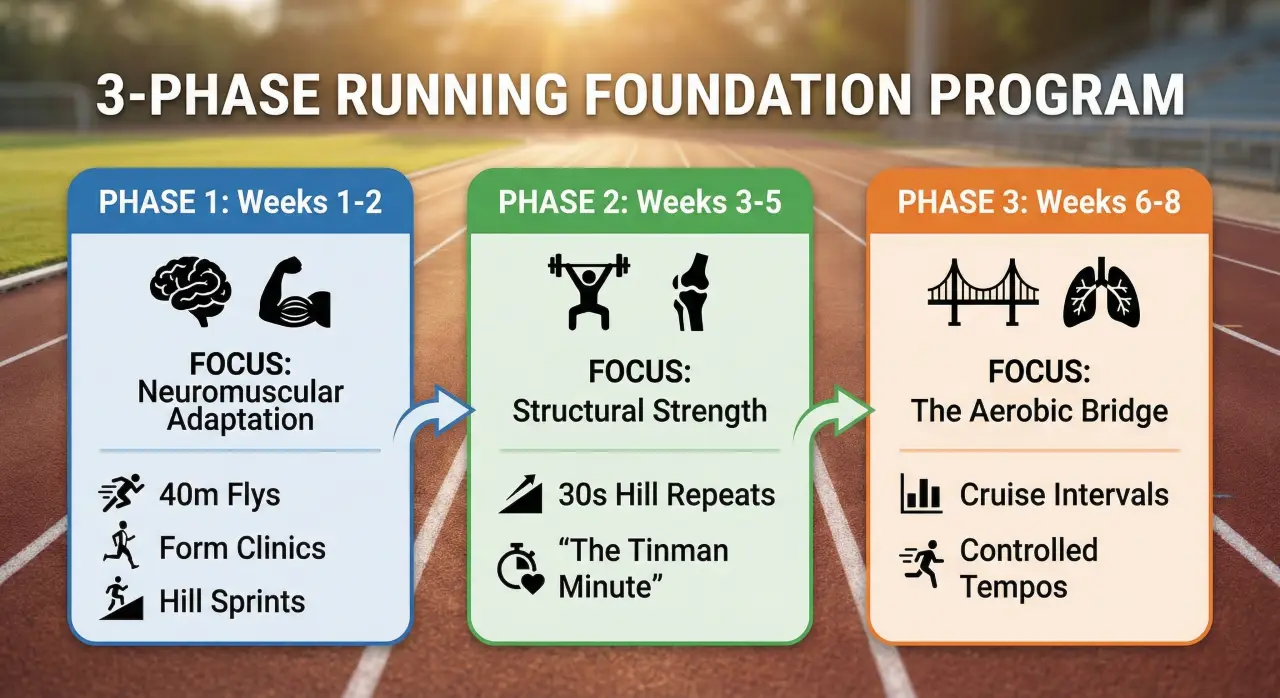
The 8-Week Form and Foundation Template
This plan ignores the traditional “mileage-first” approach and instead focuses on neuromuscular recruitment and structural integrity.
Goal: By Week 8, the athlete should be moving with better efficiency, possessing a basic “top gear” for sprinting, and having a consistent aerobic base to join the main team workouts.
Phase 1: Neuromuscular Adaptation (Weeks 1-2)
Focus: Coordination over Conditioning
- Monday: 15 min Easy + 6 x 40m Flys (full recovery, focus on upright posture)
- Tuesday: 30 min Form Clinic + Core (high knees, butt kicks, A-skips)
- Wednesday: 20 min Easy + 4 x 100m Strides (focus on “quiet feet” and soft landings)
- Thursday: Off or Cross-Train (prevent early shin splints)
- Friday: 15 min Easy + 5 x 10s Hill Sprints (power and correct form)
- Saturday: 30 min “Conversation” Run (if they can’t speak in full sentences, too fast)
- Sunday: Rest (mental and physical recovery)
Phase 2: Structural Strength (Weeks 3-5)
Focus: Building the “Hidden Weight Room”
Introduce “The Tinman Minute” using time-based intervals instead of distance repeats. The Hill Circuit becomes central: 4-6 x 30-second hill repeats at hard effort, walking back down for recovery. This builds the glutes and hip flexors without the pounding of track intervals.
Coach’s Tip: Watch the freshman’s head position. If they are looking at their feet, their hips will drop. Teach them to “run tall” with their eyes on the horizon.
Phase 3: The Aerobic Bridge (Weeks 6-8)
Focus: Extending the Stimulus
Introduce “Cruise Intervals”—short repetitions with very short rest. This builds the aerobic engine without the high acid levels that can discourage a young runner. Find the correct paces using my free training pace calculator.
- Week 6: Workout A: 6 x 2 mins @ Threshold (1 min rest) | Workout B: 4 x 150m Strides (focus on “float”)
- Week 7: Workout A: 8 x 2 mins @ Threshold (1 min rest) | Workout B: 2 sets of 4 x 60m Sprints (full recovery)
- Week 8: Workout A: 3 x 1 Mile @ Controlled Tempo | Workout B: 6 x 100m “Fast but Relaxed”
The Expert Toolbox for Slower Athletes
To keep these athletes engaged while they are still “slow,” use these specific coaching cues and tools:
Cadence Over Pacing: Don’t give a freshman a time goal (e.g., “Run a 9:00 mile”). Give them a cadence goal. Help them realize that “fast” comes from turnover, not just “pushing harder.”
The Talk Test: Instead of a time trial, use the Talk Test. If they can recite the “Pledge of Allegiance” while running, they are in the correct aerobic zone. If they can only gasp out one or two words, they are digging a hole they can’t recover from yet.
The “Check-In” System: Ask them every Friday: “How do your shins feel on a scale of 1-10?” Slow freshmen often ignore pain because they want to “prove” they belong. Catching a 3/10 shin pain in Week 2 prevents a stress reaction in Week 6.
Your Project Freshman Roadmap
Months 1-2: 70% Form/Drills/Speed, 30% Easy Running. No “grinder” workouts.
Months 3-6: Introduce 1000m “Cruise Intervals” at a very controlled pace. Focus on “locking in” the form learned in Month 1.
The Summer Bridge: This is where the magic happens. A slow freshman who completes 20-25 miles a week consistently over the summer will return as a different athlete.
The journey from slow freshman to competitive senior requires patience, proper sequencing, and unwavering belief. Build the athlete first, and the runner will follow.