
5K Race Strategy: A Science-Backed Guide for Coaches
I stood at the one-mile mark of a divisional championship and watched one of my best runners come apart. She had trained perfectly for twelve weeks. Her fitness said 6:05 for the first mile. She went through in 5:45.
By two miles she was shuffling. She was fighting just to keep her chin up and her eyes forward. By 2.5 miles her race was over, even though she still had to finish it. Our number two runner finished as our number seven. We missed States by single digits.
I have coached distance runners for twenty-five years. Here is what that day taught me, and what dozens of races since have confirmed. Talent and training get you to the starting line. Race strategy decides what you do with them.
This guide covers what the pacing research actually shows, how to break a 5K into four phases, how to handle hills, mud, and weather, and how to run a pre-race strategy meeting with your team.
Quick Answer
The best 5K plan for most high school runners:
- Run the first 800m 3 to 5 seconds per mile faster than goal pace. No faster.
- Settle into a steady, controlled rhythm through the middle of the race.
- Hold your effort from 2 to 2.5 miles, when it hurts most.
- Build speed over the final 800m. Do not wait for a last-200m kick.
What the Pacing Research Actually Shows
For decades, coaches taught even pacing. Run every mile at the same speed. It sounds efficient. It is not how the best races are run.
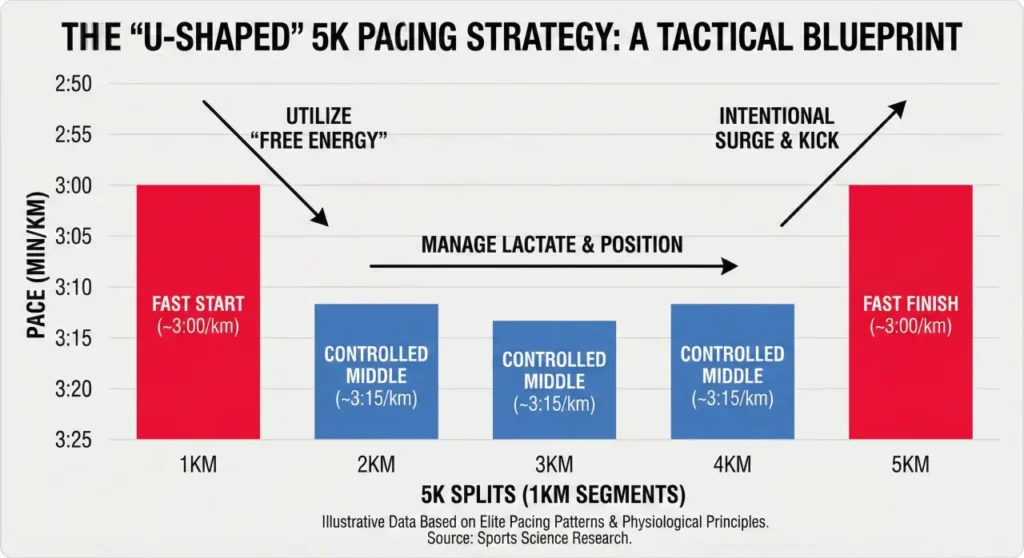
In 2006, sports scientists Ross Tucker, Michael Lambert, and Tim Noakes studied the splits from men’s world records at 5,000m and 10,000m. A clear pattern showed up. In most of those records, the first kilometer and the last kilometer were faster than the kilometers in between. Pacing looked like a U, not a flat line. Alex Hutchinson brought this research to a wide audience in his book Endure: Mind, Body, and the Curiously Elastic Limits of Human Performance.
Why a fast start? Early in a race, your body can cover a slightly faster pace without paying much for it. Your anaerobic systems help in the first minute or two before fatigue builds. A quick start also gets you into position before the field bunches up.
09
Salty Talks
Listen to the episode
The Pre-Race Warmup That Actually Matters
That slightly fast opening 800 is only cheap if the engine is already running. Episode 9 covers the warmup that makes this race plan work, and why cold legs turn free energy into a loan at a terrible rate. 18 minutes.
Play Episode 9Here is the catch. A fast start does not mean a sprint. Elite pacing follows a simple shape, as COROS coaches explain in their breakdown of 5K pacing. A slightly quick first kilometer. Controlled middle kilometers. A faster finish, when runners can let fatigue build because the line is close.
For high school coaches, the lesson is simple. Teach athletes to open about 3 to 5 seconds per mile faster than goal pace for the first 800m. Settle into rhythm for the middle two miles. Then build speed from 2.5 miles to the finish. That is not reckless. It is smart use of what the body gives you.
The Four Phases of a 5K
Joe Vigil built the Adams State distance program into a national power and later coached Deena Kastor to Olympic marathon bronze. He taught his runners to understand what each part of a race demands. Here is how I break down the 5K.
| Phase | Distance | Goal | Pace |
|---|---|---|---|
| 1. Position | Start to 800m | Get clear of traffic without overspending | 3 to 5 sec/mile faster than goal |
| 2. Patience | 800m to 2 miles | Stay in contact, stay relaxed | At or just under goal pace |
| 3. Crucible | 2 to 2.5 miles | Hold effort when it hurts most | Goal pace, no fade |
| 4. Finish | Final 800m | Fastest segment of the race | Build steadily to all-out |
11
Salty Talks
Listen to the episode
Why Even Splits Are a Myth: 5K Race Strategy
This table, out loud. Episode 11 walks through all four phases, why five seconds too fast costs more than five seconds too slow, how to practice pacing until it becomes a feel, and the 15-minute team meeting to hold two days before a championship. 18 minutes.
Play Episode 11Phase 1: The Opening 800m (Position Without Panic)
The goal: Get good position without burning energy you need later.
In a crowded field, the first 400m decides whether you run in traffic or in open space. Narrow trails and early funnels on cross country courses make this even more important. You cannot control the start. You can control how you respond to it.
What to teach:
- Run 3 to 5 seconds per mile faster than goal pace. No more.
- Stay on the outside of the pack so you do not get boxed in. Avoid the inside of early turns, where runners jam up.
- Drop your shoulders. Keep your breathing under control.
- If it feels comfortably hard, you are right on. If it feels hard, you went out too fast.
Phase 2: 800m to 2 Miles (The Patience Test)
The goal: Stay in contact with your competitors while running a pace you can hold.
This is where races are lost. Runners who went out too fast start to fade here. Your job is to run your own race while staying close to the action. In the record data, this is the stretch where elite runners ease slightly off their opening pace. They are not tired yet. They are saving energy for the finish.
Arthur Lydiard, who coached Peter Snell and Murray Halberg to Olympic gold in 1960, built his runners on long aerobic work. That base is what lets an athlete hold a hard but steady effort in the middle of a race. If your athletes fade in this phase, look at their aerobic foundation first. Coaches building that engine should read how zone 2 training prevents burnout over a four-year high school career.
What to teach:
- Stay within 3 to 5 seconds of the leaders. Close enough to respond. Far enough to avoid their mistakes.
- Take the outside of turns on cross country courses to keep momentum.
- Hold effort, not pace, on uphills. Use downhills to recover a little.
- Stay loose. A clenched jaw is wasted energy.
Phase 3: 2 to 2.5 Miles (The Mental Crucible)
The goal: Do not slow down when it hurts the most.
This is the hardest part of a 5K. Fatigue builds fast. Effort feels huge. The brain starts sending strong signals to back off.
Exercise scientist Tim Noakes proposed the “central governor” model to explain this. His idea is that the brain limits effort before the body reaches true failure, as a form of protection. Scientists still debate the details. Hutchinson covers that debate in Endure. The practical point for coaches holds up either way: the urge to slow down shows up before the body is truly out of gas.
Experienced racers still feel that discomfort. They have learned to expect it and keep working through it. Young runners have not had that practice yet. Understanding why runners self-sabotage and how to break self-limiting beliefs helps you coach athletes through this phase.
What to teach:
- Expect the hurt and name it: “This means I’m running hard.”
- Make or answer moves here. In high school races, waiting until the last 400m is often too late.
- On hilly courses, push over the top of hills while other runners are recovering.
- Break it into small targets. Get to that tree. Then get to that cone.
Phase 4: The Final 800m (Controlled Aggression)
The goal: Run the last half mile faster than any other part of the race while holding form.
For most of the race, your runner has kept fatigue in check. Now it is time to let it build. The finish is close enough that the body can handle it.
Finishing fast is not only about fitness. Tired legs still have to recruit muscle and move with good mechanics. That is why regular strides, sprint drills, and form work matter all season long. For a framework on the late-race surge, see the three-step move for breaking the pack.
What to teach:
- Start building speed at 2.5 miles. Do not wait for a kick.
- Focus on form. Drive the knees. Pump the arms. Lift the chest.
- In the final 400m, commit fully. There is nothing to save it for.
- Use whatever top speed is left in the final 200m.
Free Tool
5K Pace Strategy Calculator
Enter a goal time and get target splits for all four phases of the race. Hand every runner a plan they can actually follow.
Open CalculatorCross Country Tactics: Hills, Mud, and Weather
Cross country is not run on a flat track. Your athletes need plans for the ground and the conditions in front of them.
Running Uphill
What most runners do: Attack the hill and pass people on the way up.
What works better: Hold effort on the way up. Then speed up over the top and down the other side.
Surging up a hill costs a lot of energy. Runners who charge the climb often fade right after the top. Teach your runners to:
- Shorten the stride and quicken the steps.
- Lean slightly forward from the ankles.
- Keep the effort steady and accept a slower pace.
- Accelerate over the crest while others are catching their breath.
- Carry that momentum down the other side.
The runners who gain the most on hills are not the ones who charge up them. They are the ones who recover least at the top.
Running Downhill
Downhills should be free speed. Most high school runners brake too hard because they are afraid of falling. Teach them to:
- Lean slightly forward, not back.
- Take quicker steps, not longer ones.
- Stay light and quick on their feet.
- Let the arms swing out a bit for balance.
- Avoid slamming down on the heels.
- Use the speed to carry into the next climb.
A runner who is comfortable on downhills can gain real ground on a hilly course without spending extra energy. Practice it in training on safe, grassy slopes.
Running in Mud, Sand, or Soft Ground
When the course turns bad, everyone slows down. The runner who slows down least wins.
- Shorten the stride. Reaching for a long stride in mud wastes energy.
- Lift the knees and keep ground contact short.
- Accept that everyone is slower. Focus on being less slow.
- Look 10 to 15 meters ahead to pick the best footing.
I have watched plenty of runners with slower track times beat faster runners on sloppy courses. Mud rewards toughness and footwork, not just speed.
Weather
Heat and humidity: Every runner will be slower. Adjust goal splits before the race, not after a blown first mile. Start more conservatively and plan to race hardest in the last mile, when others are fading.
Cold and wind: Tuck in behind other runners when running into the wind. Save your moves for stretches where the wind is at your back.
Rain and technical courses: See the mud section above. Confidence on bad footing is a real advantage, and it can be practiced.

The Mental Game: What Separates Good From Great
Great racers do not feel less pain. They expect it, accept it, and keep working.
Tactics matter most when fitness is close. Bernard Lagat, a five-time Olympian, earned Olympic medals and world titles over a long career largely through patient positioning and a well-timed finish. In championship finals where everyone is fit, the smarter racer often wins.
Building Mental Toughness in Training
- Run some time trials without watches so athletes learn to race by feel.
- Use surge-and-recover workouts where athletes must answer random pace changes.
- Build race-simulation workouts with real competitive situations.
Tools for Race Day
- Breathing rhythm: A simple count, such as three steps in and two steps out, gives the mind something to hold onto when it hurts.
- Outward focus: “Lock onto the back of the runner ahead” works better than “my legs hurt.”
- Small segments: “Stay strong to the next turn.” Then the next one.
For more on handling pressure mid-race, The Chimp Paradox framework gives coaches a practical model for managing emotional reactions.
Pre-Race Visualization
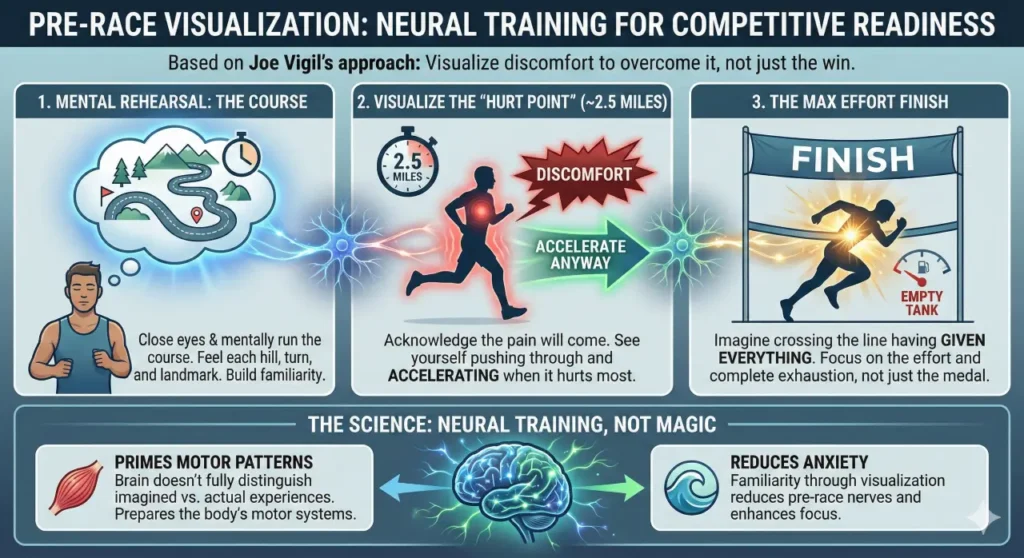
Visualization is not magic. It is rehearsal. Research on mental imagery shows that imagining a movement activates many of the same brain areas used to perform it. Athletes who rehearse the race also tend to feel less anxious because the race feels familiar. Joe Vigil encouraged his runners to picture the hard parts of a race, not just the finish. Use three steps:
- Rehearse the course. Eyes closed. Run it in your mind. Every hill, turn, and landmark.
- See the hurt point. Picture 2.5 miles. Feel the discomfort arrive. See yourself speeding up anyway.
- See the finish. Picture crossing the line with nothing left. Focus on the effort, not the medal.
Coaching Game Plan: The Pre-Race Strategy Meeting
Two days before a championship, hold a 15-minute team meeting. Cover four things.
1. Know the Course
- Walk the course if you can. If not, study video or satellite images.
- Find the first turn. That is where position matters most.
- Mark every major hill. Decide where to hold effort and where to attack.
- Know the last 400m. Is it straight? A turn? Uphill?
2. Give Each Runner a Plan
- Assign each athlete a first-800m split based on current fitness.
- Make it clear: 5 seconds too fast hurts more than 5 seconds too slow.
- Say it plainly: “You can’t win the race in the first mile. You can lose it there.”
3. Prepare Their Minds
- Normalize the pain: “Everyone hurts at 2.5 miles. The winner is the one who hurts and keeps pushing. No quit, no mercy.”
- Pick a team mantra, like “Strong and smooth.”
- Walk through the visualization steps together.
4. Plan Team Tactics
- If your middle runners are close in fitness, have them work together through 2 miles. After that, each one races for every place.
- Name specific targets: “Stay with the green singlet through 2 miles. Then drop her.”
- Remind your 6th and 7th runners that every runner they pass pushes the other teams’ scores up.
What Coaches Get Wrong About Race Strategy
Mistake #1: Treating every athlete the same. A front-runner with a big aerobic base should race differently than a runner with a strong kick. Build the plan around the athlete.
Mistake #2: Ignoring the competition. A runner fit for 16:30 is running about 5:19 per mile. If the lead pack goes through the mile in 5:05, that runner has a choice. Go with them and risk blowing up, or run their own pace and try to reel people in late. There is no universal answer. It depends on the athlete’s strengths, and you should decide it together before the gun.
Mistake #3: Overvaluing the kick. High school races are usually decided between 2 and 3 miles, not in the final 200m.
Building Race Smarts Over Four Years
Tactical awareness is not something runners are born with. They learn it, season by season.
Freshman and sophomore years:
- Teach pacing first.
- Race by effort more than by the watch.
- Use shorter time trials, 1600m to 3000m, to practice the phases.
Junior and senior years:
- Add tactical situations to workouts: “Answer a surge at 2 miles.”
- Watch race video together and find where races were won and lost.
- Give them ownership: “You know the plan. Trust yourself to run it.”
Joe Vigil’s Adams State teams won national titles by developing runners, not just recruiting them. He taught them to think about racing and to execute. That kind of growth starts with a strong base. See how a March-to-November base building plan lays the aerobic foundation championship racing demands.
The Final Word: Controlled Aggression
The best race strategy is not timid. It is not reckless. It is controlled aggression. Race at the edge of your ability and make smart choices about when to push and when to wait.
Your job on race day is not to make your athletes fitter. The training already did that. Your job is to teach them to use that fitness well. Make good decisions while tired. Keep pushing when the brain says stop. And make sure they arrive rested, not run down. Know when fatigue crosses the line into overtraining so your runners show up ready.
The runner on the podium is not always the fastest runner in the field. It is the one who raced best that day.
Related Resources
→ Complete Guide to Coaching High School Distance Runners
→ Building a Culture of Excellence in High School Running
→ The 3 Essential Workouts Every XC Runner Needs
Sources
- Tucker R, Lambert MI, Noakes TD. An analysis of pacing strategies during men’s world-record performances in track athletics. International Journal of Sports Physiology and Performance. 2006;1(3):233-245.
- Noakes TD, St Clair Gibson A, Lambert EV. From catastrophe to complexity: a novel model of integrative central neural regulation of effort and fatigue during exercise in humans. British Journal of Sports Medicine. 2005;39(2):120-124.
- Hutchinson A. Endure: Mind, Body, and the Curiously Elastic Limits of Human Performance. William Morrow; 2018.
- COROS Coaches. The Science Behind Pacing for a 5K.