
The 3 Essential Workouts Every XC Runner Needs: A High-ROI Guide
In the world of high school cross country, we are drowning in data but starving for wisdom. You open Instagram and see Newbury Park doing double thresholds. You read a Steve Magness blog about neuromuscular fatigue. You check a forum and someone is arguing about mitochondrial density.
It’s easy to get lost in the “fancy” stuff.
This article is part of our Complete Guide to High School Cross Country Training, which covers everything from seasonal planning to race day tactics.
But here is the truth I’ve learned over years of coaching and talking the greats like Scott Christensen and studying the most successful programs like Niwot and Great Oak: You don’t need a PhD in physiology to run fast. You need a high Return on Investment (ROI).
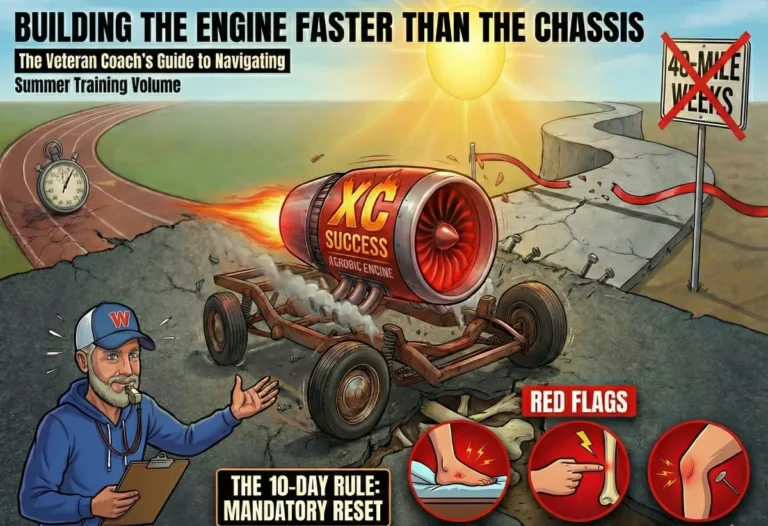
High school runners have limited fuel tanks. If we drain the tank on Tuesday, they have nothing left for the race on Saturday. We need workouts that build a massive engine without destroying the chassis.
Based on the modern science of endurance and the practical habits of the nation’s best teams, these are the Big 3 Workouts that act as the pillars of a successful XC season.
1. The Threshold Run (The Engine)
The Influence: Newbury Park, Alex Hutchinson, Jakob Ingebrigtsen
If you only do one workout hard a week, make it this one. The “Tempo” or “Threshold” run is the bread and butter of aerobic development.
The Science Behind Threshold Training:
Running at your lactate threshold (roughly the pace you can hold for an hour) teaches your body to clear lactate as fast as it produces it. It pushes back the point where your legs turn to cement. As Alex Hutchinson often notes, the goal isn’t to run harder; it’s to improve the pace at which running feels easy.
The Workout:
- Traditional: 20–25 minutes continuous run at “comfortably hard” effort.
- The “Broken” Tempo (Better for HS): 4 x 6 minutes or 3 x 8 minutes at Threshold pace with 60–90 seconds strict rest (walk/jog).
Coach Saltmarsh’s Tip: Most high schoolers run these too fast. They turn it into a race. I tell my athletes: “If you are bent over hands-on-knees at the end, you failed.” You should finish feeling like you could have gone another mile. This is about control, not guts.
2. Critical Velocity (CV) Intervals (Stamina)
The Influence: Scott Christensen, Tom “Tinman” Schwartz
This is the secret sauce. Scott Christensen, a legend in coaching education, champions Critical Velocity (CV) because it targets Type IIa (fast-twitch) muscle fibers and forces them to work aerobically.
Why The CV Works for the 5K:
CV pace is roughly 90% of your V02 Max (think: a pace you can hold for about 30–35 minutes in a race). It is faster than a tempo, but slower than mile repeats. It builds “fatigue resistance” specifically for the 5K distance without the high acidity and burnout risk of V02 max intervals.
The Workout:
- Volume: Total volume should be around 16–20 minutes of work.
- Structure: 5–7 x 3 minutes (or 800m–1000m) at CV Pace.
- Recovery: 90 seconds to 2 minutes jog. The rest is slightly generous to ensure the pace stays high quality.
Coach Saltmarsh’s Tip: Think of this as “managing discomfort.” It’s not searing pain; it’s a nagging pressure. This pace mimics the feeling of the second mile of a 5K. We do this almost year-round because it keeps the fast-twitch fibers aerobic without frying the central nervous system.
3. Short Hill Sprints (Neuromuscular)
The Influence: Steve Magness, Great Oak, Niwot
You might expect “Long Run” or “400m Repeats” here. But the biggest missing piece in high school training is pure power and mechanical efficiency.
The Science of Muscle Fiber Recruitment:
Steve Magness talks extensively about “recruitment.” If you can’t recruit a muscle fiber, you can’t train it. Short, max-effort hills recruit 100% of your muscle fibers. It serves as a stealth strength workout, improving running economy (how much oxygen you use at a given speed) and protecting against injury by strengthening tendons and ligaments.
The Workout:
- When: Do this at the end of an easy run, 1–2 times per week.
- The Reps: 6–10 reps of 8 to 10 seconds uphill.
- The Effort: Max. 100%. All out.
- The Rest: Walk back down slowly. Full recovery (2–3 minutes).
Coach Saltmarsh’s Tip: This is not a conditioning workout. If the athletes are panting heavily before the next rep, they are doing it wrong. This is about force production. We use these short sprints to make our 5K race pace feel mechanically effortless.
The Bottom Line
Don’t get distracted by the flashy stuff.
- Build the engine with Thresholds.
- Increase the stamina with CV.
- Reinforce the structure with Hill Sprints.
Rinse and repeat. That is how champions are built. Now, let’s get to work!
Executing these essential workouts requires a disciplined schedule. Learn how to organize your daily practice to fit it all in.
Need help figuring out Threshold and Stamina paces? Use my free training pace calculator to dial in each athlete’s target pace for every workout.