

The Guide to Freshman Mileage
Many high school coaches are so terrified of “breaking” a freshman that they accidentally train them to be slow forever.
They treat 14-year-olds like fragile porcelain dolls, capping them at 15 miles a week of junk mileage, terrified that a long run will snap a growth plate. The reality? Volume is rarely the killer; intensity is. If you want a freshman to reach their senior year potential, you don’t shield them from mileage—you teach them how to progress safely.
🔑 Key Takeaways for Freshman Mileage
- Assess History Don’t use Chronological Age; use “Running Age” (sports background).
- Mandatory Strides Perform 4–6x strides (20 sec) 2–3 times a week to fix mechanics.
- Step Cycles Use a 3-week progression with a recovery week (e.g., 20mi, 22mi, 24mi, 20mi).
- Consistency Frequency (days per week) comes before volume (miles per day).
1. The Metric That Matters: Running Age vs. Chronological Age
The single biggest mistake coaches make is looking at a birth certificate to determine training volume. You must look at Running Age (Training Age) and Background Aerobic Age.
- Scenario A: The “Soccer” Freshman
- Profile: Has played competitive soccer or lacrosse for 6+ years.
- Physiology: High Aerobic Age, low skeletal durability. Their lungs say “Go,” but their shins say “No.”
- Progression: Faster aerobic ramp-up, but strict caps on pavement pounding.
- Scenario B: The “Couch-to-5K” Freshman
- Profile: No sports background, sedentary lifestyle.
- Physiology: Low aerobic floor, low durability.
- Progression: The long term approach—patience. Frequency before volume. 4 days becomes 5, then 6.
- Scenario C: The “Burnout” Transfer
- Profile: Ran youth track/AAU since age 8.
- Physiology: High Running Age, high burnout risk.
- Progression: They don’t need more mileage; they need different stimulus.
2. The Secret Sauce: Strides & Neuromuscular Hygiene
If you only run slow, you learn to be slow.
Freshmen who run nothing but easy mileage develop what I call “The Shuffle”—hips drop, knees barely lift, and ground contact time increases. You are effectively training them to be inefficient.
Why Strides Are Mandatory (Not Optional):
- Neuromuscular Wiring: Running long runs uses slow-twitch fibers. Strides force the brain to recruit fast-twitch fibers even in a fatigued state. This doesn’t make the athlete a sprinter; it makes their cruising speed efficient.
- Mechanical Efficiency: You cannot “cue” good form at 9:00/mile pace. You have to run fast to force the body to organize itself. Strides naturally fix mechanics: the athlete gets up on their toes, hips drive forward, and arms sync up.
- The Lydiard/Canova Connection: Lydiard insisted on “wind sprints” during base phase to keep the nervous system sharp. Canova uses “Alactic Sprints” to improve the chassis without taxing the engine.
The Saltmarsh Prescription:
- The Rest: Full recovery. Walking back to the start. If they are breathing hard when they start the next one, it’s an interval workout, not a neuromuscular drill.
- When: 2–3 times a week, after an easy run. Never on recovery days.
- The Protocol: 4-6 x 100 meters
- The Pace: Accelerate to 95% speed (fast, but relaxed). Not a max effort sprint. If they are straining their face, they are doing it wrong.
Applying the Masters to 9th Graders
We don’t reinvent the wheel; we just scale it down.
- The Lydiard Foundation: Arthur Lydiard proved that aerobic development is a lifetime project. For a freshman, we aren’t building a pyramid for this season; we are laying the concrete slab for their Senior year. The “Long Run” is non-negotiable. Even for a freshman, building up to a 60-minute run (at conversational pace) does more for their future physiology than any amount of 400m repeats.
- The Jack Daniels Consistency: Daniels emphasizes training at the right VDOT (current fitness), not goal fitness. Freshmen often run their easy days too hard (Category 3 pacing). You must force them to run slow to run long. If they can’t hold a conversation, the mileage doesn’t count.
- Canova’s “Extensive to Intensive”: Renato Canova teaches us to extend the ability to run longer before we run faster. Before you increase the speed of a tempo run, increase the duration of the tempo run.
4. Special Considerations: Boys vs. Girls
You cannot coach them identically during puberty.
- The Freshman Boy:
- Risks: Testosterone surges lead to aggressive running and “ego miles.” They will try to race their easy runs.
- Adjustment: Strict pace enforcement. Use heart rate monitors or the “talk test” relentlessly.
- The Freshman Girl:
- Risks: The Q-angle (hip width) changes, affecting knee mechanics. Bone density issues are real if nutrition isn’t tracking with energy expenditure (RED-S).
- Adjustment: Focus heavily on posterior chain strength (glutes/hips) to support the mileage. If a girl grows tall rapidly, plateau the mileage until coordination catches up.
5. The Practical Progression Models
Forget the generic “10% Rule.” It’s too linear. Use Step Cycles.
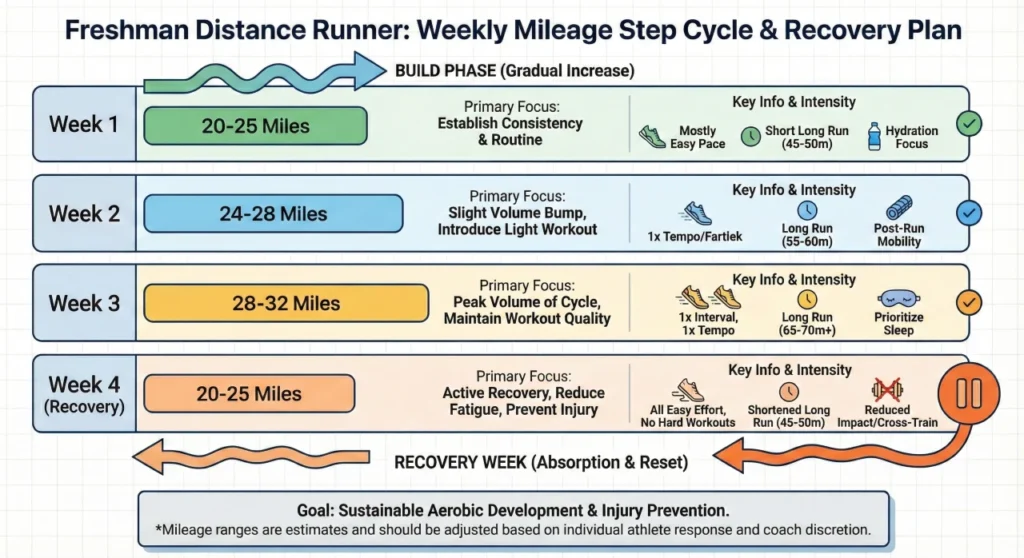
Coach Saltmarsh’s Golden Rule: Never increase volume and intensity in the same week. If you add intervals, cut the mileage.
Final Recommendation for Coaches
Stop looking at mileage as a risk and start viewing it as an investment account.
- Be Patient: It takes 6–8 weeks for the cardiovascular system to adapt, but months for tendons to catch up.
- Be Individual: The 14-year-old girl who grew 3 inches this summer has different needs than the 14-year-old boy who hasn’t hit his growth spurt.
- Be Consistent: A freshman who runs 25 miles a week for 12 weeks beats the freshman who runs 40 miles for 3 weeks and spends the rest in the pool.
Build the engine first. The chassis comes later.
For a tool that does the math for you and customizes these progressions based on the athlete’s specific season length use my Mileage Progression Tool. For a complete Summer Training Plan use my Summer XC Plan Generator.