
How Lactate Threshold Training Fixes Your 5K Time (Stop Training Too Fast!)
It’s a late summer tradition: enthusiastic high school runners hammering every single workout like it’s the state championship. The logic seems sound—to run a fast 5K, you need to run at 5K pace, right? Wrong.
This approach produces exactly what you’d expect: tired legs, stagnant PRs, and frustrated athletes who can’t understand why they’re not improving. The missing piece isn’t more speed. It’s a stronger aerobic engine, and lactate threshold training is the tool that builds it.
The Science: Understanding Lactate Threshold and 5K Performance
Your muscles need energy. To create that energy, they break down glucose, and lactate is one of the byproducts. At easy paces, your body clears lactate effortlessly and even recycles it as fuel. But as you run faster, lactate production eventually exceeds your body’s ability to clear it. That tipping point—where production outpaces removal—is your lactate threshold.
Think of it like a bathtub with the drain open. At easy paces, the water draining out matches the water flowing in. Turn up the faucet (run faster), and eventually the tub starts to fill. Your lactate threshold is the exact flow rate where the tub stays level—maximum production while maintaining equilibrium.
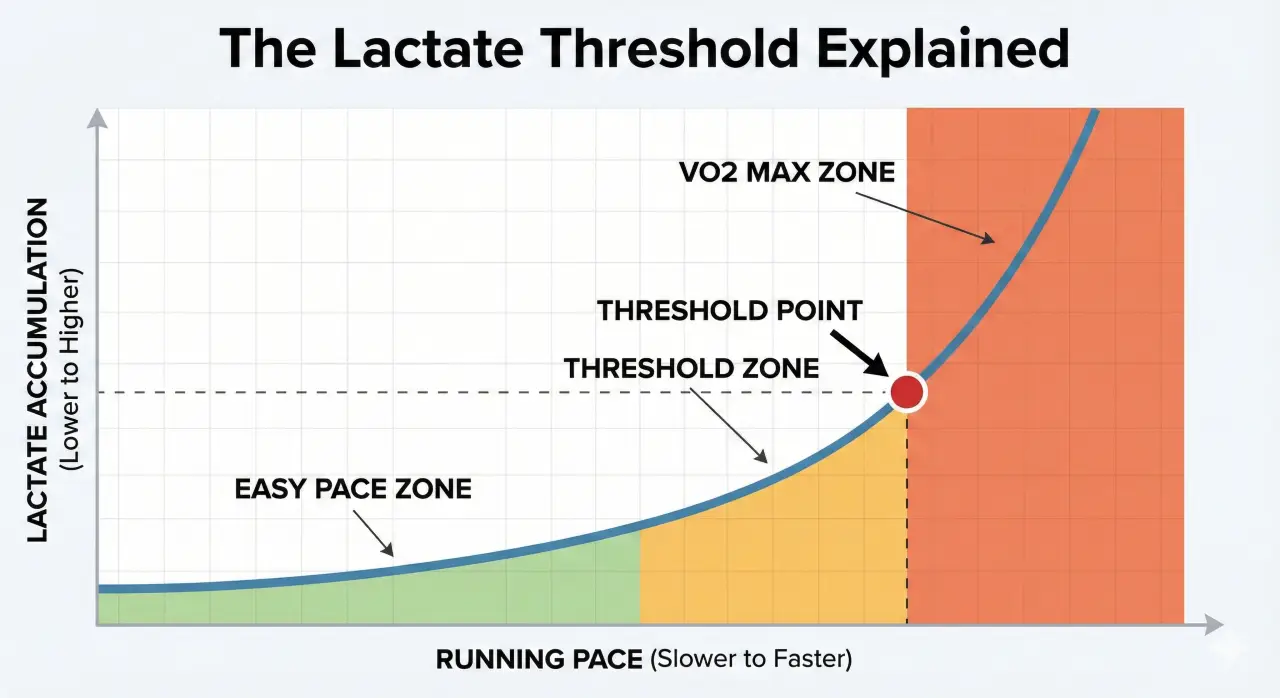
For most runners, lactate threshold corresponds to a pace they could sustain for 50 to 60 minutes in a race. That’s roughly between 10K and half marathon pace for high school athletes. Here’s the critical part: a 5K race is 95-99% aerobic, meaning your body relies almost entirely on oxygen-based energy systems. The stronger your threshold, the faster you can run while staying aerobic.
Why Threshold Training Matters More Than You Think
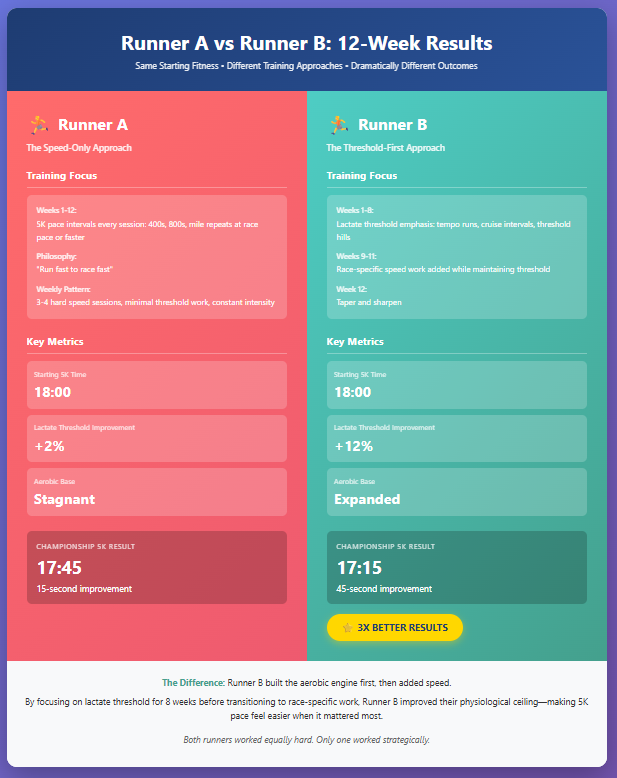
Let’s use some real numbers. Imagine two runners, both capable of running 18:00 for 5K at the start of the season:
Runner A spends twelve weeks doing nothing but 5K pace intervals—400s, 800s, mile repeats, all at race pace or faster. She gets really good at running hard, but her aerobic base stays stagnant.
Runner B spends eight weeks focused on lactate threshold work—longer tempo runs at a controlled, sustainable pace—then transitions to race-specific speed work for the final four weeks.
By championship season, Runner B will almost always outperform Runner A. Why? Because Runner B built a more efficient engine first. When she eventually adds the speed, her body can sustain those faster paces with less physiological stress. Runner A just taught her body to suffer at the same speed for three months straight.
Research has found that it’s much easier to improve lactate threshold than to improve raw speed or VO2 max. With consistent training, runners can continue improving their threshold for years. This makes it the highest-leverage workout in your training arsenal.
How to Find Your Threshold Pace (Without a Lab)
Forget the fancy lab tests with blood samples and lactate meters. For high school coaches working with 30 athletes, that’s not practical. Instead, you need field-tested methods that work.
The simplest approach? Run your best 5K in a race or time trial, then use that performance to estimate your threshold pace. Your threshold will be slightly slower than 5K pace—usually about 10-15 seconds per mile slower for high school runners. Or, use this training pace calculator.
On a rate of perceived exertion scale, threshold pace should feel like a 7 or 8 out of 10. It’s uncomfortable but controlled. You could speak in short sentences, but you wouldn’t want to. The old-school coaching cue is “comfortably hard”—you should finish the workout feeling like you could have done one more rep, but you’re genuinely glad you don’t have to.
If your athletes are gasping for air or their form is falling apart, and certainly if they’re throwing up, they’re running too fast. The goal is not to simulate race suffering; the goal is to teach the body to run efficiently at higher speeds.
4 Essential Threshold Workouts for 5K Runners
The Periodization Reality: When Threshold Work Belongs
Here’s where most high school programs go wrong: they do a little bit of everything all season long hoping it will fill in the gaps. That’s not how elite programs operate. They use mesocycles to determine specific training stimulus to achieve specific adaptations at different points in the season.
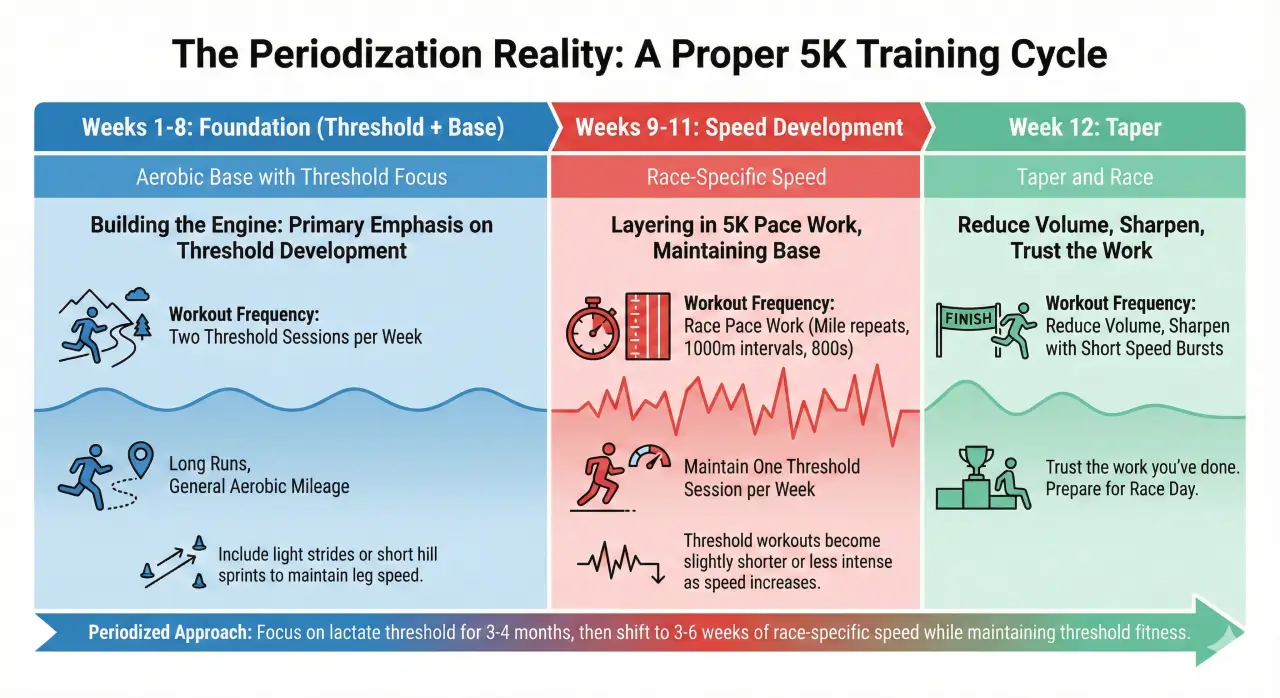
A proper 5K training cycle should look like this:
Weeks 1-8: Aerobic Base with Threshold Focus
This is your foundation phase. Two threshold sessions per week, long runs, and general aerobic mileage. You’re building the engine. Yes, include some light strides or short hill sprints to maintain leg speed, but the primary emphasis is threshold development.
Weeks 9-11: Race-Specific Speed
Now you layer in the 5K pace work—mile repeats, 1000m intervals, 800s at race pace. But you maintain one threshold session per week to prevent your aerobic base from eroding. The threshold workouts become slightly shorter or less intense as the speed work increases.
Week 12: Taper and Race
Reduce volume, sharpen with short speed bursts, and trust the work you’ve done.
Many successful programs follow this approach: focus on lactate threshold for 3-4 months including base work, then shift to 3-6 weeks of race-specific speed while maintaining threshold fitness.
The Technology Question: Do You Need a Lactate Meter?
Absolutely not. The Norwegian training revolution, popularized by the Ingebrigtsen brothers, uses portable lactate analyzers during workouts to dial in precise physiological zones. That’s fantastic if you’re training Olympic-level athletes with unlimited resources. But, let’s coach the athletes in front of us.
For everyone else, it’s unnecessary. A stopwatch, a measured course, and a coach who can read athletes’ body language will get you 95% of the way there. If an athlete is grimacing, tensing up, or losing form, they’re too fast. If they’re chatting with teammates mid-rep, they’re too easy. Threshold training is as much art as science.
That said, heart rate monitors do provide valuable feedback. If you have the technology, use heart rate as a ceiling for aerobic workouts. When heart rate drifts too high for the intended pace, slow down—your body is telling you the physiological cost is too expensive that day. Use my free heartrate calculator for teenage athletes.
The Mistake Every Beginner Coach Makes
New coaches see “threshold” in a training plan and treat it like an interval workout. They tell athletes to “crush it” and “leave it all out there.” That’s the exact opposite of what threshold training accomplishes.
Threshold work is boring. It’s supposed to be boring. The magic happens because you’re spending extended time at a specific physiological intensity, teaching your body to become more efficient at that pace. Turning it into a suffer-fest defeats the entire purpose.
When executing threshold work, the goal is to raise the lactate threshold point, allowing runners to maintain faster paces for longer periods. This happens through consistent, controlled exposure—not through heroic displays of pain tolerance.
Real-World Results: What to Expect
How long before you see improvement? Most athletes show measurable threshold gains within 3-4 weeks of consistent training. You’ll notice that paces that used to feel hard now feel manageable. Conversations during group runs become easier. Heart rate at a given pace starts dropping.
In terms of race performance, a well-executed threshold training block can produce 30-45 second improvements in a high school 5K time—not from running faster in workouts, but from running more efficiently at race pace. That’s a massive return on investment for what is, frankly, less painful training than constant speedwork.
The Bottom Line
Here’s the truth that most runners don’t want to hear: the key to running faster in the 5K isn’t more 5K pace work. It’s building the aerobic foundation that makes 5K pace feel easier.
Lactate threshold training is the bridge between easy mileage and race-specific speed. It’s the unglamorous middle ground that separates athletes who stagnate from athletes who break through. Master the threshold, layer in the speed, and watch your times drop.
Your body is smarter than you think. Give it the right stimulus at the right time, and it will adapt. That’s not motivational fluff—that’s exercise physiology.
Have questions about incorporating threshold work into your team’s plan? Drop a comment below or get in touch.