
The Parker Valby Blueprint: Redefining High School Cross-Country With High-Intensity Cross-Training
Introduction: The Anomaly And The Experiment
Cross country running has long been defined by a simple equation: more miles equals more success. It is a sport of rugged trails, long intervals, and often, high attrition rates.
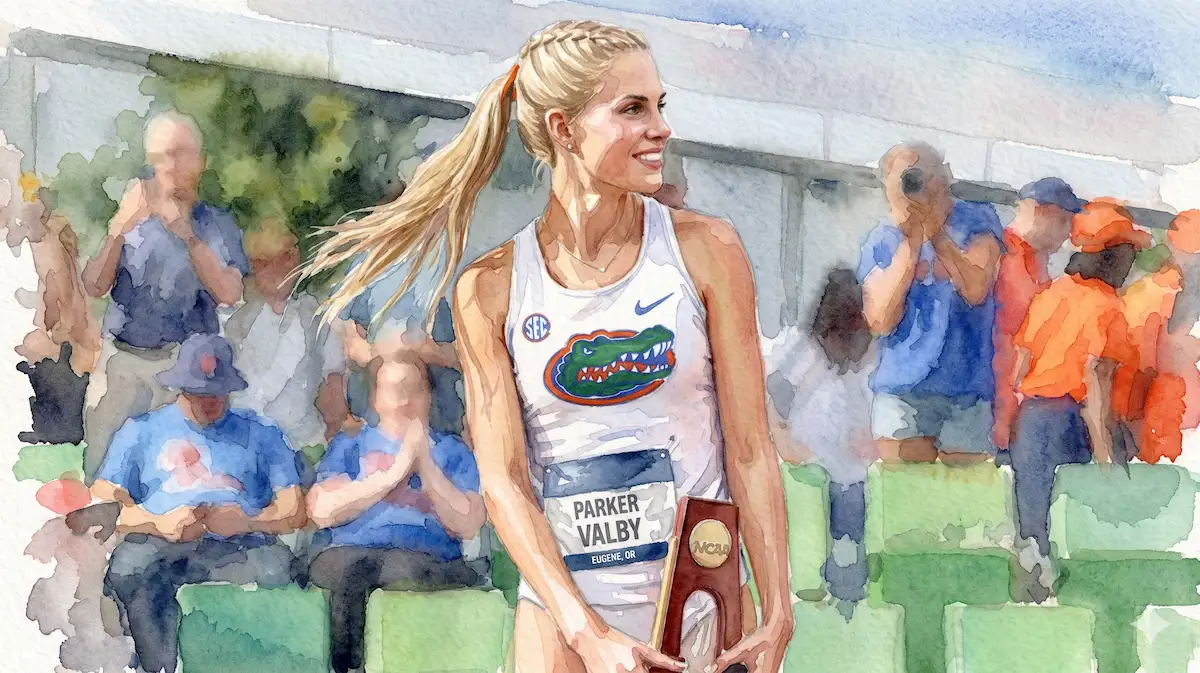
But Parker Valby, the University of Florida legend and 2024 Olympian, forced the running world to check its math. Valby’s resume is etched in history: 6-time NCAA Champion, Bowerman Award winner, and the first collegiate woman to break the 15:00 (5k) and 31:00 (10k) barriers. She has since turned professional with New Balance, joining the Team New Balance Boston squad in October 2024 under coach Mark Coogan. But what captivates coaches isn’t just the times, it’s the method. For much of her collegiate dominance, Valby adopted a distinctly individualized and unconventional structure.
The Method: It’s Not “Off” Days
When Valby revealed she was running only 2-3 days a week prior to her 2023 NCAA Cross Country title, many critics assumed she was training “light.” They were wrong.
The Valby Method did not use cross-training for recovery; it used it for volume. She replaced the “junk miles” (easy aerobic runs) with high-intensity sessions on specialized equipment that mimics runner mechanics. This approach prioritized raw mechanical output and speed over aerobic accumulation.
The Intensity: Valby described these sessions as “gut-wrenching,” with heart rate reported to exceed her average HR during running.
The Volume: On non-running days, cross-training sessions lasted for up to two hours, featuring AM/PM doubles on arc trainer and in the pool. Her overall volume was professional in structure, featuring 25-40 miles per week total, and an average of 30 mpw during her 2023 XC title campaign, with cross-training volume reaching 6-8 sessions per week.
The Result: She built a massive aerobic engine without the pounding impact that typically breaks fragile athletes.
The Catalyst: The Injury As Validation
Valby’s massive development in cross-training was not arbitrary; it was a response to critical feedback from her body.
In 2022, she was diagnosed with multiple calcaneal and cuboid stress fractures. This diagnosis accelerated the transition to the cross-training model, moving it from an accessory to the foundational structure of her program. Rather than diminishing her ceiling, this accelerated model validated its long-term potential.
Use the Cross Training to Running Conversion Calculator
The Pro Transition: Vindication And Reality Check
Valby’s leap to the professional ranks turned the Valby Principle into a national experiment. After finishing 11th in the 10,000m final at the Paris Olympics (30:59.28), she signed one of the most lucrative contracts in women’s distance running with New Balance and relocated to Boston to train with Mark Coogan and teammates including Olympic medalist Elle St. Pierre.
Then her body talked back again.
In February 2025, she opened her professional career at the New Balance Indoor Grand Prix with a 3,000m personal best of 8:34.95. Shortly after, she fractured the navicular bone in her left foot, costing her the remainder of the 2025 season. A 10th-place finish at USATF Cross Country in December 2025 kept her off the team for the 2026 World Cross Country Championships which were held, painfully enough, on her home course in Tallahassee.
For coaches watching from the outside, the temptation is to read this as a failure of the method. It isn’t. Two things can be true at once:
- Cross-training cannot eliminate skeletal stress entirely. Running mileage, even reduced running mileage, still loads the foot. Genetics, bone density, biomechanics, and life-stage factors all play roles the elliptical can’t overwrite. Which is why injury prevention has to be a year-round priority, not a post-injury reaction.
- Cross-training is what made the comeback possible. During her rehab, Valby spent time training in Crested Butte with steeplechaser Emma Coburn, building fitness on the bike and in the pool before a single hard running session.
Her return blueprint looked familiar: heavy cross-training, patient progression, and a refusal to chase mileage at the expense of health. In May 2026, she returned to racing at the LA Track Fest and won the 5,000m in a 14:49.41 personal best. Her first race back from the navicular injury.
The Lesson For Coaches: The Valby Principles are not a vaccine against injury. They are a strategy for managing aerobic load when bone load becomes the rate-limiter. The athletes who benefit most from this approach are the ones who have already broken, or the ones whose history suggests they are likely to. And when injury does strike, an athlete who already knows how to train hard in the pool and on the arc trainer doesn’t lose six months of fitness. She loses six weeks.
The Coaching Perspective
Coach Will Palmer stated that his ultimate goal for Parker Valby was a gradual, long-term increase in running mileage over time. Crucially, however, he prioritized the cross-training output for aerobic stimulus over forced running. Palmer chose patience, ensuring that mileage was never increased at the expense of health or high performance.
The 7-Day Architecture: The Blueprint
| Day | Session Type | Description |
|---|---|---|
| Monday | Volume Consolidation (CT) | Cross-Train Double: AM + PM Arc Trainer / Aqua Jogging. |
| Tuesday | Primary Workout (Run) | High-Intensity Track or Grass session. |
| Wednesday | Consolidation (CT) | Cross-Train Single. |
| Thursday | Secondary Workout (Mix) | Track Workout or Cross-Train Double, depending on upcoming race schedule. |
| Friday | Volume Consolidation (CT) | Cross-Train Double. |
| Saturday | Aerobic Support (Mix) | Track Workout, Off, or Cross-Training depending on macrocycle week. |
| Sunday | Aerobic Consolidation (CT) | Cross-Training (Up to 2 hours, sometimes doubling). |
Application: Why This Matters For Your Team
You don’t need an Arc Trainer or an Olympic talent to apply the “Valby Principles.” Here is how we can integrate this philosophy into a high school or club program.
Amplifying Volume Without Risk
For athletes prone to shin splints or stress fractures, increasing mileage is a gamble.
The Fix: Instead of jumping from 40 to 50 miles a week, keep the running volume static and add two 45-minute cross-training sessions. You get the aerobic adaptation of higher mileage without the skeletal load.
The “Active Recovery” Flush
Some runners need to move to recover, but the impact of a recovery run can be counterproductive.
The Fix: Replace the standard “Easy Monday” run with 45 minutes of aqua jogging or cycling. This flushes lactate and increases blood flow while preserving the legs for Tuesday’s hard workout.
Enhancing Cadence And Turnover
Sloppy form often sets in during the final miles of a long run.
The Fix: Strategically structured cross-training (like high-RPM spinning or Arc Trainer work) forces the athlete to maintain a high turnover rate when tired, reinforcing efficient movement mechanics without the risk of form breakdown on pavement.
The Mental Reset
Burnout is real. Staring at the same stretch of asphalt every day drains the battery.
The Fix: A deliberate shift to cross-training infuses variety. It changes the scenery and the stimulus. As Valby proved, you can stay locked in mentally without lacing up spikes every single day. Keeping athletes engaged is key to solving the 4-year burnout crisis.
The Comeback Insurance Policy
The hardest training conversation a coach has is the one that starts with an MRI report.
The Fix: Athletes who already cross-train as part of their normal week have a built-in rehab vehicle when injury strikes. They don’t have to learn to aqua jog while panicking about lost fitness. They already know the work. Valby’s 2026 comeback from a navicular fracture wasn’t a miracle; it was a transferable skill she had been practicing for years.
The Bottom Line
Parker Valby proved that cross-training is not just a “hospital ward” activity for injured athletes. It is a legitimate weapon for performance enhancement. It amplifies training volume, aids recovery, and keeps legs fresh for the days that matter most. And as her 2025 setback and 2026 return have shown, it doubles as the most reliable comeback infrastructure in the sport.