
Coach Joe Vigil: Cracking the Code
The Godfather of American Distance
If there is a Mount Rushmore of American distance coaching, Dr. Joe Vigil is on it.
His tenure at Adams State College didn’t just produce wins; it produced a dynasty. Vigil led teams to 19 national championships and a staggering 12 NAIA National Cross Country titles. His winning percentage of 94.2% is nearly statistically impossible in a sport with so many variables.
But his impact goes beyond the collegiate ranks. He was the architect behind Deena Kastor’s 2004 Olympic Silver Medal and has mentored countless coaches. For those of us running high school programs, Vigil’s philosophy offers a masterclass in how to blend hard science with the “art” of motivation.
(Note: If you want to go to the source, I highly recommend purchasing Dr. Vigil’s book, Road to the Top. It is a dense read, but a gold mine.)
Part 1: The Mindset (“Eat Breakfast, Run”)
Vigil’s philosophy starts with the mind. He famously stated, “If you eat breakfast that day, you run that day.”
This wasn’t just a catchy slogan; it was a mandate for consistency. At Adams State, he required his athletes to run 7 days a week. He believed that resilience is not a trait you are born with, but a callus you build through repetition.
The “Unshatterable” Belief
Vigil placed a premium on team unity. He knew that suffering is easier when shared. At the beginning of the season, he would reportedly hang a sign on the wall:
“If you do not believe we can have a national championship, you don’t belong here.”
HS Coaching Application: You might not be chasing a national title, but you can chase a State Championship or a Divisional title. The lesson is to set the goal early and publicly. If the athletes don’t believe it’s possible, the training won’t matter.
Part 2: The Physiology (Lydiard with a Twist)
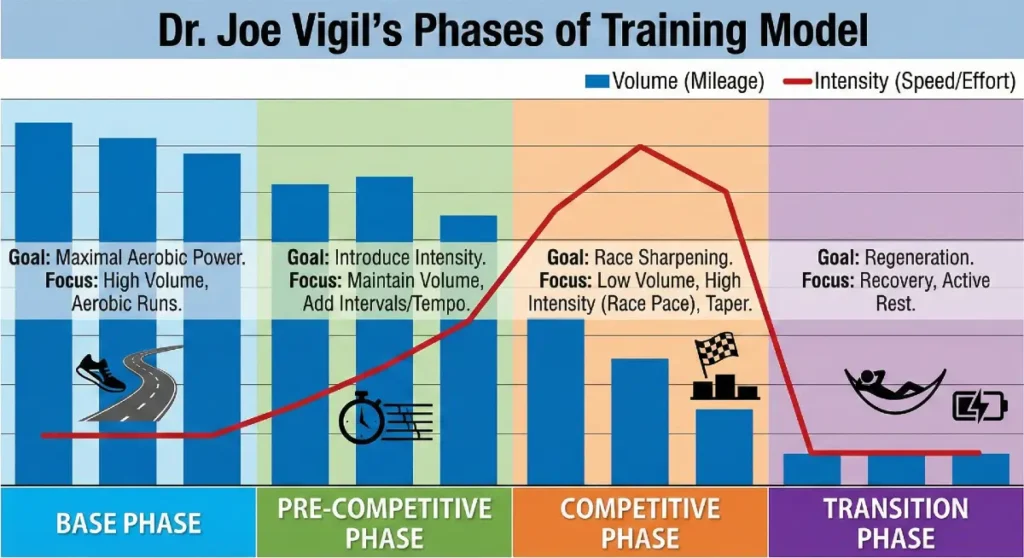
Vigil is a scientist (he holds a Ph.D. in Exercise Physiology). He adopted Arthur Lydiard’s periodization model but refined it with strict physiological testing. He believed both the coach and the runner must understand the “Why” behind the workout.
Here is how Vigil structures a season:
| Phase | Primary Goal | Sample Workout |
|---|---|---|
| Base Phase | Maximal Aerobic Power (VO2 Max development via volume). | Long Run: 15-19 miles every 14 days; alternate with 12.5 miles. |
| Pre-Competitive | Introduce intensity while holding volume. | 6 x 800m @ 3K Pace (400m jog recovery). |
| Competitive | Race sharpening and speed. | Week A: 6 x 600m (All Out) Week B: 4 x 400m (All Out, 5-8 min rest) |
| Transition | Regeneration. Maintain aerobic levels, drop intensity. | 60 mins easy/moderate running. |
Part 3: Strength Training (Running Comes First)
Vigil is often cited as a “high mileage” coach, but he does not neglect strength—he just sequences it carefully.
If time is limited (as it is for high schoolers), he prioritizes the run. However, his benchmarks for elite distance runners are surprisingly high:
- Squat: Bodyweight equivalent
- Bench Press: Bodyweight equivalent
- Deadlift: 1.5x Bodyweight
The Caveat: He prefers plyometrics and elastic strength work over heavy lifting during the season, and ideally, he wants the lift separated from the run by 6-8 hours (a luxury most high schoolers don’t have).
Plan Your Phases Like a Pro
Dr. Vigil’s periodization can be complex to map out on a calendar. I’ve simplified the structure into a plug-and-play template. Download my Free Season Planning Template to build your Base, Pre-Comp, and Competition phases.
Get the Free Season PlanThe Bottom Line: Why It Works
Vigil’s system is a symphony of iron-clad discipline and science. He reminds his athletes that training is voluntary—you don’t have to be here. But if you are, you owe it to the team to be all in.
As he told his athletes:
“You have something to get up for every morning. You’re loved. You have a team.”
That combination of love and high expectations is the sweet spot where championships are won.