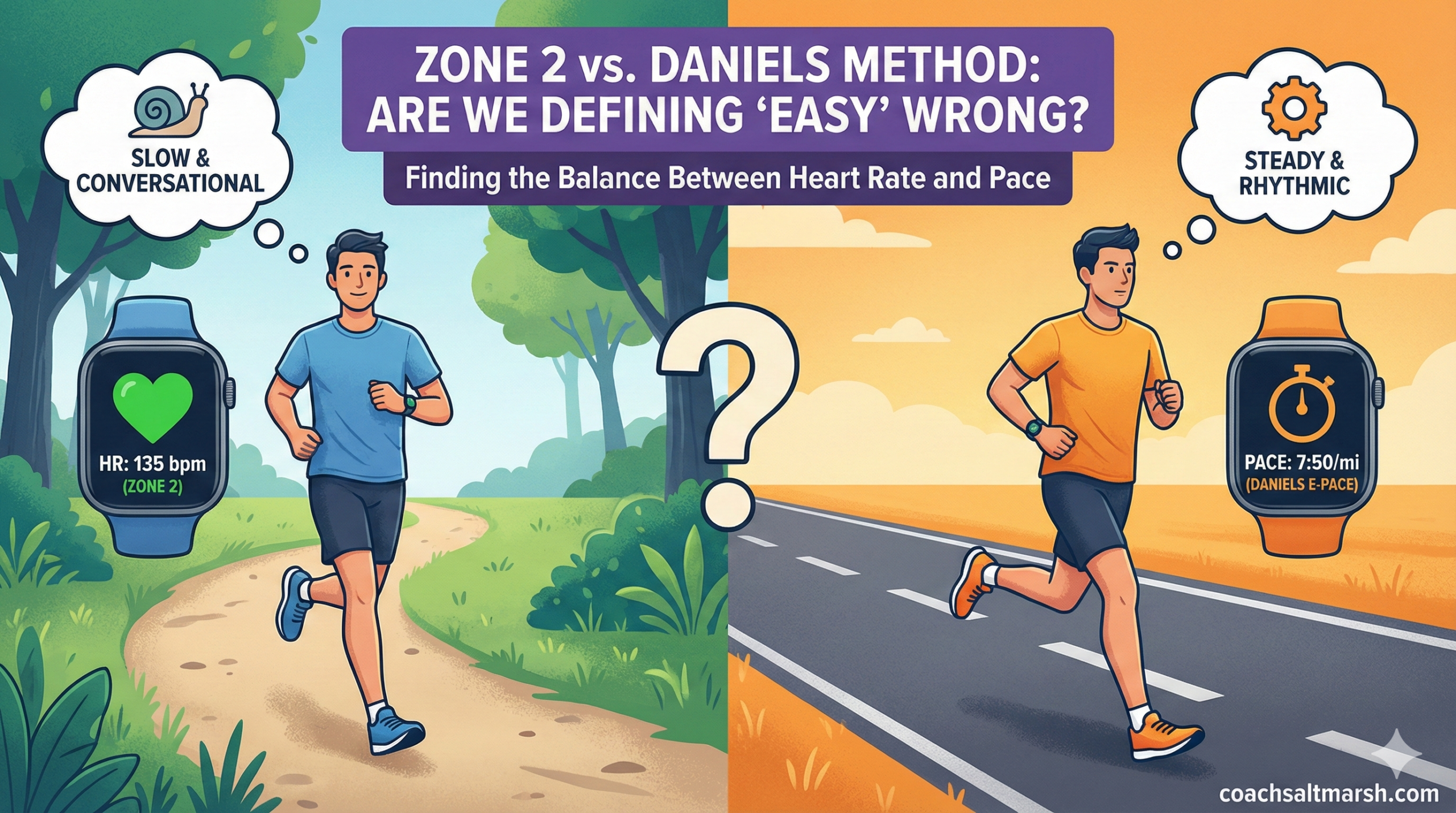
Zone 2 Training vs. The Daniels Method: What is an EASY run?
Unless you’ve been living under a rock, you’ve been bombarded by the media obsession with Zone 2 training. You see it mentioned on Strava, Social Media, Runner World, even NPR called it the latest trend in fitness. I’ll break it down for you, explain how Zone 2 is defined and then compare it to the traditional gold-standard methodology of Dr. Jack Daniels. As you’ll see, neither is wrong, but “easy” is a spectrum of effort and pace.
The Case for Zone 2: The Metabolic Engine
Zone 2 training can feel deceptively underwhelming. It lacks the intensity of track intervals or the satisfying exhaustion of a tempo run. But beneath the surface, this low-intensity state is where the biological foundation of endurance is built. This is the foundation that supports the faster work later on.
The Definition
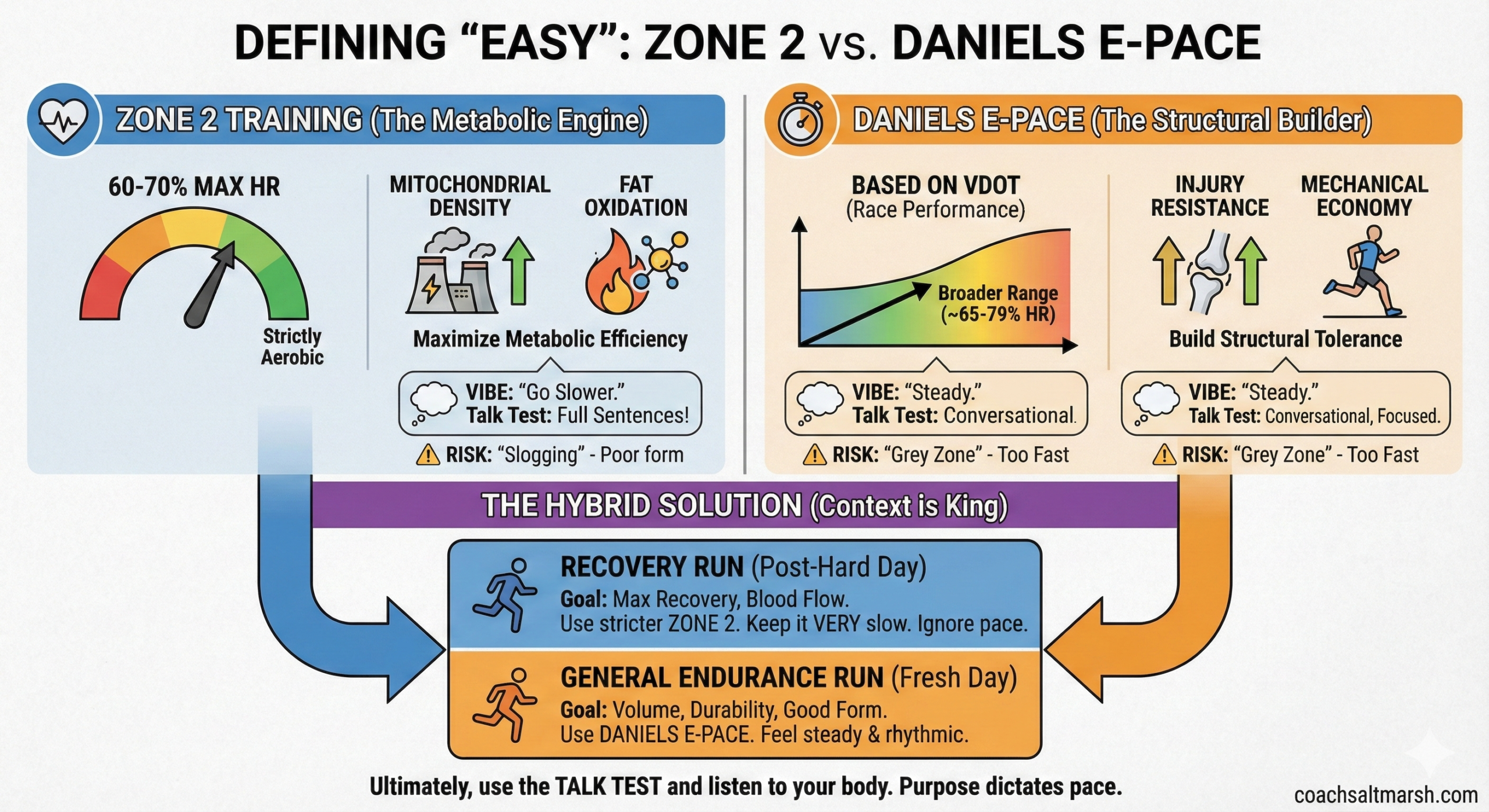
Physiologically, Zone 2 is typically defined as 60–70% of your Maximum Heart Rate. However, the specific heart rate number is secondary to what is happening biologically: Zone 2 sits strictly below your Aerobic Threshold. This is the intensity at which your blood lactate levels remain steady. In this zone, your body is clearing metabolic waste just as fast as it is producing it, allowing you to sustain the effort almost indefinitely. Hence, the term “Easy.”
The Science: Building the Infrastructure
Why spend so much time running slowly? Because two specific adaptations occur in Zone 2 that simply do not happen as efficiently at higher intensities.
1. Mitochondrial Density Think of mitochondria as the microscopic engines inside your muscle cells that turn fuel into energy. Zone 2 training stimulates the production of more mitochondria and makes the existing ones larger. By increasing your mitochondrial density, your body can produce more energy with less strain.
2. Fat Oxidation Your body has two main fuel tanks: Glycogen which is like a small, high-octane gas tank, and Body Fat, which is like a massive diesel reserve (virtually unlimited calories).
- High-intensity running relies heavily on that limited (90-120 minutes) Glycogen tank.
- Zone 2 running trains the body to bypass the Glycogen and burn Fat instead.
The Goal: Metabolic Efficiency
The ultimate objective of Zone 2 is not just to run slowly, but to eventually run faster at the same heart rate. This is metabolic efficiency. Over months of Zone 2 training, a pace that used to spike your heart rate to 150 bpm might eventually only require 135 bpm, proving that your engine has become more powerful and fuel-efficient.
The Vibe: “Go Slower”
The hardest part of Zone 2 isn’t the physical effort; it’s the ego. It requires the discipline to be passed by slower runners. It demands that you ignore your GPS watch pace (and your resulting Strava ranking) and instead listen to your body. The mantra for this zone is simple: “Keep it slow. If you think you’re going slow, go slower.”
The Case for Daniels (VDOT): The Structural Builder
While the Zone 2 approach focuses entirely on the internal biological engine, the Jack Daniels method—based on his famous VDOT formula—focuses on race results. For Daniels, training paces are dictated by what your body has proven it can do in a race, not just what your heart rate monitor says. Heart rate can be unreliable, varying due to external factors like weather, terrain, and an individual’s true maximum heart rate.
The Definition
In the Daniels system, the “E-Pace” (Easy/Long) is calculated based on a recent race result. Unlike the strict heart rate caps of Zone 2, Daniels’ E-Pace is a broader range. If you run a 20-minute 5K, there is a specific E-Pace assigned to that fitness level (roughly 7:59–8:46/mile), regardless of whether your heart rate is 135 or 150 on a given day.
The Science: Resistance Training for the Legs
Daniels views easy running largely through a structural lens. While he acknowledges the aerobic benefits, he emphasizes that “E” runs are the primary tool for injury resistance. Running places massive impact forces on the body (2.5 to 3 times body weight per step). By accumulating volume at E-Pace, you are subjecting your bones, tendons, and ligaments to a specific stress load. This repetitive stress triggers adaptation: your structural tissues thicken and harden to handle the load.
The Nuance: The “No-Shuffle” Rule
This is where the controversy usually begins. Daniels’ E-Pace often sits between 65% and 79% of Maximum Heart Rate. The upper end of this range is significantly faster than strict Zone 2.
Why the speed? Mechanical Economy. Daniels argues that if you run too slowly, your running mechanics degrade. You stop using the elastic energy (the spring) in your calves and Achilles, and you begin to “shuffle” or plod. Running long miles with sloppy mechanics reinforces, you guessed it- sloppy mechanics.
- The Daniels Fix: Running at a “steady” pace where your form feels crisp and natural.
The Goal: Mechanical Efficiency
The ultimate goal of the Daniels method is to build a runner who is not just aerobically fit, but mechanically durable. By running at a slightly quicker “steady” state, you are training your nervous system to maintain good turnover and posture even when tired. You are building the tolerance to withstand the pounding of a marathon, ensuring that your legs don’t give out before your lungs do.
The “Grey Zone” Conflict: When “Easy” Isn’t Easy
This is where most runners (and coaches) get confused. To see the conflict clearly, let’s look at a concrete example of a fairly competitive runner.
Let’s imagine a runner named Sofia. She has just run a 20:00 5K (6:26/mile pace). This gives Sofia a VDOT score of roughly 49.8.
- The Zone 2 Prescription:
- Pace: ~8:45 – 9:30 per mile.
- Focus: Strict heart rate cap (likely under 145 bpm).
- Feel: Very light.
- The Daniels (VDOT) Prescription:
- Pace: ~7:50 – 8:40 per mile.
- Focus: Mechanical rhythm and steady volume.
- Feel: Comfortable, but requiring focus.
The Conflict: A Minute Per Mile Difference!
There is nearly a full minute per mile difference between the slow end of Zone 2 and the fast end of Daniels’ E-Pace. That gap is where the controversy lives.
The Zone 2 Argument: “The Grey Zone Trap” Zone 2 purists look at that Daniels pace (7:50/mile) and call it the Grey Zone.
- The argument: It is too fast to be purely aerobic (you are likely producing some lactate), but it is too slow to build speed.
- The risk: You accumulate just enough fatigue to ruin your recovery for tomorrow’s workout, without getting the maximum mitochondrial benefit of a true slow run.
The Daniels Argument: “The Slogging Trap” Daniels proponents look at that Zone 2 pace (9:30/mile) and call it Slogging.
- The argument: Running that slowly forces Sofia to alter her biomechanics. She loses the “pop” in her stride, dragging her feet and increasing ground contact time.
- The risk: You reinforce poor movement patterns. If you train your body to move sluggishly, you will race sluggishly.
So, Are We Defining “Easy” Wrong? (The Solution)
The confusion stems from a simple linguistic problem: we use the word “Easy” to describe too many things. We use it for recovery shuffles, for long steady runs, and for warm-ups. The truth is that neither the Zone 2 method nor the Daniels method is “wrong.” The error lies in trying to apply one rigid definition to every single run. The solution is not to pick a side, but to pick the right training stimulus for the training macrocycle.
🔄 The Seasonal Shift
Your definition of “easy” should evolve as your training cycle progresses.
(The Off-Season)
(In-Season)
The “Recovery” Distinction
Perhaps the biggest mistake runners make is lumping “Recovery Runs” and “General Endurance Runs” into the same category. They are not the same thing.
- The Recovery Run (Zone 2):
- When: The day immediately after a hard workout or a massive long run.
- The Goal: Blood flow and movement without stress.
- The Pace: Ignore the watch. If you feel like walking, walk.
- The General Endurance Run (Daniels):
- When: A standard mileage day where you are fresh.
- The Goal: Aerobic volume and structural hardening.
- The Pace: “Steady.” You are running with purpose.
Practical Takeaways for the Runner
At the end of the day, training charts are just mathematical averages applied to living breathing humans with a variety of unique situations. They are guidelines, not laws. Here is how to navigate the space between the two philosophies.
1. Don’t Be a Slave to the Data
Your body is not a machine that performs identically every day. Stress, sleep, caffeine, breakups, friend drama, homework and weather all impact your heart rate and perceived exertion.
- If Daniels E-Pace feels hard: If you are hitting the prescribed pace but you are gasping for air or your legs feel heavy, slow down.
- If Zone 2 feels awkward: If sticking to a low heart rate forces you to shorten your stride or you feel like you are tripping over your own feet, speed up a bit.
2. Use the “Talk Test”
When in doubt, ditch the watch and use your voice. The “Talk Test” is the ultimate definition of easy pace. You should be able to speak in complete sentences—not just gasping out “yes” or “no”—without straining. If you have to pause for a breath in the middle of a sentence, you have drifted out of the true easy zone.
3. The Hybrid Approach
The most successful runners often blend the two:
- For Recovery Runs: Use Zone 2. Let the heart rate dictate the effort. Run as slow as needed to keep the system calm.
- For Long Runs: Lean closer to Daniels E-Pace. Use the “steady” state to build mental toughness and physical resilience for the miles ahead.
Conclusion
So, is “easy” defined by a heart rate or race performance? The answer is: Yes.
“Easy” is not a single number; it is a subjective effort relative to the goal of the day. Sometimes the goal is just to get the legs moving (Zone 2), and sometimes the goal is improved endurance stamina (Daniels). The runners who make the most progress are not the ones who blindly follow a spreadsheet, but the ones who understand why they are running a certain pace.
Ask yourself, “What is the purpose of this run?” Once you answer that, the pace will take care of itself.