
5K Training Guide: Free Plans for Beginners to Elite Runners
The 5K (3.1 miles) is the perfect racing distance. It’s short enough that beginners can complete one after just a few weeks of training, yet challenging enough that elite athletes spend years chasing personal records measured in seconds, not minutes. Whether you’re lacing up your first pair of running shoes or hunting for that elusive sub-20 minute finish, the 5K rewards smart training more than natural talent.
As a USATF Level 2 Coach and NHIAA Coach of the Year, I’ve guided athletes from their very first mile to state championships. The secret isn’t genetics. It’s understanding how to build aerobic capacity, develop speed safely, and execute a race strategy that matches your current fitness level.
This guide will take you from wherever you are now—couch, casual jogger, or competitive runner—to standing on that starting line with confidence, a clear training plan, and realistic expectations for what you can achieve. You can do this!
Why the 5K? Understanding the Perfect Racing Distance
The 5K sits in a unique physiological sweet spot. It’s long enough to require a strong aerobic base (your body’s ability to use oxygen efficiently), yet short enough to demand significant speed endurance (holding a challenging pace for 15-40 minutes). According to race data analyzed by RunRepeat across 28,000 races, the average 5K finish time is 26-36 minutes.
But here’s what makes the 5K special: it’s the most forgiving distance for busy people. Unlike marathon training—which demands 18-20 weeks and 40-50 mile weeks—you can prepare for a 5K in 6-8 weeks running just 3-4 days per week. Recovery is measured in days, not weeks. You can race 5Ks throughout the year without risking overtraining or burnout. Yes, you can have fun racing!
The 5K is also the most accessible racing distance. Every town hosts 5Ks—charity runs, fun runs, competitive races. They happen year-round, on roads, trails, and tracks. The barriers to entry are minimal: a pair of running shoes and the willingness to show up. In fact, the 5K is the most diverse racing distance in the world. According to Running USA, it has the highest female participation rate (approx 60%) and sees the widest age variance, from junior athletes to runners in their 80s.And, walk or run, you’ll find a pack of fellow athletes to keep you company and cheer you forward.
Start Here: Assess Your Current Fitness Level
Before diving into a training plan, you need to know where you’re starting. This determines which approach will work best for you.
Complete Beginner (Never Run Before)
If you can’t currently run for 5 continuous minutes, start with a walk-run program. Don’t be embarrassed—every runner started here. The key is progressive overload: gradually asking your body to do slightly more each week without overwhelming it.
Recreational Runner (Can Run 2-3 Miles)
If you’re already running 2-3 times per week and can comfortably run 20-30 minutes, you have the base fitness to train specifically for a 5K. Your goal is to add structure: speed workouts, long runs, and recovery days that systematically build both speed and endurance.
Competitive Runner (Chasing PRs)
If you’ve already completed multiple 5Ks and want to break specific time barriers (sub-25, sub-20, sub-18), your training needs to be more sophisticated. You’ll need higher weekly mileage (30-50 miles), specific pace work, and strategic race-day execution.
Use the training pace calculator below to determine your current fitness level and target training paces:
Training Paces
Input your most recent 5K time or mile time to calculate your personalized training zones:
- Easy: This is your most important zone. These runs build aerobic volume and allow your body to absorb hard training. If you run these too fast, you won't recover for the real workouts.
- Threshold: The "comfortably hard" zone. This pace improves your body's ability to clear lactate, allowing you to run faster for longer without fatigue setting in.
- Critical Velocity: It is often defined as the fastest pace a runner can sustain for 30 to 45 minutes of all-out running.
- 5K Race Pace: These workouts (usually 800m–1200m repeats) increase the maximum amount of oxygen your body can use.
- Mile Race Pace: These short bouts improve your running economy, mechanics, and raw speed.
🚀 Ready for the Next Level?
Stop guessing. Start building. Join 1,000+ disciplined coaches getting weekly insights on volume progression and peak performance.
✅ Subscribe for FreeThe Beginner's 8-Week Couch to 5K Plan
If you're starting from scratch, this walk-run progression will get you to the finish line injury-free. The goal isn't speed—it's consistency and adaptation.
Weeks 1-2: Building the Habit
Monday: Rest
Tuesday: 20 minutes walk-run (1 min run / 2 min walk)
Wednesday: Rest or gentle walk
Thursday: 20 minutes walk-run (1 min run / 2 min walk)
Friday: Rest
Saturday: 25 minutes walk-run (1 min run / 2 min walk)
Sunday: Rest or 20 minute walk
Weeks 3-4: Extending Run Time
Monday: Rest
Tuesday: 25 minutes walk-run (2 min run / 1 min walk)
Wednesday: Rest or cross-training (bike, swim, yoga)
Thursday: 25 minutes walk-run (2 min run / 1 min walk)
Friday: Rest
Saturday: 30 minutes walk-run (3 min run / 1 min walk)
Sunday: Rest or 25 minute walk
Weeks 5-6: Longer Continuous Running
Monday: Rest
Tuesday: 30 minutes walk-run (5 min run / 1 min walk)
Wednesday: 20 minute easy run or cross-training
Thursday: 30 minutes walk-run (5 min run / 1 min walk)
Friday: Rest
Saturday: 35 minutes walk-run (8 min run / 1 min walk)
Sunday: Rest or 30 minute walk
Weeks 7-8: Race Preparation
Monday: Rest
Tuesday: 25 minutes continuous easy run
Wednesday: 20 minute easy run or cross-training
Thursday: 30 minutes continuous easy run
Friday: Rest
Saturday: 35 minutes continuous easy run
Sunday: Rest
Week 8 Race Week:
Tuesday: 20 minute easy run
Thursday: 15 minute easy run
Saturday: Race Day!
Beginner Mistakes to Avoid
- The "Grey Zone" Trap: Many beginners run their easy days too hard and their hard days too easy. If you can't recite the pledge of allegiance while running, you aren't in your aerobic base zone. Slow down.
- Skipping Rest Days: Adaptation happens during recovery, not during workouts. Rest days aren't lazy—they're strategic.
- Comparing Yourself to Others: Your only competition is yesterday's version of yourself.
- New Gear on Race Day: Never wear new shoes or clothes on race day. Only race in gear you've trained in.
The "Start Strong" Foundation
Best for: First-Timers & Returning Runners- Duration: 8 Weeks
- Commitment: 3–4 days/week (20–35 mins)
- Method: Walk-Run Progression
- Goal: Finish comfortably without stopping
Intermediate 5K Plan: Breaking 25 Minutes
If you can already run 3 miles comfortably, this plan adds structure and speed work to lower your 5K time.
Training Week Structure
Monday: Rest or active recovery (walk, yoga, foam rolling)
Tuesday: Speed Work (intervals or tempo)
Wednesday: Easy Run (30-40 minutes conversational pace)
Thursday: Easy Run (30-40 minutes) + Strength Training
Friday: Rest
Saturday: Long Run (45-60 minutes easy pace)
Sunday: Easy Run (30 minutes) or Cross-Training
The Three Essential Workouts
1. Interval Training (Tuesday)
Intervals develop your body's ability to clear lactate while running fast. These are hard efforts with recovery jogs between.
Example Workout (Week 4):
- Warm-up: 10 minutes easy running
- Main Set: 6 x 800m at 5K goal pace with 2:00 rest
- Cool-down: 10 minutes easy running
Progress weekly: Week 1 (4 x 400m), Week 2 (5 x 400m), Week 3 (6 x 400m), Week 4 (6 x 800m)
2. Tempo Runs (Tuesday, alternating weeks)
Tempo runs build lactate threshold—the pace you can sustain for roughly 45-60 minutes. This pace should feel "comfortably hard."
Example Workout:
- Warm-up: 10 minutes easy
- Main Set: 20 minutes at tempo pace (about 30 seconds slower than 5K pace)
- Cool-down: 10 minutes easy
3. Long Runs (Saturday)
Long runs build aerobic endurance and mental toughness. Run these at an easy, conversational pace—significantly slower than race pace.
Weekly Progression:
- Week 1-2: 45 minutes
- Week 3-4: 50 minutes
- Week 5-6: 55 minutes
- Week 7: 60 minutes
- Week 8: 30 minutes (taper week)
Sample Week (Week 5)
Monday: Rest
Tuesday: 10 min warm-up + 5 x 1K at 5K pace (2:30 rest) + 10 min cool-down
Wednesday: 35 minutes easy
Thursday: 35 minutes easy + 20 min strength (squats, lunges, planks)
Friday: Rest
Saturday: 55 minutes long run (easy, conversational)
Sunday: 30 minutes easy or bike/swim
Total Weekly Mileage: Approximately 20-25 miles
Intermediate Training Principles
- The 80/20 Rule: 80% of your running should be easy (conversational pace). Only 20% should be hard (tempo runs, intervals). Most intermediate runners make the mistake of running their easy days too hard, which prevents recovery and increases injury risk.
- Progressive Overload: Gradually increase training stress (volume or intensity) by no more than 10% per week. Your body adapts to stress during recovery—if you never recover, you never improve.
- Specificity Matters: Want to race fast? You need to practice running fast. Once a week, run at or near your goal 5K pace during workouts.
- Strength Training Prevents Injuries: Two 20-30 minute sessions per week focusing on single-leg strength, glutes, and core will make you a more durable runner. You don't need heavy weights—bodyweight exercises work perfectly.
The PR Chaser Plan
Best for: Breaking 30:00 or 25:00- Duration: 8 Weeks
- Mileage: 20–25 miles/week
- Key Workouts: Tuesday Intervals & Saturday Long Run
- Goal: Build speed endurance & strategy
Advanced 5K Training: How to Break Sub-20 Minutes
Breaking 20 minutes for the 5K (6:26 per mile pace) requires consistent training at higher volumes and intensities. This is for runners who already have a solid base (25-35 miles per week) and a recent 5K time under 22 minutes.
Prerequisites for Sub-20 Training
Before attempting this plan, you should be able to:
- Run 6-7 miles continuously at easy pace
- Complete a tempo run at 6:50 per mile pace for 15-20 minutes
- Handle 30-40 miles per week without injury
If you can't meet these benchmarks, spend 4-6 weeks building your base before starting race-specific training.
10-Week Sub-20 Minute Training Plan Structure
Weekly Mileage Progression: Start at 30 miles, peak at 45 miles (Week 7), taper to 25 miles (Week 10)
Key Workouts Each Week:
- Tuesday: Speed Work (intervals or hill repeats)
- Thursday: Tempo Run or Lactate Threshold Work
- Saturday: Long Run (60-90 minutes)
- All other days: Easy recovery runs
Sample Training Week (Week 6 - Peak Week)
Monday: Rest or 30 min easy + strength training
Tuesday: VO2max Intervals
- Warm-up: 15 minutes
- Main Set: 8 x 800m at 6:15 pace (90 sec jog recovery)
- Cool-down: 15 minutes
- Total: 8 miles
Wednesday: 40 minutes easy (8:30 pace)
Total: 5 miles
Thursday: Threshold Run
- Warm-up: 15 minutes
- Main Set: 3 x 8 minutes at 6:40 pace (2 min recovery)
- Cool-down: 15 minutes
- Total: 7 miles
Friday: 30 minutes easy (8:30 pace)
Total: 4 miles
Saturday: Long Run
- 90 minutes at easy pace (8:00-8:30 per mile)
- Total: 11 miles
Sunday: 50 minutes easy (8:30 pace)
Total: 6 miles
Weekly Total: 41 miles
Advanced Training Principles
- Periodization: Your training should follow a 3-week progression + 1 recovery week pattern. Weeks 1-3 increase volume/intensity, Week 4 reduces both by 30% for recovery.
- VO2max Development: The key workout for sub-20 is 800m-1200m repeats at 5K pace or slightly faster. These build your aerobic ceiling—your body's maximum ability to use oxygen.
- Threshold Work: Tempo runs should be done at roughly 15 to 20 seconds slower per mile than your goal 5K race pace. This is the "comfortably hard" pace you could theoretically hold for 45-60 minutes.
- Hill Repeats for Power: Once every 2-3 weeks, substitute intervals with 8-10 x 90-second hill sprints. Hills build power and running economy without the pounding of track intervals.
- Recovery Runs Are Mandatory: Advanced runners often struggle to run easy. Your recovery runs should be 8:30-9:00 pace or slower. If you can't hold a conversation, you're defeating the purpose.
The Sub-20 Protocol
Best for: Competitive Athletes & HS XC- Duration: 10 Weeks (includes taper)
- Mileage: 30–45 miles/week
- Key Workouts: VO2 Max Repeats & Threshold Tempos
- Goal: Maximize aerobic capacity
Understanding Heart Rate Training for 5K
Heart rate training removes guesswork. Instead of relying on pace (which varies with terrain, weather, and fatigue), you train based on physiological stress.
Calculate Your Heart Rate Zones
HR Zone Calculator
Your Training Zones
Est. Max HR: bpm
HR Reserve: bpm
| Zone | Focus | Range |
|---|
Heart Rate Training Zones:
Zone 1 (50-60% HRmax): Active recovery, warm-up, cool-down
Example: 93-111 bpm
Zone 2 (60-70% HRmax): Easy aerobic running, long runs
Example: 111-130 bpm
Zone 3 (70-80% HRmax): Moderate aerobic running
Example: 130-148 bpm
Zone 4 (80-90% HRmax): Lactate threshold, tempo runs
Example: 148-167 bpm
Zone 5 (90-100% HRmax): VO2max intervals, race pace
Example: 167-185 bpm
How to Use Heart Rate in Training
Easy Runs: Stay in Zone 2. If your heart rate creeps into Zone 3, slow down. You're building aerobic capacity, not testing it.
Tempo Runs: Maintain Zone 4 (85-88% HRmax). This should feel "comfortably hard"—you can speak in short sentences but not hold a conversation.
Intervals: Hit Zone 5 during work intervals. Your heart rate will drift upward during each repeat—this is normal and expected.
Long Runs: Most of your long run should be Zone 2, potentially drifting into Zone 3 during the final miles as fatigue accumulates.
Race Day: A well-executed 5K will see you in Zone 4 for the first mile, transitioning to Zone 5 for the final two miles.
Predict Your 5K Time
Race Time Predictor
Projected Times
| Distance | Projected Time | Pace |
|---|
Input your best recent time at any distance (mile, 5K, 10K, half marathon) to predict what you're currently capable of running for a 5K.
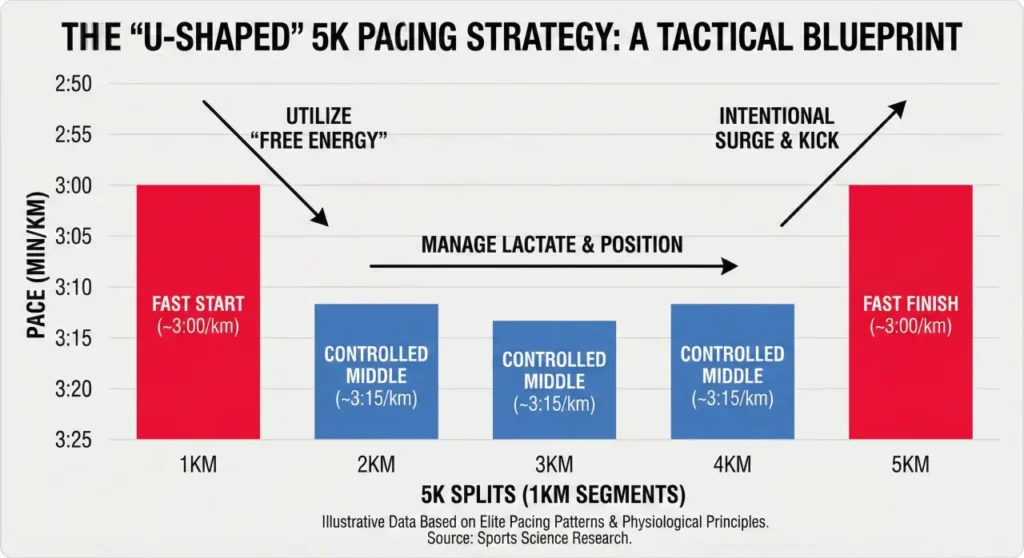
The Art of 5K Race Strategy
Training gets you to the start line. Race strategy gets you to the finish line with your best possible time.
The Three-Mile Breakdown
Mile 1: Controlled Aggression (10-15 seconds slower than goal pace)
The single biggest mistake in 5K racing is going out too fast. The adrenaline rush at the start line makes goal pace feel easy—resist the temptation to sprint.
Strategy:
- Position yourself appropriately in the starting corral (don't line up with sub-18 runners if you're targeting 25 minutes)
- Use the first 45 seconds to surge through congestion, then immediately settle into a controlled rhythm
- Your breathing should be heavy but controlled—you should be able to speak in short phrases
- Target: 10-15 seconds slower per mile than goal average pace
Example: Targeting 24:00 (7:44 average pace)? Run Mile 1 in 7:55-8:00.
Mile 2: The Grind (Goal pace or 5 seconds slower)
This is the hardest mile mentally. Dial in and stay focused on your goal. Positive talk helps.
Strategy:
- Focus on rhythm and form—shoulders relaxed, hands loose, eyes forward
- Break this mile into 400m segments mentally: "Just get to the next telephone pole"
- Stay with your planned pace group if possible
- Resist the urge to slow down when discomfort peaks around Mile 2.5
Example: Run Mile 2 at goal pace (7:44) or slightly slower (7:50).
Mile 3: The Finish (Goal pace, accelerating to finish)
You have 1.1 miles left. This is where mental toughness separates PRs from disappointments.
Strategy:
- At Mile 2.5, consciously decide: "I'm finishing strong"
- Mile 3 should be at goal pace, then progressively accelerate
- The final 400m (quarter mile) should be an all-out effort—leave nothing for after the finish line
- Focus on form as you fatigue: lift your knees, pump your arms, lean slightly forward
Example: Run Mile 3 at 7:40, with final 0.1 miles at sub-7:00 pace.
Pacing Strategies Explained
Even Splits: Running each mile at the same pace. Safe and effective for beginners who aren't sure what they're capable of.
Negative Splits: Running the second half faster than the first half. Requires discipline but produces the most consistent PRs.
Positive Splits (Go Hard): Running the first half fast, then hanging on. Risky—you're gambling that adrenaline will carry you through when lactate accumulates. Not recommended unless you're extremely fit.
Common Race Day Mistakes
Starting Too Fast: You'll pay for every second you run faster than goal pace in Mile 1 by the time you hit Mile 2.5.
No Warm-Up: Unlike marathons, 5Ks hurt from the gun. You need a 15-20 minute warm-up including 4-6 strides (short 100m accelerations) to wake up your neuromuscular system.
Going Out With Faster Runners: Don't follow people who are fitter than you. They'll drop you, and you'll have wasted energy trying to stay with them.
Forgetting to Race: Training teaches you to run at controlled efforts. Racing requires controlled aggression—pushing into discomfort and staying there.
Essential 5K Gear: Run Smart, Finish Comfortable
You don't need expensive equipment to run a 5K; the beauty of the sport is its simplicity. However, the right basics will prevent injuries, eliminate chafing, and make training enjoyable.
Based on thousands of runner reviews and coaching experience, these are the high-value essentials that provide the best bang for your buck.
👟 A Note on Running Shoes
Shoes are the most important gear you own, but they are highly individual. What works for your friend might injure you. We recommend visiting a local dedicated running store to get fitted for a "Daily Trainer" from reputable brands like Brooks, Saucony, Hoka, or New Balance. Don't buy shoes based on looks alone!

Balega Hidden Comfort Running Socks
Cotton is the enemy of runners (it holds sweat and causes blisters). These are the industry gold standard—high cushion, moisture-wicking, and incredibly durable.
View on Amazon
Garmin Forerunner 55
Stop guessing your pace. This is the best value entry-level GPS watch on the market. It tracks accurate distance, pace, and heart rate without overwhelming you with complex data.
View on Amazon
Body Glide Original Anti-Chafe Balm
As you increase mileage, friction becomes an issue. Apply this anywhere skin rubs (thighs, underarms, etc.) before a run to prevent painful chafing. A runner's best friend.
View on Amazon
SPIbelt Minimalist Running Belt
Holding your phone in your hand alters your running gait. This belt is famously minimalist, expandable, and critically—does not bounce while you run.
View on Amazon
TriggerPoint GRID Foam Roller
Essential for working out tight calves and quads after training sessions to prevent injury. This hollow-core design is durable and won't break down over time like cheap foam.
View on Amazon
Coros Pace 4
Ready to level up? Known for legendary battery life and a featherlight design, the Pace 4 adds advanced metrics like running power for data-hungry athletes chasing a new PR.
View on AmazonStrength Training for 5K Runners
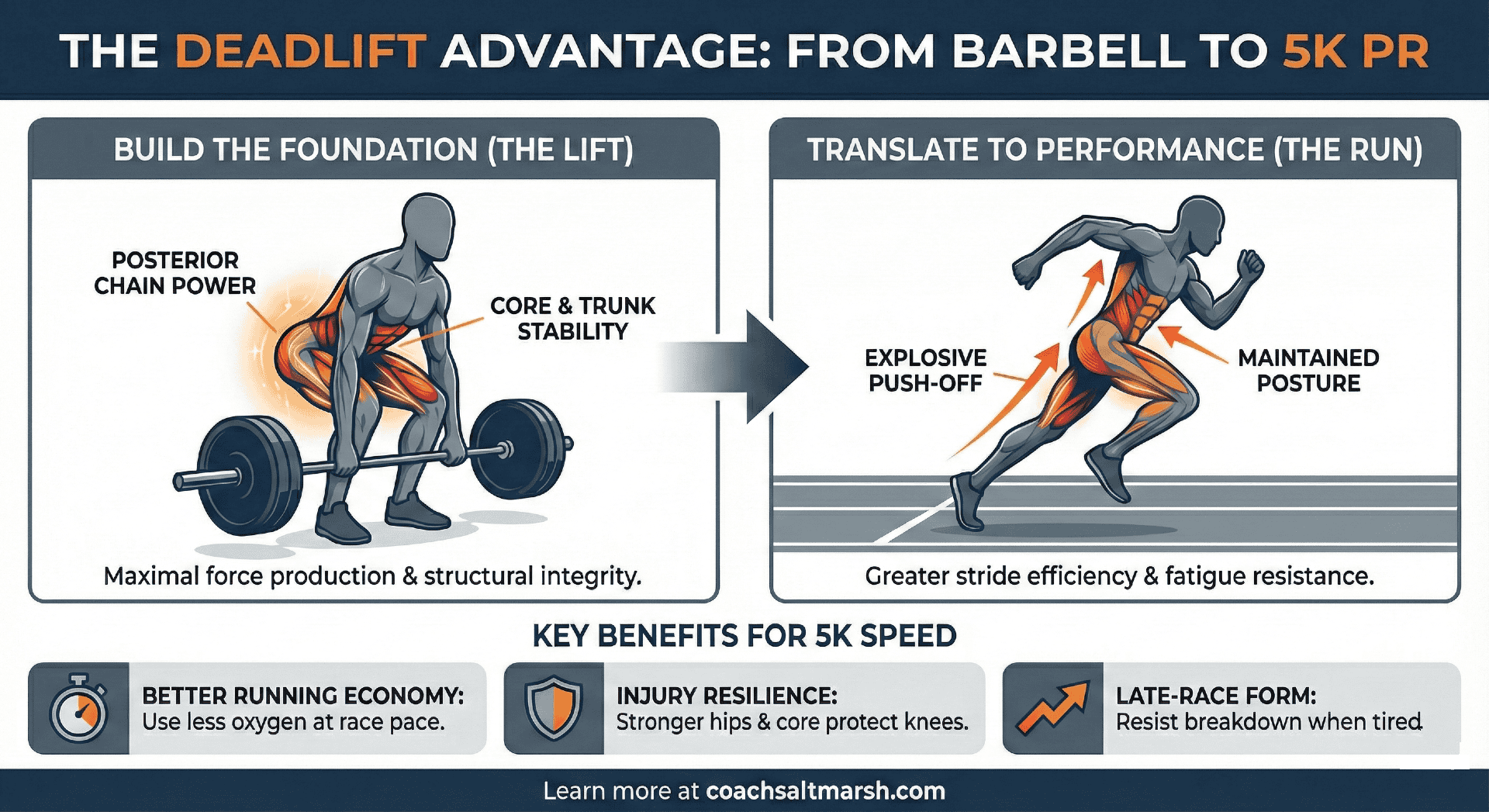
Running makes you a good runner. Strength training makes you a durable, injury-resistant runner who can handle higher training loads.
The Two-Exercise Foundation
If you do nothing else, do these two exercises twice a week:
1. Single-Leg Romanian Deadlifts (3 x 8 each leg)
- Builds glute and hamstring strength
- Prevents IT band syndrome and knee pain
- Improves balance and running economy
2. Plank Variations (3 x 30-60 seconds)
- Strengthens core for better posture
- Reduces lower back pain
- Improves power transfer from upper to lower body
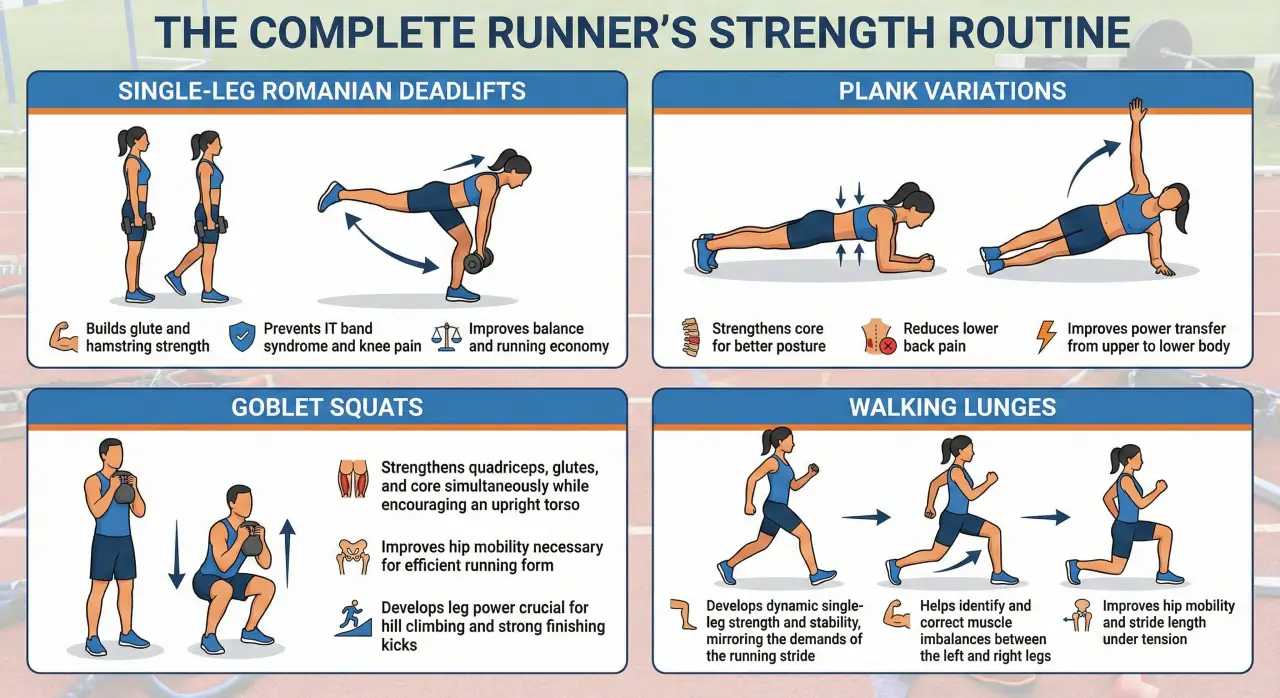
The Complete Runner's Strength Routine (20 Minutes, 2x per Week)
Circuit (3 rounds):
- Goblet Squats: 12 reps
- Single-Leg Deadlifts: 8 reps each leg
- Walking Lunges: 10 reps each leg
- Glute Bridges: 15 reps
- Side Planks: 30 seconds each side
- Clamshells: 15 reps each side
When to Strength Train:
- After easy runs (not before speed work)
- On rest days as active recovery
- Never within 48 hours of a race
Nutrition for 5K Training and Racing
The 5K is short enough that you don't need mid-race fueling, but nutrition still matters for training quality and recovery.
Daily Nutrition Guidelines
Carbohydrates: 3-5 grams per kilogram bodyweight
Needed for glycogen replenishment after training
Example: 140 lb runner (64 kg) needs 192-320g carbs daily
Protein: 1.2-1.6 grams per kilogram bodyweight
Supports muscle repair and adaptation
Example: 140 lb runner needs 77-102g protein daily
Fats: 20-30% of total calories
Supports hormonal health and vitamin absorption
Pre-Race Nutrition
3-4 Hours Before:
Light meal with easily digestible carbs and minimal fiber
Example: Toast with honey and banana, water
60-90 Minutes Before:
Small carb snack if needed
Example: Energy gel, pretzels, or sports drink
30 Minutes Before:
Nothing except small sips of water. Your stomach should feel empty.
Post-Race Recovery
Within 30 Minutes:
20-30g protein + 40-60g carbs
Example: Chocolate milk, protein shake, recovery bar
Why it matters: The 30-minute window post-workout maximizes glycogen replenishment and muscle protein synthesis.
Injury Prevention and Management
The #1 reason runners fail to complete 5K training plans? Injury. Here's how to stay healthy.
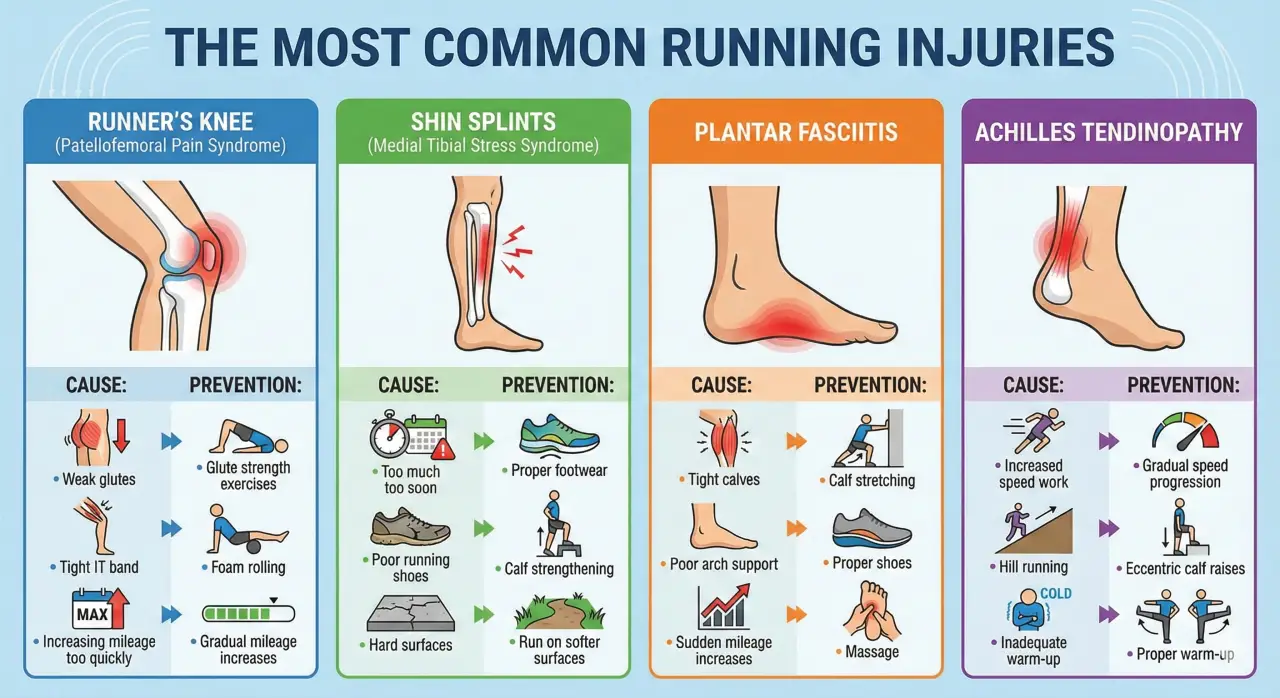
The Most Common Running Injuries
Runner's Knee (Patellofemoral Pain Syndrome)
Cause: Weak glutes, tight IT band, increasing mileage too quickly
Prevention: Glute strength exercises, foam rolling, gradual mileage increases
Shin Splints (Medial Tibial Stress Syndrome)
Cause: Too much too soon, poor running shoes, hard surfaces
Prevention: Proper footwear, calf strengthening, run on softer surfaces
Plantar Fasciitis
Cause: Tight calves, poor arch support, sudden mileage increases
Prevention: Calf stretching, proper shoes, massage
Achilles Tendinopathy
Cause: Increased speed work, hill running, inadequate warm-up
Prevention: Gradual speed progression, eccentric calf raises, proper warm-up
The 10% Rule
Never increase weekly mileage by more than 10% from one week to the next. Your cardiovascular system adapts quickly—your bones, tendons, and ligaments do not.
Example:
- Week 1: 20 miles
- Week 2: 22 miles (10% increase)
- Week 3: 24 miles
- Week 4: 18 miles (recovery week, -25%)
When to Rest vs. Push Through
Take Rest if:
- Sharp, localized pain (not general muscle soreness)
- Pain that changes your running gait
- Pain that persists more than 3 days
- Morning stiffness that doesn't improve after warm-up
You Can Train Through:
- General muscle soreness (DOMS)
- Mild fatigue
- Weather anxiety ("it's too cold/hot/windy")
- Lack of motivation (sometimes you just need to start)
Mental Skills for 5K Success
The 5K is as much a mental challenge as a physical one. When your lungs are screaming and your legs are burning, your brain will send powerful signals to slow down. Champions have learned to interpret those signals differently.
The Power of Self-Talk
Replace negative thoughts with neutral or positive reframes:
Negative: "This hurts too much, I can't keep this pace"
Reframe: "This is supposed to hurt. Everyone hurts at Mile 2.5. I can hold this for 5 more minutes."
Negative: "I'm falling behind my goal time"
Reframe: "I have 1.5 miles to close a 15-second gap. That's 10 seconds per mile. I can do that."
Visualization Practice
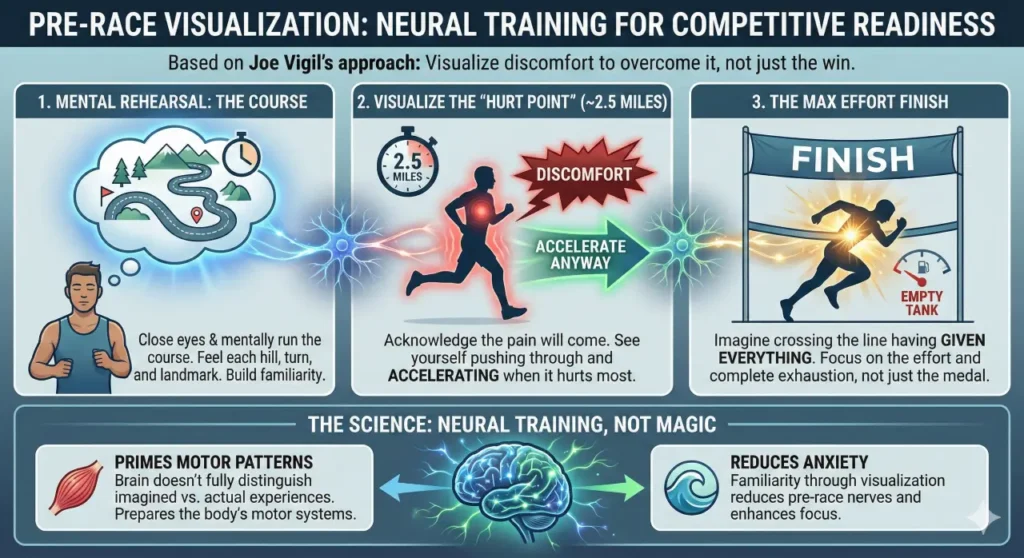
The Week Before Your Race:
Spend 10 minutes visualizing your race in detail:
- Standing at the starting line, feeling calm and prepared
- The gun going off, settling into rhythm
- Mile 2 discomfort arriving on schedule
- Making the decision to push through to the finish
- Crossing the line having given everything
Research shows that mental rehearsal activates similar neural pathways as actual performance. Your brain doesn't fully distinguish between imagined and real experiences.
Race Day Mantras
Pick one short phrase to repeat when things get hard:
- "Strong and smooth"
- "Relax and push"
- "You've got this"
- "Finish strong"
Tapering: The Week Before Your Race
Taper is when you reduce training volume to arrive at race day fresh, not fatigued. Many runners fear tapering, worried they'll "lose fitness." You won't. Fitness doesn't disappear in a week—but fatigue does.
7-Day Taper Protocol
7 Days Out: Last hard workout (tempo run or short intervals). Keep it moderate—don't test your fitness now.
6 Days Out: Easy 30-minute run
5 Days Out: Rest or 20 minutes very easy
4 Days Out: Easy 30-minute run with 4 x 100m strides at race pace
3 Days Out: Rest or 20 minutes very easy
2 Days Out: 20 minutes easy with 4 x 100m strides
1 Day Out: Rest or 15 minutes very easy with 2 strides
Race Day!
Taper Mistakes to Avoid
Training Through Fatigue: "I don't feel ready, I need one more hard workout." No. Trust your training.
Eating Differently: Don't carb-load excessively for a 5K. Maintain your normal diet. You have adequate glycogen stores for a 20-40 minute race.
Staying Off Your Feet: Complete rest makes you feel sluggish. Short, easy runs maintain neuromuscular readiness without adding fatigue.
Race Day Logistics: The Final Checklist
Night Before:
- Lay out all race gear (bib, shoes, clothes, watch)
- Set two alarms
- Light dinner (nothing new or adventurous)
- Hydrate normally (don't overdo it)
- Review race plan
Race Morning (2-3 Hours Before):
- Light breakfast you've eaten before training runs
- Coffee if you normally drink coffee
- Arrive at race venue 60-75 minutes early
60 Minutes Before Start:
- Pick up bib if not done already
- Bathroom visit #1
- Begin warm-up routine
30 Minutes Before Start:
- Finish warm-up: 15 min easy jog + 4-6 strides
- Bathroom visit #2 (yes, again)
- Remove warm-up clothes, get to starting area
10 Minutes Before Start:
- Final mental check: "I'm prepared. I trust my training. I'm ready to race."
- Position yourself in the appropriate starting corral
- Relax your shoulders, shake out your arms
Start Line:
- Controlled aggression, not panic
- Settle into rhythm by 800m
- Execute your race plan
After the Race: Recovery and What's Next
Immediate Post-Race (0-30 minutes):
- Keep walking for 5-10 minutes (don't sit down immediately)
- Hydrate with water or sports drink
- Light stretching if desired
Same Day:
- Consume 20-30g protein + carbs within 30 minutes
- Celebratory meal (you earned it!)
- Ice bath or contrast shower if sore
Days 1-3 After:
- Rest or easy walking
- Focus on sleep and nutrition
- Reflect on what went well and what to improve
Week After:
- Easy 20-30 minute runs if you feel good
- No speed work or hard efforts
- Begin planning your next goal
Setting Your Next Goal
If you just completed your first 5K:
Options: Run another 5K and go for a time goal, or try a longer distance (10K, half marathon)
If you hit your time goal:
Options: Train for a faster 5K time, or move to a new distance challenge
If you missed your goal:
Analyze what happened: Went out too fast? Undertrained? Bad weather? Illness? Use this information to adjust your next training cycle.
Conclusion: Your 5K Journey Starts Now
The 5K is more than a race distance—it's a testing ground for discipline, a proving ground for fitness, and a celebration of what your body can do when you train it systematically.
Whether you're starting from the couch or chasing championship times, the principles are the same: build your aerobic base patiently, add speed gradually, recover adequately, and race strategically.
Every runner you see crossing finish lines started exactly where you are now. Some trained for years to go from 30-minute 5Ks to sub-20 performances. Others completed their first 5K after eight weeks of walk-run training. Both are legitimate victories.
The question isn't whether you're "fast enough" to run a 5K. The question is: are you willing to start training today for the finish line you want to cross months from now?
Your 5K journey begins with a single run. Lace up. Get out the door. Trust the process.
Related 5K Training Resources
Essential Training Articles
→ How to Blend Daniels VDOT Paces with Heart Rate Training
→ Why Your Deadlift is Helping Your 5K
→ The Science of Periodization for High School Seasons
→ Race Strategy: Teaching Athletes to Compete Smart
Free Training Tools
→ Training Pace Calculator - Calculate your personalized training zones
→ Race Time Predictor - Predict your 5K potential based on other distances
→ Mileage Progression Calculator - Plan safe weekly mileage increases
→ Add/Subtract Split Calculator - Calculate pace adjustments for different goals
Advanced Training Guides
→ Complete Guide to Coaching High School Distance Runners
→ The VDOT Training Zones Explained Simply
→ Mesocycle Training Guide
→ Mental Performance: Race-Day Mindset
Note from Coach Saltmarsh:
I'm a USATF Level 2 Endurance Coach and former NH High School Cross Country Coach of the Year. Over twenty years, I've coached hundreds of runners from their first 5K to state championship performances. I believe the 5K is the perfect distance to learn the fundamentals of smart training—it's short enough to race frequently, yet long enough to demand respect. My coaching philosophy combines analytical rigor from two decades as a Chief Information Officer with practical wisdom learned from guiding dozens of athletes to championship performances. Whether you're running your first 5K or chasing a sub-18 finish, the training principles that produce results are the same: patience, consistency, and intelligent progression.
If you are looking for personalized coaching services, I do take on a limited amount of clients. You can reach out directly if interested at jsaltmarsh (at) gmail.com