

High school cross country training plan · 22 weeks · 4 levelsYour whole season, planned to the day.
A 10-week summer base. A 12-week season. A taper timed to your championship weekends. Every run and every workout for four levels, with every pace set from one 5K and a calculator that does the math. You don't design a season. You open the page, read the week, and coach.
Coaching winter and track too? Get the whole year for $179.
- Instant access: two PDFs and a pace calculator
- Every pace on the P-Scale
- 30-day money-back guarantee

- 31state champions coached
- 25 yearscoaching high school distance runners
- USATF Level 2Endurance Coach
- Coach of the YearNew Hampshire cross country, 2018
The P-Scale
One 5K sets the whole week.
Every pace in the Blueprint is a P number. An athlete's current 5K race pace is P90. From that one race comes Easy, Steady, P80, P90 and P100. Appendix A in the Coach's Guide adjusts cross country times for the course. The P-Scale Pace Calculator does this math for every athlete on your roster.
| Zone | How it feels | Per mile | Per 400m |
|---|---|---|---|
| Easy, P62 or slower | Full sentences, easily. Most of every week. | 7:40+ | 1:54+ |
| Steady, P70 to 75 | Full sentences, with rhythm. Comfortably fast. | 6:57 to 7:14 | 1:44 to 1:48 |
| P80, threshold | Short phrases. Comfortably hard. Could hold it 20 minutes or more. | 6:40 | 99 s |
| P90, current 5K pace | A word or two. The anchor for every other pace. | 6:07 | 91 s |
| P100, estimated mile | Current 1600m race pace, estimated from the 5K. | 5:34 | 83 s |
Example: a 19:00 5K on a fast course. Try any 5K in the free cross country pace calculator. On hills and grass, run the talk test. When the chart and the talk test disagree, the talk test wins.
A look inside
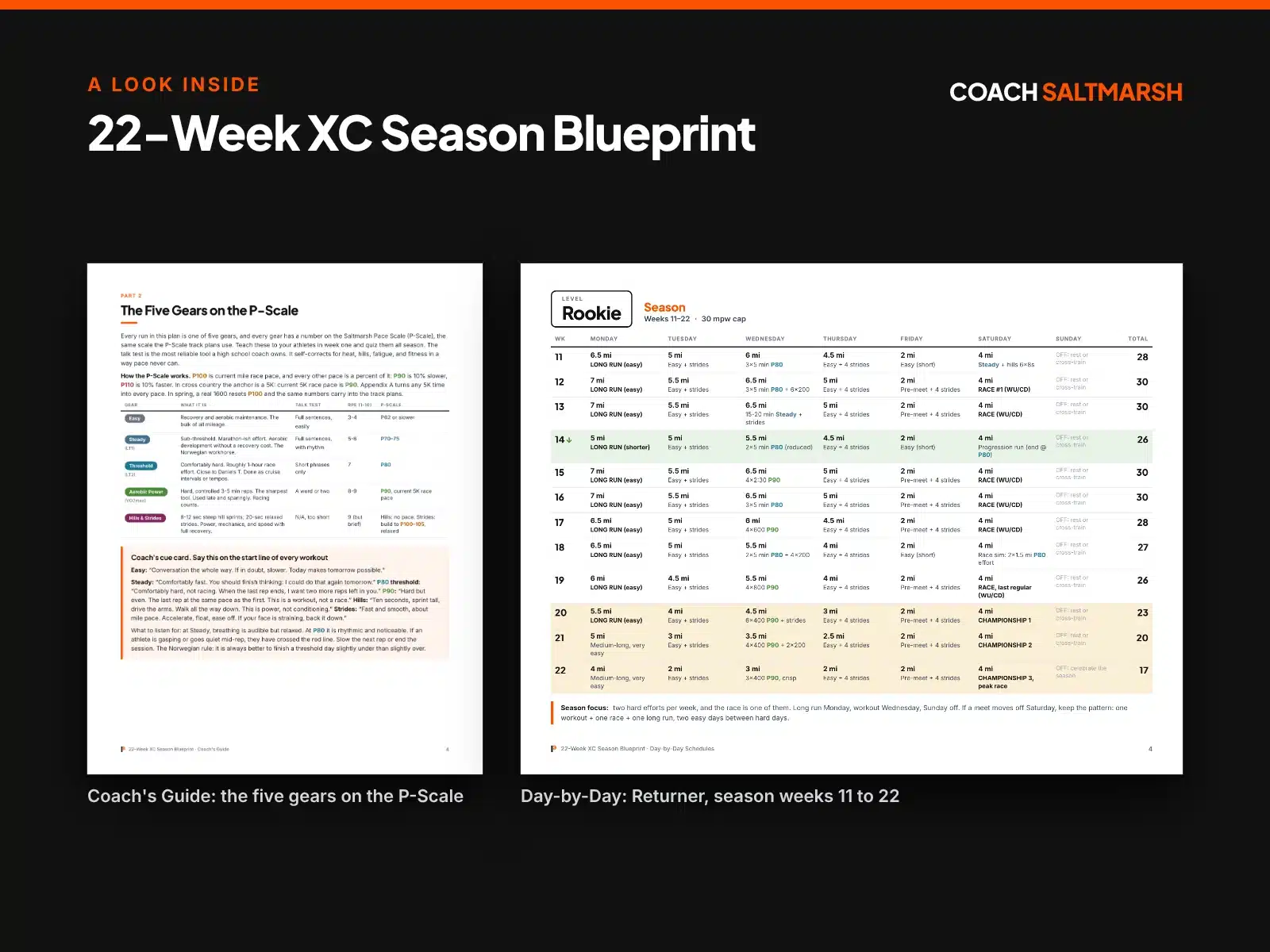
This is the actual product. Rookie, weeks 11 to 22.
Not a mockup. The real print-and-post page your rookies would follow from the first race to the state meet, beside the Coach's Guide page on the P-Scale gears. Every week adds up to plan.
How the 22 weeks are built
Everything between June and the state meet.
Weeks 1 to 10
Summer base
A Lydiard-style aerobic build, written by level.
Weeks 11 to 19
Racing season
Threshold first, a down week placed for you, race-pace work in the final third.
Weeks 20 to 22
Taper
Volume drops to about 78, 67 and 55 percent of peak and lands on three championship weekends.
Every day, every level
All 22 weeks for Rookie, Returner and Veteran, plus weeks 11 to 22 for No Summer. Landscape pages: athletes read their row, coaches read the room.
Four levels, one practice
The same sessions on the same days at scaled doses, so your top runner and your first-timer warm up together.
Coach cue cards
What to say at the start of every workout, Easy to P90, hills and strides, and what to listen for so nobody races a Tuesday.
The red-flag watch list
Bone pain, RED-S, overtraining, low iron and the workout hero who flops on Saturday: what you'll see, what it means and what to do.
The P-Scale pace chart
Paces for any 5K, adjusted for the course, and the talk test that survives heat and hills.
Meet weeks that travel
One workout, the race and the long run. Never more. The guide shows how to shift it for Tuesday or Thursday meets.
Four levels
The whole roster on one plan.
Three levels share one practice: the same sessions on the same days at scaled doses. A fourth level catches athletes who missed the summer. The Coach's Guide places each athlete and says when to move them.
The team's sessions at the smallest dose.
The middle dose of the same sessions.
The full dose, for athletes with the base to carry it.
For athletes who join at the season with no summer base. Builds to 23 miles by week 17 and joins the Rookie group in week 19.
Who it's for
Built for every coach on the start line.
The first-year coach
You inherited a team and a meet schedule. Open the page, read the week, run practice. The cue cards tell you what to say.
The veteran coach
A complete, defensible framework (Lydiard base, Daniels dosing and Norwegian threshold control) on one pace scale, ready to adjust instead of rebuilding every June.
The teacher-coach with no time
The planning is done. Your evenings go back to grading, family and sleep, not spreadsheets.
The program builder
Levels give your athletes a system to grow through for four years, not a plan they outgrow by October.
From a coach who ran it
Our program had been very old school and speed intensive. A few weeks into the season I bought the 14-week Norwegian Plan and later the 22-week guide. I relied heavily on the day-by-day guides in both, adapting them to fit our schedule. The taper information was also tremendously useful.
The team has mostly bought in. I'm particularly pleased with the progress our ninth graders made. For them the threshold approach seems normal. They are excited about the future and believe in the coaching they are getting.
Our girls team had an outstanding season: a district title, our second consecutive state qualification and an individual regional championship. The top 10 also stayed completely healthy.
What you get
Two PDFs and a calculator. The whole season.
The Coach's Guide
Read it before week 1 and you can place every athlete, set every pace and explain every session.
- The season plan and the P-Scale pace chart
- Cue cards for each workout
- The red-flag watch list
- The No Summer addendum
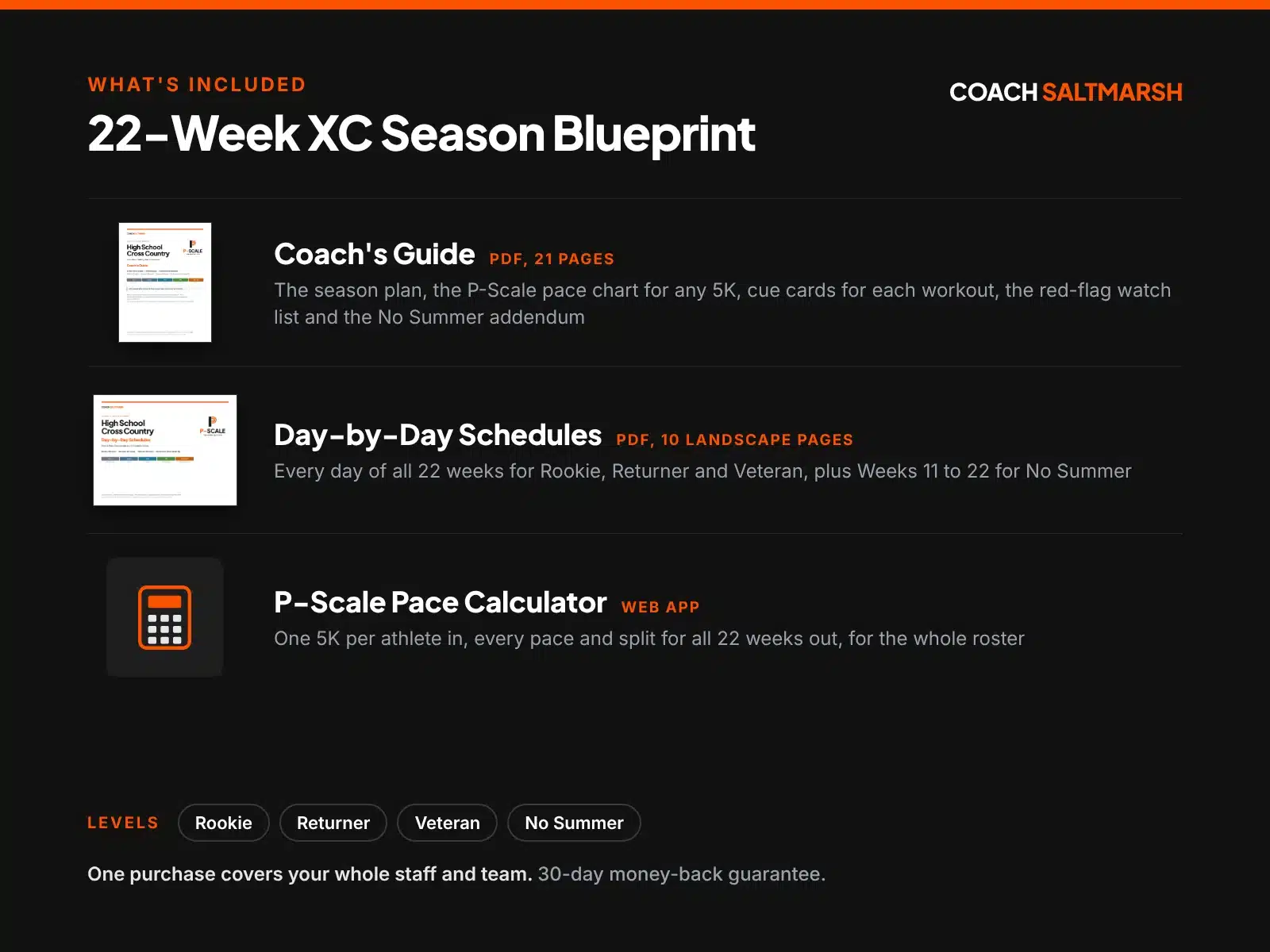
Day-by-Day Schedules
Every day of all 22 weeks, written out with its session and its miles.
- Rookie, Returner and Veteran, weeks 1 to 22
- No Summer, weeks 11 to 22
- Ready to print and post
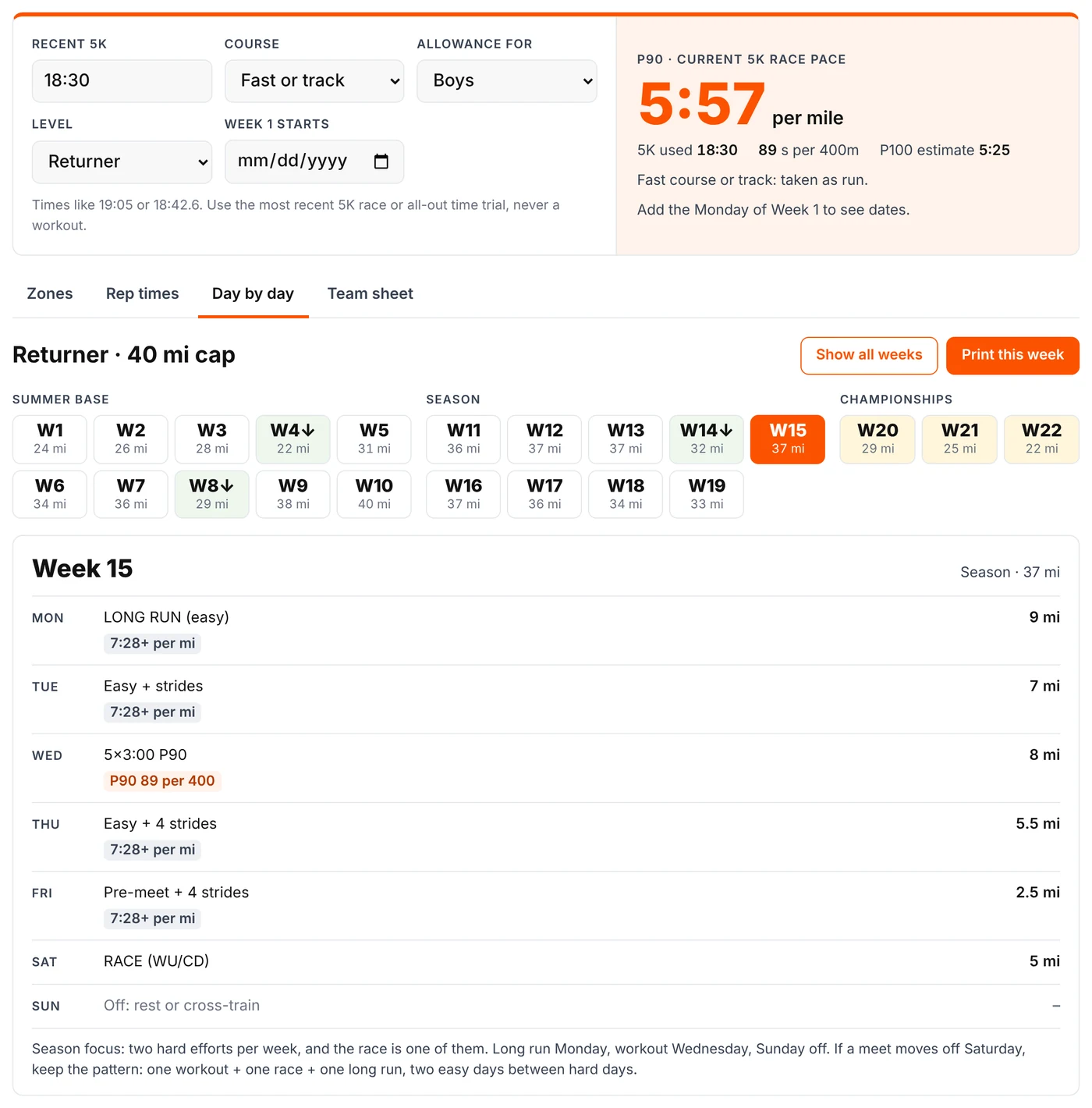
The P-Scale Pace Calculator
Enter each athlete's 5K and the course. It writes their paces and a split beside every rep for all 22 weeks.
- Every pace from one 5K
- A split beside every rep, every week
- A team sheet for any day, ready to print
The 30-day use-it-with-your-team guarantee.
Run it with your actual roster. If it doesn't earn its keep, reply to your receipt email within 30 days for a full refund. No forms, no questions.
Coaching all year?
The HS Distance Bundle: the Blueprint, the Winter Block and all three track plans for $179.
A full year in one system, from the first summer run to the last track race. $38 less than buying them separately, plus the P-Scale crosswalk that ties the seasons together.
Questions
Questions coaches ask about the Blueprint.
Something else? Send me a note and I'll answer it myself.
I've never coached cross country. Can I actually run this?
It was built for exactly that. Every week is laid out day by day with the mileage already set for each level, plus cue cards telling you what to say and what to watch for. If you can read a page a week, you can coach this season.
What is the P-Scale?
One pace language for the whole year. An athlete's current 5K race pace is P90, and every other pace is a percent of their estimated mile. One race sets the whole week, and the talk test keeps it honest on hills and grass.
How does the pace calculator work?
It is a web page you open with the password in your receipt. Enter each athlete's 5K and the course. It shows their paces, a split beside every rep for all 22 weeks, and a team sheet for any day. It works on a phone, and it prints.
Some of my athletes don't run in the summer.
Put them on No Summer. They start at week 11 at 12 miles a week, build to 23 by week 17 and join the Rookie group in week 19.
What if my championship meets fall on different weeks?
The structure slides to fit. The rules are built in: races start after a full training week, there's a mid-season down week, the hardest race-pace work stays in the final third, and the three-week taper lands on your championships. You move the labels, not the logic.
What if my meets aren't on Saturdays?
The meet-week template travels: one workout, one race and one long run, two easy days between hard days, and strides the day before racing. The Coach's Guide shows how to shift it for Tuesday or Thursday meets.
Is there a free sample?
Yes. The Rookie level's 12-week season is free as a printable PDF: the high school cross country training plan. The Blueprint adds the summer base, the other three levels, the cue cards and the pace chart.
I bought the Blueprint before. Do I get this edition?
Yes. Every buyer gets the P-Scale edition, the No Summer level and the pace calculator at no charge. Watch your inbox for the update.
Can I share it with my assistant coaches and athletes?
Yes. Your purchase covers your coaching staff and team, and the schedule pages are made to be printed and handed out. Share the calculator password with your staff too. Please don't redistribute any of it outside your program.
Can my school or booster club pay for it?
Yes. Your receipt arrives by email and works for reimbursement. If your school needs an invoice or purchase order first, contact me and I'll send one.
The rest of the year
Winter Training Block · $59
A 20-week winter plan for high school distance runners, from the last cross country race to the first outdoor meet. Two paths, with or without an indoor season, and four levels.
P-Scale Track Bundle: 800m, 1600m and 3200m Plans · $99
All three P-Scale high school track plans in one purchase: six PDFs and three full pace calculators, in one pace language for your whole distance group. $117 bought separately.
22-Week XC Season Blueprint
You've seen the plan. Now run it.
Four levels, all 22 weeks, and every pace from one 5K. One purchase covers your staff and team.