

20-week winter training plan for high school distance runners: The Winter Training Block
Twenty weeks from the last cross country race to the first outdoor meet, written out day by day.
Two paths, one for programs with a real indoor season and one for programs without. Four levels, assigned by each athlete’s cross country peak week. The strength, the hills, the letters home and the event decisions are all in the box.
- Instant download
- Covers your whole staff and team
- 30-day money-back guarantee
- 31 state champions coached
- 25 years coaching distance runners
- USATF Level 2 Endurance Coach
- Twelve cited research sources
- 30-day money-back guarantee
What they walk into March with.
The tibia does not break during the base block. It breaks in the first three weeks of racing and building mileage at the same time. This block is built so your athletes arrive at that moment ready for it.
- Volume at or near their cross country peak, arrived at gradually.
- Twelve weeks of strength work in their legs, heavy paired with fast.
- Hill work in their history, built one rep at a time.
- Turnover they have touched twice a week since December.
- Bones that were given time to adapt, one held volume step at a time.
The four winter mistakes it takes off the table
- Adding volume in the bone window.Every step holds for three weeks through week nine. If it feels too slow in week four, it is working.
- Letting Wednesday turn into a race.Gear 4 is a locked door all winter. Ninety percent of the running is Chat pace.
- Racing ten times indoors.Six to eight races, rotated across the roster. On a race week, the race is the workout.
- Writing the cold policy on the cold morning.It goes to your athletic director in November, with your numbers in it.
Indoor season or not: which winter path are you on?
Answer this before you write a single workout. It changes the shape of all twenty weeks. Weeks 1 to 6 are identical on both paths, because bone does not care whether you have indoor meets.
Path A: indoor season
Your program races indoor meets that count, with a championship.
Two peaks in five months. Build for three weeks, race for six or seven, taper into a February championship, reset for ten to fourteen days, then build again for outdoor. Racing constrains the volume, so the winter peak sits lower than Path B, and that is correct.
Peak week, miles
Path B: no indoor season
No indoor meets, or occasional races that nobody tapers for.
One uninterrupted build in Lydiard order: base, then hills, then quality. Each block earns the right to the next one. This is the highest volume a high school distance runner will ever carry. The hard part is not physiology. It is consistency.
Peak week, miles
Some athletes race indoors and some don’t? Run Path B for the team and move the three or four indoor athletes onto Path A individually. Do not split the whole program for four kids.
Weekly mileage for all 20 winter weeks.
Pick a path and a level. Every bar is a weekly ceiling from the calendars. Watch the flat steps: that is the plan waiting for bone to catch up.
- Break and rebuild
- Base and build
- Race, hills and quality
- Down, taper and reset
- Championship and outdoor handoff
Mileage is a ceiling, not a target. Adjust a single day by 10 percent either way. Adjust the week only downward. Week 1 is the week after the last cross country race, not a calendar date.
This is the actual product. Judge it yourself.
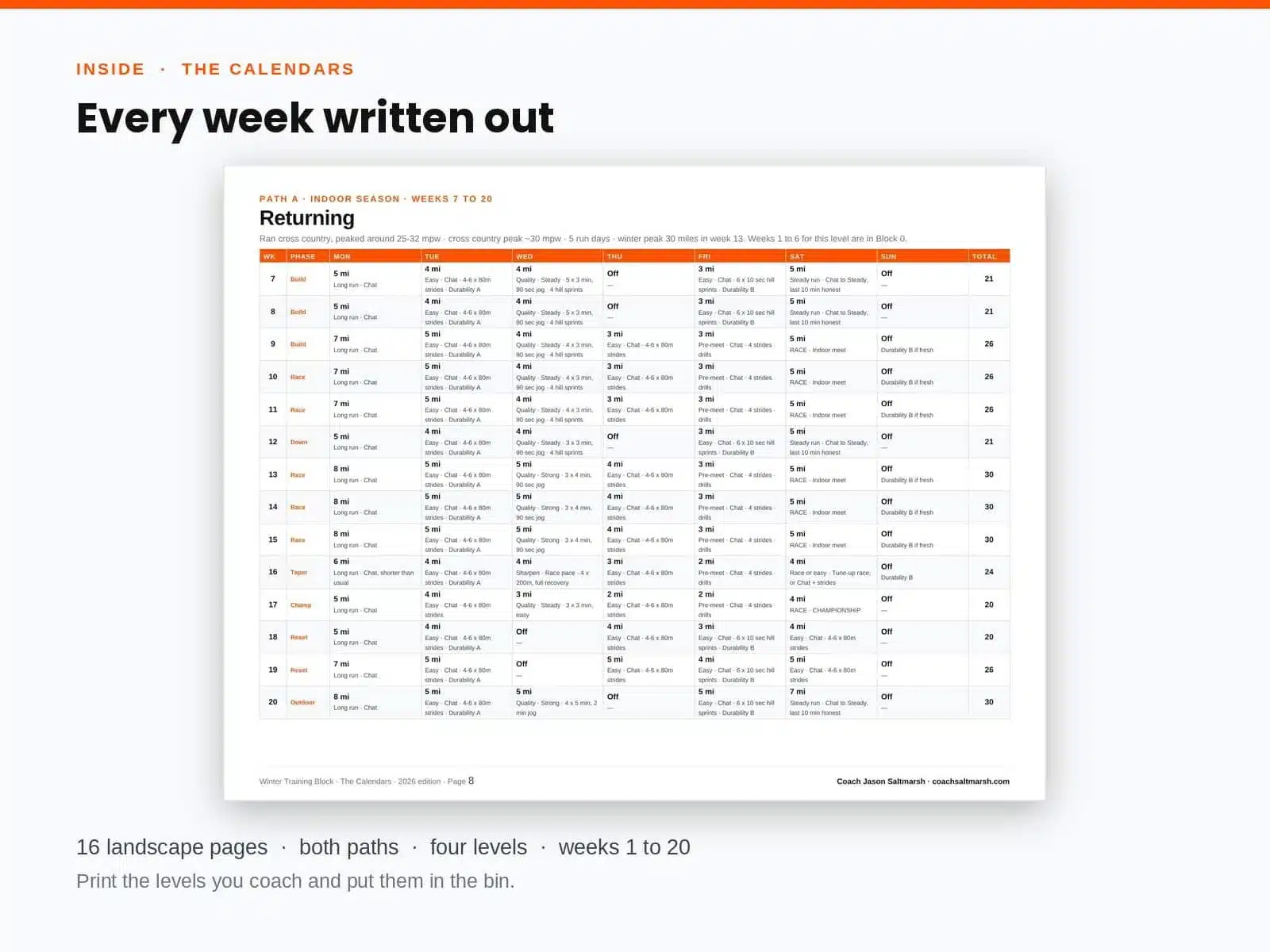
Six weeks lifted straight from the Calendars. Every level on both paths gets a page like this, from week 1 to week 20.
Path B, no indoor season
Sample winter training schedule: Returning, weeks 7 to 12
Swipe sideways to see the full week.
| WK | PHASE | MON | TUE | WED | THU | FRI | SAT | SUN | TOTAL |
|---|---|---|---|---|---|---|---|---|---|
| 7 | Base | 5 miLong run · Chat | 4 miEasy · Chat · 4 x 20 sec strides · Durability A | 4 miQuality · Steady · 5 x 3 min, 90 sec jog | Off | 3 miEasy · Chat · 6 x 10 sec hill sprints · Durability B | 5 miSteady run · Chat to Steady, last 10 min honest | Off | 21 |
| 8 | Base | 5 miLong run · Chat | 4 miEasy · Chat · 4 x 20 sec strides · Durability A | 4 miQuality · Steady · 5 x 3 min, 90 sec jog | Off | 3 miEasy · Chat · 6 x 10 sec hill sprints · Durability B | 5 miSteady run · Chat to Steady, last 10 min honest | Off | 21 |
| 9 | Base | 7 miLong run · Chat | 5 miEasy · Chat · 4 x 20 sec strides · Durability A | 5 miQuality · Strong · 4 x 6 min, 90 sec jog | Off | 4 miEasy · Chat · 6 x 10 sec hill sprints · Durability B | 6 miSteady run · Chat to Steady, last 10 min honest | Off | 26 |
| 10 | Base | 7 miLong run · Chat | 5 miEasy · Chat · 4 x 20 sec strides · Durability A | 5 miQuality · Strong · 4 x 6 min, 90 sec jog | Off | 4 miEasy · Chat · 6 x 10 sec hill sprints · Durability B | 6 miSteady run · Chat to Steady, last 10 min honest | Off | 26 |
| 11 | Base | 7 miLong run · Chat | 5 miEasy · Chat · 4 x 20 sec strides · Durability A | 5 miQuality · Strong · 4 x 6 min, 90 sec jog | Off | 4 miEasy · Chat · 6 x 10 sec hill sprints · Durability B | 6 miSteady run · Chat to Steady, last 10 min honest | Off | 26 |
| 12 | Down | 5 miLong run · Chat | 4 miEasy · Chat · 4 x 20 sec strides · Durability A | 4 miQuality · Steady · 3 x 5 min, 2 min jog | Off | 3 miEasy · Chat · 6 x 10 sec hill sprints · Durability B | 5 miSteady run · Time trial or fun run, optional | Off | 21 |
What’s in the winter training plan.
Five pieces, one winter: the plan, the reasoning behind it, and the paperwork that usually eats a coach’s November.
The Coach’s Guide
Every decision in the plan, explained before you have to make it.
- Which path you are on, and how to assign each athlete’s level
- The break: seven to ten days off, then two weeks easy, and why
- Durability A and B, with a no-weight-room version
- When a week falls apart, and the March handoff
The Calendars
Day by day, every level, both paths. Print the levels you coach and put them in the bin.
- Block 0, weeks 1 to 6, shared by both paths
- Weeks 7 to 20 for Path A and Path B, one page per level
- Volume overviews with every level’s peak week
- Strength, strides and hill sprints placed on the right days
The Winter Kit
The paperwork, done. Edit the orange text and send it.
- The Cold Policy for your athletic director
- The Break Letter to families
- Indoor Meet Day: warm-up clock and bin list
- The March Check-In, one per athlete
The Event Guide
Which race each athlete runs indoors, and how training changes once you decide.
- The open 400 speed reserve test
- Five athlete types and their events
- A selection calendar that runs with Path A
- Event tweaks, doubling, the 4×800
The Volume Planner
Enter each athlete’s cross country peak. Everything else calculates.
- Level assigned automatically, with an override
- Weeks 1 to 20 filled in for the path you pick
- A single-run cap for every athlete
- A team summary by path and level
If it feels too slow in week four, it is working.
Weeks 3 to 5, 6 to 8 and 9 to 11 each hold one volume. Week 12 is the first down week. After that, two-week steps with a down week every fourth.
When bone is loaded hard enough to matter, a micro-crack forms. The body spends roughly three weeks clearing the damaged tissue, and through that window the bone is more porous and less stiff. It is more vulnerable to load, not less.
So the bone is at its weakest two to three weeks after a jump in training, which is exactly when most winter plans schedule the next jump. This plan holds every step for three weeks through week nine, until the remodeling cycle has caught up with the loading cycle.
A seven-year study of Division I distance runners found tibial and femoral shaft injuries peaking in the early competitive phase of each season. That is the fingerprint of a bad winter build, and it shows up in March.
Assign the level by cross country peak.
Not grade level, not talent, not what they think they can handle. Talent is not durability.
| LEVEL | WHO | XC PEAK | DAYS |
|---|---|---|---|
| Returning | Ran cross country, peaked around 25 to 32 mpw | ~30 | 5 |
| Developing | Ran cross country, peaked around 33 to 42 mpw | ~40 | 6 |
| Veteran | Ran cross country, peaked around 43 to 55 mpw | ~50 | 6 |
| No Fall Season | Did not run cross country this fall | none | 4 |
Between two levels, go lower. Hurt this fall, go one level lower than the mileage says, however good they feel now.
Built for
- High school distance coaches whose cross country season just ended
- Programs with a competitive indoor season, and programs with none
- Mixed rosters: returners, first-timers and winter-sport athletes who arrive late
- Coaches who want the reasoning, not just the workouts
Not built for
- Middle school athletes. The volumes assume high school training ages
- An indoor season with a race every Saturday for everyone
- An athlete in pain right now. Localized bone pain means a physician first
- Coaches who want Wednesday to feel like a race
Set against the research, and 25 years of coaching.
Volume, progression and season structure are checked against these sources. They are cited in the Coach’s Guide, so you can show your athletic director where every number came from.
- Mujika and Padilla, Detraining, Part I. Sports Medicine, 2000
- Houmard et al., Reduced training maintains performance in distance runners. Int J Sports Med, 1990
- Meta-analysis of training cessation and VO2max, including the faster decline under age 20
- Chen et al., Two weeks of detraining in endurance athletes. Eur J Sport Sci, 2022
- Brenner, AAP Council on Sports Medicine and Fitness. Pediatrics, 2016
- Wolff et al., Seasonal patterns of bone stress injury in D1 distance runners. Am J Sports Med, 2025
- Bone stress injuries in adolescent athletes: a narrative review
- Running injury risk factors in high school and collegiate cross country: a systematic review
- Llanos-Lagos et al., Strength training methods and running economy. Sports Medicine, 2024
- Complex training and running economy in adolescent distance runners. Frontiers in Physiology, 2025
- NFHS, Guidelines for Competition in the Cold
- Running Periodization Part 4: High School and College. Track Coach
This is general coaching education, not medical advice.
The 30-day use-it-with-your-team guarantee
Run it with your actual roster. If it doesn’t save you hours in the first month, reply to your receipt email for a full refund. No forms, no questions.
Questions coaches ask about winter training.
Something else? Send me a note and I’ll answer it myself.
When should I buy it?
Before your last cross country race. Week 1 is the week after that race, and the Break Letter goes to families that same week. Anchoring to the race instead of a date is what makes the plan work in every state.
Only some of my athletes race indoors. Which path?
Run Path B for the team and move the three or four indoor athletes onto Path A individually. Do not split a whole program for four kids. The Volume Planner tracks who is on which path.
What about athletes who didn’t run cross country?
They start on the No Fall Season level: four run days, no break, and they never join the top of either path. An athlete arriving late from basketball or swimming starts at week 2 of that column, with the first six weeks compressed to four.
We don’t have a weight room.
Run the unloaded version. Every fast movement stays exactly as written and each heavy movement becomes its bodyweight version. You keep most of the benefit and none of the supervision risk.
What if the hill is under ice?
A treadmill at six to eight percent, stadium stairs, or a plowed and well-lit parking garage ramp. If nothing else exists, there is a flat substitute at Strong gear. Ice cancels workouts. Cold does not.
Does it connect to the Season Blueprint?
Yes. Same five gears and the same level logic, so an athlete who trains here in January recognizes every word of it in August.
Is it part of Coach OS?
No. The Winter Training Block is sold separately. Coach OS covers the five core tools for the fall season.
Can I share it with my assistant coaches?
Yes. Your purchase covers your coaching staff and team. Please don’t redistribute outside your program.
Is this medical advice?
No. It is general coaching education. Any athlete with pain localized to a bone, pain that sharpens during running, or pain that does not settle within two weeks should be evaluated by a physician before training continues.
The rest of the year.
Same five gears, same level logic, from the first summer run to the last winter week.
High school, June to November
22-Week XC Season Blueprint
Your whole fall season planned to the day, summer build through the championship taper. The athletes who finish this block start there.
High school, the fall season
Coach OS Bundle
The five core tools that run a cross country season: the Blueprint, fueling, the parent meeting, the training log and recruiting.
Week 1 is the week after your last race.
Have the Break Letter out that week and the calendars printed before they come back. The athletes who run well in May are the ones who were bored and a little restless in November.