

Free · Complete 12-Week Schedule · Grades 5 to 8
Middle School Cross Country Training Plan
The complete Builder schedule, free. Twelve weeks, day by day, foundation through championship. Print it, post it, run it.
Get the free PDF Three printable pages. Free. Arrives by email in about a minute.
Coach Jason Saltmarsh · USATF Level 2 Endurance · 25 years coaching, 31 state champions
What a middle school cross country training plan should look like
A middle school cross country training plan should run about twelve weeks, prescribe volume in minutes rather than miles, keep roughly ninety percent of running at conversational effort, and allow no more than one hard effort per week. This schedule does all four.
- Length: 12 weeks. Four-week foundation, eight-week season.
- Volume: caps at 20 miles per week, about 190 minutes.
- Unit: minutes, not miles.
- Hard days: one per week. On meet weeks the race is it.
- Intervals: none. Not one VO2max session in twelve weeks.
- Sundays: off. Every week, no exceptions.
- Meets: six, on Wednesdays, starting week 5.
This page is the schedule itself. If you want the reasoning behind these numbers, the practice structure, the injury list, and how to run middle school and high school on one field, that is all in the guide: how to coach middle school cross country. If your season starts in the next two weeks and you have never done this before, start with your first week coaching middle school cross country instead, then come back here.
Jump to
Which level is this?
Level is set by training age, meaning continuous months of organized running. Not grade, not talent. A fast fifth grader is a first-year runner. So is an eighth grader who has never trained. The guide has the full level table and the reasoning behind the caps.
Explorer · 15 mpw
First season, or coming back from a layoff. Four to five run days. Long run caps at 45 min or 4 miles.
Builder · 20 mpw
One full season completed and healthy since. Typically sixth and seventh grade. Five run days. Long run caps at 50 min or 5 miles.
Bridge · 25 mpw
Two or more seasons, healthy, handled Builder volume well. Typically seventh and eighth grade. Long run caps at 60 min or 5.5 miles.
If your team is all first-year runners, run the Builder structure below and cut every listed time by about twenty-five percent. That is not the same as the Explorer doses, but it will not hurt anybody.
The five gears
You cannot read the schedule without these. Teach them in week one and quiz the team all season. They are the same five gears used in my high school plan with kid-facing names, so a graduate walks into a varsity practice already knowing what threshold feels like in their legs.
Scroll table sideways →
| Gear | Kid name | What it is | Talk test | High school name |
|---|---|---|---|---|
| 1 | Chat | Almost everything we run. Recovery and aerobic development. | Full sentences, easily. | Easy |
| 2 | Steady | Comfortably fast. | Full sentences, with rhythm. | LT1 steady |
| 3 | Strong | Comfortably hard. | Three or four words. | LT2 threshold |
| 4 | Race | Only on race day. | A word or two. | VO2max |
| 5 | Zoom | 8 to 10 second hill sprints and 15 to 20 second strides. Full recovery. | Too short to talk. | Hills and strides |
Gear 4 is a locked door. Tell the team that directly. There is a gear we do not train in middle school and we only visit it on race day. Kids love a locked door, and it removes the most common middle school coaching error, which is turning Wednesday into a race because the kids were fired up.
How to read the schedule
Everything is minutes. Mile equivalents assume roughly nine and a half minutes per mile. Adjust the equivalents for your team. Do not adjust the minutes.
Adjust any single day plus or minus five minutes freely. Adjust the week only downward.
Minutes are running only. Every practice opens with the seventeen-minute Athlete Base warm-up and closes with the cool-down, and neither is counted below. Both are laid out in the guide.
Durability A and B are the two bodyweight strength sessions, fifteen to twenty minutes, after the run, never the day before a meet.
Pre-meet days and meet days follow the same shape every time. The warm-up clock, the entries, and what to say at the finish line are in the meet day section of the guide.
Weeks 1 to 4: foundation
Builder level. 20 miles per week cap, about 190 minutes. Five run days. Long run caps at 50 minutes or 5 miles, whichever arrives first. Every session is Chat pace except the Steady blocks in week 3. Hill sprints begin week 3.
Scroll table sideways →
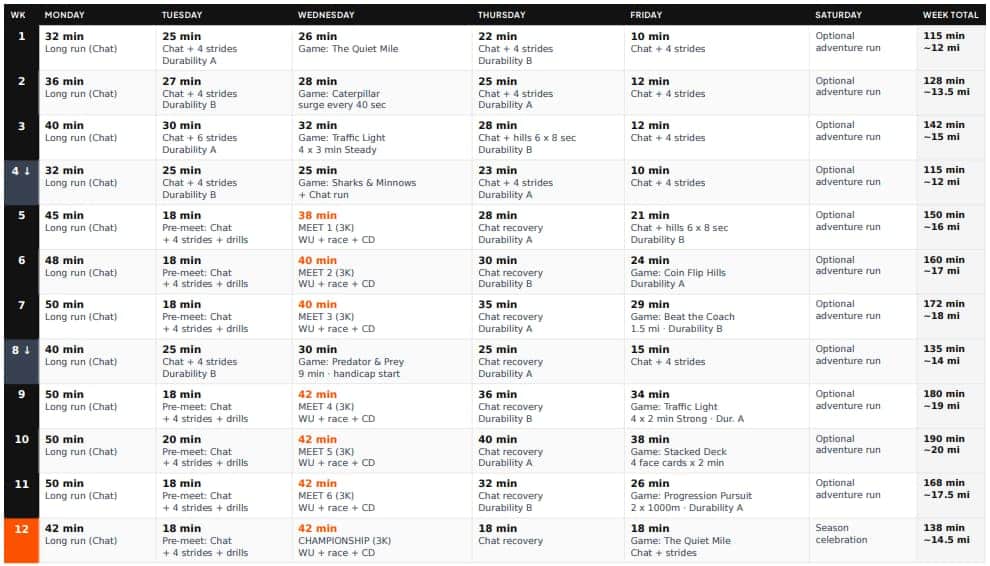
| Wk | Monday | Tuesday | Wednesday | Thursday | Friday | Saturday | Total |
|---|---|---|---|---|---|---|---|
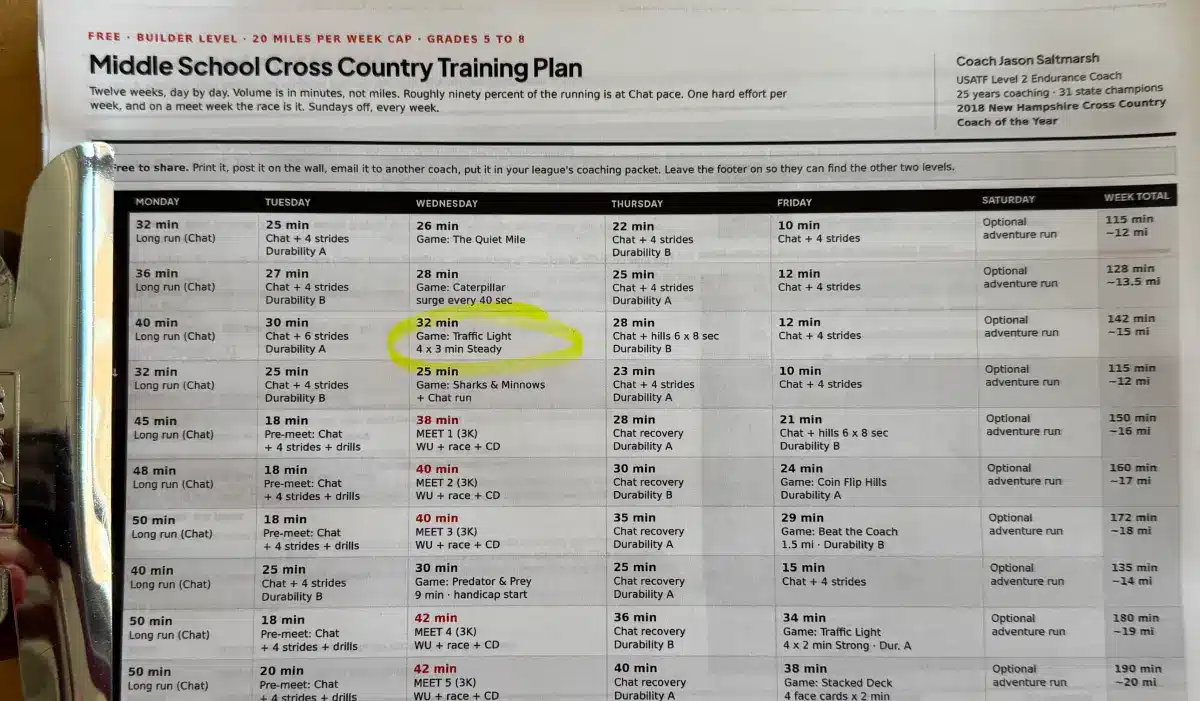
| 1 | 32 minLong run (Chat) | 25 minChat + 4 strides Durability A | 26 minGame: The Quiet Mile | 22 minChat + 4 strides Durability B | 10 minChat + 4 strides | Optional adventure run | 115 min ~12 mi |
| 2 | 36 minLong run (Chat) | 27 minChat + 4 strides Durability B | 28 minGame: Caterpillar surge every 40 sec | 25 minChat + 4 strides Durability A | 12 minChat + 4 strides | Optional adventure run | 128 min ~13.5 mi |
| 3 | 40 minLong run (Chat) | 30 minChat + 6 strides Durability A | 32 minGame: Traffic Light 4 x 3 min Steady | 28 minChat + hills 6 x 8 sec Durability B | 12 minChat + 4 strides | Optional adventure run | 142 min ~15 mi |
| 4 ↓ | 32 minLong run (Chat) | 25 minChat + 4 strides Durability B | 25 minGame: Sharks & Minnows + Chat run | 23 minChat + 4 strides Durability A | 10 minChat + 4 strides | Optional adventure run | 115 min ~12 mi |
Foundation focus: re-learn the gears, rebuild the base, no Strong work at all. Builders often arrive from a summer of nothing. Treat weeks 1 and 2 as if they did.
Weeks 5 to 12: season
Meets are on Wednesday. On a meet week the race is the only hard effort. On non-meet weeks the Friday game carries the week’s quality. Strong work returns in week 9, not before. The Monday long run holds at 50 minutes from week 7, so the peak weeks add their minutes to Thursday and Friday instead.
Scroll table sideways →
| Wk | Monday | Tuesday | Wednesday | Thursday | Friday | Saturday | Total |
|---|---|---|---|---|---|---|---|
| 5 | 45 minLong run (Chat) | 18 minPre-meet: Chat + 4 strides + drills | 38 minMEET 1 (3K) WU + race + CD | 28 minChat recovery Durability A | 21 minChat + hills 6 x 8 sec Durability B | Optional adventure run | 150 min ~16 mi |
| 6 | 48 minLong run (Chat) | 18 minPre-meet: Chat + 4 strides + drills | 40 minMEET 2 (3K) WU + race + CD | 30 minChat recovery Durability B | 24 minGame: Coin Flip Hills Durability A | Optional adventure run | 160 min ~17 mi |
| 7 | 50 minLong run (Chat) | 18 minPre-meet: Chat + 4 strides + drills | 40 minMEET 3 (3K) WU + race + CD | 35 minChat recovery Durability A | 29 minGame: Beat the Coach 1.5 mi · Durability B | Optional adventure run | 172 min ~18 mi |
| 8 ↓ | 40 minLong run (Chat) | 25 minChat + 4 strides Durability B | 30 minGame: Predator & Prey 9 min · handicap start | 25 minChat recovery Durability A | 15 minChat + 4 strides | Optional adventure run | 135 min ~14 mi |
| 9 | 50 minLong run (Chat) | 18 minPre-meet: Chat + 4 strides + drills | 42 minMEET 4 (3K) WU + race + CD | 36 minChat recovery Durability B | 34 minGame: Traffic Light 4 x 2 min Strong · Dur. A | Optional adventure run | 180 min ~19 mi |
| 10 | 50 minLong run (Chat) | 20 minPre-meet: Chat + 4 strides + drills | 42 minMEET 5 (3K) WU + race + CD | 40 minChat recovery Durability A | 38 minGame: Stacked Deck 4 face cards x 2 min · Dur. B | Optional adventure run | 190 min ~20 mi |
| 11 | 50 minLong run (Chat) | 18 minPre-meet: Chat + 4 strides + drills | 42 minMEET 6 (3K) WU + race + CD | 32 minChat recovery Durability B | 26 minGame: Progression Pursuit 2 x 1000m · Durability A | Optional adventure run | 168 min ~17.5 mi |
| 12 | 42 minLong run (Chat) | 18 minPre-meet: Chat + 4 strides + drills | 42 minCHAMPIONSHIP (3K) | 18 minChat recovery | 18 minGame: The Quiet Mile Chat + strides | Season celebration | 138 min ~14.5 mi |
Season focus: one hard effort per week. Peak is week 10, at the 20 mile cap. Volume falls in weeks 11 and 12. Weeks 4 and 8 are down weeks and they are not optional.
Weekly volume at a glance
| Week | Minutes | Approx. miles | What is happening |
|---|---|---|---|
| 1 | 115 | ~12 | All Chat pace. Learn the gears, learn the warm-up, learn names. |
| 2 | 128 | ~13.5 | All Chat pace plus strides. First Gear Check whistles. |
| 3 | 142 | ~15 | Add hill sprints. First Steady blocks inside a game. |
| 4 ↓ | 115 | ~12 | Down week. Keep strides and games. |
| 5 | 150 | ~16 | Meet 1. The race is the only hard effort this week. |
| 6 | 160 | ~17 | Meet 2. |
| 7 | 172 | ~18 | Meet 3. |
| 8 ↓ | 135 | ~14 | Down week. Predator and Prey on Wednesday. |
| 9 | 180 | ~19 | Meet 4. First Strong touches return. |
| 10 | 190 | ~20 | Meet 5. At the cap. This is the peak. |
| 11 | 168 | ~17.5 | Meet 6. Volume begins falling. |
| 12 | 138 | ~14.5 | Championship. Short, crisp, confident. |
If your season is shorter than twelve weeks
Most middle school seasons run eight to ten weeks. Use weeks 1 to 4 as a summer or preseason block if you have one. If you do not, start at week 3 and run weeks 3 through 12 as a ten-week season. To compress further, cut weeks 6 and 7. Never cut a down week.
The Saturday column
Saturday is optional and it is not counted in the weekly totals. It is a family run, a trail run, a run with the dog. Athletes who do it get twenty to thirty minutes of free aerobic development and a good association with running on the weekend. Athletes who skip it lose nothing. Never assign it, never track it, and never mention in front of the team who did it.
The games in this schedule
Every quality session above is delivered as a game, with the coach setting the dose before the athletes see the wrapper. The doses below are Builder. Full setup for each one, plus the specific way each falls apart, is in 12 middle school cross country workouts disguised as games.
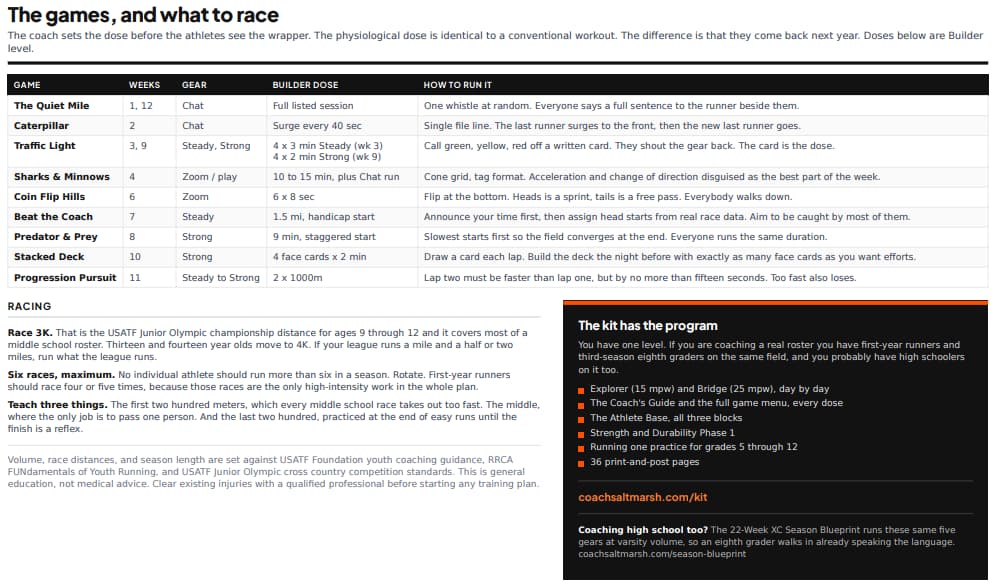
| Game | Weeks | Gear | Builder dose |
|---|---|---|---|
| The Quiet Mile | 1, 12 | Chat | Full listed session |
| Caterpillar | 2 | Chat | Full session, surge every 40 sec |
| Traffic Light | 3, 9 | Steady, then Strong | 4 x 3 min Steady (wk 3) · 4 x 2 min Strong (wk 9) |
| Sharks & Minnows | 4 | Zoom / play | 10 to 15 min, plus Chat run |
| Coin Flip Hills | 6 | Zoom | 6 x 8 sec |
| Beat the Coach | 7 | Steady | 1.5 mi, handicap start |
| Predator & Prey | 8 | Strong | 9 min, staggered start |
| Stacked Deck | 10 | Strong | 4 face cards x 2 min |
| Progression Pursuit | 11 | Steady to Strong | 2 x 1000m, second lap faster by under 15 sec |
Race distance in this plan
The schedule races 3K, which is the USATF Junior Olympic championship distance for ages 9 through 12 and covers most of a middle school roster. Thirteen and fourteen year olds move to 4K. If your league races 1.5 miles or 2 miles, run what the league runs.
Six meets across the twelve weeks, and no individual athlete should run more than six in a season. Rotate. First-year runners should race four to five times. The full distance table by age division, how often to race, and how to run meet day itself are in the coaching guide. If a parent wants to argue about mileage, send them how many miles should a 12-year-old run.
Get the plan (free PDF)
All twelve weeks on one landscape sheet for the locker room wall, plus the five gears, the ten rules, and every game with its dose and setup. Three pages, free. Enter your email and it arrives in about a minute. Print it, post it on the wall, and hand a copy to your assistant coach.
Middle School Cross Country Training Plan, 12 Weeks
Page 1 is the full day-by-day grid. Page 2 is the gears, the rules, and the weekly ramp. Page 3 is the game menu and what to race. Built for a clipboard.
Send me the 12-week plan
Confirm your email and the PDF is in your inbox a minute later.
One email with the PDF, then the occasional coaching note. Unsubscribe in one click, any time. Once it’s yours, it’s free to share with another coach.
You have one level. The kit has the program.
The schedule above is the Builder level, complete and free. If you are coaching a real roster you have first-year runners and experienced eighth graders on the same field, and you probably have high schoolers on it too.
- All three levels, twelve weeks, day by day. Explorer at 15 mpw and Bridge at 25 mpw.
- The Coach’s Guide. Level assignment, the full game menu with every dose, the points economy.
- The Athlete Base, all three blocks. Movement series, sprint skills, and speed work, printed and cued.
- Strength and Durability Phase 1, the full bodyweight program with weekly progressions.
- Running one practice for grades 5 through 12. The combined grid, staffing by coach count, and Big and Little pairings.
- The gear chart anchored to a 2-mile time, plus the entry table into the 22-Week Season Blueprint.
- 36 print-and-post PDF pages for the locker room and the clipboard.
Instant download. One-time. Covers your whole staff. 30-day guarantee.
Questions about this schedule
How long should a middle school cross country season be?
Twelve weeks, split into a four-week foundation block and an eight-week competitive season, then two weeks completely off. USATF Foundation guidance and RRCA youth running guidelines both describe an organized program of roughly two to three months at this age.
What if my season is only eight or ten weeks?
Start at week 3 and run weeks 3 through 12 for a ten-week season. For eight weeks, also cut weeks 6 and 7. Never cut a down week, which means weeks 4 and 8 stay in no matter how short you go.
Can I use this schedule for fifth graders?
Fifth graders belong at the Explorer level, which caps at 15 miles per week. If you only have this page, run the structure above and cut every listed time by about a quarter. Race them least and score improvement rather than place.
How many meets are in this plan?
Six, on Wednesdays, from week 5 through week 11, with the championship in week 12. No individual athlete should run more than six races in a season, so rotate athletes out rather than racing everyone every week.
Is there a printable version?
Yes. Get the free three-page PDF by email. It is the Builder twelve weeks on three landscape sheets, built for a clipboard and a locker room wall. The full kit includes 36 print-and-post pages covering all three levels.
Can I share this plan with other coaches?
Yes. Print it, email it, hand it to your assistant, put it in your league’s coaching packet. The only thing I ask is that you leave the footer on it so a coach who wants the other two levels knows where to find them.
Keep reading
- How to coach middle school cross country. The reasoning behind every number on this page. Practice structure, the Athlete Base, meet day, the injuries you will actually see, and coaching grades 5 through 12 on one field.
- Your first week coaching middle school cross country. What to do before day one, the first five practices, and the questions parents will ask in the parking lot.
- 12 middle school cross country workouts disguised as games. Every game with its setup, its dose, and how it falls apart.
- How many miles should a 12-year-old run? The parent-facing version, with what the AAP, NATA, and RRCA actually publish.
- How to start a middle school cross country program. Approvals, state rules, budget, and where a first roster comes from.
- The 22-Week Season Blueprint. Where these athletes go as freshmen, in the same language.
Volume, race distances, and season length in this schedule are set against USATF Foundation youth coaching guidance, RRCA FUNdamentals of Youth Running, and USATF Junior Olympic cross country competition standards. This page is general education, not medical advice. Clear existing injuries with a qualified professional before starting any training plan.