


Free · Complete 12-Week Season · Grades 9 to 12
High School Cross Country Training Plan
The complete Rookie season, free. Twelve weeks, day by day, from the first race to the state meet. Print it, post it, run it.
Get the free PDF Two printable pages. Free. Arrives by email in about a minute.
Coach Jason Saltmarsh · USATF Level 2 Endurance · 25 years coaching, 31 state champions
What a high school cross country training plan should look like
A high school cross country training plan should run a twelve-week season on top of a summer base, schedule two hard efforts a week with the race counting as one, put a down week right after the first races, hold race-pace work until the season is under way, and taper for three weeks into the championships. This schedule does all five.
- Length: 12-week season. These are weeks 11 to 22 of the 22-Week XC Season Blueprint.
- Volume: Rookie level, capped at 30 miles per week.
- Week shape: long run Monday, workout Wednesday, race Saturday, Sunday off.
- Hard days: two per week, and the race is one of them.
- Workouts: threshold first. VO2 work at 5K race pace starts in week 5.
- Down week: week 4, right after the first two races.
- Races: six regular-season meets, then three championship weekends.
- Taper: weeks 10 to 12, at 23, 20 and 17 miles.
This page is the schedule itself. If you want the reasoning behind it, the four training phases, and how the summer base sets up the season, that is all in the guide: high school cross country training. If you just inherited a team, start with how to build a cross country team from scratch, then come back here.
Jump to
Which level is this?
Level is set by running age, meaning how long an athlete has trained consistently. Not class year, not talent. A sophomore who ran club cross country all year might be ready for more. A junior who played football last fall is a Rookie. Same session types, same days, different doses, so the whole roster warms up together and trains on one system.
Rookie · 30 mpw
Newer runners, typically in a first or second season. The schedule below, every day of it.
Returner · 40 mpw
Back for another season with a healthy summer base behind them.
Veteran · 50 mpw
Your most experienced runners, with multiple healthy seasons and the mileage to show for it.
If your top runners have years of training behind them, this level is too light for them. Their versions of these same twelve weeks are in the 22-Week XC Season Blueprint.
The five gears
You cannot read the schedule without these. Teach them in the first week and use the same words all season. Get each athlete’s paces from one recent race with the free LT1 and LT2 training pace calculator.
Scroll table sideways →
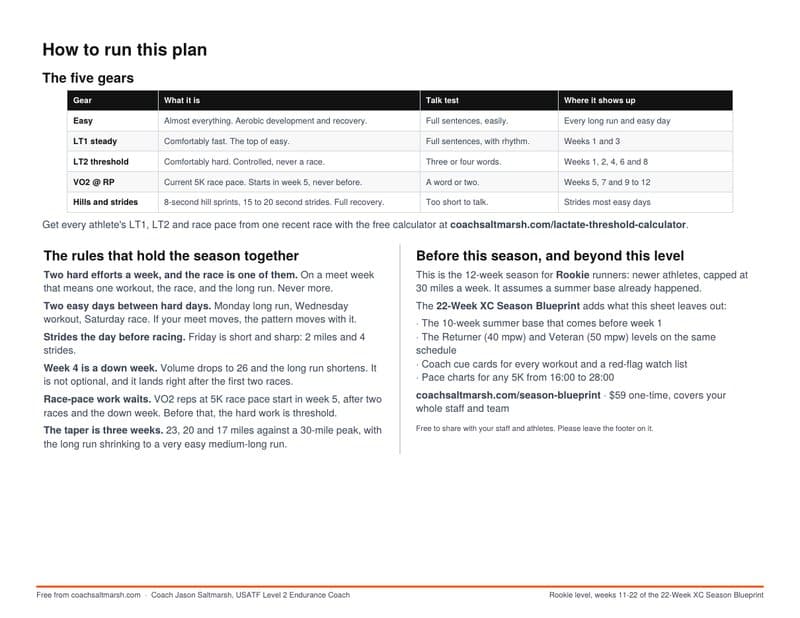
| Gear | Name | What it is | Talk test | Where it shows up |
|---|---|---|---|---|
| 1 | Easy | Almost everything. Aerobic development and recovery. | Full sentences, easily. | Every long run and easy day |
| 2 | LT1 steady | Comfortably fast. The top of easy. | Full sentences, with rhythm. | Weeks 1 and 3 |
| 3 | LT2 threshold | Comfortably hard. Controlled, never a race. | Three or four words. | Weeks 1, 2, 4, 6 and 8 |
| 4 | VO2 @ RP | Current 5K race pace. Starts in week 5, never before. | A word or two. | Weeks 5, 7 and 9 to 12 |
| 5 | Hills and strides | 8-second hill sprints and 15 to 20 second strides. Full recovery. | Too short to talk. | Strides on most easy days |
How to read the schedule
Everything is miles per day. Workout and race days include the warm-up and cool-down in the total.
RP is current 5K race pace. What the athlete can run for 5K today, not their goal for November.
Two hard efforts a week, and the race is one of them. On a meet week that means one workout, the race, and the long run. Never more.
Two easy days between hard days. If a meet moves off Saturday, the pattern moves with it, with strides the day before racing.
Green is a down week. Gold is a championship weekend. If your championships fall on different weeks, move the labels, not the logic.
Weeks 1 to 4: into the season
Rookie level. 30 miles per week cap. Week 1 is a full training week before anybody races. Threshold carries the hard work. The first two races land in weeks 2 and 3, and week 4 pulls volume back to 26 miles right after them.
Scroll table sideways →
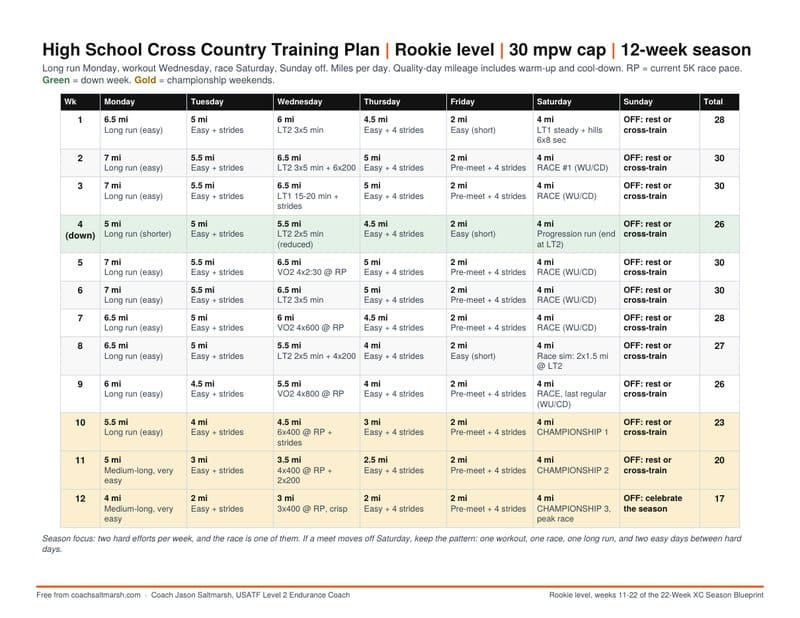
| Wk | Monday | Tuesday | Wednesday | Thursday | Friday | Saturday | Sunday | Total |
|---|---|---|---|---|---|---|---|---|
| 1 | 6.5 miLong run (easy) | 5 miEasy + strides | 6 miLT2 3×5 min | 4.5 miEasy + 4 strides | 2 miEasy (short) | 4 miLT1 steady + hills 6×8 sec | Off rest or cross-train | 28 mi |
| 2 | 7 miLong run (easy) | 5.5 miEasy + strides | 6.5 miLT2 3×5 min + 6×200 | 5 miEasy + 4 strides | 2 miPre-meet + 4 strides | 4 miRACE #1 (WU/CD) | Off rest or cross-train | 30 mi |
| 3 | 7 miLong run (easy) | 5.5 miEasy + strides | 6.5 miLT1 15-20 min + strides | 5 miEasy + 4 strides | 2 miPre-meet + 4 strides | 4 miRACE (WU/CD) | Off rest or cross-train | 30 mi |
| 4 ↓ | 5 miLong run (shorter) | 5 miEasy + strides | 5.5 miLT2 2×5 min (reduced) | 4.5 miEasy + 4 strides | 2 miEasy (short) | 4 miProgression run (end at LT2) | Off rest or cross-train | 26 mi |
Focus: threshold before speed. LT2 on Wednesdays, LT1 in week 3, and a progression run that finishes at LT2 instead of a race in the down week.
Weeks 5 to 9: racing season
Race-pace work starts in week 5, after two races and the down week, and alternates with threshold on Wednesdays. Week 8 has no meet, so Saturday becomes a race simulation at LT2. Week 9 is the last regular-season race.
Scroll table sideways →
| Wk | Monday | Tuesday | Wednesday | Thursday | Friday | Saturday | Sunday | Total |
|---|---|---|---|---|---|---|---|---|
| 5 | 7 miLong run (easy) | 5.5 miEasy + strides | 6.5 miVO2 4×2:30 @ RP | 5 miEasy + 4 strides | 2 miPre-meet + 4 strides | 4 miRACE (WU/CD) | Off rest or cross-train | 30 mi |
| 6 | 7 miLong run (easy) | 5.5 miEasy + strides | 6.5 miLT2 3×5 min | 5 miEasy + 4 strides | 2 miPre-meet + 4 strides | 4 miRACE (WU/CD) | Off rest or cross-train | 30 mi |
| 7 | 6.5 miLong run (easy) | 5 miEasy + strides | 6 miVO2 4×600 @ RP | 4.5 miEasy + 4 strides | 2 miPre-meet + 4 strides | 4 miRACE (WU/CD) | Off rest or cross-train | 28 mi |
| 8 | 6.5 miLong run (easy) | 5 miEasy + strides | 5.5 miLT2 2×5 min + 4×200 | 4 miEasy + 4 strides | 2 miEasy (short) | 4 miRace sim: 2×1.5 mi @ LT2 | Off rest or cross-train | 27 mi |
| 9 | 6 miLong run (easy) | 4.5 miEasy + strides | 5.5 miVO2 4×800 @ RP | 4 miEasy + 4 strides | 2 miPre-meet + 4 strides | 4 miRACE, last regular (WU/CD) | Off rest or cross-train | 26 mi |
Focus: one workout, one race, one long run. Volume holds at 26 to 30 miles while the Wednesday sessions alternate between VO2 at race pace and LT2.
Weeks 10 to 12: the championship taper
Three championship weekends, three weeks of taper. Volume drops to 23, then 20, then 17 miles. Workouts shrink to short reps at race pace, and the long run becomes a very easy medium-long run. Fresh legs, sharp Wednesdays, nothing new.
Scroll table sideways →
| Wk | Monday | Tuesday | Wednesday | Thursday | Friday | Saturday | Sunday | Total |
|---|---|---|---|---|---|---|---|---|
| 10 | 5.5 miLong run (easy) | 4 miEasy + strides | 4.5 mi6×400 @ RP + strides | 3 miEasy + 4 strides | 2 miPre-meet + 4 strides | 4 miCHAMPIONSHIP 1 | Off rest or cross-train | 23 mi |
| 11 | 5 miMedium-long, very easy | 3 miEasy + strides | 3.5 mi4×400 @ RP + 2×200 | 2.5 miEasy + 4 strides | 2 miPre-meet + 4 strides | 4 miCHAMPIONSHIP 2 | Off rest or cross-train | 20 mi |
| 12 | 4 miMedium-long, very easy | 2 miEasy + strides | 3 mi3×400 @ RP, crisp | 2 miEasy + 4 strides | 2 miPre-meet + 4 strides | 4 miCHAMPIONSHIP 3, peak race | Off celebrate the season | 17 mi |
Focus: arrive fresh. Nothing gets added in the last three weeks. If a race goes badly, the answer is rest, not an extra workout.
Weekly volume at a glance
| Week | Miles | What is happening |
|---|---|---|
| 1 | 28 | Full training week before any racing. LT2 Wednesday, LT1 and hills Saturday. |
| 2 | 30 | First race. LT2 plus 200s on Wednesday. |
| 3 | 30 | Second race. LT1 Wednesday. |
| 4 ↓ | 26 | Down week. Progression run instead of a race. |
| 5 | 30 | Race-pace work begins: VO2 4 x 2:30. |
| 6 | 30 | Back to LT2 on Wednesday. |
| 7 | 28 | VO2 4 x 600. |
| 8 | 27 | No meet. Race simulation at LT2 on Saturday. |
| 9 | 26 | Last regular-season race. VO2 4 x 800. |
| 10 | 23 | Championship 1. Taper begins. |
| 11 | 20 | Championship 2. |
| 12 | 17 | Championship 3. Peak race. |
If your season looks different
Fewer weeks, or championships on other dates? Keep the invariants and slide everything else: a full training week before the first race, a down week right after the first races, race-pace work only after that, and a three-week taper into your championships.
Before week 1: the summer
This schedule assumes a summer base already happened. Week 1 opens with a 6.5-mile long run and a threshold session, which is too much for an athlete who has not run since June. In the Blueprint, the ten weeks before this page are a Lydiard-style summer build, written by level.
If you are building the summer yourself, start with the free XC summer training plan generator, the safe summer base mileage guide, and how to safely increase mileage. The rule that matters most: no single run more than 10% past the longest run of the previous 30 days.
Get the plan (free PDF)
All twelve weeks on one landscape sheet for the team board, plus the five gears, the rules that hold the season together, and what the full Blueprint adds. Two pages, free. Enter your email and it arrives in about a minute. Print it, post it, and hand a copy to your assistant coach.
High School Cross Country Training Plan, 12 Weeks
Page 1 is the full day-by-day grid. Page 2 is the gears, the season rules, and the taper. Built for a clipboard and a locker room wall.
Send me the 12-week plan
Confirm your email and the PDF is in your inbox a minute later.
One email with the PDF, then the occasional coaching note. Unsubscribe in one click, any time. Once it’s yours, it’s free to share with your staff and athletes.
You have one level and one season. The Blueprint has the program.
The schedule above is the Rookie season, complete and free. A real roster has first-year runners, returners and varsity veterans on the same field, and the season starts in June, not at the first meet.
- The 10-week summer base that comes before week 1, written by level.
- All three levels, Rookie, Returner and Veteran, on one team schedule. 154 days planned.
- Coach cue cards for every workout: what to say, what to look for.
- The red-flag watch list. Bone pain, RED-S, low iron, overtraining, and exactly what to do.
- Pace charts for any 5K from 16:00 to 28:00. The math is done.
- Editable Word doc plus print-ready schedules, with free lifetime updates.
Get the Blueprint for $59 See what’s inside
Instant download. One-time. Covers your whole staff and team. 30-day money-back guarantee.
Questions about this schedule
How many miles a week should a high school cross country runner run?
It depends on running age, not class year. This Rookie level peaks at 30 miles a week. In the Blueprint, Returners cap at 40 and Veterans at 50. Athletes reach those numbers through the summer base, not in August. The full year-by-year framework is in progressive mileage guidelines for high school runners.
How long should a high school cross country season be?
About twelve weeks of racing season on top of roughly ten weeks of summer base. This page is the twelve-week season. The Blueprint is all twenty-two weeks.
How many hard workouts a week should high school cross country runners do?
Two, and the race counts as one. On a meet week that is one workout, the race, and the long run, with two easy days between hard days.
When should VO2max workouts start?
In week 5 of this plan, after two races and a down week. Before that, the hard work is LT1 and LT2 threshold. Race-pace reps on top of an unfinished aerobic base are how a team peaks in September.
What if our meets are not on Saturday?
Keep the pattern and move the days: one workout, one race, one long run, two easy days between hard days, and strides the day before racing.
Is there a printable version?
Yes. Get the free two-page PDF by email. Page 1 is the twelve-week grid, built for a clipboard and a locker room wall. The Blueprint includes print-ready pages for all three levels and all twenty-two weeks.
Can I share this plan with my athletes and assistant coaches?
Yes. Print it, post it, email it to your staff. The only thing I ask is that you leave the footer on it so a coach who wants the other two levels knows where to find them.
Keep reading
- High school cross country training. The guide behind this schedule: the four phases, the summer base, and how championship programs are built.
- High school XC periodization. Why the season is shaped the way it is, from base to taper.
- High school XC practice structure. What the two hours around each of these runs should look like.
- The 3 XC workouts that build a championship engine. The Wednesday sessions, explained.
- The Pack Attack workout. A team-building Saturday for the weeks without a meet.
- Middle school cross country training plan. Coaching the feeder program too? The same system, in minutes, for grades 5 to 8.
This schedule is the Rookie level of the 22-Week XC Season Blueprint, weeks 11 to 22. This page is general education, not medical advice. Clear existing injuries with a qualified professional before starting any training plan.