
Jackson Spencer Training: The Undefeated Blueprint (2026)
Jackson Spencer Training: The Undefeated Blueprint (2026)
How a Utah Senior Went Undefeated Across Nine Races, Swept Both National Titles, and What Doug Soles’s System Teaches Coaches Developing Front-Runners
By Coach Saltmarsh, USATF Level 2 Endurance Coach with 25 years of championship experience.
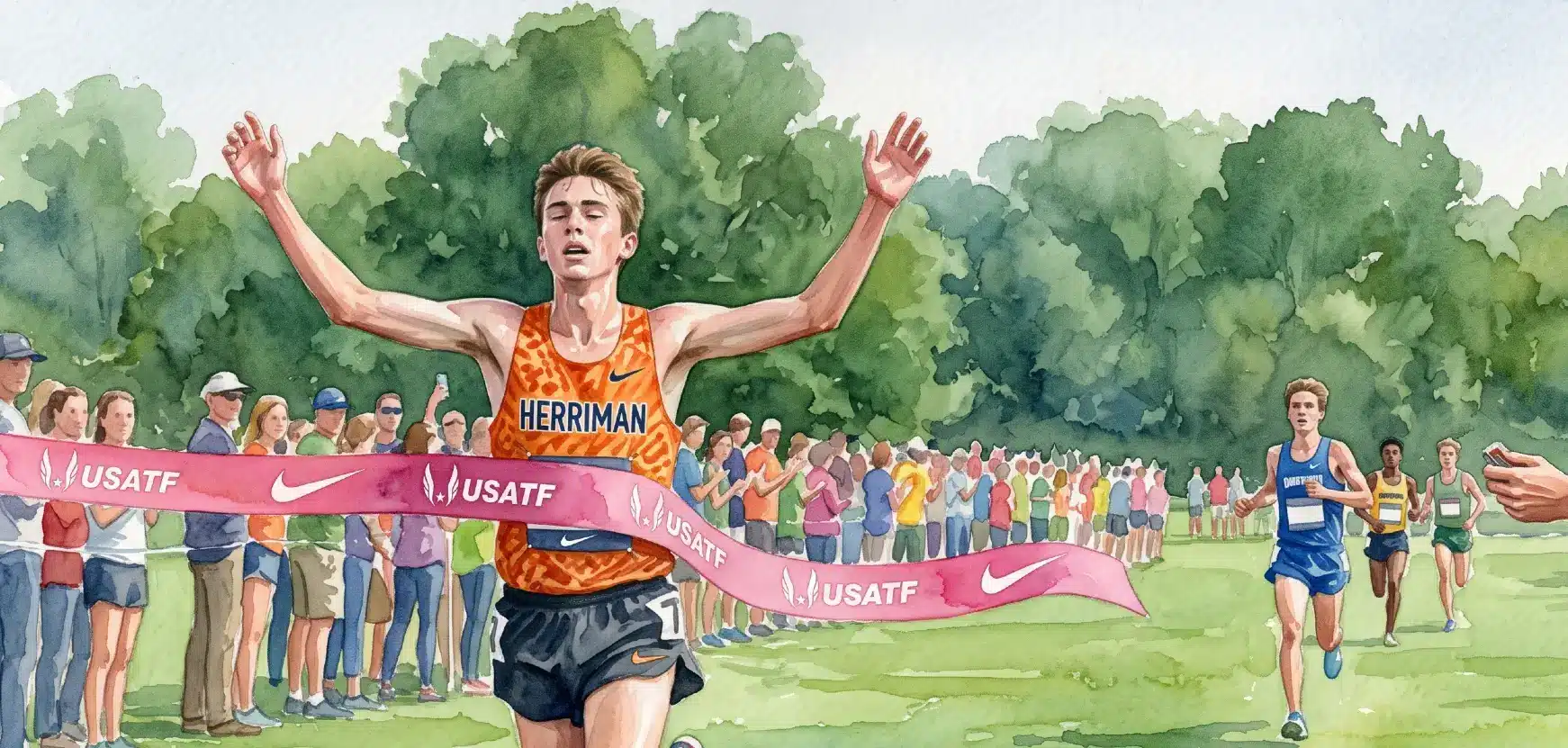
On October 29, 2025, at Sugar House Park in Salt Lake City, Jackson Spencer did something the Utah state cross country meet had never seen. He broke from the gun, ran alone for three miles, and crossed the line in 14:29.78, the fastest time in the history of the Utah state championships, erasing a record held by Casey Clinger. His margin of victory was 47.7 seconds.
That race was not the outlier. It was the pattern.
Spencer, a senior at Herriman High School, ran nine races in the fall of 2025 and won every one of them. He won the Woodbridge Classic, the largest cross country meet in the country, running 13:42.1 for three miles and beating the next runner by 18 seconds. He won the Clovis Invitational in 14:16.9, taking seven seconds off the Woodward Park high school course record that German Fernandez had held since 2007. A record that had survived Nico Young’s 14:26 in 2019. Then he won both Nike Cross Nationals and the Brooks XC Championships in the same December. A national title double, a feat no male high school runner had pulled off in years.
But here is the part worth studying. Spencer’s rise was not built on the highest mileage or the most grinding summer in the country. It was built on a periodization system that treats fitness as something you spend deliberately, pushing hard right before the biggest races, then pulling back to absorb the work. His coach, Doug Soles, is the only coach in U.S. history to win an NXN title at two different schools. The blueprint is unusually visible, because Spencer’s own training data was published, and because he talked openly about how the plan was constructed.
Let’s break it down.
If this reminds you of the Cooper Lutkenhaus 30-mile blueprint or the Cam Myers aerobic-first system, you’re seeing the same underlying truth from a different angle: intelligent periodization and hard-earned fitness beat raw volume.
Jackson Spencer: Progression & Track Stats
Jackson Spencer was born November 29, 2007, in Provo, Utah. He first attended Syracuse High School before transferring to Herriman, joining Doug Soles’s program as a junior. A move that, in Spencer’s own telling, gave him something he couldn’t manufacture alone: teammates fast enough to train with at the front.
His progression is worth reading as a curve, not a single number:
| Year | Milestone | Mark |
|---|---|---|
| 2023 (Soph.) | UHSAA 6A State XC | 19th |
| 2024 (Jr.) | UHSAA 6A State XC | Runner-up |
| 2024 (Jr.) | NXN | 7th |
| 2025 (Jr., track) | 4x800m anchor, national record | 7:26.12 |
| 2025 (Sr., XC) | Woodbridge Classic (3 mi) | 13:42.1 |
| 2025 (Sr., XC) | Clovis Invitational (5K, course record) | 14:16.9 |
| 2025 (Sr., XC) | UHSAA 6A State (course record) | 14:29.78 |
| 2025 (Sr., XC) | Nike Cross Nationals | 1st |
| 2025 (Sr., XC) | Brooks XC Championships | 1st |
| 2026 (Jan.) | U20 World XC Champs, Tallahassee (8K) | 18th, team bronze |
| 2026 (Mar.) | New Balance Indoor Nationals, 5000m | 13:54.70 (US No. 2 all-time HS indoor) |
| 2026 (Apr.) | Jesuit Twilight Relays, mile | 3:58.17 |
| 2026 (Apr.) | Arcadia Invitational, 3200m (HS national record) | 8:31.80 |
| 2026 (Jun.) | HOKA Festival of Miles, mile / 1600m split | 3:57.24 / 3:55.63 PB |
That is a 19th-place sophomore who became the best high school cross country runner in the country as a senior, then backed it up on the track with a sub-four mile and the second-fastest indoor 5K in American high school history. He carried a 3.92 GPA, plays piano, and has signed with BYU to run for Coach Ed Eyestone.
Coach Doug Soles’s Cross Country Training System
You cannot understand Spencer’s training without understanding Doug Soles. Now in his 26th year as a head coach, Soles built Great Oak High School (Temecula, CA) into a national dynasty: 14 California Division 1 state titles, and a boys’ NXN championship in 2015. He took over a brand-new program at Herriman in 2022. In his first Herriman season his boys won Woodbridge and finished third at NXN. In 2023 they won NXN outright, making Soles the only coach ever to win the title at two schools.
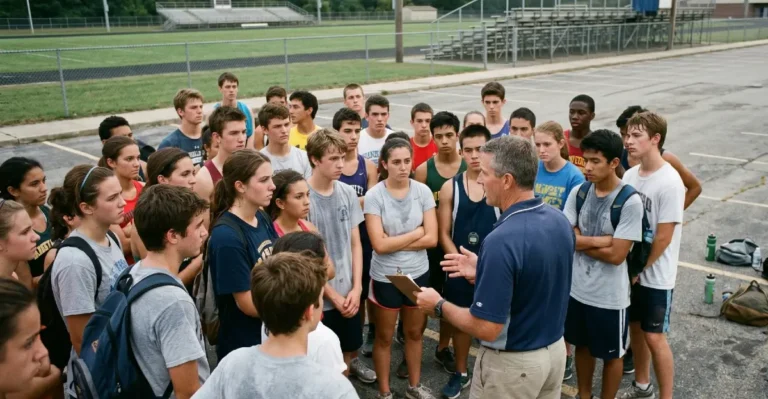
Soles has written two books on his method: Building Championship Cross Country Programs and Becoming Varsity — and the throughline in both is that he coaches people, not splits. In his own framing, the work is the architecture of community, progressive training loads, disciplined goal-setting, and building belief in kids who haven’t yet found the edge of their own potential. He talks about developing “athletes, not just runners,” and about staying healthy as a precondition for everything else.
That philosophy shows up directly in how Spencer was raced. Notice that Soles built the plan and Spencer believed it:
“My expectations going in aren’t super high, but then my coach tells me a plan and has me believe in it, I’m like, ‘You know what Coach, you’re right, I should try and do this.’ And then it goes successfully.” — Jackson Spencer, CITIUS MAG
Cross Country Periodization & Base Fitness
Here is where Spencer’s season becomes genuinely instructive, because the data was published through his COROS training platform.
Spencer came into the fall of 2025 with a Base Fitness of roughly 100 (COROS’s aggregate fitness metric). Over the following months he grew that number by nearly 50%, peaking around 146 before the national races. That is not a straight climb. It’s a series of hard blocks separated by carefully planned recovery phases. His fitness was built in waves, not one long push.
The two most intense blocks of his entire season were the week leading into Clovis (his single highest-mileage week of the fall) and the final build toward nationals. And this is the counterintuitive part most high school programs get backwards:
“One of the more unique aspects of Jackson’s training is how his biggest training efforts are right before the biggest races, followed by a lower-intensity block afterwards. ‘I think it helps build the momentum a lot,’ he says. ‘But yeah, the week after Clovis I had to chill a bit cause I needed to recover.’”
Read that carefully. Spencer ran his hardest training week immediately before one of his biggest races. He then broke the Woodward Park course record in that race and backed off after. Then he repeated the pattern into nationals.
Inside a Signature Workout: Grass Intervals
One of Spencer’s sharpest sessions of the fall was captured in full, and it’s a clean template you can lift directly.
The structure:
- 3 × 800m, with a 2-minute jog recovery between reps
- then 1 × 400m
- 4-minute jog between the two sets
The execution: Spencer averaged 2:10 for the 800s and 60 seconds for the 400 run on grass. His average heart rate for the session was 166, squarely in the range you’d expect for controlled anaerobic work. The recovery jogs were run around 10:00/mile. That’s slow enough to recover, but still adding a touch of aerobic benefit rather than standing around.
Two things make this workout worth studying. First, it was run on grass, not the track, which blunts the raw pace, protects the legs, and rehearses the actual surface of a cross country race. Second, Spencer’s efficiency score that day was only 97%, meaning his body wasn’t at peak sharpness, and he still nailed every split. That’s the signature of a deep aerobic base: the floor is high even on an average day.
Sample Spencer-Style Cross Country Week (Peak Block)
| Day | Session | Purpose |
|---|---|---|
| Mon | Easy aerobic + strides | Recovery, neuromuscular touch |
| Tue | Grass intervals: 3 × 800 (2:00 jog) + 400, 4:00 between sets | Anaerobic power, race-surface specificity |
| Wed | Medium-long aerobic run | Aerobic durability |
| Thu | Aerobic + short hill work | Strength, recovery with stimulus |
| Fri | Easy + strides | Freshen |
| Sat | Tempo or race-specific effort | Threshold / race rehearsal |
| Sun | Long run | Aerobic engine |
This is a representative peak-block week in the Soles mold, not a prescription. Spencer’s exact volume was periodized in waves around his race calendar, with the hardest loading deliberately placed before his biggest meets.
The Front-Runner’s Education: Racing Up and Racing Smart
Spencer is a front-runner, but he is not a naive one. What separates his 2025 season from a simple “go to the front and hang on” story is how much tactical discipline Soles layered on top of the fitness.
At NXR Southwest, a brutally deep regional that doubles as a national preview, Soles gave Spencer an explicit constraint: do not take the lead for at least the first mile. If the pace was slow he could take it in the second mile, but not before.
“My coach wasn’t allowing me to take the lead for at least the first mile… I was wanting to take it with a K to go, and that kind of happened. Abdinasir put in a crazy surge, so I just had to take my time and match that. I guess with 400m to go was my real move.” — Jackson Spencer
That’s a runner with world-class fitness being coached into patience, matching a rival’s surge instead of panicking, then delivering the decisive move at 400m to go. He did the same thing at NXN, where the plan accounted for the team title:
“I didn’t want to go out too hard and risk dying because then that would be detrimental to the team. It’s awesome to be able to compete with a team and to have them in the back of my mind as my reason why.” — Jackson Spencer
At Brooks Nationals, on a narrow course Spencer got boxed in for the first mile. He adapted rather than unraveled: he waited for the field to string out, then reeled in the leader on a hill.
The key is course study. Spencer scouted each national course in advance, identified where the race would likely break open, and pre-planned his moves. When Plan A survived, he executed it. When it didn’t, he had already thought about Plan B.
Transitioning XC Fitness to Track Season
A truly special season would have ended in December. Spencer’s didn’t. Winning NXN qualified him for the U20 World Cross Country Championships in Tallahassee in January 2026, an event he admitted he didn’t even know existed until it was announced, at which point it became “one more reason to go win NXN.” He placed 18th in the world over 8K, the top American finisher, and anchored Team USA to a bronze medal.
Then came the track. Indoors, Spencer ran 13:54.70 for 5000m at New Balance Indoor Nationals. Solo, leading the final 4500 meters, the second-fastest indoor 5K in American high school history. Outdoors he broke four minutes in the mile (3:58.17 at the Jesuit Twilight Relays, then 3:57.24 at the HOKA Festival of Miles, moving to No. 2 on the all-time high-school-only mile list), set the American high school 3200m national record of 8:31.80 at the Arcadia Invitational, and swept the 800-1600-3200 triple at the Utah state meet.
Coach’s Corner: Key Takeaways
For Coaches
- Periodize fitness in waves, and spend it on purpose.
- Build the running environment, not just the runner. The jump from 19th as a sophomore to national champion required teammates fast enough to train behind.
- Steal the grass intervals. 3 × 800 (2:00 jog) + 400, on grass, at controlled effort.
- Coach tactical patience into your front-runner.
- Base first, specialization later.
For Parents
- Environment can matter as much as talent. A transfer into a stronger training group unlocked Spencer’s ceiling.
- Trust the recovery blocks. The “chill week” after Clovis wasn’t lost fitness, it was what made the hard week repeatable.
- The whole person is the point. Soles’s system is built around developing athletes and people, not just times. The 3.92 GPA and the piano lessons are the same disciplined kid.
For Athletes
- Believe the plan, then run to your fitness.
- Study the course. Know where the race will break open and pre-plan your move.
- Race up. Dominating a weak field teaches you nothing.
- Build a base deep enough that your average day is still fast.
The Undefeated Blueprint
Athlete: Spencer · Coach: Soles · Program: Herriman
Jackson Spencer’s undefeated fall isn’t just a highlight reel. It’s a clean demonstration that a high school runner can be raced aggressively with hard blocks up against big meets, front-running from the gun, if the aerobic base is deep enough to support it and the recovery is disciplined enough to make it repeatable.
Video, Podcast & Written Resources
Watch
- Doug Soles on Spencer’s Brooks XC title (DyeStat)
- Spencer wins Boys 5000m — NBNO 2026 (DyeStat)
- Spencer sets Arcadia 3200m record (MileSplit)
- Interview with Coach Doug Soles (MileSplit / NXN)
Listen
- Doug Soles: Building Championship XC Programs (Steadfast Running)
- Ep. 105: Doug Soles, Legendary XC Coach (On Track & Field)
- #TheJourneytoCompete, Ep. 2: Jackson Spencer (RunBlogRun)