

Store / 12-Week Middle School XC Plan
The season that makes them want a next season.
Twelve weeks for grades 5 through 8. Every run, every game, and every word to say at practice, for all three experience levels on your roster. Volume in minutes rather than miles, so a nine-minute-miler and a thirteen-minute-miler get the same training. Built on the same five-gear system as the 22-Week Season Blueprint, so the eighth grader you finish with walks into high school already speaking the language.
- All 12 weeks, 3 levels deep. 36 print-and-post schedule pages. Every day accounted for, every week sums exactly to plan requirements.
- Explorer (15 mpw) · Builder (20) · Bridge (25). Levels set by training age, not grade or talent, so a fast fifth grader and a slow one train the same
- The Game Manual: 12 games, one page each — setup, exact dose by level, the lines to say, and the predictable way each one goes wrong
- One practice, grades 5 through 12. One loop, one clock, six doses — with staffing tables for one, two, or three coaches
- USATF-backed. Season length, volume progression, and race distances mapped to their source in Appendix C — bring it to your athletic director
Long Run (Chat)At the cap ✓
Chat recoveryDurability B ✓
This is the actual product.
Explorer level, weeks 5–12.
Not a mockup. The real print-and-post page a first-year fifth grader would follow from their first meet to the championship. Every minute calculated, every week sums exactly to plan, every long run under the cap. Judge it yourself.
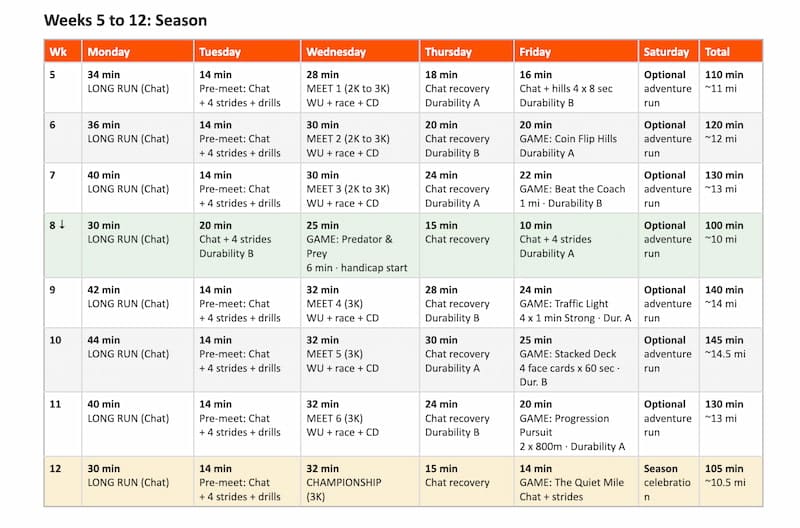
Green = down week · Gold = championship week · Chat = conversation pace · Minutes are running only — the Athlete Base and cool-down are not counted · Print it and hand it to your staff.
Everything between the first practice
and the championship.
Three documents in the middle school cross country training plan, in Word and PDF. Built to be printed, posted, and handed to a volunteer who has never coached before.
The Coach’s Guide
Twelve sections: athlete levels, mileage guidelines, the five gears, the seventeen-minute Athlete Base, racing, and the red-flag watch list. Plus the full strategy for running one practice for grades 5 through 12 at the same time.
36 Day-by-Day Week Grids
Every day of all 12 weeks, for all three levels, in minutes with mile equivalents alongside. Print-and-post pages — athletes read their row, coaches read the room.
The Game Manual
Twelve games, one page each. Setup, exact dose per level, numbered steps, the actual lines to say, and two boxes that matter most: how to stop a game inflating the workout, and the predictable way it goes wrong.
The 12-Week Architecture
Four weeks of foundation with zero quality work, then an eight-week season with down weeks pre-placed at 4 and 8. One long run, one game day, one hard effort per week — and on meet weeks, the race is that effort.
The Athlete Base
Seventeen minutes of movement, drills, and real sprinting at the front of every practice. Identical for a fifth grader and a senior, which is exactly why a combined program shares it. The window closes at fifteen and most programs never open it.
The Red-Flag Watch List
Sever’s, Osgood-Schlatter, the growth spurt that scrambles a coordinated kid overnight, RED-S, and the athlete who used to laugh at practice and stopped. This table is different from the high school one because the injuries are.
Built for whoever ended up
with the middle schoolers.
- The high school coach who inherited the feeder program. You now run two teams on one field with one whistle. Section 9 is written for exactly that. One measured loop, one clock, six doses, and staffing tables for one, two, or three coaches.
- The middle school coach with no cross country background. The planning is done. Open the week, read the row, run the game off the page. The manual tells you what to say at the start line.
- The parent volunteer. Every game page is built to be read cold in the parking lot and handed back. No jargon you have to look up first.
- The program builder. Three levels means a kid enters in fifth grade and grows through the system for four years, then steps into the 22-Week Blueprint already knowing the gears, the talk test, and the durability work.
Grade five to senior year,
on one system.
Most middle school plans are a high school plan with the mileage halved. This one was built backward from the Blueprint instead. Same five gears, same level logic, same Strength and Durability program. So nothing has to be unlearned in ninth grade.
- Explorer 15 mpw · grades 5–6
- Builder 20 mpw · grades 6–7
- Bridge 25 mpw · grades 7–8
- Rookie — 22-Week Blueprint 30 mpw · freshman
- Returner — 22-Week Blueprint 40 mpw
- Veteran — 22-Week Blueprint 50 mpw
The 30-day “use it with your team” guarantee
Run it with your actual roster. If it doesn’t earn its keep in the first month, reply to your receipt email for a full refund. No forms, no questions.
Frequently asked
My middle schoolers practice with the high school team. Does this actually work?
My season is only nine weeks. Do I lose a third of the plan?
Is 25 miles a week too much for an eighth grader?
My league races two miles, not 3K. Does that break anything?
What if I already own the 22-Week Season Blueprint?
Can I share it with my assistants and athletes?
You’ve seen the week. Now run the season.
All three levels, all 12 weeks, all 12 games, and the practice plan that puts grades 5 through 12 on one field. The fifth grader you keep this fall is the senior who scores in four years.
Get the Plan — $49