
The Engelhardt Blueprint: Balancing High Performance with Long-Term Growth
I’m going to tell you something that most coaches, parents, and athletes don’t want to hear about high school distance running training: doing more doesn’t make you better. Running harder doesn’t make you faster. And chasing every race on the calendar doesn’t make you tougher—it makes you broken. I’ve seen runners put themselves in a hole based on making every day tougher than the last, and before long they can’t climb out.
Why Sadie Engelhardt’s Training Model Matters
Sadie Engelhardt’s journey to a 4:28 mile (in high school) and the Olympic Trials isn’t just a story of talent. It’s a masterclass in what happens when you shut out the noise, trust the process, and build something that lasts. Her high school career offers a roadmap for navigating that gray area between high school stardom and professional potential.
For Coaches: Precision Over Volume
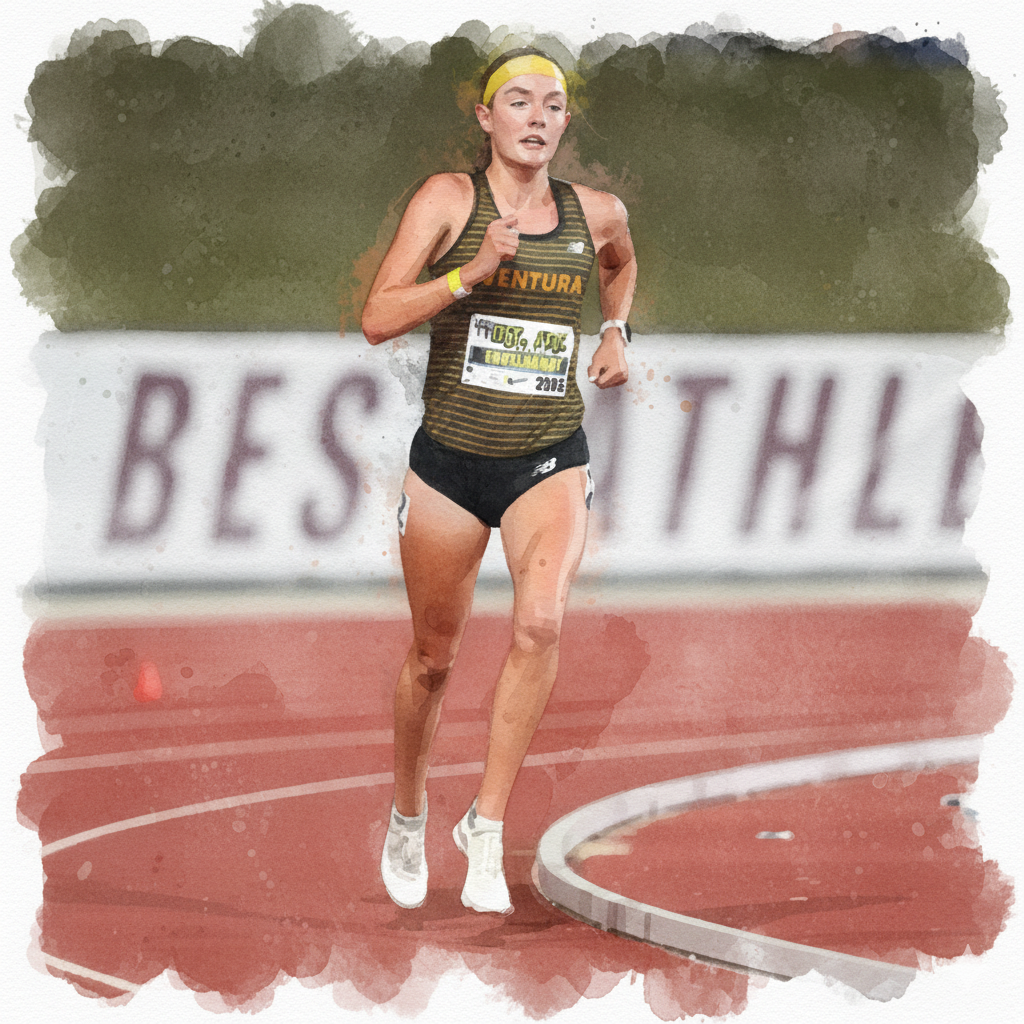
Here’s what gets me fired up: Sadie ran around 35 miles per week during her high school career under coaches Josh Spiker and Tyree Cruz at Ventura High School. Not 50. Not 60. Thirty-five. While everyone else was grinding themselves into the ground chasing mileage totals, she was building a machine.
The secret? Quality over quantity. Race-specific training that actually prepares you for the pain cave you’re going to enter in that final 200 meters.
Actionable Tip for HS Coaches: Stop adding junk miles just to hit some arbitrary weekly total. Develop race specificity. Instead of logging miles for Strava, design workouts that simulate the exact physiological demands your athlete will face when it matters. Do as little as possible to get the maximum adaptations for your event.
The Workout: Try Sadie’s “1500m Clusters”—400m at goal pace (around 65 seconds for her) / 800m at threshold (2:15) / 300m at finish speed, with short recovery between reps. This isn’t about destroying your athlete. It’s about building the aerobic power and neuromuscular coordination needed for that final lap without the physical toll of unnecessary volume.
Sadie’s training emphasized broken intervals and threshold work that targeted specific energy systems rather than just accumulating fatigue. That’s coaching with intention, not just tradition.
For Parents: Protecting the “Student” in Student-Athlete
It’s easy to get swept up in the recruitment hype, the Instagram posts, the USA Today rankings. But Sadie’s 4.59 GPA and her decision to compete unattached in late 2024 highlight something more important than any trophy: balance.
Her move to go unattached wasn’t about ego or drama. It was about load management. By strategically bypassing some of the high-frequency high school championship qualifying rounds, she avoided racing herself into the ground before the summer championship season began. She was playing the long game.
Autonomy is Key. Your job as a parent isn’t to manage every decision—it’s to create space for your athlete to make smart ones. Sadie and her coaches used data from her Coros running watch to monitor recovery metrics, heart rate variability, and training load. That’s not being soft—that’s being smart.
According to Runner’s World coverage of her training philosophy, her team emphasized recovery as much as intensity, understanding that adaptation happens during rest, not just during work. Encourage your athlete to listen to their body AND their technology, not just “grit it out” because that’s what someone’s parents did in 1987.
The sport has evolved. Your mindset should too.
Stop Guessing. Start Coaching with Science.
High school coaching is hard enough without trying to decipher complex physiology papers. Every week, I break down elite training concepts into actionable, safe advice for the high school level. No fluff—just workouts that work.
Join the Coach Saltmarsh Newsletter Get the “Science of Speed” delivered to your inbox every Tuesday.For Athletes: Become a Student of the Sport
Here’s what separates good from great: Sadie didn’t just run the workouts—she understood them. She’s known for being incredibly analytical about her heart rate trends, pacing strategy, and training zones. She wasn’t blindly following orders; she was taking an active part in her training and development.
Actionable Tip: Don’t just upload your runs to Strava for the likes and the kudos. Actually look at your data. What’s your cadence doing? How quickly does your heart rate recover between intervals? Are you actually recovering on your easy days, or are you stuck in that gray zone where you’re too tired to go hard and too fast to recover?
Citius Mag interviewed Sadie about her analytical approach, noting that she regularly reviewed her training metrics with her coaches to adjust workouts based on readiness, not just what was written on the calendar.
Consistency Wins. Sadie’s success wasn’t built in a single season. It was a progression that started with her youth development under Matt Hammel at Conejo Valley Track Club, continued through her high school years, and culminated in that 4:28 mile. Trust the slow build. Embrace the boring middle. That’s where champions are made.
The Real Blueprint
Look, there’s no magic workout. There’s no secret supplement. There’s no shortcut. What Sadie Engelhardt and her coaching team demonstrated is something far more valuable: intelligent progression, strategic rest, and the courage to do less when everyone else seemingly doing more.
For coaches: Stop coaching everyone the same way. Build training that’s specific to the individual and the race.
For parents: Your athlete doesn’t need another pusher—they need a protector who understands the difference between challenge and damage.
For athletes: Get obsessed with the details. Understand the “why” behind every workout. And remember that the goal isn’t to survive high school running—it’s to thrive beyond it.
Sadie’s now competing at NC State, continuing to develop under professional-caliber coaching. Her high school blueprint wasn’t about peaking at 18—it was about building a foundation that would last a lifetime.
That’s the real lesson here. Are you building a peak or a foundation?
How many miles per week did Sadie Engelhardt run in high school?
Sadie Engelhardt ran approximately 35 miles per week during her high school career, focusing on quality race-specific training rather than high volume mileage.
What was Sadie Engelhardt’s best high school mile time?
Sadie Engelhardt ran 4:28 for the mile, establishing herself as one of the fastest high school milers in U.S. history. Her record was broken by Jane Hendengren‘s 4:25.
What kind of workouts did Sadie Engelhardt do?
Her signature workout included 1500m clusters: 400m at goal pace / 800m at threshold / 300m at finish speed, with short recovery between reps.
How did Sadie Engelhardt balance school and running?
She maintained a 4.59 GPA while competing at an elite level, using strategic race selection and data-driven recovery monitoring to avoid burnout.