

High school 1600m training plan · 4 levelsTwelve weeks to the mile. Every split already written.
Every pace is a P number, a percent of the athlete’s current mile. Enter one race and one goal per athlete, and the calculator puts their split next to every rep, every day, all season.
- Instant download
- Full calculator included
- 30-day money-back guarantee
- 31state champions coached
- 25 yearscoaching high school distance runners
- USATF Level 2Endurance Coach
- Coach of the YearNew Hampshire cross country, 2018
The Saltmarsh Pace Scale
The workout is easy to write. The splits are the work.
You write 6 × 800m on the whiteboard. Then the whole roster asks for their split. Most 1600m plans for sale are written for one runner chasing one goal time. Your roster is first-year kids next to four-year seniors. This plan starts from a race each athlete actually ran, writes every session in laps they already know, and does the math for the whole team.
One number for every pace.
400m splits for a 5:00 1600m runner with a 4:50 goal. Easy is per mile.
Start from a real race.
P100 is the athlete’s current 1600m race pace, from a race they ran. Any race from 800m to 3200m converts.
Read the P number.
P90 is 10% slower than mile pace. P110 is 10% faster. A session reads 6 × 800m P80, 60 s jog. Most reps are one, two or four laps.
Set the goal. Rehearse it.
After the week 3 time trial, each athlete gets G, their goal 1600m pace. Rolling 200s at G settle them into goal rhythm. A 1000m at G in week 11 tells you if the goal is ready.
Three coaches. One scale.
Jack Daniels
Paces come from races, as in his VDOT system. Every session is checked against a per-session limit for its level.
Renato Canova
Every pace is a percent of race pace, moving from general to specific. Mondays climb from P80 to P95. Wednesdays come down from P110 to race pace.
Mihály Iglói
Sets with easy running between reps. The cue is relaxed, and a rep that tightens ends the set. The rolling 200s come straight from him.
Daniels supplies the physiology and the safety limits. Canova supplies the percent-of-race-pace ladder and how to progress it. The P-Scale puts both into one number for every pace, a percent of the athlete’s current mile, with workouts written in laps high schoolers already know.
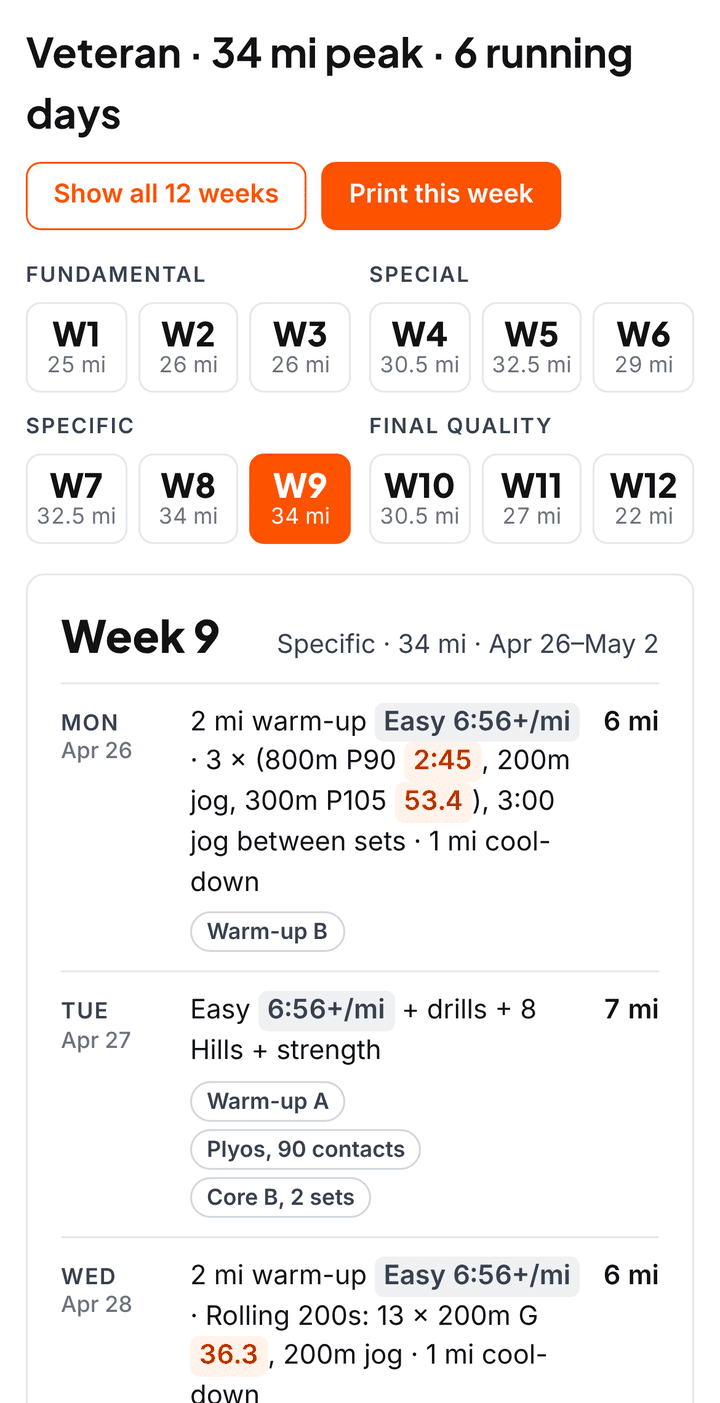
A real week from the plan
Veteran, week 9. Splits filled in.
A 5:00 1600m runner with a 4:50 goal. Every split on this page comes from those two numbers. Monday is Canova’s alternations. Wednesday is 13 rolling 200s at goal pace.
| Mon | 2 mi warm-up Easy 6:56+/mi · 3 × (800m P90 2:45, 200m jog, 300m P105 53.4), 3:00 jog between sets · 1 mi cool-down | 6 mi |
|---|---|---|
| Tue | Easy 6:56+/mi + drills + 8 Hills + strength | 7 mi |
| Wed | 2 mi warm-up Easy 6:56+/mi · Rolling 200s: 13 × 200m G 36.3, 200m jog · 1 mi cool-down | 6 mi |
| Thu | Easy 6:56+/mi + 6 × 100m P90–95 19.7–20.6 relaxed | 6 mi |
| Fri | Easy 6:56+/mi | 4.5 mi |
| Sat | Meet: 1600m (warm-up Easy 6:56+/mi, race, cool-down) | 4.5 mi |
| Sun | Off | Off |
Four levels
Place them by training history, not grade.
Same order, same session types, same P zones. The levels differ in volume, reps per set and running days. Every session stays under the per-session limit for its level.
5 running days
First season, or under about 15 miles a week this winter.
6 running days
Second season, or back from a break with 6+ weeks of steady running.
6 running days
Third- and fourth-year runners with a 22 to 30 mile winter base.
7 days in weeks 2 to 11
Multi-year runners who have handled 35+ miles a week.
The full P-Scale Pace Calculator
The calculator does the split math. For the whole roster.
One race and one goal per athlete in. A season of splits out.
Free calculator
Zones and rep times for one athlete.
Full calculator, included
Every day of the season with each athlete’s splits, goal pace, team sheets, routines and printouts.
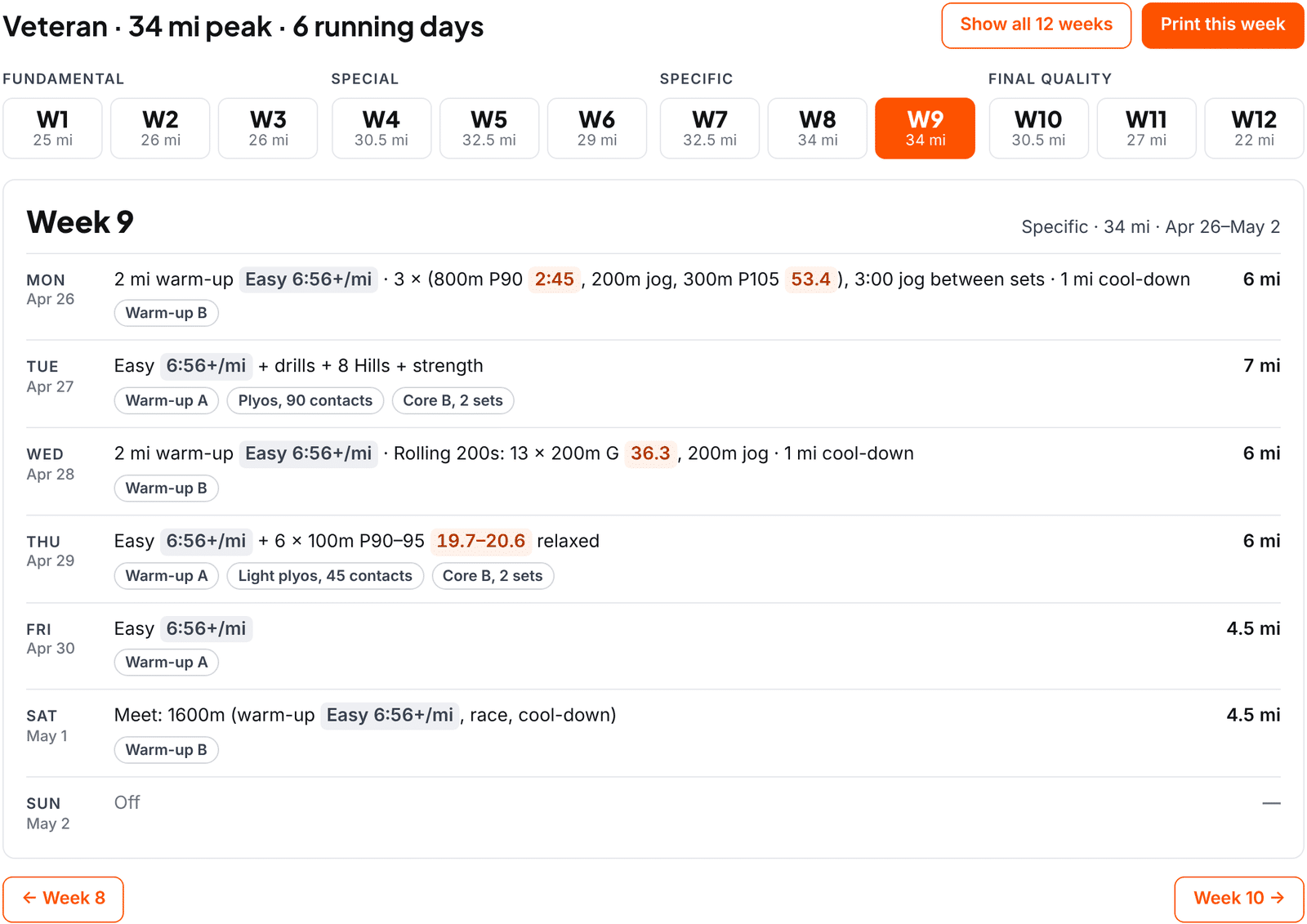
The season, with their splits.
Pick a level and a start Monday. All 12 weeks fill in with that athlete’s split next to each rep, Easy pace on easy days, and the warm-up, core and plyos for the day.
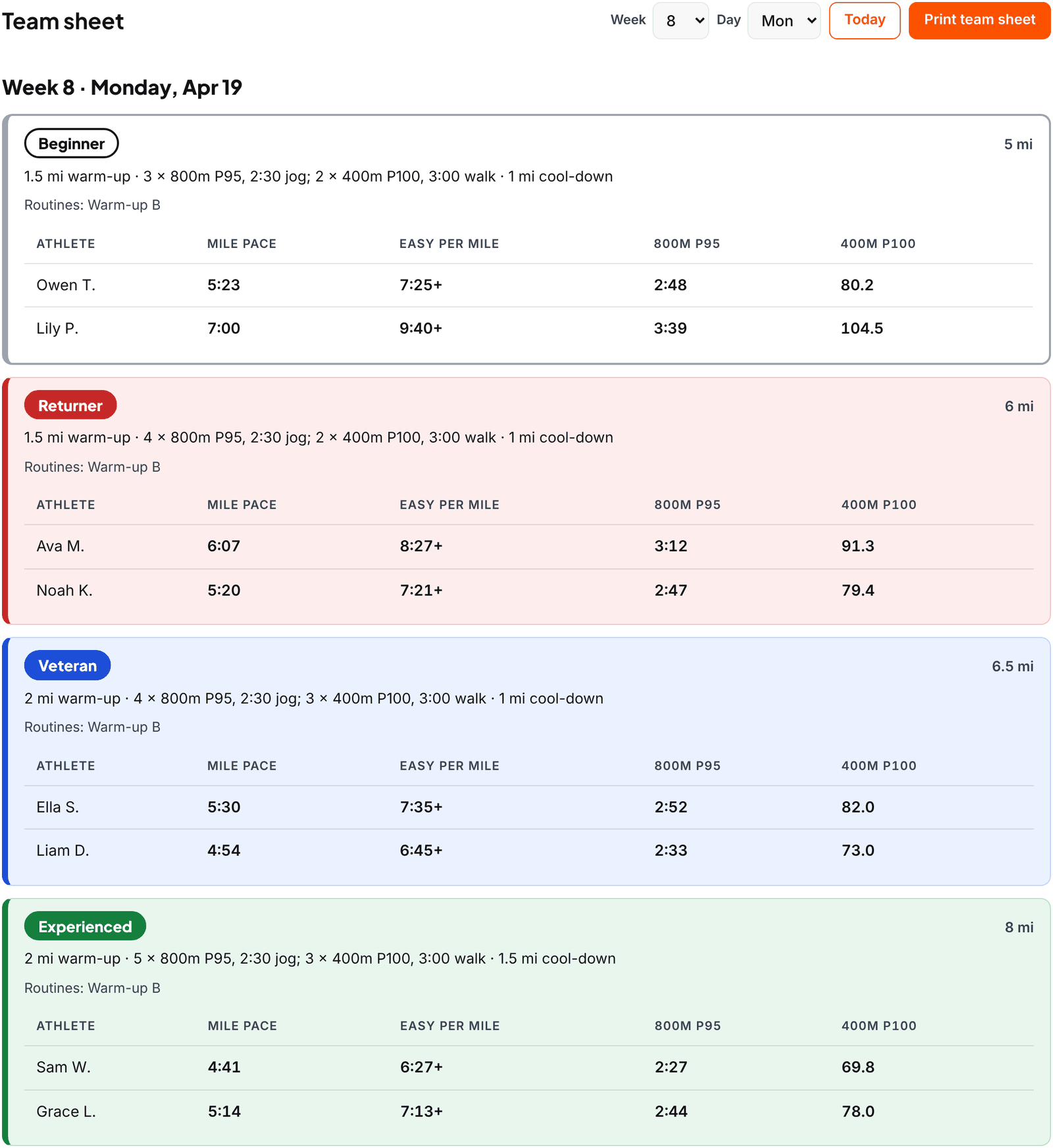
The whole team on one page.
Pick a day. Every athlete, grouped by level and color, with their own splits for that session. Your roster saves in your browser.
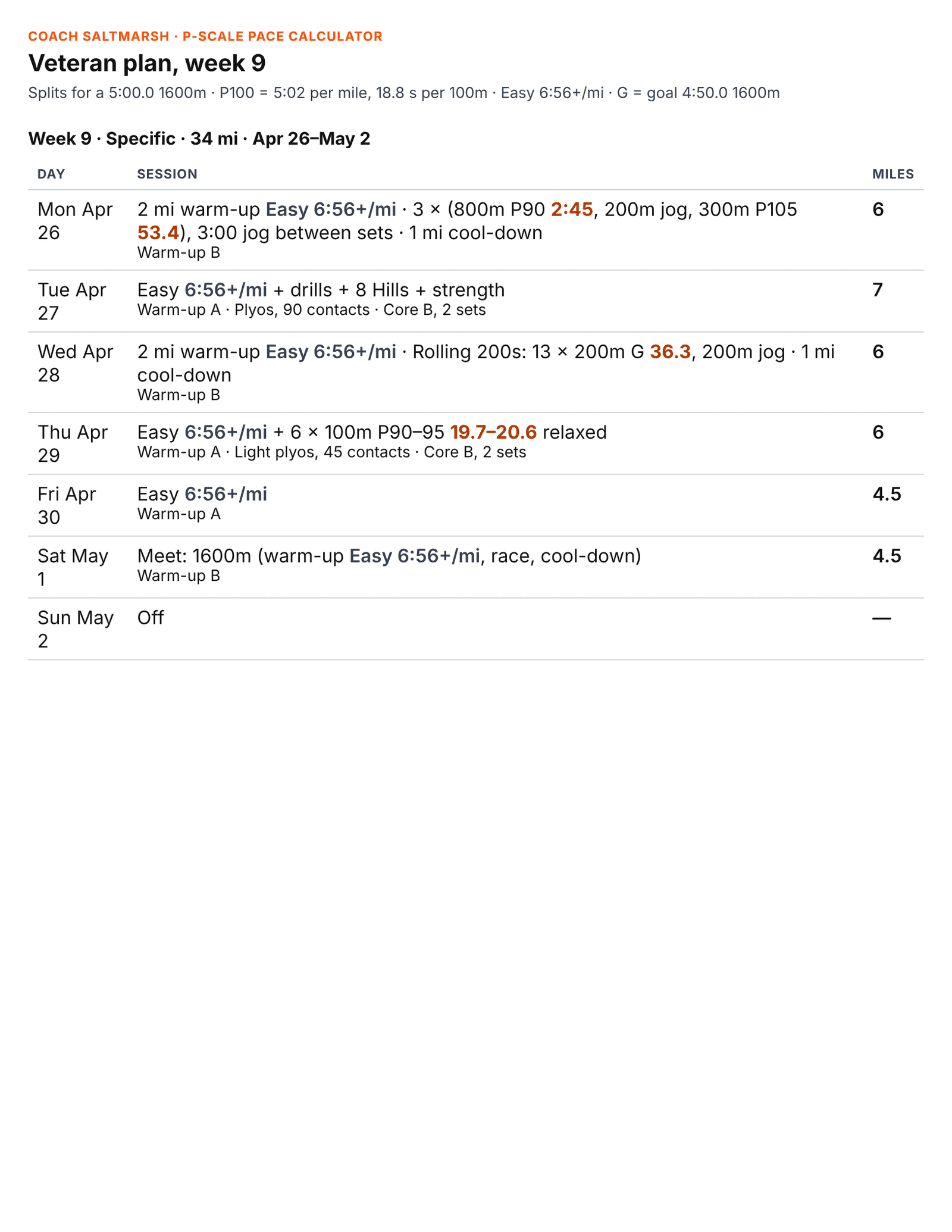
Print it, or check it on a phone.
Pace cards, week sheets, team sheets and routines print clean. Any browser, phone or laptop. Nothing to install. No athlete accounts. No subscription.
What you get
Everything in the 1600m plan, from week 1 to the goal race.
The whole high school 1600m training plan: two PDFs to print and keep, and the full calculator to run the season.
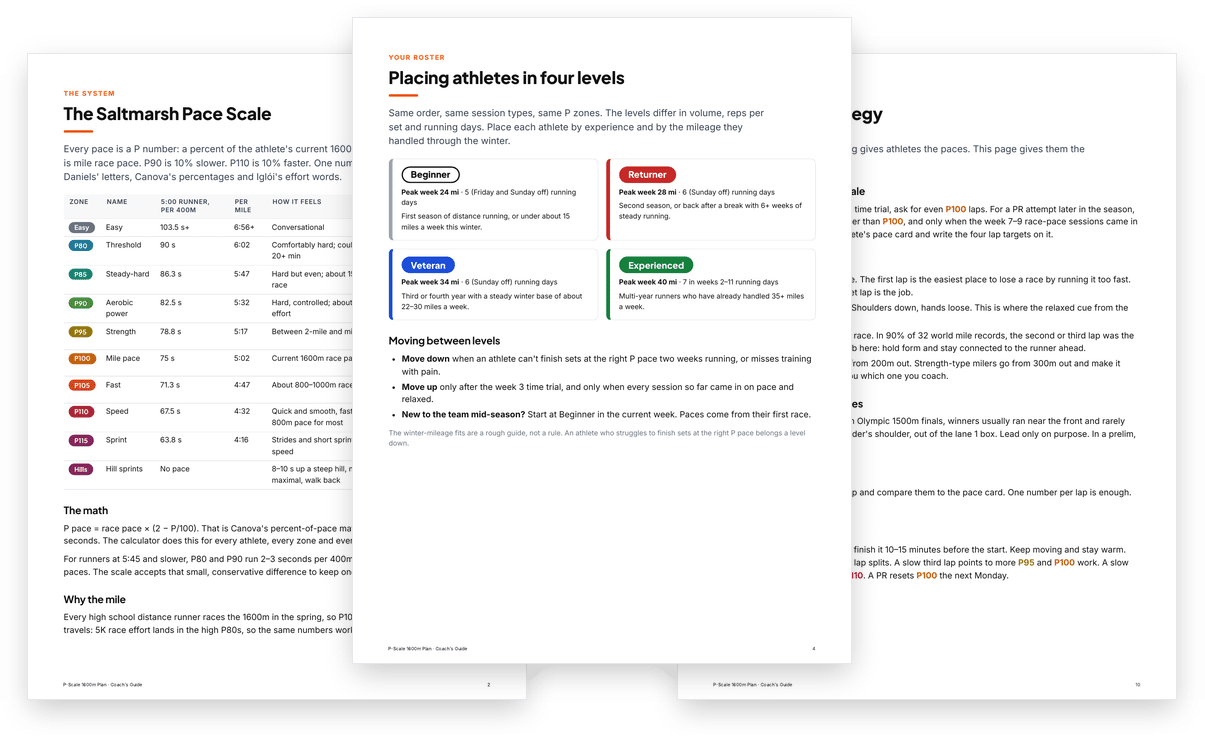
The Coach’s Guide
Read it before week 1 and you can place every athlete, explain every session and coach the race itself.
- The P-Scale, zone by zone
- Placing athletes, moving them between levels
- 1600m race strategy, lap by lap
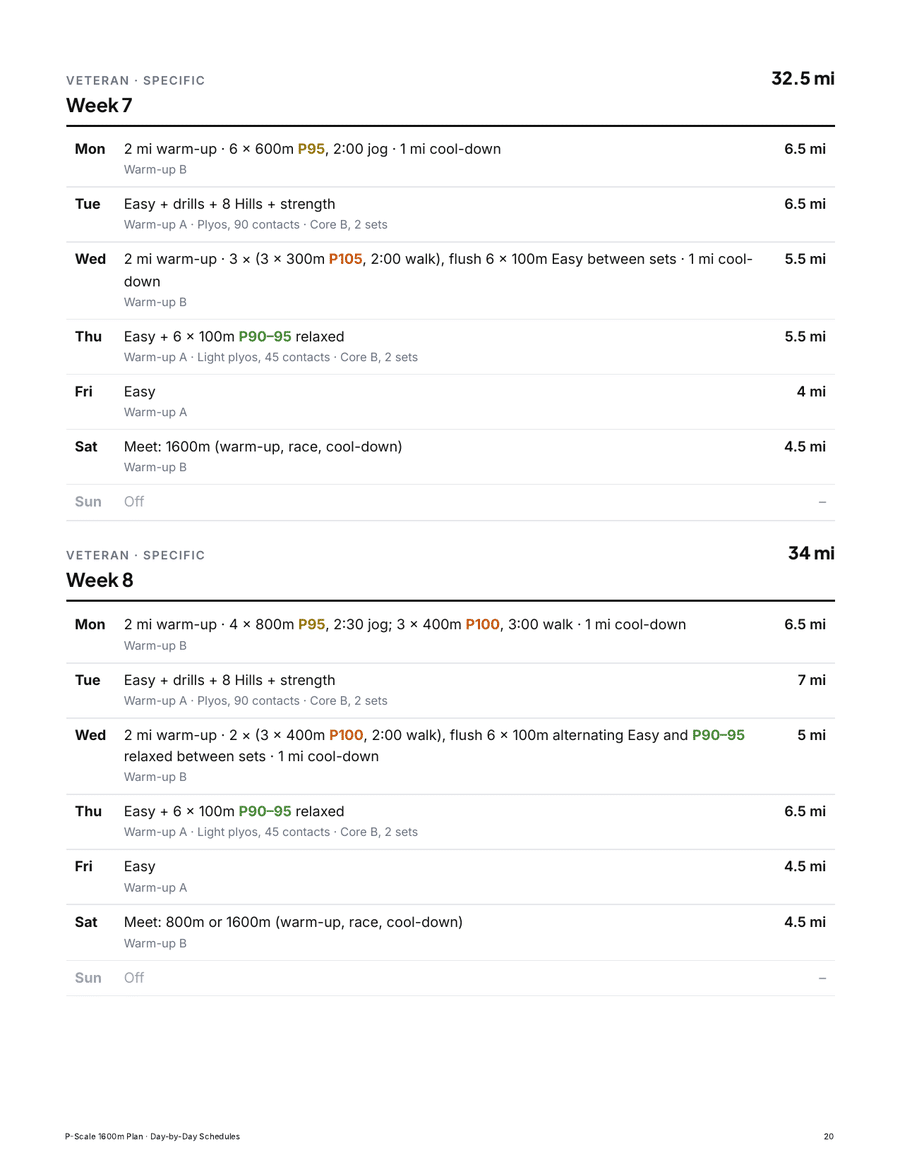
Day-by-Day Schedules
Four levels, 12 weeks, every day with its session, its routines and its miles.
- Print a level, post it, coach
- Rolling 200s and the week 11 1000m built in
- Midweek meets and short seasons covered
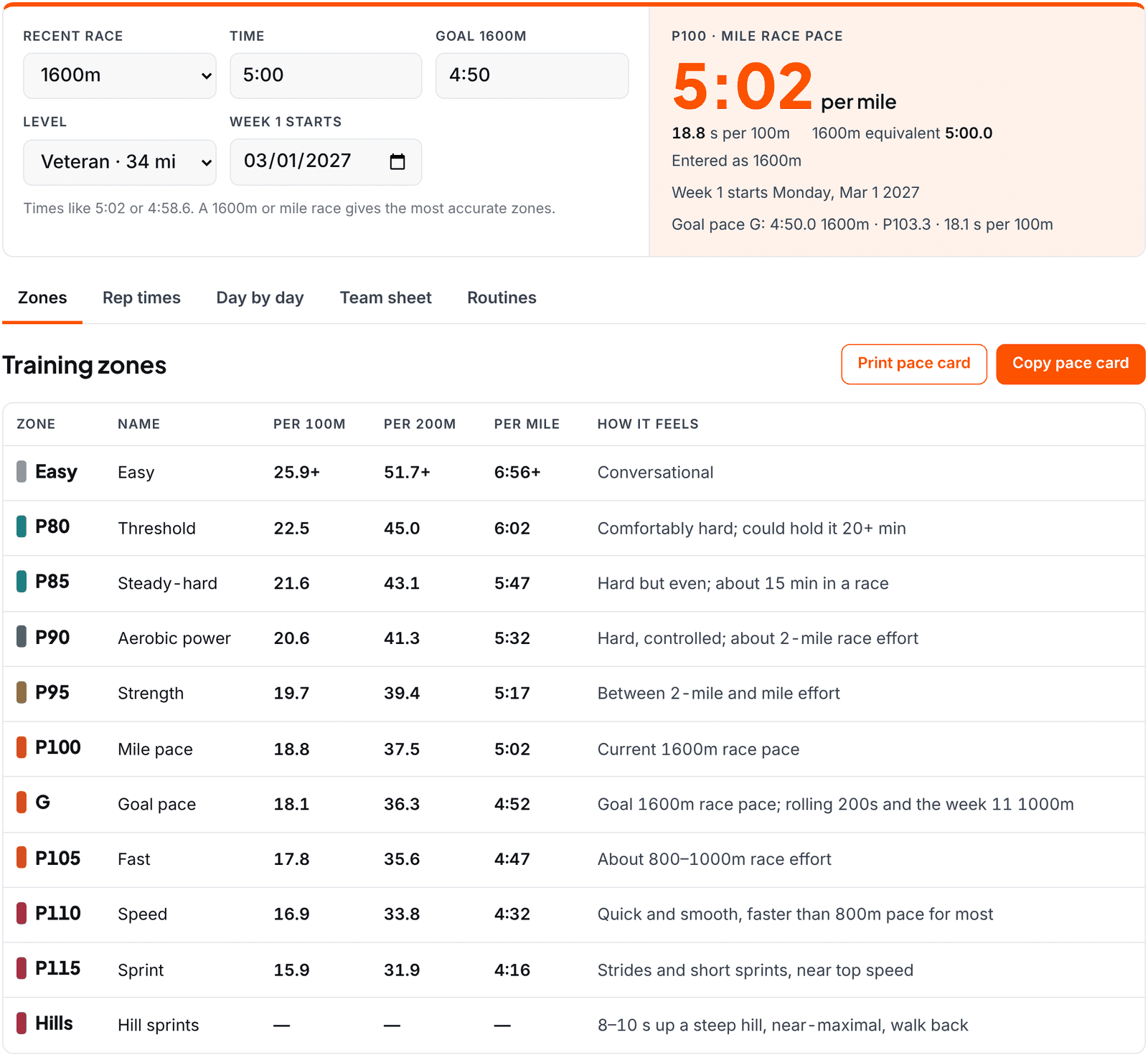
The full P-Scale Pace Calculator
One race and one goal per athlete in, a season of splits out, for every athlete on your roster.
- Every day with every split
- Team sheet for any day
- Pace cards and week sheets that print
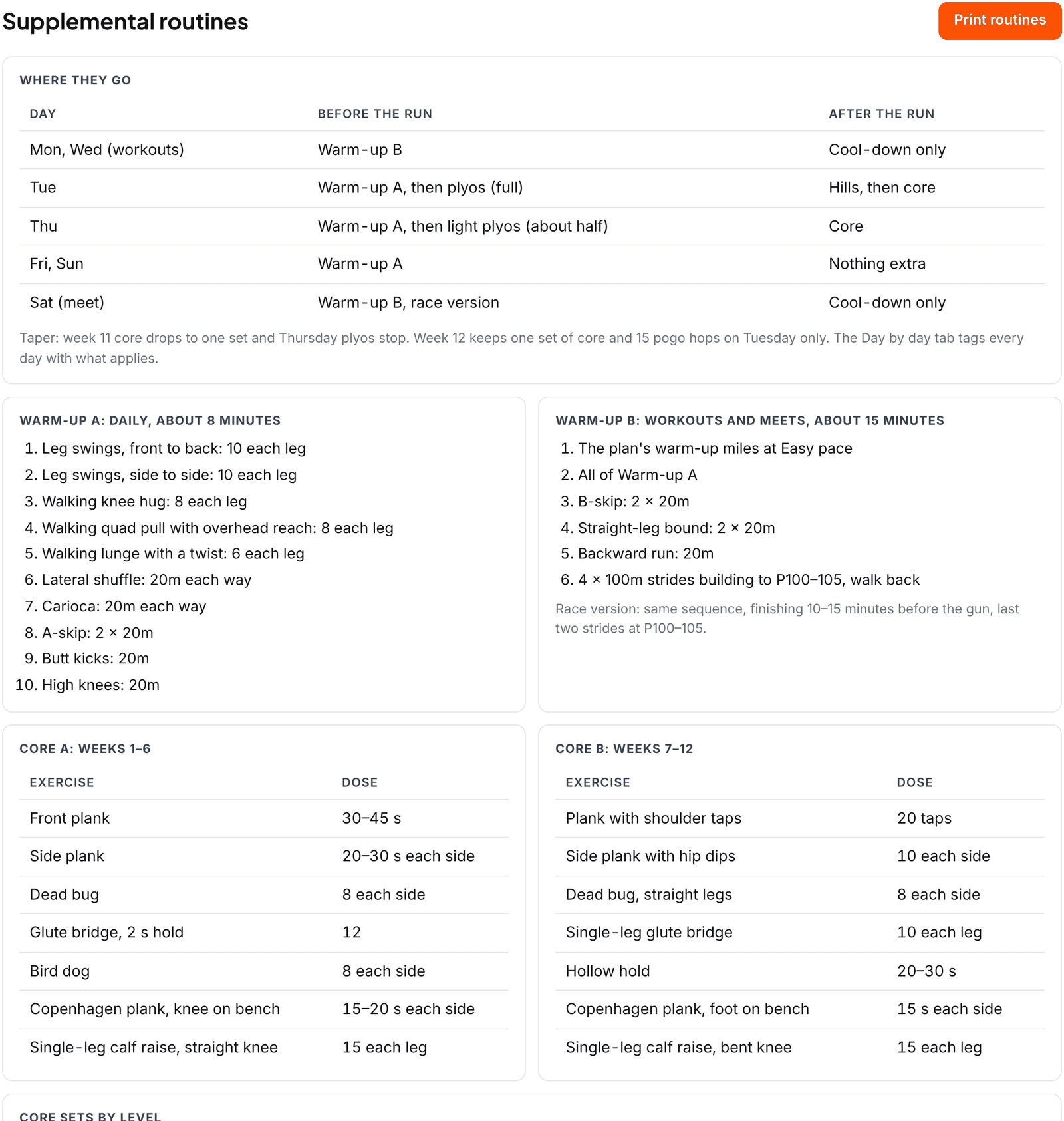
Warm-ups, core and plyos
Two warm-ups, core and plyos dosed by level, tagged on every day of the plan.
- Warm-up A daily, Warm-up B before workouts and meets
- Core A and B, sets by level
- Plyo ground contacts by level, with a taper
The 30-day use-it-with-your-team guarantee.
Run it with your actual roster. If it doesn’t earn its keep, reply to your receipt email within 30 days for a full refund. No forms, no questions.
The 12 weeks
Wide at the start. Narrow at the finish.
Fundamental, Special, Specific and Final quality, three weeks each. Volume eases in, steps back in week 6, peaks in weeks 8 and 9 and drops about a third by race week.
Endurance side: P80, then P90, then P95.
Easy run, drills, hill sprints, plyos, core.
Speed side: P110, then P105, then race pace. Rolling 200s at G in weeks 6, 7 and 9.
Easy run and relaxed 100s.
Easy or off.
Meet from week 3. Long easy run in weeks 1 and 2.
Why it is built this way
Built on what holds up.
Warm-ups every day
Warm-up programs cut injuries in youth athletes by about a third, and only when they are done consistently (2022 meta-analysis). That is why they are tagged on every day.
Mostly easy, more race pace late
World-class middle-distance runners keep most running easy and add race-pace work as the target race nears (Haugen et al., 2021 and 2022). So does this plan.
Honest about the evidence
No study tests the P-Scale as a package. Each part comes from methods with long track records, and every session stays under a limit for its level.
Questions
Questions coaches ask about the 1600m plan.
One-time purchase. No subscription. No per-athlete fees.
Want a second set of eyes on your placements? Reply to your receipt email to set up a one-hour call.
Will it fit my meet schedule?
It runs on weeks, not dates. Week 12 is goal-race week. Count back 11 weeks from that Monday, enter the date, and the calculator dates every day. The schedules assume a Saturday meet from week 4. A midweek meet replaces Wednesday’s session, and the Coach’s Guide shows how to move Monday’s session around a Tuesday meet.
My season is shorter than 12 weeks.
Cut from the middle, never the ends. For 11 weeks drop week 5. For 10 weeks drop weeks 4 and 5. Weeks 1 to 3 and 9 to 12 stay whole.
My athletes are at very different fitness levels. Does one plan work?
Yes. The level sets the volume. Each athlete’s own race sets the pace, and their own goal sets G. The team sheet prints the whole roster for any day, grouped by level, with every athlete’s splits.
What is G?
G is the athlete’s goal 1600m pace, set after the week 3 time trial. It drives two sessions: rolling 200s on the Wednesdays of weeks 6, 7 and 9, and a 1000m at G to open week 11. If an athlete can run that 1000m, they have a good shot at the goal on race day.
How is this different from Daniels?
Keep Daniels. The P-Scale uses his rules: paces come from races, and every session stays under a per-session limit for its level. What it adds is one number for every pace, a percent of the athlete’s current mile, written in laps your kids already know.
Does it work for the mile or the 1500m?
Yes. The plan builds to a goal 1600m, and the mile and the 1500m race off the same training. Enter a mile or 1500m time and the calculator converts it, so every split still fits the athlete.
What if an athlete hasn’t raced a 1600m yet?
Use any recent race from 800m to 3200m. The calculator converts it. The week 3 time trial or first meet resets it.
Can an athlete or parent use it without a coach?
Yes. Read the Coach’s Guide first. Enter a recent race and a goal, pick a level and a start Monday, and every day shows up with the splits filled in.
Does one purchase cover my staff and team?
Yes. One purchase covers one program: every coach on your staff and every athlete on your roster. Send the PDFs and the calculator link to your assistants. Please don’t share it outside your program.
Does it connect to cross country?
Yes. 5K race effort lands in the high P80s, so the P-Scale works in the fall too. The Coach OS Bundle covers cross country. This plan covers spring track.
Has the P-Scale been tested in a study?
Not as a package. No study tests the P-Scale itself, as none tests most coaching systems. Each part comes from methods with long track records: race-based paces and session limits from Daniels, percent-of-race-pace progression from Canova, relaxed sets from Iglói.
The rest of the year
Winter Training Block · $59
Before this plan: the gap between the last cross country race and the first outdoor meet.
Coach OS Bundle · $139
After it: summer and cross country, with tools for the whole staff.
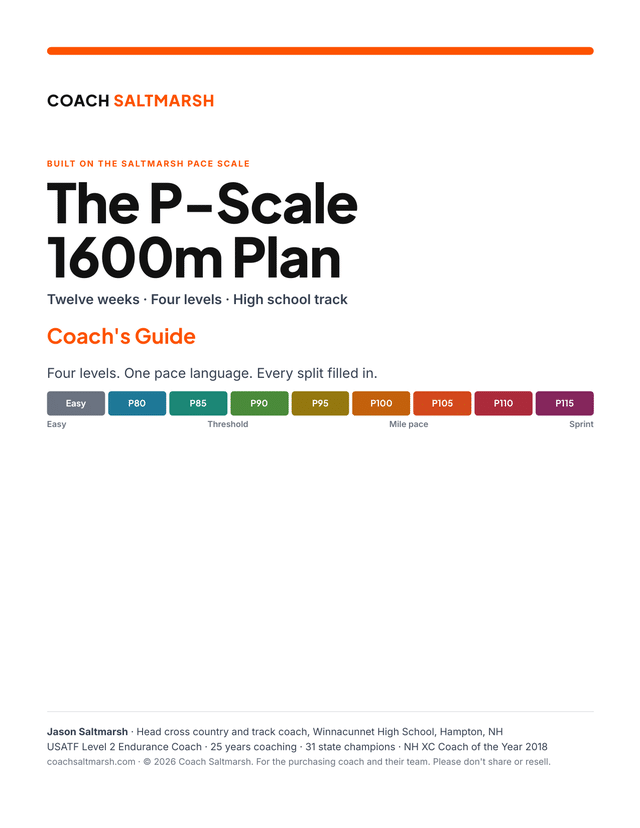
P-Scale 1600m Plan
Week 12 is the race. Count back from there.
One race and one goal per athlete. Four levels. Every split on every rep. $39, one-time, covers your staff and team.