How Cross Country Meets Are Scored: A Parent’s Guide to Understanding the Numbers
Your kid just finished their first cross country race. You saw them cross the finish line somewhere in the middle of the pack, collapse on the grass, and now you’re staring at a results sheet covered in numbers that might as well be hieroglyphics. You’re not alone. Cross country scoring confuses nearly every parent the first time they encounter it—and honestly, it’s unlike any other sport your child will compete in.
Here’s the thing: understanding how meets are scored doesn’t just help you follow along on race day. It helps you understand what your child’s coach is prioritizing, why certain training decisions get made, and what actually matters when measuring team success. Let’s break it down.
In Cross Country, the lowest score wins. The top 5 runners from each team score points equal to their finish place (1st place = 1 point). The team with the lowest combined total of their top 5 runners wins the meet. Runners 6 and 7 do not score but can displace opposing runners.
The Counter-Intuitive Truth: Lower Is Better
In cross country, low score wins. This trips up every parent initially because we’re wired to think higher numbers mean better performance. Not here. The team with the lowest score wins the meet.
Think of it like golf—lowest score wins. Your child’s finish position becomes their score. First place equals one point. Tenth place equals ten points. Fiftieth place equals fifty points.
How Team Scoring Works: The Top 5 Rule
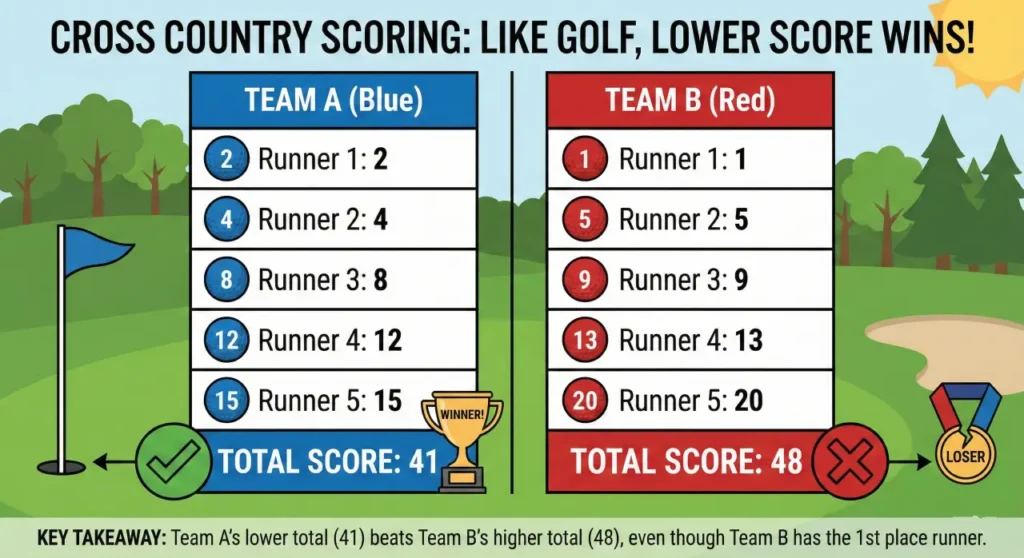
Here’s how team scoring works: the top five finishers from each team score points. Add up those five positions, and that’s your team score. Lowest total wins.
Example:
- Team A finishes: 2nd, 4th, 8th, 12th, 15th = 41 points
- Team B finishes: 1st, 5th, 9th, 13th, 20th = 48 points
- Team A wins despite Team B having the race winner
See what happened there? Team A didn’t need the individual champion. They needed five athletes bunched together near the front. This is why coaches obsess over pack running and closing gaps—it’s not just philosophical, it’s mathematical.
Displacement: Why the 6th and 7th Runners Matter
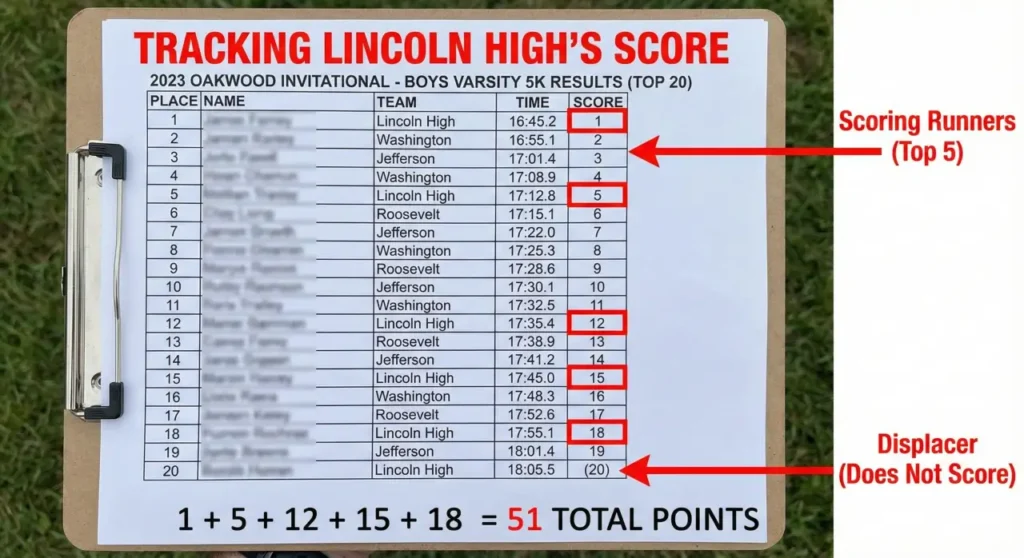
Teams typically bring seven athletes to championship meets, even though only five score. The sixth and seventh runners serve as “displacers.” Think of them as blockers. They don’t add points to your score, but they force the other team to add higher numbers to theirs
Here’s the impact:
Say your team’s top five finish 3rd, 5th, 10th, 14th, and 18th (total: 50 points). Your sixth runner finishes 20th and your seventh finishes 25th. Every opposing runner who finishes behind your sixth and seventh gets pushed back in the scoring—their 21st-place finisher becomes 23rd in the team scoring calculation. Those two extra athletes just added points to your opponents’ totals while your score stayed at 50.
This is why coaches want deep teams. It’s not just about having five strong runners—it’s about having seven good ones who can compress the field and separate the opposition.
📢 Are you a coach?
Share this article with your incoming freshman parents to save yourself 50 emails this season.
Tie-Breakers in Cross Country Scoring
If two teams have identical scores—say both teams score 40 points—the tie is broken by comparing the finish position of each team’s sixth runner. Lowest sixth-runner position wins.
If that’s also tied, they compare seventh runners. If all seven runners are somehow in identical positions (this has never happened in my twenty plus years of coaching), the teams are declared co-champions.
Individual Scoring vs. Team Scoring: What Really Matters
Your child might be the 47th person to cross the finish line, but that doesn’t necessarily mean they’re the 47th scorer. Here’s why: not all runners count in team scoring.
- Runners from incomplete teams (teams with fewer than five finishers) don’t displace other teams’ scorers
- Some large invitationals have “open” runners who compete but don’t score
So if your daughter finishes 47th overall but several non-scoring runners finished ahead of her, she might be the 42nd scorer. The results sheet will show both her overall place and her scoring place—the latter is what matters for team calculations.
Try my cross country meet scoring calculator to see how it works.
What You’ll See at a Typical Meet
Most regular-season meets are dual meets (two teams) or invitationals (multiple teams competing simultaneously). The format affects the importance of each race.
Dual meets: Head-to-head competition. One team wins, one loses. These are straightforward—lowest score wins. Usually these are mid-week races or JV races.
Invitationals: Multiple teams compete, and individual races are often separated by classification or gender. Teams are ranked by their scores, and placement matters for postseason seeding.
Championship meets (Divisionals, States, Regionals): These are the ones that matter most. Seeding, qualification for the next level, and team trophies are all on the line.
The Race Day Reality Check
Your athlete’s individual time matters for personal records and self-improvement, but on race day, their placement relative to teammates and opponents is what determines team success. This is why:
- A runner who passes three people in the final chute just lowered the team score by 3 points, even if their overall time wasn’t a personal best.
- Your child’s best race of the season might coincide with the team’s worst performance if everyone else had an off day.
- The team’s best performance might happen on a slow, muddy course where everyone’s times are terrible but the pack stays tight.
This is a hard adjustment for parents coming from track, where times are objective and absolute. In cross country, context is everything.
What Coaches Care About (And What You Should Care About)
Elite programs don’t just look at team scores—they analyze the scoring dynamics. Here’s what good coaches track:
Gap time: The time difference between a team’s first and fifth finisher. Also called the “compression” or “spread.” Tighter gaps usually mean lower scores. Elite teams aim for gaps under 60 seconds. Good teams target under 90 seconds.
Pack movement: How many opposing runners are sandwiched between your team’s scorers. Fewer is better.
Displacement: How many of your team’s sixth and seventh runners finish ahead of opponents’ fifth scorers.
When your child’s coach talks about “closing the gap” or “moving up as a pack,” this is what they mean. It’s not vague motivational language—it’s tactical team scoring strategy.
What This Means for Your Kid
Understanding scoring helps you support your athlete more effectively. Here’s what matters:
Their placement relative to teammates and opponents matters more than their time. A 20:30 5K that beats five opponents is more valuable to the team than a 19:50 5K that loses to those same five opponents.
Every position matters. If your child is the team’s sixth or seventh runner, they’re not “just a backup.” They’re pushing back opponents’ scorers and contributing to the team score even without scoring themselves.
Team success requires collective effort. Your child might run the race of their life, but if the rest of the team underperforms, the team loses. Conversely, they might have an off day, but if the team pulls together, you still win.
The Parent’s Role in All This
Your job isn’t to understand the intricacies of every scoring scenario—your kid’s coach has that covered. Your job is to:
- Celebrate effort and improvement, and prioritize placement over finish time
- Understand that team dynamics matter as much as individual performance
- Trust the coach’s decisions about lineup and strategy
- Help your child focus on what they can control (their effort, their race plan, their recovery) rather than obsessing over things they can’t (opponents’ fitness, weather conditions, course difficulty)
Cross country is a team sport masquerading as an individual sport. The scoring system reflects that paradox. Your child is simultaneously competing against every other runner on the course while also collaborating with their teammates to achieve a collective goal.
✅ Free Race Day Checklist
Never forget the spikes again. Get the printable PDF guide.
Download Now →Common Questions Parents Ask
Three runners who finished ahead of your child were either from incomplete teams or were “open” runners not scoring for any team. Their 25th overall place became 22nd in the team scoring calculation.
Absolutely. They’re displacing opponents and helping the team win. Plus, any race could be the one where a teammate has an off day, moving them into a scoring position.
Context matters. In a small dual meet with only two teams, a score of 35 against 20 means you lost decisively. In a large invitational with fifteen teams, 35 points might win the meet. Lower is always better, but the strength of competition determines what score you need to win.
Because team success depends on compression. A team with five runners finishing between 18:30 and 19:15 will almost always beat a team with one 17:30 runner and four runners finishing between 19:45 and 21:00, even though the second team has the fastest individual.
The Bottom Line
Cross country scoring rewards depth, consistency, and tactical awareness. It’s a sport where the fastest individual doesn’t always win, where teamwork determines outcomes, and where every athlete—from the front-runner to the seventh scorer—plays a meaningful role.
The scoring might seem confusing at first, but once you understand the logic, you’ll start to see the sport differently. You’ll notice pack dynamics, recognize when your child’s team is executing their race plan, and understand why coaches make the decisions they make.
And most importantly, you’ll be able to celebrate your child’s contributions to the team, whether they’re scoring or displacing, setting PRs or having off days, leading from the front or pushing from behind.
Because in cross country, everyone matters. The scoring system proves it.
Related Resources: