The Three-Step Move: How to Break the Pack When It Matters Most
Race-Winning Tactics from Grant Fisher’s Olympic Coach
I’ll never forget watching Charlotte, a very talented young runner at the NH Division 1 State Track and Field Championships a few years ago. She was running with the lead pack in the 1600m race with 350 meters to go—exactly where we’d planned. But when it came time to make her move, she did what most high school runners do: she gradually accelerated, picked up her pace over 50 meters, and tried to separate.
Her competitor saw it coming. She matched the surge, stayed glued to her shoulder, and outkicked her in the final 200. Charlotte finished second that day—and she was devastated. ‘Coach,’ she said afterward, ‘I tried to go. She just wouldn’t let me.’
Here’s what I told her: It wasn’t that her opponent was faster. It’s that she gave her too much time to react.
That conversation changed how I coach tactics. Because I realized something crucial: in high school distance running, the athlete who controls the tempo of the race often matters more than who has the fastest finishing kick. And nobody understands this better than Mike Scannell—the coach who guided Grant Fisher to back-to-back Foot Locker National Championships and, more recently, double Olympic bronze medals in Paris.
Why Traditional Surges Fail High School Runners
In a typical high school race, most runners ‘surge’—they gradually increase their effort over 50 to 100 meters. The problem? A gradual surge gives the opponent time to realize what’s happening, adjust their own effort, and ‘latch on.’
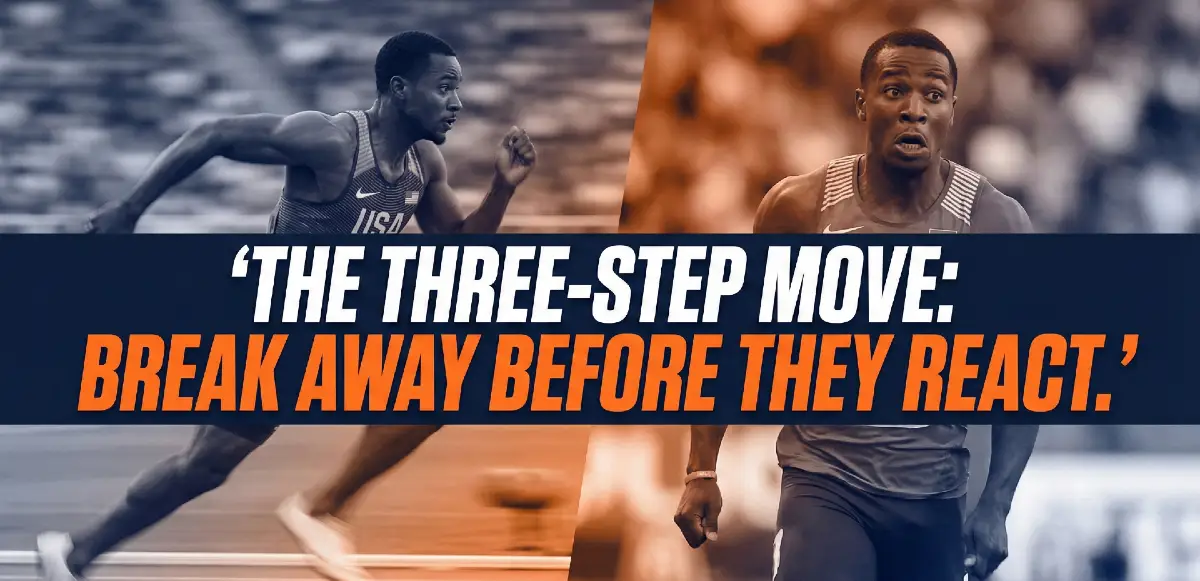
Mike Scannell’s ‘Three-Step Move’ is designed to break the ‘elastic band’ between runners before the opponent even realizes the race has changed. Pass them like they’re standing still and don’t look back. Shut the front door on them.
This isn’t theory. Scannell, who coached Hamilton High School in Arizona to multiple state championships and currently trains Olympic medalist Grant Fisher, has built his entire tactical philosophy around this principle. As he explained in a recent podcast interview, his workouts are ‘really based on the end of races and working with your VO2 max and your breathing.’ The Three-Step Move is the culmination of that training—a violent gear change that exploits both physiology and psychology.
The Strategy: Understanding the Three-Step Move
Most runners have two gears: cruising and kicking. Scannell teaches a third: the ignition.
1. The Mechanics: A ‘Violent’ Gear Change
- Step 1: The Decision. The runner doesn’t just ‘go faster’; they fully commit to a maximum-effort acceleration.
- Step 2: The Burst. This is the ‘violent’ part. For three steps, the athlete isn’t running XC pace—they are sprinting. The goal is to create a 2-to-3-meter gap instantly.
- Step 3: The Re-Settling. Once the gap is established, the runner doesn’t slow back down to their original pace. They settle into a new, slightly faster rhythm.
By the time the opponent reacts, they aren’t just trying to match a pace; they are staring at a significant gap. Psychologically, chasing a gap is much more exhausting than matching a surge.
2. Why It Works: The OODA Loop
In tactical terms, this move exploits what military strategist Colonel John Boyd called the OODA Loop (Observe, Orient, Decide, Act)—a decision-making framework developed for fighter pilots during the Korean War. Boyd discovered that victory went to the pilot who could cycle through these four stages faster than their opponent.
In a race, when you make a move, your opponent must process:
- Observe: ‘He’s moving.’
- Orient: ‘How fast is he moving?’
- Decide: ‘Should I go with him?’
- Act: ‘Okay, I’m going.’
Even with a dim-witted ‘lactate brain,’ if a runner surges gradually, the opponent can process all four stages while still maintaining contact. If a runner uses a Three-Step Move, they have already finished the ‘Act’ stage before the opponent has finished ‘Orienting.’ By the time the opponent decides to move, the ‘elastic band’ has already snapped.
As Boyd emphasized, the key isn’t just moving quickly—it’s moving unpredictably and decisively, forcing your opponent to respond to a situation that has already changed.
3. The Physiological Foundation
Scannell’s approach isn’t just psychological theater—it’s rooted in physiology. His emphasis on VO2max training creates the aerobic capacity necessary to execute these moves. Research published in Medicine & Science in Sports & Exercise demonstrates that high-intensity aerobic intervals (90-95% of max heart rate) are significantly more effective than moderate-intensity training for improving VO2 max—exactly the system you need to recover from a violent acceleration and sustain the new pace.
The Three-Step Move is simply the race-day application of this training philosophy—teaching runners to access maximal effort (anaerobic), recover quickly (lactate tolerance), and settle into a sustainable but elevated pace (VO2max).
🏃 Workout 1: Whistle Surges
Purpose: Develop the ability to execute maximum-effort bursts while fatigued, then immediately return to target pace without ‘dying.’
The Drill
During a standard interval session, blow a whistle at an unexpected moment during a rep. Athletes perform a 3-step maximum acceleration, then immediately settle back into target pace without slowing.
- “Three steps of violence—then back to business.”
- 100% effort bursts—no holding back.
- Start with 1-2 surges, building to 3-4 over time.
- Only surge during the middle 60% of the interval.
👥 Workout 2: The Shadow Drill
Purpose: Teach leaders the power of the gap and followers the difficulty of reacting in time.
The Drill
Pair runners by ability. During a tempo or interval, the leader makes a 3-step move at any point. The follower must stay within one meter. Switch roles between reps.
- Leaders: The psychological impact of a sudden gap.
- Followers: The reaction time lag when closing a 2-meter gap.
- Both: Timing moves when the opponent least expects it (turns, hills).
🏁 Workout 3: Post-Threshold Sprints
Purpose: Simulate the physiological demand of accelerating when already fatigued—race simulation.
The Drill
After a 20-24 min threshold run, immediately transition to 4 × 150m repeats. Start with 20m of violent acceleration, then “float” the remaining 130m fast but controlled.
- Access speed when glycogen is depleted.
- The “float” trains athletes to maintain momentum without crashing.
- Perform once every 10–14 days in-season.
Sample Weekly Structure
| Day | Workout |
|---|---|
| Monday | Easy run (40-50 min) + strides |
| Tuesday | 5 × 1000m @ threshold + Whistle Surges |
| Wednesday | Easy run (30-40 min) |
| Thursday | 20-24 min threshold + Post-Threshold Sprints |
| Friday | Easy run (25-35 min) |
| Saturday | Race OR 3 × 1200m with Shadow Drill |
| Sunday | Long run (60-75 min easy) |
*Note: Structure assumes a Saturday race. Adjust based on your schedule.
The Scannell Philosophy
Here’s the beautiful part of Scannell’s approach: ‘High school kids don’t know what they can’t do.’ If you tell them they can sprint for three steps in the middle of a 3200m, they’ll believe you. If you train them to do it, they’ll break the field.
This isn’t about having the most talent or the highest VO2 max (though Scannell certainly trains those systems). It’s about having a tactical weapon that your competitors don’t see coming—and don’t know how to respond to when it happens.
Watch the video below and notice the surge that David Rudisha throws in at about the 4:30 mark in the video. The race is effectively over 3-4 seconds later.
Additional Resources
To dive deeper into the science and practice behind this tactical approach:
- OODA Loop Research: John Boyd’s Decision-Making Framework
- VO2 Max Training: High-Intensity Aerobic Intervals (Medicine & Science in Sports & Exercise)
- Mike Scannell Interview: Grant Fisher’s Olympic Coach Podcast
- Racing Tactics: McMillan Running’s Simple Tactics
- Scannell’s Philosophy: The Smartest Training of a High School Runner
Putting It Into Practice
Start implementing these drills 4-6 weeks before your championship races. The key is repetition—you want the Three-Step Move to become instinctive, not something athletes have to think about when they’re oxygen-deprived and staring into the face of the God at mile 2.5 of a 5K.
Coach’s Checklist:
- Introduce the concept with Whistle Surges during threshold work
- Progress to Shadow Drills to teach timing and reaction
- Add Post-Threshold Sprints once every 10-14 days
- Practice race scenarios: when to make the move (turns, hills, after aid stations)
- Video review: Show athletes what the move looks like and its psychological impact
Most importantly, give your athletes permission to be aggressive. Too many high school runners wait for the perfect moment that never comes. The Three-Step Move teaches them that they can create their own opportunities—and that decisive action beats perfect timing.
The Race That Changed Everything
Remember that junior I mentioned at the beginning? The next season, in cross country, we trained the Three-Step Move relentlessly. Shadow drills. Whistle surges. Post-threshold sprints. She hated them at first. But eventually, they became second nature.
At the state championship, she made her move with 600 meters to go. Three steps of violence. A 2-meter gap opened instantly. Her competitors—two girls that had beat her the year before—tried to respond, but by the time they processed what was happening and decided to chase, Charlotte was already settling into her new pace, gap intact.
She won by 9 seconds.
After the race, she told me: ‘Coach, I knew I could go when I made the move. The other two were struggling and nobody was watching out for me.’
That’s the power of the Three-Step Move. It’s not just a tactical tool—it’s a mindset. It teaches your athletes that they don’t have to wait for someone else to make a mistake. They can force the issue. They can break the field. They can win.