
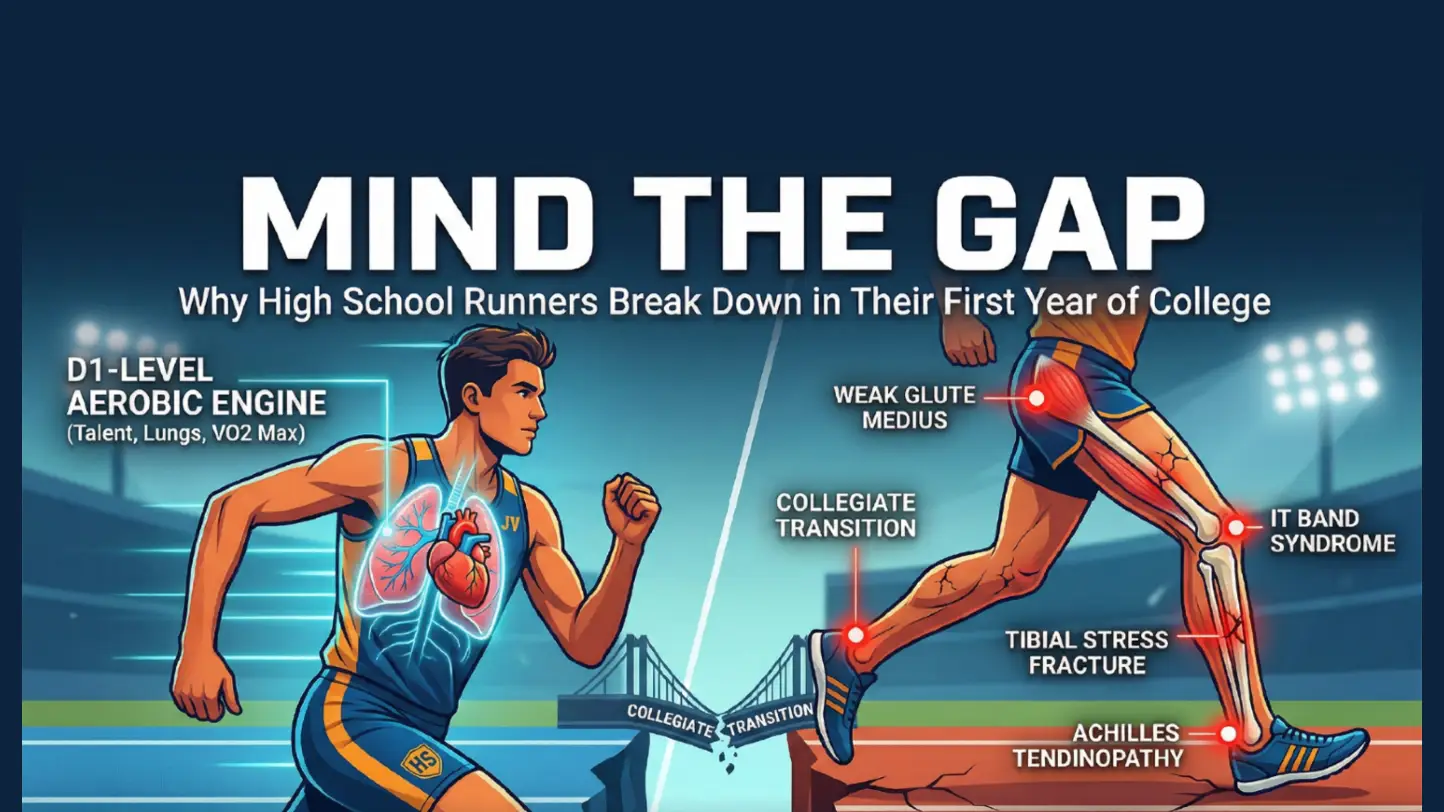
Mind the Gap: Why High School Runners Break Down in Their First Year of College
Your athletes have the lungs of a D1 runner. Their tendons, bones, and stabilizers? Still running JV.
It was late October, the week after our state qualifier, when I got a call from Jake’s college coach.
Jake had been one of the best distance runners I’d ever coached. Talented freshman, improved every year, ran 15:02 as a senior. Scholarship to a mid-major D1 program. The whole package. I’d watched him run a flawless championship race just six weeks earlier.
“He’s got a tibial stress fracture,” the college coach said. “Three weeks into the season.”
I’d like to tell you I was surprised. I wasn’t.
Jake had run 35 miles a week in high school. At his new program, they bumped him to 75 in August alone. His cardiovascular system handled it just fine. His aerobic engine was legitimately D1. His heart rate was low. His VO2 max was excellent. His times backed it all up.
But the structure holding that engine together? It had never been asked to carry this load before.
His lungs were ready for college. His tibia wasn’t.
I’ve been coaching high school distance runners for over 23 years. I’ve produced 31 state champions. And the single most consistent failure I see — in my own programs, in programs across the country — is not a lack of aerobic development. It’s a lack of structural development. We build turbocharged engines and bolt them into go-kart frames, then act confused when the whole thing falls apart under race conditions.
This post is about closing that gap. And I’m going to give you the exact 15-minute tool to do it.
⏱️ The “TLDR” Summary
The Problem: High school distance runners are aerobically advanced — and structurally unprepared. Mileage is up. Strength work is an afterthought. The result is a wave of first-year college athletes breaking down before they ever get to race.
The Science: Aerobic fitness (VO2 max, mitochondrial density) adapts in weeks. Tendons, ligaments, and bone require months to years of progressive loading. This lag — the structural gap — is where careers end.
The Solution: A non-negotiable, year-round strength progression built on single-leg stability, glute activation, and Achilles/calf loading. No weight room required. Just 15 minutes after practice — consistently.
The Paradox Nobody Talks About
Here’s the uncomfortable truth about modern high school distance running: we’re generally very good at developing aerobic systems and very bad at developing everything else.
Mileage totals are up. GPS watches track every split. Heart rate training zones are a real conversation at the high school level now. Freshman girls are running 30 miles a week. Boys logging 60 by their junior year. VO2 max testing. Double threshold workouts. The aerobic science is real and it’s working.
But walk into any high school cross country program in America and ask: “What does your structured strength progression look like?”
Most coaches will pause. Some will mention a core routine they do twice a week “when there’s time.” A few do hill bounding. Almost none have a periodized, year-round plan that systematically loads the tendons, bones, and stabilizer muscles with the same intentionality they bring to mileage progression.
The result? We produce athletes who are aerobically ready for Division I and structurally still running JV.
A 2024 systematic review in the Journal of Orthopaedic & Sports Physical Therapy tracking high school and collegiate cross-country runners found that sex, injury history, and RED-S risk factors were the strongest predictors of running-related injury — and that changes in training load were a key modifiable factor coaches should study further. And a survey of over 740 high school cross-country athletes found that 68% of female subjects and 59% of male subjects reported a history of overuse injuries, with tibial stress injury leading the list — and researchers concluded that future studies should evaluate the effects of a comprehensive strength training program on prospective injury prevention in this population.
We want to send durable athletes to the next level. What we are sending now are aerobically gifted, structurally fragile runners.
📊 KEY STATS
Injury Rates: NCAA Division 1 cross-country athletes experience the highest rate of overuse injuries in college sports.
Bone Adaptation: Human bone requires approximately four months to adapt to increased running speeds by becoming stronger and denser. Structural integrity always lags behind aerobic fitness.
Tissue Adaptation: Physical therapists suggest it takes 6–12 weeks for connective tissue adaptation to occur.
The Science of the Structural Gap
Here’s how I explain this to parents who don’t understand why their fast kid is always hurt.
Imagine your athlete’s cardiovascular system is a brand-new, high-performance engine. Six weeks of consistent training and that engine is measurably stronger — more mitochondria, better capillary density, improved fat oxidation. The aerobic system adaptations are very fast.
Now imagine the frame the engine sits in — the tendons, ligaments, cortical bone, and the small stabilizing muscles nobody talks about. That frame adapts on an entirely different timeline.
Structural adaptation to training in bones, tendons and ligaments requires months or years to be fully realized — a much slower process than gaining aerobic fitness.
Tendons are even more nuanced. Because of the limited blood flow and nutrient supply available to tendons and ligaments compared to muscle, adaptation takes years..
The metaphor that actually lands with my athletes: “Your aerobic system is the engine. Your tendons, bones, and glutes are the chassis. A Formula 1 engine in a cardboard frame doesn’t win races — it disintegrates on the course.”
So what happens when a structurally underprepared athlete arrives at a D1 program and mileage jumps from 35 to 75+ miles per week in six weeks? Exactly what happened to Jake. The engine performs fine. The frame fails.
The Specific Failures: What’s Actually Breaking Down
When I dig into my own athletes’ injury histories, four structural failures show up again and again.
1. Gluteus Medius Weakness → IT Band Syndrome & Shin Splints
The gluteus medius is the primary hip abductor and external rotator. Its job is to keep the pelvis level and the legs tracking properly every single time the foot hits the ground. When it’s weak, the legs rotate inward, stress propagates down the kinetic chain, and the IT band and tibialis posterior take the hit.
Studies found a significant difference in hip abductor strength between injured and healthy runners with IT band syndrome. Two European studies by Verrelst and associates showed that weak gluteus medius led to shin splints in athletes, with clinicians finding gluteus medius tests weak in at least two-thirds of runners presenting with shin pain. So weak glutes can cause shin splints? Who knew?
2. No Specific Calf/Achilles Loading → Bone Stress Injuries
The soleus is thought to be particularly important in reducing the bending force that the tibia experiences during impact, which is considered key to the development of bone stress injury. A weak soleus means every step sends more bending stress directly to the bone.
3. No Single-Leg Stability → Compensation Patterns
High school training rarely includes true single-leg strength work. Exercises like Bulgarian split squats and deadlifts are particularly effective in targeting weak stabilizers, and strength training reduces the risk of repetitive stress injuries by addressing muscle imbalances and improving joint stability.
🩺 Injury-to-Cause Table
| Structural Weakness | Downstream Injury Risk | Prevention Exercise |
|---|---|---|
| Gluteus Medius | IT Band Syndrome, Shin Splints, Runner’s Knee | Clamshells, Single-Leg Glute Bridge, SL Deadlift |
| Soleus / Calf Complex | Tibial Stress Fractures, Achilles | Single-Leg Bent-Knee Calf Raises |
| Core Anti-Rotation | Low Back Pain, Form Collapse | Dead Bug, Plank |
| Single-Leg Stability | Ankle and Knee Stress | Bulgarian Split Squat, Step-Ups |
The “No Time” Myth
I’ve heard every version of this objection.
“Coach, we barely have time for the actual run.”
“I don’t like the weight room.”
“I’m not trying to get swole.”
Here’s my response: If you don’t have 15 minutes for strength work, you won’t have months for injury rehabilitation.
A tibial stress fracture costs 8–12 weeks of real training. IT band syndrome, managed poorly, can derail an entire season. The time cost of not doing the work far outweighs the time cost of doing it.
No weight room? No problem.The optimal injury-prevention routine for runners consists of exercises targeting the gluteal muscles — clamshells, side steps, single-leg glute bridges, bent-knee quadruped hip extensions, side-lying leg lifts, and single-leg deadlifts — all bodyweight, all doable on the track surface.
The best implementation I’ve found is immediately post-practice, on the track, before anyone gets in a car. No commute. No equipment. Shoes still on. Fifteen minutes. Done.
⏱️ The 15-Minute Durability Circuit: Build the Frame
This is the system I’ve refined over years of coaching and observing what our athletes actually need at the structural level. The order matters.
PHASE 1 — Dynamic Mobility (3 Minutes): Open the System
- Hip 90/90 Rotations — 6 per side. Restore internal and external hip rotation before loading.
- Ankle Circles + Dorsiflexion CARs — 8 per side. Wake up the ankle complex.
- Thoracic Rotation in Quadruped — 8 per side. Open the upper back so the core doesn’t compensate.
- Leg Swing Progressions (forward/lateral) — 10 per side. Actively lengthen hip flexors and adductors.
PHASE 2 — Muscle Activation (4 Minutes): Wake Up the Stabilizers
- Clamshells — 15 per side, slow and controlled. Feel the burn in the lateral hip, not the quad. This is glute medius isolation.
- Single-Leg Glute Bridge — 10 per side. Drive through the heel. Pause 2 seconds at top. The pause activates the posterior chain instead of defaulting to lumbar extensors.
- Dead Bug — 8 per side. Opposite arm/leg, lower back pinned to the ground. Activates the deep core stabilizers before loading the body in single-leg positions.
PHASE 3 — Foundational Strength (8 Minutes): Load the Frame
- Single-Leg Deadlift — 3×8 per side. Hinge at the hip, flat back. Recent research confirmed that the single-leg RDL challenges the whole glute complex making it one of the most efficient structural exercises for distance runners.
- Bulgarian Split Squat — 2×10 per side. Rear foot elevated. Front knee tracks over second toe. This is where you find the asymmetries that become injuries.
- Single-Leg Bent-Knee Calf Raise — 3×12 per side, 3-second eccentric. Bent-knee specifically loads the soleus. Do not rush this one.
- Copenhagen Plank — 3×20 seconds per side. Inner thigh foot on a bench, bottom leg hovering. Athletes showed dramatic groin injury reductions in athletes who included Copenhagen planks.
Compliance: How to Make This Stick Without It Feeling Like Punishment
A few things I’ve learned about implementation:
Anchor it to practice. It happens on the track, immediately after the cool-down jog. Non-negotiable, like the warm-up.
Use the science as a selling tool, not a lecture. Show athletes the data. Tell them about the structural gap. High school athletes respond incredibly well to the honest explanation: “Your aerobic system is ready. Your frame isn’t. This is how we fix that.” They’re not children — they can understand the mechanism, and when they do, they buy in.
Pair it with a story. Jake’s story, or even better, your own version of it — is more persuasive than any research citation. “Here’s an all-state athlete who did everything right, was recruited, and still lost his freshman year to a stress fracture” lands hard.Progress it across the year: Summer/preseason = 3 days per week. Competitive season = 2 days (never night before race). Offseason/winter base = back to 3 days. The stimulus needs to be consistent over months and years. That’s how structural adaptation happens.
🏋️ Coach’s Challenge to You
Audit your program. When did your athletes last do progressive single-leg strength work? If the answer is “never” or “sometimes,” you have a structural gap. Acknowledge it and fix it.
Start this week. After your next practice. All 15 minutes. Yes, even mid-season. Your athletes are not too fragile for 15 minutes of bodyweight work.
Have the conversation. Explain the engine vs. chassis concept. Use a convincing story. Athletes who understand will train with intention.
Commit to the offseason. The athletes most at risk are the ones with huge aerobic engines who took November through January completely off.
The Bottom Line
I’ve watched too many talented athletes arrive at college with legitimate D1 engines and spend their freshman year in the training room. I’ve watched high school coaches — good coaches, people who care deeply — inadvertently produce that outcome because nobody told them that mileage and structural preparation are not the same thing.
They’re not. And the gap between them is where careers end.
Building a fast athlete and building a durable athlete are the same job. You cannot separate them. An athlete who is aerobically brilliant but structurally fragile is not a developed athlete — they’re a liability waiting to happen. Developing their structure is not extra work. It’s basic work.
Fifteen minutes. Bodyweight. On the track. No excuses.
Jake’s stress fracture healed. He had a strong sophomore year. But he missed the fall races that matter for visibility and team positioning. He spent October doing pool running and learning to hate the ARC trainer instead of racing the people he’d trained all summer to beat.
That cost is real. And for most athletes, it’s preventable. Chassis and frame for the win.
📥 Ready to build a more resilient chassis?
Download the complete 15-Minute Runner’s Durability Circuit PDF. It’s fully scannable, requires zero equipment, and can be done right on the track after a workout.
Download the Free PDF