
Best Running Shoes for Shin Splints (2026): Coach-Tested
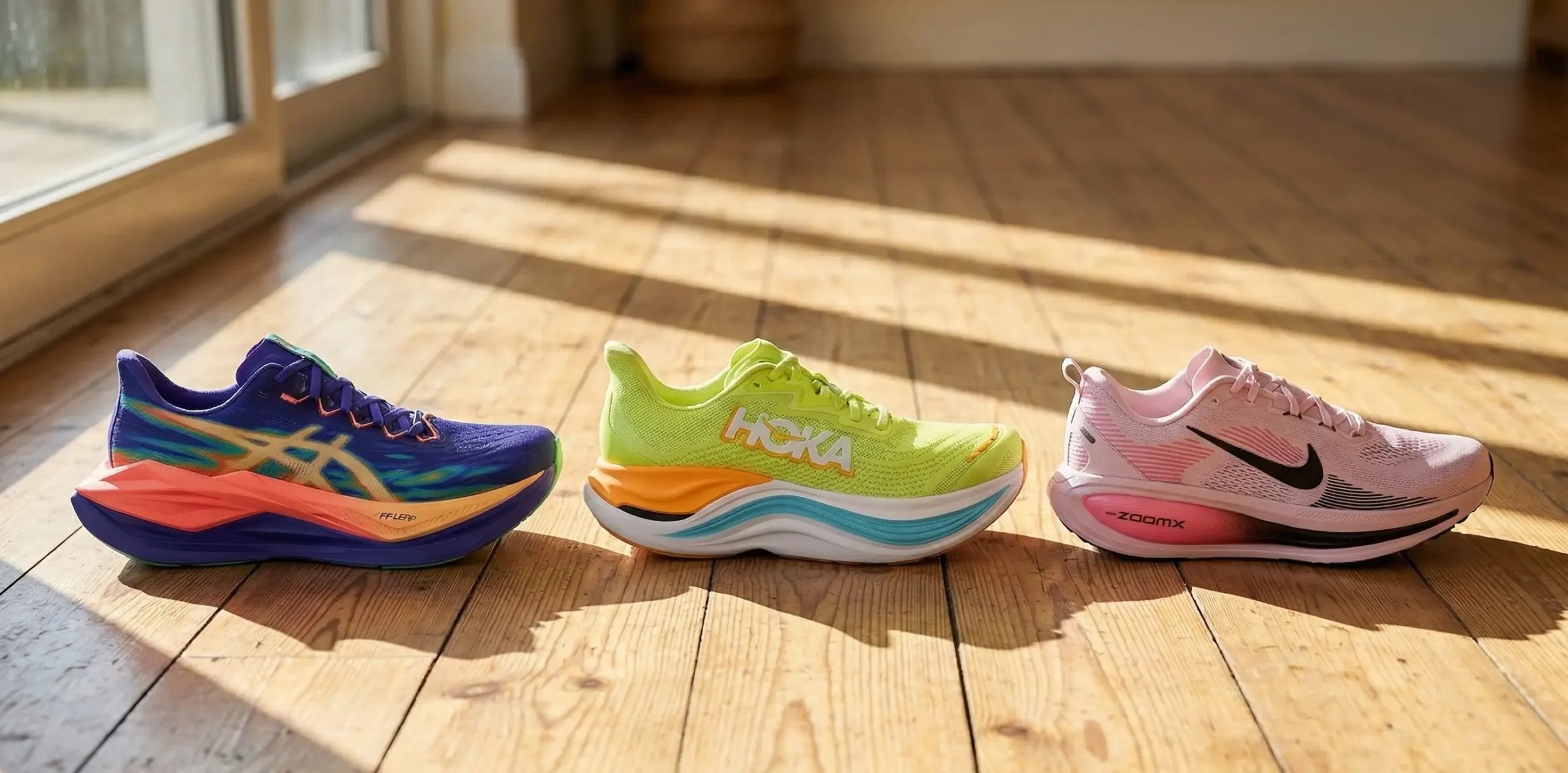
Shin splints are the most common overuse injury in distance running, and the right shoe is one of the few prevention tools you can put on tomorrow. After twenty-five years coaching high school distance runners and watching the same injury take down athletes every preseason, here are the five shoes I actually recommend in 2026, sorted by what you need them for, with budget picks under $200 and separate guidance for women and men.
Quick Answer: The Best Shoes for Shin Splints in 2026
- Best overall: ASICS Superblast 3 — tall, protective cushioning that still runs fast ($210)
- Best for overpronation: New Balance Fresh Foam X 1080v14 — stable, planted, comes in wide ($165)
- Best for recovery and easy days: Nike Vomero 18 — max-cushion, higher drop, eases calf and shin load ($141)
- Best budget pick (under $150): Brooks Ghost 17 — reliable, stable, easy on inflamed shins ($140)
- Best for high mileage: Hoka Skyward X — the most total shock absorption on this list ($225)
All five are neutral-to-stability daily trainers chosen for impact protection. The right one depends on your mileage, your foot mechanics, and whether your shins hurt right now. Details below, plus the part most lists leave out: the shoe is not the whole fix.
One thing up front, because it is the most important sentence on this page. A shoe reduces the impact force reaching your shin, and that genuinely helps, but shin splints are a load problem first. If your mileage is climbing faster than your bones can adapt, no shoe will save you. I will cover both the shoes and the load, because that is the only honest way to answer this question.
How I Chose These Shoes
I am a USATF Level 2 endurance coach, and I have spent more than two decades putting shoes on teenage runners and watching what happens to their legs. These picks are filtered through that, not through a spec sheet alone. Every shoe here meets three tests: enough cushioning to meaningfully reduce peak tibial impact, a heel drop that keeps loading sensible for a shin-splint-prone runner, and durability that survives real training volume. I note where I have seen a shoe work and where it does not, including the athletes I steer away from it. Some links are Amazon affiliate links; I only list shoes I would put on athletes I coach.
Comparison Table: 2026 Shin Splint Shoe Picks
| Shoe | Best For | Stack (Heel) | Drop | Weight | Price |
|---|---|---|---|---|---|
| ASICS Superblast 3 | Overall pick, tempo + long runs | 46.5mm | 8mm | 8.4 oz | $210 |
| NB Fresh Foam X 1080v14 | Overpronation, daily training | 38mm | 8mm | 9.3 oz | $165 |
| Nike Vomero 18 | Recovery + easy days | 46mm | 10mm | 10.5 oz | $141 |
| Brooks Ghost 17 | Budget pick, easy days | 36mm | 12mm | 9.6 oz | $140 |
| Hoka Skyward X | High mileage, Achilles history | 48mm | 5mm | 11.3 oz | $225 |
The 5 Best Running Shoes for Shin Splints in 2026
1. ASICS Superblast 3 — Best Overall ($210)
Best for: Long runs, tempo work, and athletes who want one protective shoe that still runs fast
The Superblast has been the gold standard of the super trainer category since 2022, and the third generation (available from late February 2026) is a real step forward. ASICS replaced the previous foam with FF Leap, an A-TPU material previously reserved for their $250-plus MetaSpeed racing series. The difference is immediate: the Superblast 3 performs out of the box where the v2 needed 50-plus miles to find its rhythm. ASICS reports 15% improved energy return versus the previous model.
Key specs: 46.5mm heel / 38.5mm forefoot · 8mm drop · 8.4 oz (men’s US 9) · wider toe box than v2
Why it helps shin splints: The 46.5mm heel stack is among the tallest in any daily trainer, and it absorbs the repetitive asphalt impact that otherwise transfers straight into the tibia. The 8mm drop keeps loading balanced between calf and knee without the extreme heel elevation that creates its own problems over time.
Coach’s note: This is where I send most athletes asking for a single shoe for the season. It is light enough for threshold and pace work, protective enough for easy mileage on hard roads, and it lives in a narrow window most shoes cannot hit. One caveat: the softer new foam shows some lateral instability at very slow paces for heavy overpronators. For neutral to mild pronators, which is most serious runners, it is excellent.
2. New Balance Fresh Foam X 1080v14 — Best for Overpronation ($165)
Best for: Daily training at all paces, especially flat-footed or overpronating runners
The 1080 has been New Balance’s flagship daily trainer for over a decade, and the v14 is the most protective version yet. The Fresh Foam X midsole, NB’s highest-density cushioned foam, delivers 38mm of heel stack in a shoe that runs more stable than its softness suggests.
Key specs: 38mm heel / 30mm forefoot · 8mm drop · 9.3 oz (men’s US 9) · available in 2E wide
Why it helps shin splints: Slightly lower stack than the Superblast 3, but the broader base and denser foam give better stability for runners with moderate overpronation, a genuine mechanical driver of MTSS. The 8mm drop is what I recommend for most shin-splint-prone athletes.
Coach’s note: I steer this toward runners who found the Superblast unstable, and toward anyone whose shin pain comes alongside arch fatigue or general foot soreness, signs that foot mechanics are part of the picture. It is a more planted ride than the Superblast, which is exactly what some runners need. The wide sizing is a real advantage if your foot has ever felt crammed.
3. Nike Vomero 18 — Best for Recovery and Easy Days ($141)
Best for: Easy and recovery days, the day after a hard effort, beat-up legs
Nike overhauled the Vomero line in early 2025, and the 18 became a genuine max-cushion recovery tool. They stacked ZoomX foam (PEBA-based, the same foam in the Alphafly racer) over a thick ReactX base, producing a dual-foam midsole that is plush on impact yet responsive enough not to feel dead.
Key specs: 46mm heel · 10mm drop · ~10.5 oz (men’s US 9) · dual ZoomX + ReactX midsole
Why it helps shin splints: The 10mm drop encourages a slightly rearward loading pattern that reduces calf and Achilles demand on days when those structures are already stressed. The higher weight naturally slows your gait, which is the entire point of a recovery day. Runners who push their easy days too fast, which is most of them, will naturally back off in this shoe.
Coach’s note: Easy days are easy days. Keeping that pace truly aerobic is one of the most protective habits there is, and this shoe is a mechanical nudge toward it. Reviewers who say it does not feel fast are correct. It is not supposed to be fast. It is supposed to save your legs. Sizing runs slightly snug; if between sizes, go half up.
4. Brooks Ghost 17 — Best Budget Pick Under $150 ($140)
Best for: Easy days, runners coming out of motion-control shoes, anyone shopping on a budget
The Ghost has been one of the most reliable daily trainers in running for over a decade. The v17 uses Brooks’ DNA Loft v3, a nitrogen-infused EVA foam that cushions meaningfully better than older Ghost versions without the PEBA price.
Key specs: 36mm heel / 28mm forefoot · 12mm drop · 9.6 oz (men’s US 9) · GuideRails stability system
Why it helps shin splints: The GuideRails, two denser foam segments on each side of the midsole, give passive stability without a rigid medial post, reducing overpronation without overcorrecting. The 12mm drop is the highest on this list, which makes it a good fit for runners with calf tightness or Achilles history alongside the shin pain.
Coach’s note: This is my pick when budget is a real constraint or when a runner is stepping down from a motion-control shoe and needs less support while still protecting an inflamed shin. At $140 it is accessible and it works. Not the most exciting shoe here, and it does not need to be.
5. Hoka Skyward X — Best for High Mileage ($225)
Best for: High-mileage runners, Achilles or calf history, rough-surface running
The Skyward X is Hoka’s answer to the super trainer category, and they did not go halfway: 48mm of heel stack built around a convex H-shaped carbon suspension plate between a PEBA top layer and a supercritical EVA frame. That plate is not a propulsive racing plate. It is an engineering fix for a specific problem, how to hold the geometry and stability of a 48mm foam stack together through thousands of miles. It locks the foam, maintains the rocker, and rolls the foot forward in a way that reduces Achilles and calf loading.
Key specs: 48mm heel / 43mm forefoot · 5mm drop · 11.3 oz · H-shaped carbon suspension plate
Why it helps shin splints: For anyone running 40 to 50 miles a week on varied surfaces, this offers more total shock attenuation than anything else here. The rocker reduces peak Achilles force on each stride, which matters when shin symptoms travel with lower-leg tightness.
Coach’s note: I steer this toward high-mileage runners, especially those carrying lower-leg tightness out of a hard season. At 11.3 oz it is a dedicated easy-day shoe. Do not race or do quality work in it. But on back roads during base building it can meaningfully cut the cumulative tibial load that causes MTSS. Hoka tends to fit narrow; size up half if between sizes.
Best Running Shoes for Shin Splints: Women
Every shoe above comes in a women’s version, and all five are good choices. But two points matter specifically for female runners, because they are not interchangeable with the men’s guidance.
First, female distance runners develop shin splints at meaningfully higher rates than male runners, with some studies reporting roughly 41% lifetime prevalence in girls versus 34% in boys. The reasons include differences in bone density timelines, hormonal effects on bone metabolism, and gait patterns (higher hip adduction and knee valgus) that increase tibial bending stress. A cushioned, stable shoe is more important, not less.
Second, and I cannot say this strongly enough, for a female runner with recurring shin splints the conversation cannot stop at footwear. Inadequate fuel relative to training load, known as RED-S (Relative Energy Deficiency in Sport), directly weakens bone and is more common in female distance runners. If shin pain keeps returning, screen nutrition (calcium, vitamin D, total caloric intake) before you buy another pair of shoes.
My women’s picks: the New Balance 1080v14 for daily training (stable, comes in wide and narrow), the Nike Vomero 18 for recovery, and the ASICS Superblast 3 if you want one shoe that does everything.
Best Running Shoes for Shin Splints: Men
Men’s shin splints most often trace back to one thing: a fast jump in training load on hard surfaces, frequently combined with running easy days too fast. The shoe picks are the same five, and the order I recommend them in does not change. For most male runners I start with the ASICS Superblast 3 as the do-everything shoe, add the Nike Vomero 18 or Brooks Ghost 17 as a dedicated easy-day shoe, and reserve the Hoka Skyward X for those logging genuinely high mileage. If you overpronate or have wide feet, start instead with the New Balance 1080v14.
Best Shoes for Shin Splints Under $200
Three of the five picks come in under $200, and you do not need to spend more than that to protect your shins well. If budget is the deciding factor:
- Brooks Ghost 17 ($140) — the best value here, stable and protective, ideal for easy days
- Nike Vomero 18 ($141) — the most cushioning per dollar, excellent for recovery
- New Balance 1080v14 ($165) — the best budget choice if you overpronate or want a do-everything daily trainer
The Superblast 3 ($210) and Skyward X ($225) are worth the premium for specific needs (a fast-and-protective single shoe, or very high mileage), but a runner on a budget loses very little by building a two-shoe rotation from the Ghost and the 1080.
What to Look For in a Shoe for Shin Splints
If none of the five fit your foot, here is how to evaluate any shoe yourself. These are the four things that actually matter.
Cushioning and stack height. More foam between your foot and the road means less peak impact force reaching the tibia. For a 130-lb runner at 7:00 pace, each foot strike generates roughly 2.5 to 3 times bodyweight in ground reaction force, repeated about 1,500 times per mile. A tall, responsive stack absorbs and distributes that load before it reaches bone. Look for 38mm or more of heel stack.
Heel drop. The difference between heel and forefoot height changes where stress concentrates. Higher drop (10 to 12mm) shifts load toward the knee and Achilles, easing calf and shin demand. Lower drop (0 to 4mm) does the opposite. For shin symptoms, a moderate drop of 6 to 10mm is usually the safest choice.
Stability. If you overpronate (your foot rolls inward excessively after heel strike), look for a stability feature like GuideRails or a broad, dense base. Overpronation is one of the mechanical drivers of tibial rotational stress.
Durability. Cushioning that packs out in 150 miles is not protecting you by mile 200. Daily trainers with quality foam hold their structure for 400 to 500 miles. Replace them before they go flat.
The Honest Part: A Shoe Is Not the Whole Fix
This is where most “best shoes for shin splints” lists stop, and it is where the real answer begins.
“Shin splints” usually means medial tibial stress syndrome (MTSS), inflammation of the tissue covering your shin bone from repetitive loading. It sits on a continuum with stress fractures. Untreated, it can progress to a tibial stress reaction and then a full stress fracture, a six-to-ten-week injury. Shin pain is a warning signal, not something to run through.
Four mechanical factors drive MTSS, and a shoe only addresses two of them:
- Rapid training load increase — the most common trigger, and a shoe does nothing for it
- Low arch or flat-foot mechanics — higher tibial bending stress; may need orthotics, not just a shoe
- Overpronation — a stability shoe helps here
- Hard-surface impact without cushioning — a cushioned shoe helps here
The single most reliable predictor of shin splints at every level I have coached is a training load that climbs faster than the body can adapt. Keep weekly mileage increases at or under roughly 10%. Run easy days genuinely easy. Build a shoe rotation so your recovery shoe, workout shoe, and race shoe are not the same pair. Add calf raises and posterior-chain strength work. Those habits prevent more shin splints than any single shoe on this page.
Already Have Shin Splints? Do This Now
The picks above are preventive. If your shins hurt right now:
- Days 1 to 3: cut mileage 30 to 50%, get off hard surfaces, and run only in max-cushion shoes. Look back at your training log: what changed in the last two weeks?
- Days 3 to 14: swap in pool running, elliptical, or the bike to keep fitness without loading the tibia. Start calf raises. Do not return to full training while it still hurts.
- See a doctor if: the pain is focal and pinpoint rather than diffuse, it worsens after you warm up instead of easing, you have pain at night or rest, or there is no improvement after two weeks of modified training. Those are stress-fracture signs and need imaging, not a new shoe.
Frequently Asked Questions
What are the best running shoes for shin splints?
For most runners, the ASICS Superblast 3 is the best overall pick because it combines a tall protective stack with a sensible 8mm drop and still runs fast. If you overpronate, the New Balance 1080v14 is the better starting point. For recovery days, the Nike Vomero 18. On a budget, the Brooks Ghost 17 at $140.
Do cushioned shoes actually help shin splints?
Yes, for two of the four causes. A cushioned shoe reduces the peak impact force reaching your shin on hard surfaces, and a stability shoe reduces overpronation stress. Neither fixes a training load that is climbing too fast or flat-foot mechanics that may need orthotics. The shoe is a real tool, not a complete solution.
What heel drop is best for shin splints?
A moderate drop of 6 to 10mm suits most runners with shin symptoms. A higher drop (10 to 12mm, like the Brooks Ghost) shifts load away from the calf and shin and can help when Achilles or calf tightness comes along with the shin pain.
Can the wrong shoes cause shin splints?
They can contribute. Worn-out shoes with packed-out foam, shoes too minimal for your mileage, or racing flats used for daily road training all raise the impact load on the tibia. But the wrong shoe rarely acts alone; it usually combines with a fast mileage increase.
Should I keep running with shin splints?
Not at full load. Cut mileage, get off hard surfaces, and cross-train to hold fitness. If the pain is pinpoint rather than diffuse, worsens after warming up, or wakes you at night, stop and see a sports medicine physician, because those are stress-fracture warning signs.
Related Coaching Guides
If you are working through shin splints, these go deeper on the load side of the equation, which is where most cases actually start:
- Progressive mileage guidelines — how to build volume without outrunning your bones
- Strength training for distance runners — the calf and posterior-chain work that protects the tibia
- The Norwegian Method guide — structuring easy and hard days so the easy days stay easy
Affiliate disclosure: some links on this page are Amazon affiliate links. If you buy through them, I may earn a small commission at no extra cost to you. I only recommend shoes I would put on the athletes I coach.