

The High School Coach’s Guide to the Norwegian Method

The short answer
High school runners should not copy the Norwegian Method. Double threshold days, lactate meters, and 100-plus-mile weeks do not fit a school schedule or a teenage aerobic base. The principle that does transfer is intensity control: more time at a strictly controlled threshold effort. Spread it across two practices a week and regulate it by feel.
Picture the two-mile mark of a championship race. Your top varsity girl should be surging toward a PR. Instead, she is fading. Her breathing is labored. Her stride is choppy. Her form is coming apart, and the race is slipping away.
Three weeks earlier, her coach got caught up in the Norwegian Method hype. The lactate-guided double threshold system turned Jakob Ingebrigtsen and his brothers into distance running royalty. The coach read the articles, watched the documentaries, and thought: this is the secret. So the mid-season block got double threshold sessions. Tempo at 6 AM before school. Intervals at 3 PM after class. A high school squad training like Olympians.
That scenario is a trap waiting for every eager, competitive distance coach. I know, because I have fallen into a version of it. I have handed a plan built for a high-caliber athlete to a beginner, and I paid the price.
Here is what every coach needs to understand: your varsity squad is not the Ingebrigtsen family. Copy elite training directly and you will wreck high school athletes.
The good news: the principles behind the Norwegian Method are sound, and the science is legit. Adapt them correctly and threshold training can transform your program. No lactate meters. No 6 AM doubles. No kids parked in the training room.
Here is how.
The Norwegian Method: what everyone is talking about
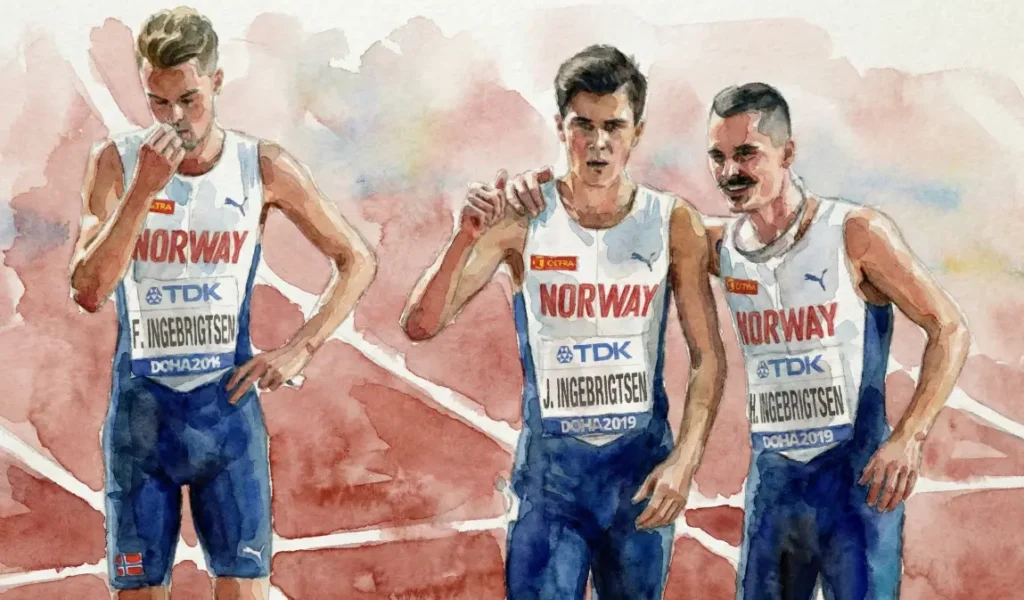
If you have been anywhere near the distance running community in the past few years, you have heard about the Norwegian Method. It is the system behind Olympic champion Jakob Ingebrigtsen and his brothers, all European 1500m champions from the same family. Teen phenoms Sam Ruthe and Cooper Lutkenhaus have borrowed from it too.
The core principles are deceptively simple:
- Double threshold training: two threshold workouts in a single day, typically separated by 5+ hours.
- Lactate-guided intensity: portable lactate meters keep blood lactate between 2.0 and 4.5 mmol/L.
- High volume, controlled intensity: around 180 km a week (roughly 112 miles), with threshold work twice weekly.
- The 80/20 split: 80% easy aerobic running, 20% high-quality threshold work.
The advantage, according to the research, is volume. Athletes accumulate more running at fast paces with less fatigue than traditional interval training produces.
Here is why it works at the elite level. Splitting threshold work into morning and evening sessions lets athletes log more total minutes at or near lactate threshold without crossing into the zone where lactate builds faster than the body can clear it. The evening session benefits from partial glycogen replenishment and hours of recovery from the morning.
Elite system vs. your team
Put the two side by side and the gap is obvious.
| Ingebrigtsen system | Norwegian-Lite for high school | |
|---|---|---|
| Threshold days | Twice a week, two sessions each day | Twice a week, one session each day |
| Recovery between sessions | 7 to 8 hours of rest and food | 48 hours between threshold days |
| Intensity control | Lactate meter, 2.0 to 4.5 mmol/L | Talk test, RPE 6 to 7, heart rate |
| Weekly volume | About 112 miles | 20 to 55+ miles by class year |
| Equipment cost | $300 to $500 meter, plus strips | Nothing |
The problem: why this breaks high school athletes
Let’s be brutally honest about why the Norwegian Method, as the Ingebrigtsens practice it, will not work for your team.
1. The schedule reality
The Ingebrigtsens run their morning threshold session around 8 to 9 AM and their evening session around 4 to 5 PM. That is a 7 to 8 hour recovery window with proper food and rest.
Your reality? A 6 AM workout before school is a huge ask for parents and for sleep-deprived athletes. Then classes. Then a 3 PM practice. That is 9 hours, but your athletes are not resting. They are sitting in chemistry, stressed about a calculus test, surviving on cafeteria pizza and energy drinks.
The logistics alone make true double threshold training nearly impossible for high schoolers.
2. The equipment gap
Elite Norwegian athletes test blood lactate in real time, pricking a finger between intervals to stay in the 2.0 to 4.5 mmol/L range.
A basic lactate meter costs $300 to $500. Test strips run $2 to $3 each. Test 15 varsity athletes twice a week with 8 to 10 readings per session and you burn through more than 1,000 strips a month. That is over $2,000 a month in strips alone.
That does not count the liability of medical testing on public school students. Any coach with common sense would not touch this with a 10-foot pole.
3. The aerobic base problem
The Ingebrigtsens did not start with double thresholds. They spent years building massive aerobic bases. During base periods, most of their training sits in zones 1 and 2, below lactate threshold, with only one session a week in zones 4 or 5.
Your typical high school runner has 2 to 3 years of competitive training at most. Freshman year, maybe 15 to 25 miles a week. Junior year, 35 to 40.
Jakob Ingebrigtsen has run high volume since his early teens and averages around 112 miles a week.
Most high school athletes simply do not have the aerobic engine to handle the volume and intensity of true Norwegian-style training.
4. The injury risk
Try it with high school runners and here is what shows up within three weeks:
- Stress reactions
- Overtraining
- Chronic fatigue that takes a month or more to clear
High school runners are still developing physically. Stacking frequent high-intensity work on a growing body puts young runners at serious risk for overuse injuries. It is also why you need to understand the gap between high school and college training demands before you push.
The adaptation: Norwegian-Lite for high school
You do not need to copy the Norwegian Method. You need to adapt it.
I spent six months studying the research, consulting with exercise physiologists, and experimenting with my own athletes. The result is what I call Norwegian-Lite: a system that captures the benefits of threshold training without the equipment, the logistics, or the injury risk.
Want the 14 weeks written out for you?
The Norwegian Method 14-Week XC Plan turns these principles into a full season, from base building to the championship meet.
- The Master Plan: 14 weeks, 4 athlete levels, 56 weekly templates
- The Coach’s Guide: why each session works and when to bend the plan
- Athlete workout sheets: day-by-day, printable, with color-coded effort tags
One-time purchase. Covers your whole coaching staff and team. 30-day money-back guarantee.
Principle 1: controlled thresholds over double thresholds
Forget the double sessions. Run your threshold work at a strictly controlled intensity inside your regular practice structure. The magic of the Norwegian Method is not the timing of the sessions. It is the intensity control. The goal is more volume at threshold pace without excessive fatigue.
| Approach | Threshold sessions |
|---|---|
| Elite Norwegian Method | 2 x (6 x 3 min at threshold), both on the same day |
| High school Norwegian-Lite | Tuesday: 9 x 3 min, 90 sec recovery Thursday: 7 x 4 min, 2 min recovery |
Same short, controlled repeats. You just spread them across the week so they fit your schedule and leave room to recover.
Principle 2: the feel metric replaces lactate testing
You are not buying a lactate meter. Teach your athletes three ways to control intensity instead.
A. The talk test (primary method)
This is your most reliable tool for threshold work.
| Effort | What the athlete can say |
|---|---|
| Below threshold (too easy) | Full sentences, comfortably |
| At threshold (target) | 3 to 5 words at a time with effort. Breathing deep and controlled, not gasping. |
| Above threshold (too hard) | 1 or 2 words. Breathing turns to uncontrolled panting. |
When breathing goes from deep and labored to uncontrolled panting, the athlete has crossed above threshold. To see how nasal breathing fits into intensity regulation, read what the research says.
B. Heart rate (secondary method)
If your athletes have basic heart rate monitors, the threshold zone is 85 to 92% of max heart rate. For an athlete with an estimated max of 204 bpm, that works out to roughly 173 to 188 bpm. Set each athlete’s range with the teen heart rate zone calculator.
Heart rate is a secondary tool. The talk test and RPE come first.
C. Rate of perceived exertion (RPE)
Teach your athletes the 1 to 10 scale.
| RPE | What it feels like |
|---|---|
| 1 to 3 | Easy, conversational |
| 4 to 5 | Comfortably hard |
| 6 to 7 | Threshold zone. This is your target. |
| 8 to 9 | Hard intervals (VO2 max work) |
| 10 | All-out sprint |
Prefer paces to feel? The LT1 and LT2 training pace calculator turns a recent race into threshold paces.
Principle 3: volume by class year
One of the biggest mistakes I made was treating my squad as a single unit. Your team is a pyramid. Structure mileage like one.
| Class year | Miles per week | Threshold sessions | Focus |
|---|---|---|---|
| Freshmen | 20 to 30 | 1 | Easy aerobic running |
| Sophomores | 30 to 40 | 2 | Consistency |
| Juniors | 40 to 50 | 2 | Quality threshold work |
| Seniors | 45 to 55+ | 2 to 3 | Race-specific layering |
Critical rule: raise weekly mileage by no more than about 10% at a time, and make every fourth week a recovery week cut by 20 to 25%. My progressive mileage guidelines lay out the full week-by-week framework, and the 30-Day Ceiling Calculator caps any single run.
Principle 4: the threshold workout library
Four threshold workouts that capture the Norwegian Method’s intensity without the double-session logistics.
| Workout | The session | Why it works |
|---|---|---|
| The 10 x 3 | 10 x 3 min at RPE 6 to 7, 90 sec recovery | Short reps and short rest hold intensity steady. Your bread-and-butter threshold day. |
| The Double Pyramid | 3-4-5-4-3 min (90 sec rest), 5 min jog, repeat | The jog between sets mimics the partial recovery of a double threshold day. |
| The Steady-State Cruise | 2 x 15 min at strict RPE 6, 4 min rest | Builds the mental endurance to hold an effort without drifting faster. |
| The Norwegian Mix | 6 x 4 min at RPE 6 (5 to 7 min rest), then 10 x 1 min at RPE 7 (30 sec rest) | Compresses the daily double into one practice. |
Making it work at your school
Teaching the threshold feel
The biggest challenge is not the workout. It is teaching athletes to run at the right intensity. Walk them through pacing over a 5-week block, shifting from coach-led calibration to athlete self-regulation.
The X element: hill training
The Norwegians do not live on threshold work alone. I add hills once a week, usually Saturday after the long run: 8 to 10 x 30-second hills. They develop the neuromuscular system and provide the pop that pure threshold work does not. Pair them with a dedicated strength training protocol to amplify the gains.
Training philosophy vs. training fads
Your job is not to copy the Ingebrigtsens. Your job is to understand why their training works, then adapt those principles to your athletes’ reality.
Can you develop threshold endurance without lactate meters? Absolutely. Can you build aerobic capacity without 6 AM sessions? Of course. Commit to the approach for a full season. Trust the process. Monitor your athletes carefully. Adjust based on their response.
Ready to put this into a full season?
Skip the hours of calculating paces and progressive load. The Norwegian Method 14-Week XC Plan is the blueprint I use to train high school distance runners safely and effectively.
- 14 weeks from base building to championship season
- 4 athlete levels and 56 weekly templates
- A coach’s guide plus printable athlete workout sheets
$49
One-time purchase with instant download. 30-day money-back guarantee.
Frequently asked questions
Can high school runners use the Norwegian Method?
High school runners should not follow the Norwegian Method as elite athletes practice it. The system requires a 7 to 8 hour recovery window, lactate testing equipment, and a massive aerobic base. Most high school athletes lack all three. The underlying principles can be safely adapted into Norwegian-Lite, which spreads threshold work across the week within a normal practice schedule.
How do you measure lactate threshold without a lactate meter?
High school coaches can use three practical methods. The talk test: athletes should be able to speak 3 to 5 words at a time. Heart rate: target 85 to 92% of max heart rate. Rate of perceived exertion: RPE 6 to 7 on a 1 to 10 scale. Teaching athletes to self-regulate with these tools gives accurate intensity control at no equipment cost.
What is the Norwegian Method in running?
The Norwegian Method centers on double threshold training: two threshold sessions in a single day, guided by portable lactate meters, combined with very high weekly mileage and an 80/20 split between easy and quality running. It has produced world-class results at the elite level but needs significant adaptation for high school athletes.
What is double threshold training, and should I use it with my team?
Double threshold training means two threshold workouts in one day. True double threshold training is not recommended for high school teams because of school schedules, limited aerobic base, and injury risk. The safer alternative is to split the total threshold volume across two separate days in the same week.
What threshold workouts work best for high school cross country?
Effective options include 10 x 3 minutes at RPE 6 to 7, the Double Pyramid (3-4-5-4-3 minutes, repeated twice), the Steady-State Cruise (2 x 15 minutes at strict RPE 6), and the Norwegian Mix (long and short intervals compressed into one practice). All four keep intensity controlled and fit a normal school schedule.