
Building the Championship Season: A Case Study
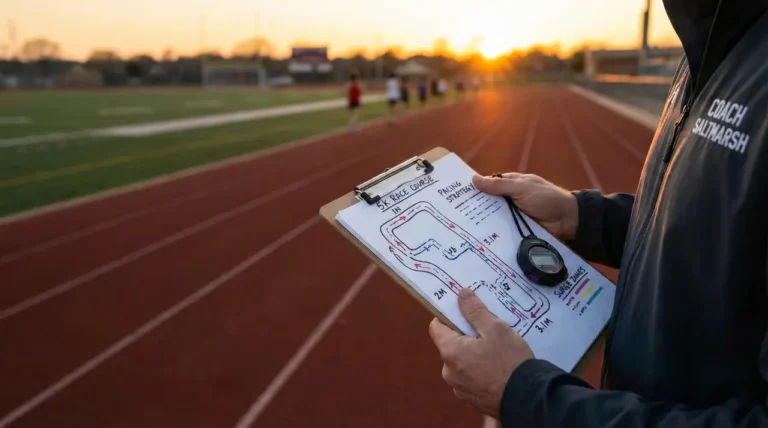
A successful running season isn’t random; it’s designed. By utilizing mesocycles—distinct training blocks lasting 3-6 weeks spanning the aerobic base, threshold, and VO2 max phases—coaches can ensure athletes handle progressive overload and peak exactly on race day. Here is a 13-week case study on building that structure.
Let me walk through a specific example—a hypothetical but realistic program building toward a state championship meet scheduled for November 9th.
This article is part of our Complete Guide to High School Cross Country Training, which covers everything from seasonal planning to race day tactics.
1. The Season Roadmap
| Dates | Phase | Primary Focus |
|---|---|---|
| Aug 12 – Sept 1 | General Preparation | Aerobic Foundation & Durability |
| Sept 2 – Sept 29 | Specific Preparation | Threshold Development & Race Intros |
| Sept 30 – Oct 27 | Pre-Competition | VO2 Max & Race Specificity |
| Oct 28 – Nov 9 | Championship | Taper & Peak Performance |
2. Weekly Mileage Targets (Varsity Boys)
| Phase | Week 1 | Week 2 | Week 3 | Week 4 |
|---|---|---|---|---|
| General Prep | 40 | 45 | 47 | — |
| Specific Prep | 50 | 52 | 50 | 48 |
| Pre-Comp | 45 | 47 | 44 | 42 |
| The Taper | 32 | 25 | — | — |
3. The Training Deck
Click a phase below to reveal the specific workouts.
Phase 1: General Prep (Aug 12 – Sept 1)
The Goal: Constructing the aerobic machinery. Boring but essential.
- Week 1: Easy volume only. No workouts.
- Week 2:
- Tue: 7 miles steady (Marathon Effort)
- Sat: 12 mile Long Run
- Week 3:
- Tue: 2 x 15 min Tempo (Easy Tempo intro)
- Sat: 13 mile Long Run
Phase 2: Specific Prep (Sept 2 – Sept 29)
The Goal: Improving lactate clearance. Threshold pace drops 5-8s/mile.
- Week 4: Tue: 3x8min Threshold | Sat: 13mi (Last 3 steady)
- Week 5 (Peak Vol): Tue: 2x12min Threshold | Thu: 6mi Steady | Sat: Race
- Week 6: Tue: 20min Cont. Tempo | Sat: 14mi Long Run
- Week 7: Tue: 25min Cont. Tempo | Thu: 6×400 (VO2 Intro) | Sat: Race
Phase 3: Pre-Competition (Sept 30 – Oct 27)
The Goal: VO2 Max rises. Race pace becomes sustainable.
- Week 8: Tue: 6×800 @ 5k | Thu: 6×200 Fast | Sat: Race
- Week 9: Tue: 5×1000 @ 5k | Thu: Easy + Strides | Sat: Race
- Week 10: Tue: 3x1mi @ 5k | Thu: 15min Tempo | Sat: Conf. Champ
- Week 11: Tue: 3×1200 @ 5k | Thu: Easy + Strides | Sat: Reg. Champ
Phase 4: The Taper (Oct 28 – Nov 9)
The Goal: Fatigue clears while fitness holds.
- Week 12: Tue: 3×800 @ 5k (Full Rest) | Sat: Rest or Shakeout
- Week 13 (Championship):
- Tue: 3×600 @ 5k
- Thu: 20min shakeout + strides
- Sat: STATE CHAMPIONSHIP
🧠 Why This Works
The Principles
- Volume: Peaks mid-season (Weeks 5-7), then declines as intensity rises.
- Transition: Gradual shifts. Week 7 introduces VO2 work lightly before Week 8 commits to it.
- Taper: Aggressive drop in volume, but intensity stays sharp.
The Physiological Timeline
- September: Building the engine (Aerobic).
- October: Revving the engine (VO2 Max).
- November: Unleashing the engine (Fresh & Sharp).
“If you execute this plan—not perfectly, but consistently—you’ll arrive at state championships with athletes who are fitter in November than they were in September, fresher than they’ve been in weeks, and physiologically prepared to run the fastest 5K of their lives.”
The Long Game: Training Beyond the Season
One final note that Christensen, Magness, and every successful high school coach emphasizes: single-season periodization is insufficient. The best programs think in multi-year cycles. Patience and perspective are vital for distance coaches.
The freshman who runs 45 miles weekly during general prep becomes the sophomore running 50, the junior running 55, the senior running 60. Same mesocycle structure, progressively higher absolute loads as training age and physical maturity increase.
The athlete who runs 18:00 as a freshman using basic periodization becomes the 16:30 junior and 15:45 senior using the same framework with higher loads. The periodization didn’t change—the accumulated years of adaptation within that framework did. Trust the process.
The program that builds sustainable, repeatable periodization across four years produces college recruits and lifelong runners.
Next Steps: Learn More about the 3 Essential XC Workouts your runners should be doing this season.