

The “Michigan” is Not for You: Why Popular Workouts Backfire on Teenagers
Inexperienced coaches often start their season planning with a quick search for the ‘secret sauce’ used by the country’s top programs. They stumble upon legendary workouts like ‘The Michigan’—sessions that sound epic, garner hype for being borderline sadistic, and feel undeniably cool. It has a name, it has the allure, and it worked for the Wolverines! But copying and pasting ‘The Michigan’ into a high school varsity training plan isn’t a shortcut to dominance. It is a prime example of irresponsible and uninformed coaching that ignores the physiological reality of the teenage runner.
The “Michigan” DISTANCE WORKOUT
If there is one workout that dominates running social media every October, it’s “The Michigan.” Developed by legendary University of Michigan coach Ron Warhurst, it is undeniably cool. It combines the precision of the track with the grit of the road, mixing fast intervals (1600m, 1200m, 800m, 400m) with “recovery” tempo miles in between.
Why it works for them: For a collegiate athlete, this workout is a masterpiece of grueling race day specificity. It simulates the surging nature of a 10K NCAA Cross Country Championship. The goal is to spike lactate levels on the track, and then teach the body to “flush” or clear that lactate while still moving at a high-end aerobic clip (the tempo mile) on the road.
Why it fails High Schoolers: The problem isn’t the workout. The workout is fantastic. It’s the engine of the high school athlete running it.
- The Aerobic Gap: Warhurst’s athletes are often men in their early 20’s with cumulative lifetime mileage in the tens of thousands. They are running 80–100 miles a week. They have built an “aerobic engine” large enough to treat a 5:20 road mile as actual recovery.
- The High School Reality: Your varsity runner likely averages 30–40 miles a week. They do not possess the capillary density or mitochondrial development to clear lactate at “tempo” pace. For them, the “rest” mile isn’t recovery—it’s just a slower race interval.
- The Result: Instead of a mix of Threshold and Interval work, the high schooler experiences 45 minutes of a pure anaerobic acid bath. They never recover. They never flush the waste. They just drown in it.
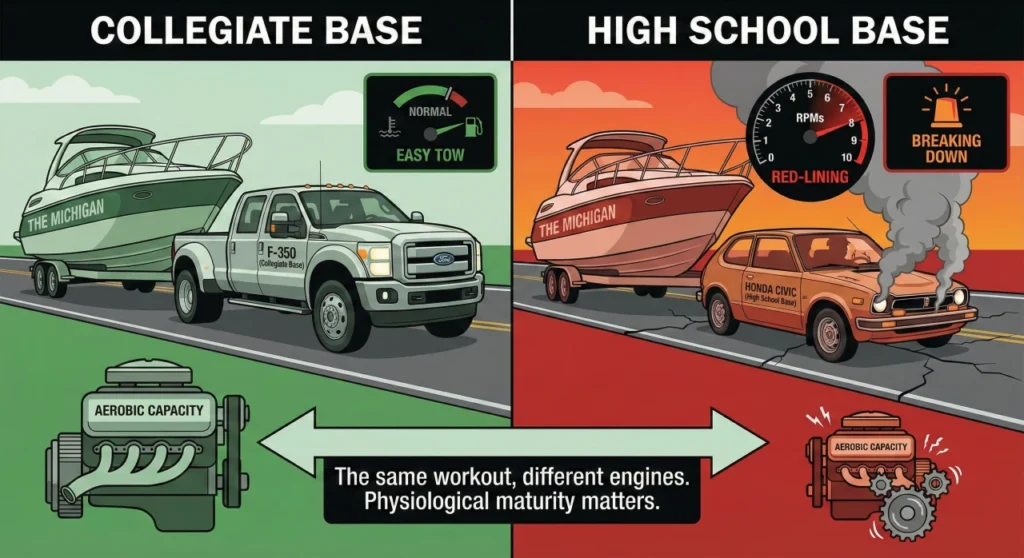
The Verdict: Leave “The Michigan” in Ann Arbor. For high schoolers, separate the tempo work from the speed work until they’re ready for it.
The Workout: “The Wolverine Lite”
The Core Concept: In this “Lite” version, we shorten the total volume and, crucially, redefine the road section from a “Tempo” to a “Steady State” to ensure true aerobic recovery between hard track bouts.
The Setup: You need a track and a roughly 1000m–1200m road or preferably a grass loop nearby.
The Warm-up
Standard dynamic warm-up + 2 miles easy jogging + 4x 150m strides.
The Track “Rhythm Setter” (Volume & Pace)
Transition 1: The Road “Flush” (Aerobic Recovery)
The Track “Grind” (VO2 Max / Critical Velocity)
(or roughly 8-10 seconds per lap faster than 5K pace) Rest: 2:00 active jog between the 800s.
Transition 2: The Road “Flush”
The Track “Finisher” (Speed & Economy)
The Cool-down
10 minutes easy jogging.
🧠 Why This Works for High Schoolers (The Theory)
True Physiological Gear Shifting
The original Michigan is often just one long, agonizing grind for teenagers. This version forces distinct physiological shifts. They move from Threshold/VO2 border (the 1600m), down to pure Aerobic (the road flush), up to VO2 Max (the 800s), back down to Aerobic, and finish with Anaerobic/Neuromuscular speed (the 300s).
Lactate Dynamics that Match the Engine
A high school aerobic engine cannot clear lactate at 5:30 pace on the roads. By slowing the road section to a “Steady State,” we allow their smaller engines to actually process the waste produced during the track intervals, enabling them to hit the next track interval with quality and confidence.
Mental Simulation without Physical Destruction
It still feels epic. Moving from the track to the road and back changes the visual field and requires mental re-engagement. They get the psychological benefit of a complex, multi-stage workout without the 5 miles of anaerobic work that ruins their season.
Appropriate Volume
Total volume of quality work is roughly 3 miles (plus the aerobic flushes). This is a digestible load for a 35–45 mile-per-week athlete in the middle of the season. Don’t do this in September, wait until October.