

Strength Training for Distance Runners: The 2-Session Weekly Protocol
The research is clear. Two well-designed sessions per week improve running economy, reduce injury risk, and build the structural durability your athletes need to perform their best. Here’s the exact protocol for implementing strength training for distance runners.
There’s a race I keep coming back to.
It was a late season invitational meet a few years ago. One of my varsity boys had the fitness to win. He’d run consistent workouts all season, his threshold times were right where we wanted them, and through the first two miles he was exactly where he needed to be.
Then the wheels fell off.
Not his lungs. His lungs were fine. What quit on him was everything else. His arms crossed his midline, his foot strike got sloppy and loud. By the time he hit the final 800 meters, he was running like a piano had been dropped on his back. He finished fourth. He should have finished first.
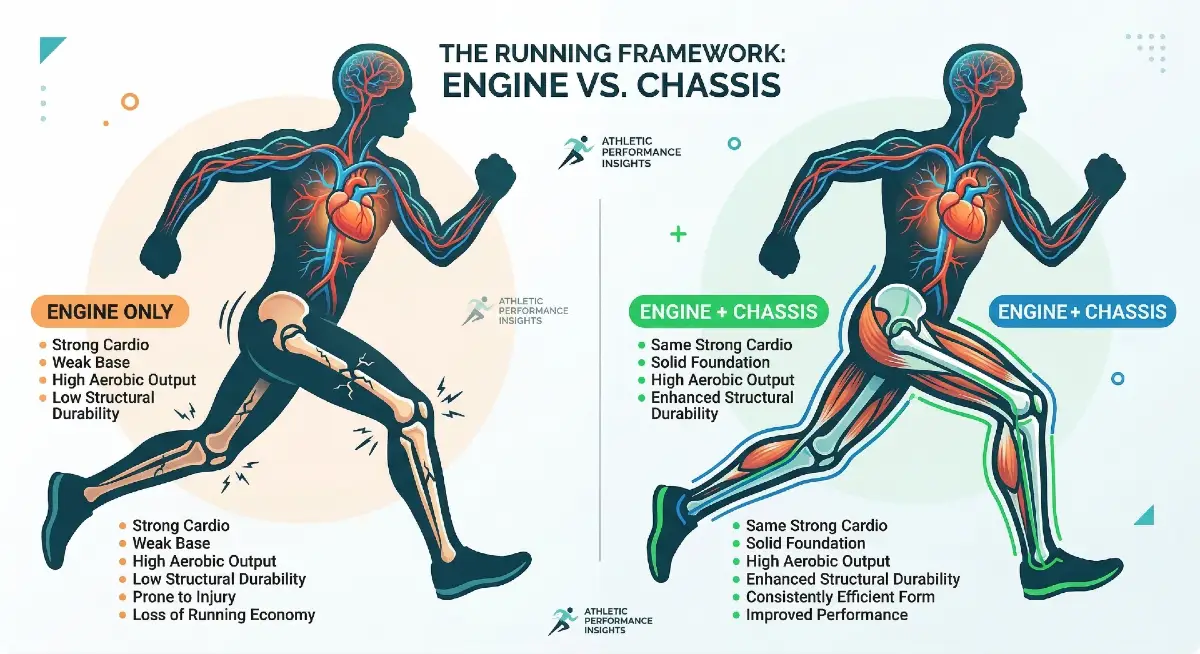
The aerobic engine was there. The chassis wasn’t.
That race is what made me take strength training seriously. Not as an add-on, not as something we do when it rains and can’t go outside, but as a required part of the program. Coaches, you can build the best cardiovascular system in your conference, and it won’t matter if the muscular or skeletal systems carrying it break down.
Two sessions a week. Done right. That’s the investment. This article will tell you exactly what to do.
At A Glance: The Starter Kit
Not ready to commit to the full protocol yet? These three exercises, done twice a week, touch every major structural failure point. This is the first phase in establishing strength training for distance runners.
| Exercise | Sets × Reps | What it protects |
|---|---|---|
| Single-leg Romanian deadlift | 3 × 8 each side | Hamstrings & glutes are the primary running engine |
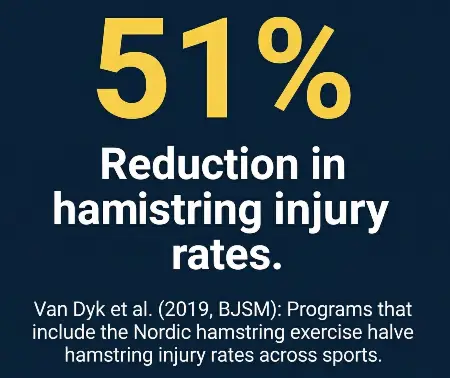
| Nordic curl (eccentric-only to start) | 3 × 5 | Hamstring injury prevention with a 51% reduction in injury rates |
| Single-leg calf raise (slow eccentric) | 3 × 12 each side | Achilles tendon load capacity |
The full protocol with seasonal progressions, scheduling guidance, and session-by-session breakdowns is below.
How to Perform a Romanian Deadlift
How to Perform a Nordic Curl
Why Strength Training for Distance Runners Matters
Most distance coaches know, at some level, that lifting is probably a good idea. What they’re fuzzier on is why. So before we get into the protocol, let’s take a deeper dive into the science.
Running economy is the target
VO2 max gets all the attention. It’s the number everyone talks about. But running economy, how efficiently your body uses oxygen at a given pace, is actually the better predictor of performance at the high school level. Two athletes can have identical VO2 max numbers and run very different race times based on how economically they move.

A 2016 meta-analysis published in the Journal of Strength and Conditioning Research looked specifically at strength training and running economy in competitive distance runners. They found that a program of low-to-high intensity resistance exercises and plyometrics performed two to three times per week improves running economy.
The mechanism isn’t complicated. Strength training increases muscle stiffness and tendon elasticity, which means more energy return from each ground contact. A stiffer spring releases more energy.
The structural durability argument
Most high school distance injuries aren’t fitness failures. They’re structural failures. The bones, tendons, and connective tissue that carry all those training miles gave out before the aerobic system did.
Stress fractures. Shin splints. IT band syndrome. Achilles tendinopathy. These are load-bearing failures. The athlete asked more of their structure than their structure could handle, and it broke.
Strength training builds load-bearing capacity. This is also why, as I wrote about in the Mind the Gap post on freshman-to-college breakdown, talented high school runners often fall apart in their first year of college. Their aerobic systems are ready for the jump in training. Their tendons and bones are not. The structural work needs to happen in high school.
On the ‘bulky’ concern
This comes up every year, usually from a parent or from a runner who doesn’t want to lift. Two sessions per week at low-to-moderate load does not produce significant hypertrophy (muscle mass) in endurance athletes. The caloric demands of distance training suppress the hormonal environment required for hypertrophy aka “getting huge.”
What you actually get from this program is stronger tendons, better neuromuscular coordination, and improved force production. None of that adds meaningful weight.
The Scheduling Question Nobody Talks About
Here’s where most coaches make a critical error: they decide to add strength training without thinking carefully about when in the week it fits. The default assumption is usually ‘lift on easy days’ and keep the hard workout days free. That logic makes intuitive sense. But the research is more complicated, and getting the scheduling right matters a lot.
The traditional model: lift on easy days
The standard approach strength sessions on Monday and Thursday if hard workouts fall on Tuesday and Saturday, is built around a sensible idea: you don’t want to be fatigued going into a quality running session.
The problem is that this model assumes strength work is less disruptive to recovery than aerobic work. For the muscular system, that’s often not true. An easy 40-minute run on legs that are sore from the previous day’s lift isn’t actually easy. By adding a lift to the easy day, you’ve added a stressor to a day that was supposed to be recovery.
The concurrent training interference problem
The research on combining strength and endurance training in the same program has grappled with the idea that adaptations to strength training can be blunted when combined with heavy aerobic work, and vice versa. The molecular mechanism involves competing signaling pathways.
A large systematic review and meta-analysis by Schumann et al. (2022) across 43 studies found that sequence and timing matter less for muscle hypertrophy and maximum strength than previously thought (we don’t care about that) but explosive strength adaptations were more compromised when both sessions happened in the same training window. For distance runners, this is relevant.
The more practical finding from this research is about what happens immediately before the strength work. When high-intensity endurance training precedes a strength session, the residual fatigue reduces the quality of strength work. You’re lifting with compromised muscles, your neuromuscular recruitment is off, and you get less from every set.
The case for lifting on workout days
If you’re running a polarized or Norwegian-style program the logic actually flips on the easy-day question.
The whole point of easy days in a polarized program is to promote recovery and accumulate genuinely low-intensity aerobic adaptation. When you add strength work to those days, even a contained 45-minute session, you’ve changed the nature of the day. You’re asking for muscular recovery and aerobic adaptation at the same time, on a day that was supposed to provide rest.
The counter-argument is that hard days are already metabolically demanding. Adding strength work after a workout doesn’t change what kind of day it is, it extends the demands, but it keeps the easy days genuinely easy. Several elite programs, including Norwegian-influenced collegiate models, sequence strength work on the same days as quality running precisely to protect the easy days. However, we’re not done yet. Read on.
The high school reality check
Here’s where I have to be honest about what the research actually tests versus what high school practice looks like.
The studies that support same-day strength-plus-endurance assume a meaningful gap between the two sessions. Typically four to six hours to allow metabolic and neuromuscular recovery between the running and the lifting. In those conditions, pairing quality running with strength work later in the day is defensible.
In a typical high school program, that gap doesn’t exist. Practice ends at 5 PM. If athletes are lifting after a Thursday workout, they’re doing it immediately after the last interval, not four hours later. That’s a different situation. And in that scenario, you’re getting compromised strength work on top of an already-taxed system.
The Two-Phase Scheduling Model
The evidence supports a seasonal shift with two distinct phases:
Base phase: Lift on easy days. Athletes have more recovery time between sessions, competition frequency is low, and the goal is building genuine strength adaptations.
Competition phase: Shift strength to workout days, immediately following the running session. The goal is now maintenance, not building. Easy days stay genuinely easy, which matters more as the championship window approaches.
The Protocol: Two Sessions Per Week
Everything below is built around five movement patterns that directly transfer to running mechanics. This is not a general fitness program.
The 5 Essential Movement Patterns for Distance Runners:
- Hip Extension (Glutes & Hamstrings) — the primary engine of running, responsible for propelling each stride forward
- Single-Leg Stability (Balance & Mechanics) — the ability to hold position and form on one leg through 50,000-plus strides per race
- Hip Flexor Strength (Knee Drive) — often ignored; directly drives knee lift and stride length, especially late in a race
- Posterior Chain Loading (Energy Return) — the connective tissue from heel to low back that absorbs and returns ground reaction force with every step
- Calf & Achilles Complex (The Spring) — the spring mechanism of distance running, and the most undertrained structure in most high school programs
Session A: Hip and Posterior Chain
| Exercise | Sets × Reps | Coaching cue | Why it matters |
|---|---|---|---|
| Single-leg Romanian deadlift | 3 × 8 each side | Hinge at the hip, soft knee, feel the hamstring load | Builds single-leg hip extension in the exact position running demands |
| Nordic curl | 3 × 5–8 | Lower slowly — 3 to 4 seconds down. That’s where the work is. | Halves hamstring injury rates per van Dyk et al. meta-analysis; improves eccentric strength |
| Glute bridge / hip thrust | 3 × 12 | Drive through the heel, pause at the top for one second | Activates glutes that are chronically underused in runners |
| Banded clamshell | 2 × 15 each side | Don’t let the hip roll back — isolation only | Gluteus medius; prevents hip drop and IT band syndrome |
| Single-leg calf raise (slow eccentric) | 3 × 15 each side | 3 seconds up, pause, 3 seconds down | Builds Achilles tendon load capacity — most common HS injury site |
| Plank + side plank | 2 × 30–45 sec each | Squeeze glutes and brace the trunk — don’t just hold position | Core stability for maintaining running posture late in races |
Note on the Nordic curl: if athletes have never done them before, start with the eccentric-only variation: lower yourself as slowly as possible, then use your hands to press back up. The soreness from the first two weeks is real. Budget for it. The eccentric phase is where the injury prevention value lives.
Session B: Single-Leg Power and Hip Flexor
| Exercise | Sets × Reps | Coaching cue | Why it matters |
|---|---|---|---|
| Bulgarian split squat | 3 × 8 each side | Back foot elevated, torso upright, front heel stays down | Builds single-leg strength and hip flexor mobility simultaneously |
| Step-up with knee drive | 3 × 10 each side | Drive the knee up aggressively at the top — simulate the stride | Transfers directly to the drive phase; trains hip flexors to fire at speed |
| Lateral band walk | 2 × 15 each direction | Slight squat, don’t let the feet touch | Hip abductor strength; prevents knee collapse |
| Single-leg box jump (stick landing) | 3 × 5 each side | Land soft, absorb for 2 seconds, don’t rush the next rep | Develops reactive power and single-leg landing mechanics |
| Reverse lunge | 3 × 10 each side | Step back into it, control the descent | More hip-hinge dominant than forward lunge; glute and hamstring focused |
| Dead bug | 2 × 8 each side | Low back stays on the floor throughout | Anti-extension core stability; protects the lumbar spine during high mileage |
Both sessions should take about 45 minutes. If you’re going past that, you’re adding exercises that don’t belong or standing around. Keep it focused.
Progression Through the Season
The protocol changes as the season progresses.
| Phase | When (XC) | Sessions/wk | Volume | Goal |
|---|---|---|---|---|
| Early base | June – mid Aug | 2 | Bodyweight only, 3 sets | Build movement patterns without soreness derailing training |
| Mid base | Mid Aug – early Sept | 2 | Light load, 3 sets | Add load, build structural adaptation |
| Build | Early Sept – mid Oct | 2 | Moderate load, 3 sets, lower reps | Peak strength stimulus |
| Competition | Mid Oct – championship | 1 | Same load, 2 sets | Maintain; protect easy days completely |
| Championship taper | Final 10–14 days | 0 | skip | Full systemic recovery |
The jump from zero to two sessions in the first week of June will produce soreness. That’s expected. The adaptation window is roughly three weeks. Starting before the season begins gives you that window without it competing with race preparation.
Maintenance lifting: one session, reduced volume, same intensity preserves the structural gains you built all summer. It’s a 35-minute investment that keeps your athletes off the injury table in October.
Does the Protocol Change for 800m and 1600m Runners?
This question comes up enough that it’s worth its own section. The answer is yes.
The five movement patterns above apply to every distance runner. But middle distance athletes competing in the 800m and 1600m have a higher anaerobic demand and spend more of their race at high-speed running mechanics. That changes a few priorities. (For a deeper look at the full middle distance training model, see the Middle Distance Training framework on this site.)
What stays the same
The posterior chain work, the Nordic curls, single-leg RDLs, calf raises stays. These are structural investments, not event-specific ones. An 800m runner with weak hamstrings and an undertrained Achilles is just as vulnerable to breakdown as a 5K runner.
Single-leg stability work also stays. The hip drop patterns that develop from weak glutes affect running mechanics at all distances.

What shifts for middle distance
Middle distance athletes benefit from a higher plyometric component. The box jump and single-leg landing work in Session B matters more for them. The ground contact forces in an 800m are higher than in a 5K, and the ability to generate and return force quickly is more directly race-relevant.
The calf raise protocol can be made slightly more explosive for 800m runners in the build phase. Drop to 10 reps, load more, focus on the calf’s ability to generate force quickly rather than slow-eccentric tendon loading alone.
Volume: 800m athletes should generally stay at the lower end of the rep ranges in Session A and invest more in the plyometric and power work in Session B. The goal is neuromuscular explosiveness and ground contact quality, not volume.
What doesn’t change: the scheduling logic
The two-phase scheduling model applies equally to middle distance athletes. If anything err on the side of protecting easy days. 800m runners are training more frequently at high intensity. Cluster the hard stimuli, protect the recovery days completely.
Mistakes When Beginning Strength Training for Distance Runners
Starting with too much load
Coaches get excited, add weight in week one, athletes are destroyed for their next workout, and everyone concludes that lifting doesn’t work for runners. Start with bodyweight-only versions of every exercise. Earn the right to add load by demonstrating consistent movement quality first.
Training to failure
Distance runners should leave reps in the tank. The goal is stimulus, not exhaustion. If an athlete cannot maintain clean form in the final rep, they did too many reps or used too much weight. The quality of the movement matters more than the number on the dumbbell.
Rushing the eccentric
Most of the injury prevention value in this program lives in the lowering phase: Nordic curls, calf raises, Romanian deadlifts. Coaches who let athletes lower quickly and focus only on the concentric movement get a fraction of the benefit. Slow the descent. That’s where the work happens.
Running athletes through a generic weight room program
If your school has a strength coach who runs athletes through a generic program with bench press, power cleans, back squats, and leg curls that’s not the same thing as this. Those movements don’t address the specific posterior chain demands, single-leg stability deficits, and calf complex weaknesses that distance runners develop. The exercises in this protocol are chosen because they transfer to running. A general athletic program doesn’t make those same choices.
Treating all class years the same
A freshman who’s been running competitively for six months should not be doing the same program as a senior with four years of base. Freshmen start with lower volume, lighter load, and more time on movement quality. They have more structural adaptation ahead of them and are more vulnerable to overload. Scale accordingly.
What to Tell Athletes (and Parents) Who Don’t Want to Lift
This comes up every year. Am I the only one that hears this?
The athlete who sees themselves as a runner, not a weightlifter
Reframe it: you’re not training to lift weight, you’re training your stride. The exercises in this program exist because they directly improve how you move when you run. The 2016 study on running economy and strength training is clear: athletes who do this work finish stronger. That’s the goal.
It also helps to show athletes that elite distance runners do structured strength work. This isn’t an add-on. It’s part of what high-performance distance training looks like.
The parent worried about injury
The American Academy of Pediatrics and the American College of Sports Medicine both conclude that supervised strength training at appropriate loads is safe for adolescents and reduces injury risk when done correctly. The risk-benefit calculation is not close. Leaving this work out is the risky choice. The Nordic curl research on halving hamstring injury rates makes that concrete: a 51% reduction is a significant number to leave on the table.
Equipment
This program requires almost nothing.
- One set of resistance bands (light, medium, heavy) — under $30
- A box or bench
- Dumbbells or a barbell if available, but bodyweight versions of every exercise exist
- A partner or wall anchor for Nordic curls
Start Smaller Than You Think
You don’t need a perfect program. You need a consistent one.
If you’re bringing this in mid-season, start with the minimum viable kit at the top of this article. If you’re planning for next year, build the full protocol into your off-season structure now so it’s established before you’re racing.
The athletes who win state in November have usually been doing this work since June.