

When Fatigue Becomes Overtraining
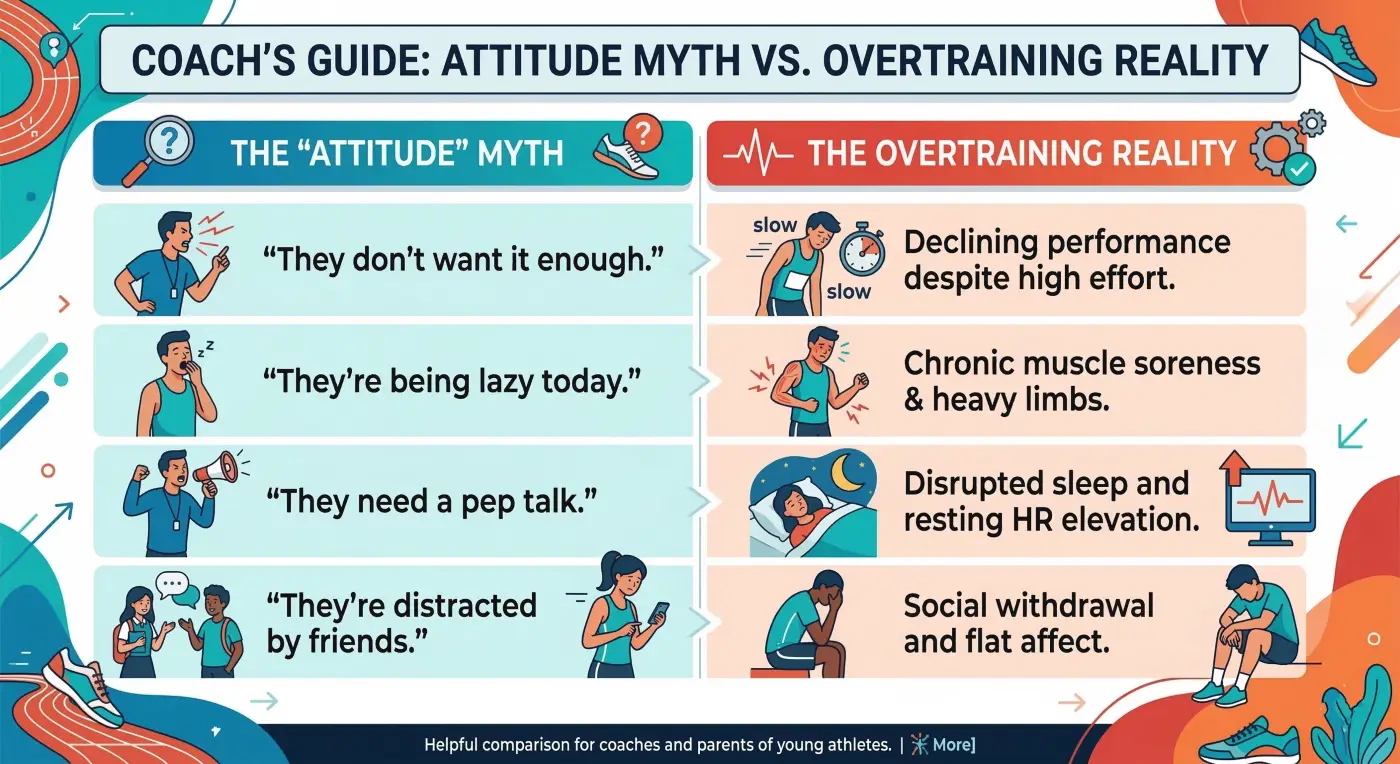
A kid who trained hard all winter shows up to the first week of track looking flat. Slow. Checked out. And the instinct is to wonder what’s going on with their attitude. I mean, c’mon! Let’s go! It’s only week one.
Sometimes it is attitude. But often it’s something else, and pushing harder is the wrong response.
Overtraining syndrome is a real medical condition, not a vague concept coaches use to excuse underperformance or rationalize injuries. It develops when training load outpaces the body’s ability to recover over a long enough stretch that multiple systems start breaking down. And once it sets in, the behavioral symptoms look a lot like what we’d call weak: withdrawal, low motivation, flat affect, declining effort.
Even when the coach recognizes some of the signs, it’s easier to ignore them and keep trying to build. After all, we have a championship to chase.
The Clinical Reality: Normal Fatigue vs. Overtraining Syndrome
Normal training fatigue clears up with a rest day or two. The athlete bounces back. That’s the adaptation process doing exactly what it should.
The trouble starts when athletes and coaches ignore the early warning signs and keep loading. Overtraining syndrome is clinically diagnosed through a history showing decreased performance, mood disturbances, and the absence of other medical explanations. By the time someone has put a name to it, you’re looking at a recovery measured in months, not days.
The early signals are easy to brush past. Lingering muscle soreness that doesn’t resolve on easy days, chronic colds, disrupted sleep, and unfinished workouts. If an athlete who typically brings energy to practice starts going through the motions and moving like they’re underwater, that’s a red flag worth noting.
The performance dip is usually obvious to a coach. A workout intensity that should feel moderate is suddenly a real struggle. The athlete looks like they’re working hard and going backwards. A good coach knows to document every workout throughout the season. You should be able to look back and see what worked, what didn’t work, and how each athlete responds to different stimuli.
The Multi-Sport Trap: Hidden Training Loads
High school athletes often carry training loads we don’t fully see. The kid on your 1600m squad may have been doing club track since October. They show up to your first practice already dug into a hole, and nothing you do in the first two weeks of March is going to pull them out of it.
The scenario I run into most often involves the multi-sport kids. I have a sophomore that just last week wanted to know if she could run track and play club soccer. She can. As long as she doesn’t miss track to attend soccer. It’s a statewide rule.
So, she runs for you Monday through Friday, but she also plays club soccer Tuesday nights, Thursday nights, and Saturday afternoons, and she’s in a Sunday league her parents enrolled her in three years ago and nobody’s had the heart to quit. From her perspective she’s a track athlete that’s keeping pace with her soccer peers and, if anything, getting fitter faster. From her body’s perspective, she hasn’t had a full rest day since November and she’s already in the hole.
You look at your training log and her week looks fine. Threshold workout on Monday, Speedwork on Wednesday, a long run Saturday morning and easy days on the sides. Reasonable. What you don’t see is the 90 minutes of soccer Tuesday and Thursday, the doubleheader on Sunday, and the science project she worked on until midnight. By the time she showed up to Monday’s workout she’s not rested from a day off like your training schedule called for, she’s already running on fumes. That’s not a fitness problem. That’s a math problem, and the numbers don’t add up.
Parents are often the last to connect the dots here because each commitment looks manageable in isolation. The soccer coach thinks she’s fine. You think she’s fine. Nobody has the full picture except her, and she’s 16 and doesn’t want to disappoint anyone, so she says nothing until her body says it for her. And unfortunately, if she thinks you’re worrying about her soccer time, she’ll likely start hiding it from you to avoid any potential conflict.
Coaches are too often unaware of the total load the athlete is carrying. A simple conversation at the start of the season goes a long way. Ask specifically about other sports. Don’t assume track is all they’re doing.
The Coach’s Toolkit: A 10-Minute Athlete Intake Survey
The conversation doesn’t have to be formal. A quick survey at the first practice takes ten minutes and tells you more than a month of observation. Here’s what I’d want to know:
Training history
- What sport or activity were you doing between November and now?
- Were you with a club program, training on your own, or mostly off?
- What does a typical week look like right now in terms of total activity?
Other current commitments
- Are you playing another sport or on another team right now, during track season?
- How many days a week, and how long are those sessions?
- Do you have games or tournaments on weekends?
Recovery indicators
- How many hours of sleep are you averaging on school nights?
- On a normal morning, do you wake up feeling rested or already tired?
- In the past month, have you been sick more than once?
Subjective feel
- On a scale of 1–10, how fresh do you feel heading into this season?
- Is there anything going on physically that you’re already managing? Soreness, tightness, something that hasn’t fully healed?
That last question matters more than coaches think. Athletes routinely show up to the first week of track carrying a hamstring they tweaked in January that never quite resolved, and they don’t mention it because they don’t want to miss reps. By April it’s a strain.
None of this replaces coaching intuition, but it gives you a baseline. If an athlete tells you she’s a 4 out of 10 on day one, you know what you’re working with. If she was a 4 in week one and she’s still a 4 in week three, it’s time to start asking harder questions.
What YOU CAN DO TO HELP PREVENT OVERTRAINING
Ask athletes how they feel before practice every day, not just at the start of the season. A 1–10 rating on readiness, tracked over two or three weeks, will tell you something. A consistent downward trend means something. A quick aside, as a veteran coach I’ve learned to do this individually to avoid groupthink and peer pressure to conform.
If you think an athlete is overtrained, the protocol isn’t complicated: back off volume significantly, eliminate quality sessions for at least a week, and have them start monitoring and recording their morning resting heart rate. A sustained elevation of even five to ten beats above their normal baseline tells you the body isn’t ready. Full recovery can take weeks or months.
Parents
The most useful thing you can offer is honesty about your child’s schedule. You see the sleep, the appetite, the dinner-table mood. You also know what’s actually on the calendar. If your athlete is getting nine hours of sleep and still dragging through the day, and you know she played two soccer games over the weekend, that context matters. Bring it to the coach.
Athletes
Your competitive instinct is going to tell you that backing off means falling behind. It usually doesn’t. What actually costs you fitness is grinding through an overtrained state for six weeks trying to prove something, then sitting out the meets that matter.
The coaches I’ve learned the most from got very good at one question: What does this athlete actually need right now? Coach the athlete in front of you, not the athlete you wish them to be.