

Forging Iron: Mastering the Pre-Season Grind (Part 1 of 3)
There is a specific smell to late August. It’s a mix of cut grass, humidity, and for a high school cross country coach, a cocktail of anxiety and teen spirit.
The first day of practice is the great equalizer. You look out at the group and you see the full spectrum: the varsity veteran who logged 400 miles this summer, and the freshman who shows up in basketball sneakers with a large Mocha Iced Coffee from Dunk’s.
I’ve heard it said a thousand times, and I’ll say it a thousand more: “Champions in November are forged in the smoldering heat of July and August”
But let’s be real for a second. Life happens. Maybe your athletes didn’t run a step this summer. Maybe you didn’t. If you’re standing on the starting line of the season looking at a team with empty mileage logs, don’t panic. It’s not hopeless.
The hay might not be in the barn yet, but the season isn’t lost. We just have to harvest the hay for some athletes later in the season.
This is Part 1 of our deep dive into the Cross Country season. Today, we are talking about the Pre/Early Season: The Foundation.
The Pyramid Philosophy: Building the Base
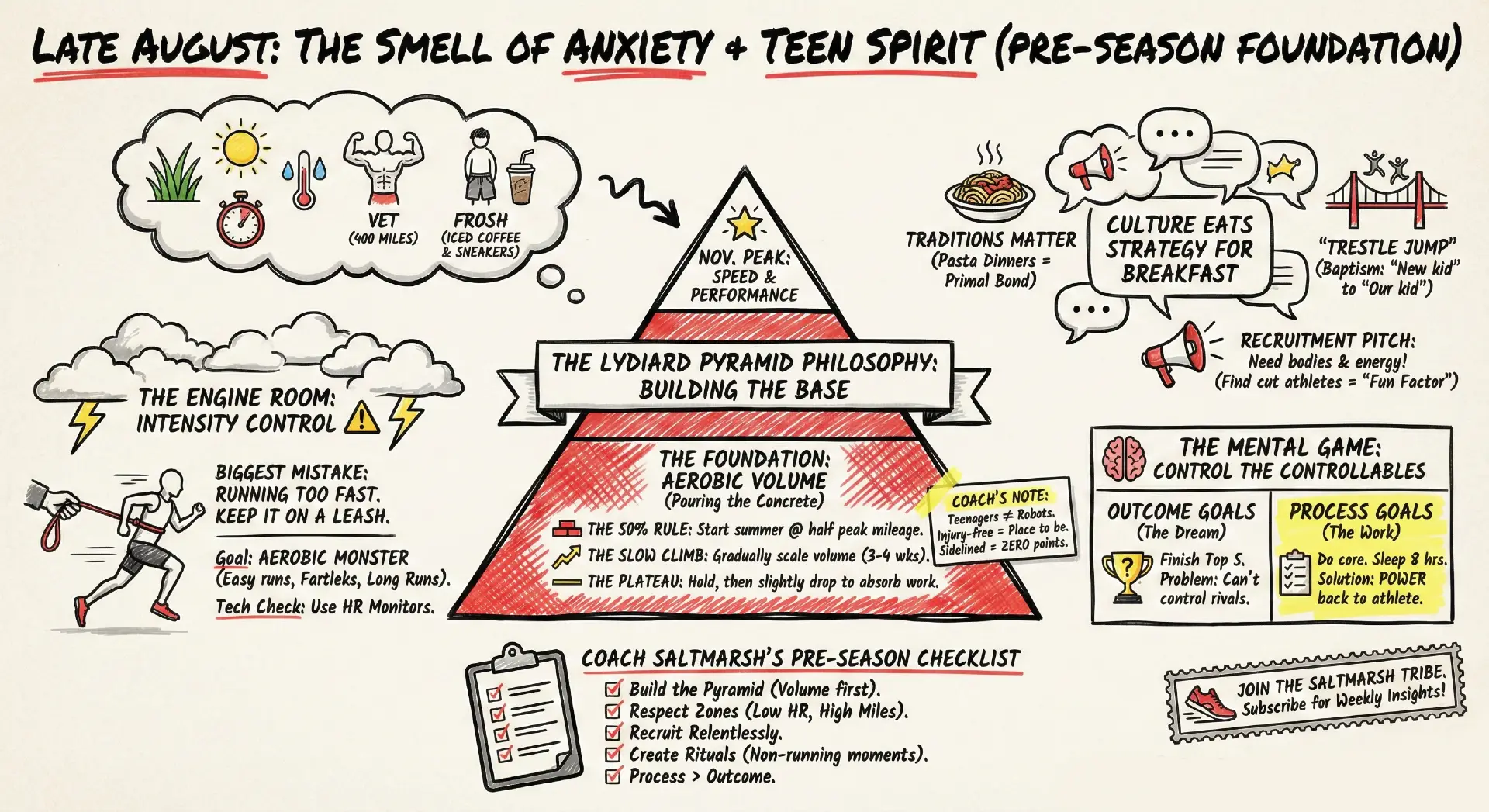
Visuals matter. When I talk to my athletes, I talk about a Pyramid. A concept made famous by legendary distance coach Arthur Lydiard.
You cannot build a skyscraper on a foundation meant for a shed. The wider the base of the pyramid (aerobic volume), the higher the peak (speed and performance) can eventually go.
In these first few weeks, your only job is to pour the concrete.
- The 50% Rule: For the first quarter of the season (summer), start your runners at roughly 50% of their peak weekly mileage goal.
- The Slow Climb: over the next 3-4 weeks, gradually scale that volume up until they hit their max.
- The Plateau: Once they hit that top mileage, hold it there. Every 3-4 weeks, drop the volume slightly to let their bodies absorb the work.
Coach’s Note: Training isn’t a math equation, and teenagers aren’t robots. If something hurts, we adjust. “Injury-free is the place to be.” A runner on the sidelines scores zero points. Here’s a free mileage progression calculator to help build your plan.
The Engine Room: Intensity Control
Here is the biggest mistake young coaches and eager athletes make in September: They run too fast. As a coach I love to see it. As athletes they love to do it. But, it’s not the right time in the training cycle to do this type of work.
The body is already freaking out about the increased mileage. If you hammer the intensity too, you’re asking for a stress fracture.
During the base phase, the intensity needs to be kept on a leash. We are looking for Easy runs, Fartleks at threshold pace, and Long Runs. We want to build an aerobic monster, not a sprinter.
- The Tech Check: Use heart rate monitors to keep honest.
- The Resource: I swear by this heart rate calculator to determine heart rate zones for teenage athletes. If they are hitting max heart rate in September, they will be burnt out and watching from the bleachers in November.
Culture Eats Strategy for Breakfast
You can write the perfect Renato Canova-inspired training plan, but if your team culture rots, you will lose.
The pre-season is where you hook them. You need to make the team a place they want to be, especially for the new kids who think “Cross Country” is just a punishment for other sports.
Traditions Matter. I’ve seen it all. The classic pasta dinners are a staple for a reason—there is something primal about breaking bread (and crushing carbs) together that bonds a squad.
But my favorite memory? The “Trestle Jump.” Years ago, on one of my teams, we had a tradition where the returning veterans would toss the rookies into the nearby river after the first practice. It wasn’t hazing; it was a baptism. It was the moment they stopped being “new kids” and started being our kids. Find your “Trestle Jump.” Build the memory.
The Recruitment Pitch
We need bodies. We need energy. Go find the soccer player who got cut. Find the basketball player who needs to get in shape for winter. These kids might not score for your Varsity 7 immediately. But they bring a “fun factor” that balances out the neuroses of your serious runners. And, that kid you recruited from the hallway might just be your number 2 runner at States. I’ve seen it happen.

The Mental Game: Control the Controllables
Cross Country is a paradox. It is the most individual sport in the world—no timeouts, no substitutions, just you and the pain cave. Yet, you can win the race and lose the meet if your team doesn’t show up.
We set two types of goals in the pre-season:
- Outcome Goals (The Dream): “I want to finish Top 5.”
- The Problem: You can’t control if the kids from rival schools that decided to train like Kenyans all summer.
- Process Goals (The Work): “I will do my core routine after every run.” “I will sleep 8 hours.”
- The Solution: This puts the power back in the athlete’s hands.
Let the athletes set the team rules. When they decide the consequences for skipping practice, they hold each other accountable. When you decide, you’re just the cop.
Coach Saltmarsh’s Pre-Season Checklist
- Build the Pyramid: Volume first. Intensity later.
- Respect the Zones: Keep the heart rate low and the mileage high.
- Recruit Relentlessly: A bigger team is a better team.
- Rituals & Traditions: Create moments that have nothing to do with running.
- Process over Outcome: Focus on the daily grind, not just the podium.
Next Up: In Part 2, we will look at the Mid-Season Transition—when to sharpen the axe and start adding speed. In Part 3, we talk about peak conditioning and the championship mindset.
Looking to dive deeper? Here are the essential guides and training philosophies from the Coach Saltmarsh archives.