

Early Season Distance Training: 2-Week Plan

Early Season Distance Training Plan for High School Distance Runners
Track
Middle DistanceKey Takeaways
- Injury Prevention Over Optimism: Stick to a strict 10% weekly volume increase to prevent early-season shin splints-the primary result of “coaching optimism” overriding biological reality.
- Data-Driven Stratification: Use the Friday 1600m time trial to move beyond guesswork and categorize athletes into Beginner, Intermediate, or Advanced tracks based on current readiness.
- Low-Impact Strength Building: Integrate hill repeats and yoga early to build neuromuscular power and hip mobility without the high ground-impact forces of flat-track sprinting.
- The “May” Mindset: Resist the urge to “rev the engine” in March; success in championship season is built on the boring, conversational aerobic miles logged during the first two weeks.
Every spring, it happens. Three days into early season distance training, I get the look. You know the one. An athlete pulls me aside during a cool-down jog their heart rate barely elevated, their form still fresh, and hits me with the question that tells me everything I need to know about where they are mentally:
“Coach, are we going to do this workout slow again today?”
And I smile. Because that question, as much as any time trial, tells me exactly what I’m working with. That athlete is ready to compete. They want to run fast. They’re itching. And they are, without question, the athlete most likely to end up in my office in three weeks with bilateral shin splints if I let them off the leash too soon.
The first two weeks of outdoor track season are not about getting faster. They’re about building the platform from which faster becomes possible. Our job as coaches is to get there safely, sustainably, and with full respect for where each athlete actually is, not where they think they are or where you hope they’ll be by May.
This article walks you through exactly how I structure those first two weeks for my distance group, which includes 800m, 1600m, and 3200m athletes. I’ll explain the rationale behind every decision, how I use a time trial to individualize training, and why the athlete who asks if we’re going slow again is usually the one I’m watching most carefully.

The Guiding Principles Behind Early Season Distance Training
Before we get into the specific workouts, let me lay out the four principles that shape every decision I make in these first two weeks. These aren’t arbitrary. They’re grounded in exercise physiology, injury research, and about 23 years of watching what happens when coaches ignore them.
1. Ramp Up Slowly to Protect Against Overuse Injury
The most common early-season mistake isn’t coaching inexperience, it’s coaching optimism. We want our kids to be ready. We know what’s coming on the schedule. And so we push the volume and intensity faster than the body can adapt.
Medial tibial stress syndrome, what most people call shin splints, accounts for 6–16% of all running injuries and up to 50% of all lower leg injuries in runners. It’s also almost entirely preventable. The primary driver of MTSS is a sudden increase in training load. Not fitness. Not talent. Load. The athlete who ran 15 miles a week in January and sees 35-mile weeks in late March because “the season is here” is a candidate for a tibial stress reaction, not a state championship.
Research from the British Journal of Sports Medicine, based on data from over 5,200 runners, reinforces this: injury risk is most strongly linked to how much longer a single run is compared to your recent longest effort. The practical takeaway is the classic 10% rule: don’t increase total weekly mileage by more than 10% week over week. But also pay attention to the individual session length. A new personal longest run is a significant stressor on its own. I ask my teams to run by minutes, not miles early in the season.
For high school athletes coming off a winter break or indoor track season with inconsistent training, the early weeks of outdoor track have to respect this biological reality. The first week is almost entirely easy aerobic running. That’s not laziness. That’s how you get athletes to championship season healthy.
2. Start Training Those Who Are Ready, But Introduce Speed Slowly
Not every athlete on your roster comes in at the same fitness level. Some have been training consistently through the winter. Some haven’t laced up since the last cross country meet. A cookie-cutter training plan that treats them identically will either undertrain your most fit athletes or overtrain your least fit ones.
This is why I use a 1600m time trial at the end of Week One to stratify my athletes into three training levels: beginner, intermediate, and advanced.
The result doesn’t just tell me their fitness, it tells me how much training stress their aerobic system can currently absorb and handle going forward.
Even for the most advanced athletes, speed introduction has to be gradual. The neuromuscular system needs to be “woken up” before you start throwing race-pace intervals at it. Strides (short 80–100m accelerations run at controlled but fast effort) are the first speed stimulus I introduce. They’re long enough to recruit fast-twitch fibers and teach the nervous system to fire quickly, but short enough that there’s no meaningful lactate accumulation.
3. Incorporate Hills for Strength
One of the most underrated tools in early-season training is the hill repeat. Not because it’s trendy, but because the science is genuinely compelling.
Running uphill builds strength in the glutes, hamstrings, quads, and calves without the high ground-impact forces of flat sprinting. This matters for two reasons. First, stronger legs absorb ground contact forces better, which directly reduces injury risk, particularly for those shin splints we’re trying to avoid. Second, the mechanics demanded by uphill running (higher knee lift, stronger arm drive, forward lean, quicker cadence) are exactly the mechanics we want to reinforce on flat ground.
A study published in Scientific Reports found that uphill training significantly improved maximal velocity and race performance in middle-distance runners. And contrary to what some athletes believe, proper hill training can actually reduce injury risk compared to flat terrain running because the shorter stride reduces impact forces per footfall.
Here’s the practical truth: a well-executed set of hill repeats is essentially strength work and speed work happening at the same time, at a fraction of the injury risk of track intervals. Early in the season, that’s an excellent trade.
4. Keep the Long Run in the Weekly Rotation
The long run is the cornerstone of aerobic development, and it doesn’t get benched just because we’re on the track now. Even in the first two weeks, every training level in my program has a dedicated long run day built in.
The long run develops mitochondrial density, improves fat oxidation at aerobic paces, strengthens tendons and connective tissue, and builds the aerobic engine that powers everything from 800m to 3200m. Without it, you’re building your house on sand.
That said, “long run” for a beginner in Week One might be 30 minutes at an easy effort. That’s not a marathon program. But it is a consistent, weekly reminder that aerobic capacity is built over time and over miles. Not in a single hard workout.

The Assessment Engine: The 1600m Time Trial
At the end of Week One, on Friday, all of my distance athletes run a 1600m time trial on the track.
This single data point tells me more than any conversation could:
- Aerobic fitness level. Where is this athlete’s VO2max-adjacent ceiling right now, at the start of the season?
- Training load tolerance. A runner who’s been logging 30+ miles per week all winter is ready for different stress than one who’s been playing video games since November.
- Speed potential vs. current capacity. Some athletes run the time trial through pure competitive fire and a fast early pace, they blow up in the second mile. Others are metronomic. Both give me information.
- Mental engagement. How does this athlete respond to a solo competitive effort with no rabbit to chase?
Based on time trial results, I place each athlete into one of three levels:
- Beginner: Athletes with limited aerobic base, returning from injury, or new to distance running. These athletes need volume consistency and aerobic development above all else. (Boys over 6:15, Girls over 7:20)
- Intermediate: Athletes with a reasonable base who are ready for some quality work but whose aerobic system isn’t yet robust enough for heavy threshold training. (Boys over 5:50, Girls over 6:50)
- Advanced: Athletes with a well-developed aerobic base who have demonstrated the capacity to absorb more training stress. These athletes are ready for structured quality workouts.
The time trial also helps me have a real conversation with each athlete about where they are versus where they want to be, and what it’s actually going to take to close that gap. It sets the tone. It’s not a punishment. It’s a compass. Everyone starts where they are and remains healthy.
For more on how I build individual athlete profiles and use data to drive training decisions, check out my Middle Distance Training Hub.
Week One: The Foundation Week (All Groups, All Levels)
Week One is the same for everyone. No exceptions. That’s not because your advanced athletes don’t need more. It’s because I don’t yet have the data I need to prescribe more, and because the human body doesn’t care how good your intentions are. Tissue adaptation takes time. Tendons don’t upgrade faster just because we want to run a good conference time. And, the ones who just came off an indoor season need a break anyways.
Here’s how the week looks:
| Day | Training |
|---|---|
| Monday | Easy Run 30 minutes |
| Tuesday | Easy Run 30 minutes |
| Wednesday | Easy Run 20 minutes + Hills + Yoga |
| Thursday | Easy Run 30 minutes |
| Friday | TRACK: 1-Mile (1600m) Time Trial |
| Saturday | Rest |
What “Easy” Means
I cannot stress this enough: easy means easy. Not “kind of comfortable.” Not “tempo-ish.” Easy means conversational pace, low perceived effort, and a heart rate that stays well within the aerobic zone. If your athlete can’t hold a conversation without gasping, they’re running too hard.
The science here is unambiguous. Easy aerobic running is the foundation on which every other training adaptation is built. It develops the slow-twitch muscle fibers that are engaged throughout every distance event. It improves capillary density. It teaches the body to use fat as fuel efficiently, which extends endurance capacity at higher intensities. And it lets the musculoskeletal system begin adapting to the repetitive stress of running without being overwhelmed.
Wednesday: Hills + Yoga
Midweek, we break out of the pure easy running loop and add two elements: hill repeats and yoga.
The hills are an early introduction to controlled intensity and neuromuscular activation. We keep the session short at this stage. The run is only 20 minutes and the hills are not all-out sprints, more like 85% effort. They’re controlled, powerful efforts uphill with full recovery (walk down) between each. The goal is good form (run tall) and strength stimulus, not lactate production.
The yoga component might surprise some coaches. But flexibility, mobility, and body awareness are often the first casualties of a distance program that just runs. Yoga improves hip flexor range of motion, strengthens stabilizing muscles, develops core engagement, and builds the body awareness that helps athletes recognize early warning signs of injury before they become actual injuries.
Friday: The Time Trial
As noted above, this is the cornerstone of Week One. We run the 1600m time trial on the track, I collect splits, and I take notes. By the end of the day Friday, I have every athlete categorized and Week Two is planned.
Train Like a State Champion
I’ve coached 31 state champions. Every week, I share one specific workout or assessment tool I use to help high schoolers peak in May.
Please leave this field empty
Check your inbox or spam folder to confirm your subscription.
Week Two: Differentiated Training by Group and Level
Here’s where it gets interesting. Week Two is the first week where training diverges based on event group and fitness level.
My distance group is split into two primary training groups. Then, split further into Advanced, Intermediate, and Beginner levels based on the time trial.
- The 800m Group: These athletes have a more speed-oriented training emphasis.
- The 1600m/3200m Group: These athletes have a more endurance-oriented training emphasis.
Week Two Training Grid
| Day | 800m Group Advanced | 1600/3200 Advanced | Intermediate | Beginner |
|---|---|---|---|---|
| Mon | 10 × 200m @ 1600m effort, 200 jog recovery | Easy Run 40 min | Easy Run 35 min | Easy Run 30 min |
| Tue | 3-mile run, 4×100m strides, weights | 4-5 × 1000m @ T-pace, 90s recovery, weights | Easy Run 30 min, strides, weights | Easy Run 30 min, strides, weights |
| Wed | 4× 400m @ 2-mile pace + 3× 200m @ 1600 pace (400 jog recovery between each) | Easy Run 30 min | 20 min run + Hills ×6 | 20 min run + Hills ×6 |
| Thu | 3-mile run, 4×100m strides, weights | 4×800m @ CV pace + 3×200m @ 1600 pace, 400 jog recovery, weights | Easy Run 30 min, strides, weights | Easy Run 30 min, strides, weights |
| Fri | 3-mile run + 8 short hills | 3-mile run + 8 short hills | 1600m Time Trial | 1600m Time Trial |
| Sat | Easy Run 40 min | Easy Run 50 min | Easy Run 35 min | Rest |
Breaking Down the 800m Group’s Week Two
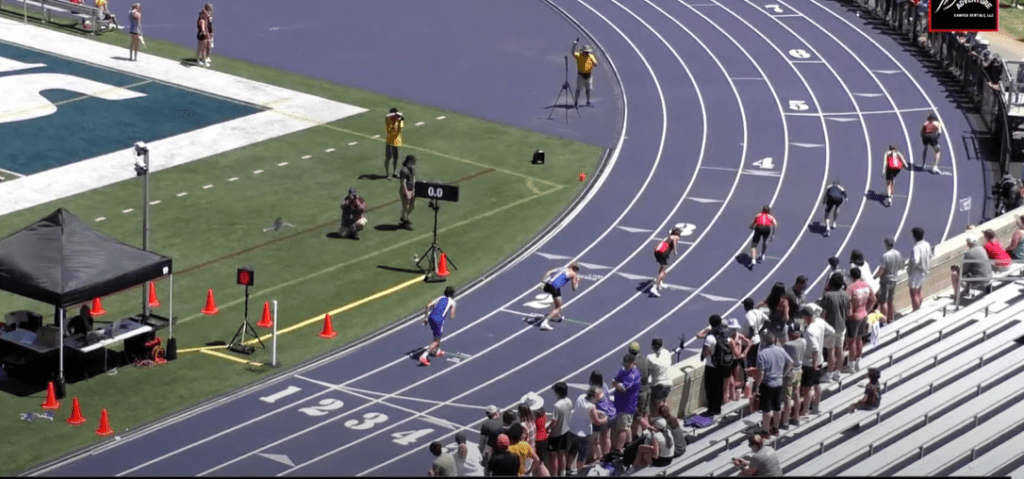
The runners in the 800m group are my speed athletes. Runners whose event is won or lost in about two minutes of near-maximal effort. They need to develop speed early, but they can’t skip the aerobic foundation either. The 800m is roughly 50% aerobic energy demand, which means your athlete’s aerobic system has to be capable of handling the load before you can train the anaerobic component effectively.
Monday: 10 × Rolling 200s. This is the first real speed stimulus of the season. They are at “1600m pace” becuase I want to inject some speed that is real, it tickles the lactate production, but doesn’t overwhelm. The recovery 200 jog between with NO STOPPING, is critical. This is a fartlek session in disguise. Thank you Coach Igloi.
Wednesday: Mixed-pace interval session. The 4×400 at 2-mile pace followed by 3×200 at 1600 pace introduces multi-pace training, a cornerstone of 800m development. We want these athletes to be comfortable switching gears mid-workout and mid-race. The jog recoveries keep the workout aerobically grounded and prevent it from becoming a pure lactate session this early in the season.
Friday: 8× hills, walk down recovery. The hill session here serves the same purpose as Monday’s 200s but from a strength angle. Driving up a hill 8 times (12-15s bursts) with full recovery teaches the posterior chain (glutes, hamstrings) to fire explosively in a context that’s relatively low-injury-risk compared to flat sprinting. Walk recovery is non-negotiable. We are not building fitness fatigue here. We’re building neuromuscular strength.
Tuesday and Friday: Strides. The 4×100m strides after an easy run are deliberately low-key. They keep the legs sharp, reinforce good running mechanics, and serve as active recovery from the harder efforts earlier in the week.
Breaking Down the 1600m/3200m Advanced Group’s Week Two
The advanced 1600/3200 athletes have earned more training stress and Week Two delivers it, primarily through threshold work.
Tuesday: 4 × 1000m at T-pace, 400m recovery. This is the first threshold workout of the season. T-pace (aerobic threshold pace) is the cornerstone of middle-distance development. It’s the pace at which lactate production begins. Hard enough to create a strong aerobic stimulus, but not so hard that recovery takes days. It actually feels kind of slow to a track athlete.
Here’s where that athlete from my opening comes back into the picture. They look at this workout and think: This should hurt more. This feels too slow. And they’re right that it feels controlled. That’s the point. Threshold runs done at a proper, sustainable effort, not redline are where the real aerobic development happens. Every minute you spend running in true Zone 3 aerobic territory is a deposit in the fitness bank. Push it into Zone 4 and you’re taking out a loan.
Research on threshold training for distance runners consistently supports this approach. Easy-effort threshold work with short recovery builds the aerobic machinery: mitochondrial density, lactate buffering enzymes, and cardiac output. The Norwegian Method’s “double threshold” philosophy is built on exactly this insight: volume at threshold pace is the real driver of aerobic improvement.
Thursday: 4×800m at CV pace + 3×200m at 1600 pace. CV (Critical Velocity) pace sits just above T-pace (roughly 3200m race effort) and this session adds a layer of intensity. The final 3x200m at 1600 pace introduces a harder closing effort that mirrors the demands of championship racing. But note: it comes after the CV work, when the athlete is already fatigued. We’re training the ability to hold form and speed under fatigue which is what wins races in May.
Breaking Down the 1600m/3200m Intermediate and Beginner Groups
The intermediate and beginner groups have a more conservative Week Two and deliberately so.
Intermediate athletes are building their aerobic base with easy running and begin introducing hills on Wednesday (6 reps), giving them the same strength stimulus as the beginner group. Their Friday is a time trial because the assessment work isn’t finished yet. I need another data point to confirm my initial classification and to establish baseline fitness metrics before I advance their training.
Beginner athletes are almost exclusively on easy running this week, with the same hills session on Wednesday and a Friday time trial. The goal here is simple: complete five days of training without injury, establish a consistent running habit, and give their bodies time to adapt to the demands of daily running.
I know some coaches would push these athletes harder. I know some athletes want to be pushed harder. But the research is clear: sudden increases in training volume are the primary driver of shin splints and other overuse injuries. The beginner who gets hurt in Week Two helps nobody. The beginner who trains consistently for 10 weeks and emerges ready for their first real workout is a win for both coach and athlete.
The Hardest Part of Coaching: Pumping the Brakes
I want to come back to that question: “Are we going to do this workout slow again today?”
This question, or some version of it, is the defining challenge of early-season coaching. Your competitive kids, the ones you want most on your roster, are the ones most likely to overtrain if you let them. They’ve got big goals, they want to work, and their identity is tied up in effort. When workouts feel easy, it can feel like failure.
Your job as a coach is to hold the line. Not because you don’t believe in them, but because you understand something they don’t yet: the workout that feels hard right now isn’t what makes you fast in May. The consistency of 12 weeks of progressive, appropriate training is what makes you fast in May.
Here are a few things I’ve found helpful when having this conversation with athletes:
- Reframe what “easy” means. Tell them easy running is active recovery that allows their next hard workout to actually be hard. It’s not rest. It’s strategic.
- Explain threshold science in plain language. The aerobic system is the engine for every distance event. Running just below redline for 20-30 minutes builds that engine more effectively than blowing it out one day and spending three days recovering.
- Set expectations early. In our pre-season team meeting, I tell every athlete: the first two weeks will feel almost too easy. If they don’t, we’re doing it wrong. I cover this in detail in my pre-season meeting guide.
- Show them the data. Athletes respond to numbers. Show them what the time trial tells you, what their T-pace is, and what the training plan is designed to accomplish. When athletes understand why, they buy in.
Championship speed isn’t forged in a furnace of constant physical suffering. It’s built on a foundation of controlled, strategic training. The coaches who get the best results over a full season are the ones who build their March strategy to define their November championship, training smarter, not just harder.
Frequently Asked Questions
My advanced runners are coming off a strong indoor track season. Can’t I start them at a higher intensity in Week One?
Even athletes coming off a strong indoor season benefit from a true reset week. One easy week won’t cost you anything. One overuse injury in Week Two might cost you everything.
What if an athlete’s time trial result doesn’t match what I expected?
Good. That’s the data working. The time trial removes assumptions and replaces them with reality. I’ve had athletes I thought were ready for advanced work test into intermediate, and beginners who surprised me with their aerobic base. Respect the result and train accordingly. You can always reassess.
What is T-pace and how do I calculate it?
T-pace (tempo or lactate threshold pace) is roughly the pace you could sustain in a 20–30 minute race effort. It’s usually calculated as approximately your 5K race pace plus 15–25 seconds per mile, though pace calculators and tools like the VDot system give you a more precise number based on recent race results or time trials.
Why walk down recovery on hills instead of jogging?
Because the purpose of early-season hill repeats is neuromuscular strength and technique not cardiovascular stress. Walk down recovery gives the nervous system time to reset so each uphill rep is executed with full force production. If you’re gasping on the recovery, you’re doing a conditioning workout, not a strength workout.
What should I be looking for during the time trial that goes beyond just the finish time?
Split pattern (even vs. positive or negative), form breakdown, breathing, how the athlete handles discomfort, how quickly their pulse returns to a resting heart rate, and most importantly: how do they race? Some athletes are fit but poor competitors. Others have the opposite problem. The time trial surfaces both.
My beginner athletes are frustrated that they aren’t doing “real” workouts. How do I handle this?
Tell them the truth: they are doing a real workout. The beginner’s real workout right now is learning to run consistently, developing the aerobic base, and building the tissue resilience to handle what’s coming. Validate their ambition, and then explain that the athletes who do the boring stuff well in March are the ones who run their best times in June.
Is yoga really necessary, or is it optional?
In my program, it’s not optional. The Wednesday hills + yoga session is one of the more important days of the week for injury prevention. Hip flexor mobility, posterior chain flexibility, and core stability are all frequently underdeveloped in high school distance runners. Yoga addresses all three in a way that’s also mentally engaging and a nice break from miles.
When do intermediate and beginner athletes “graduate” to the next level?
I reassess after the Week Two time trial and again after four weeks of training. Level isn’t permanent. It’s a snapshot of current readiness. I’ve seen beginners move to intermediate within three weeks once their body adapts to the training load. I don’t rush it, but I don’t hold athletes back once they’ve demonstrated the fitness to handle more.
What paces should 800m athletes target during the 200m rep session?
Week Two: Rolling 200s at 1600m time trail pace.
Final Thoughts
The first two weeks of outdoor track season set everything that follows. Get it right, and you build a team that’s healthy, cohesive, and climbing in fitness when it matters most. Get it wrong, push too hard, ignore the data, let the competitive kids outrun their own adaptation, and you’ll spend the rest of the season managing injuries and explaining why your most talented athletes are sitting in the training room during championships.
Train slow to race fast. Build the engine before you rev it. And when one of your kids asks if you’re going to do this workout slow again today, smile, nod, and remind them that the athletes winning state titles in late spring were the ones doing exactly what they’re doing right now.
Slow, progressive, and educated training wins. Every time.
 Coach Jason Saltmarsh
USATF Level 2 · NH XC Coach of the Year · 31 State Champions
Coach Jason Saltmarsh is a USATF Level 2 Endurance Coach and the 2024 New Hampshire Cross Country Coach of the Year. His teams have produced 31 state champions. He coaches high school distance runners in the 800m, 1600m, and 3200m.
Coach’s Library
Want the full reference breakdown? Early Season Distance Training Plan →
Part of the Distance Training System
This two-week plan is the entry point into a larger training architecture, the complete distance training system → covers the full year.