
The EXACT Pre-Race Warmup for 800m and 1600m Runners (What the Science Actually Says)

Marcus lines up for the 1600m final. He jogged two laps and did a few leg swings. His coach told him to “stay loose.” He feels fine. A little nervous, legs slightly sluggish, but fine.
The gun fires. The first 400m is a 68. His goal was 70. He goes with it. By 600m his lungs are burning in a way that usually doesn’t start until the third lap. By 800m he’s already in survival mode. He finishes in 4:52. Not bad, but nearly 10 seconds slower than his seeded time.
Was it the race plan? Fitness? Bad day?
Probably not. It was the warmup. Or rather, the lack of one.
09
Salty Talks
Listen to the episode
The Pre-Race Warmup That Actually Matters
I walk through this whole protocol out loud, plus the part the written version cannot show you: how to rebuild the schedule backward from gun time when the meet runs 20 minutes late. 18 minutes.
Play Episode 9The pre-race warmup for 800m and 1600m is the most consistently underperformed variable in high school middle-distance running. Most athletes jog a few laps, stretch for two minutes, and consider themselves ready. The science says something very different. And the gap between what most high schoolers do and what the research supports, is costing them seconds on every race.
Why the Pre-Race Warmup for 800m and 1600m Matters: The Physiology
Before we talk about what to do, it’s worth understanding what a warmup is actually doing to the body. Dr. Dawn Bishop’s landmark two-part review in Sports Medicine (2003) established the scientific foundation for warmup research. The benefits operate through two distinct mechanisms.
Mechanism 1: Temperature
Muscle temperature at rest sits around 37°C. Racing at full effort requires it to be closer to 39–40°C. That two-degree difference is enormous in physiological terms. This is why you keep your sweats on until the very last minute on cool days.
As muscle temperature rises:
Enzymatic activity accelerates. The enzymes driving aerobic energy production operate approximately 13% faster for each 1°C increase in muscle temperature. A cold muscle is a slow machine. A warm muscle runs lean and clean.
Muscle viscosity drops. Warmer muscle fibers slide past each other with less internal friction. Every stride costs less energy when the machine is warm. In a race where efficiency is everything, this matters from the first step.
Nerve conduction speeds up. Signals from the brain reach working muscles faster at higher temperature. Reaction time, coordination, and the ability to respond to a competitor’s surge all improve.
Oxygen delivery improves. Warmer blood releases oxygen to working muscles more readily. Your muscles get more fuel from every heartbeat.
The key caveat Bishop identified: the thermal benefits of a moderate warmup persist for roughly 20 minutes after completion. Run 2 miles easy at 4:45pm for a 5:30pm race, and you’ve lost most of the benefit by the time you step to the line.
Mechanism 2: VO2 Kinetics (The One Most Coaches Miss)
This is where middle-distance warmup science gets interesting and where most high school programs leave performance on the table.
VO2 kinetics refers to how quickly your body’s oxygen consumption rises at the onset of exercise. In a perfect world, the moment the gun fires, your aerobic system would instantly ramp to full capacity. In reality, there’s a lag, typically 45–90 seconds, during which oxygen demand exceeds oxygen supply. This gap is called the oxygen deficit, and during it, your body runs on anaerobic energy, building up lactate and hydrogen ions that contribute to fatigue.
In a 5K, the oxygen deficit is a small fraction of total race time. You can absorb it.
In an 800m, the oxygen deficit represents the first third of the race. You cannot afford it.
Research by Ingham, Fudge, Pringle, and Jones (2013) published in the International Journal of Sports Physiology and Performance, demonstrated something important: a prior bout of exercise at race pace speeds up VO2 kinetics in subsequent exercise. The aerobic machinery gets pre-activated. The oxygen deficit shrinks. The athlete reaches aerobic steady state faster, accumulates less anaerobic debt, and has more in reserve for the final 200m.
In their study, eleven well-trained middle-distance runners completed 800m time trials after two different warmup protocols. One group used a standard warmup with easy strides. The other replaced two of those strides with a single continuous 200m run at 800m race pace, a “priming effort.” The priming group ran meaningfully faster.
The mechanism is that hard effort during the warmup elevates your metabolic baseline. When the race starts, you’re not awakening your aerobic system from rest because it’s already partially engaged. Think of it like preheating an oven. The food cooks faster because you didn’t start from cold.
The Full Warmup Protocol: Step by Step
What follows is a protocol built from the research and refined for high school 800m and 1600m athletes. It is designed to be completed in 50–60 minutes before the start, with the entire sequence working backward from when the race fires.
Phase 1: The Easy Jog, 15 Minutes
What it does: Begins raising muscle temperature; increases heart rate and blood flow; wakes up the aerobic system gently.
How it should feel: Genuinely easy. This is not a workout and it is not a tempo run. True conversational pace. If you can’t speak in full sentences, you’re going too fast. Most high school athletes run this phase too hard.
Common mistake: Jogging two laps (roughly 800m) and calling it done. Two laps is warming the engine to 38°C when you need 39.5°C. The research is clear: 15 minutes is the minimum threshold at which meaningful temperature elevation occurs.
Practical note for distance: The jog can include the course terrain when it makes sense, a figure-eight loop around the infield, down the back stretch, easy circles. The surface doesn’t particularly matter. The time does.
Phase 2: Dynamic Drills, 5 to 7 Minutes
Drills are doing two things simultaneously: extending the range of motion through which the hip, knee, and ankle operate before racing, and activating the specific neuromuscular patterns that running at race speed demands. A cold, non-activated muscle produces force slowly and inefficiently. Drills wake it up.
Run each drill for approximately 20–25 meters, walk back, repeat the drill on the next leg. Move through this sequence continuously it should feel like structured movement, not a stop-and-start routine.
Ankling: Short, rapid steps with minimal knee lift, focusing on a quick, elastic ground contact. This activates the calf-Achilles spring mechanism that accounts for significant energy return in running.
A-Skip: Knee drives up to hip height while the opposite arm swings forward, a marching skip. Reinforces the powerful hip flexion that drives stride length at race speed. Keep the foot flat on landing, then “slide” it back under the hip.
B-Skip: Same as A-skip, but with an active extension of the leg forward before it lands. This adds the hamstring activation that A-skips alone don’t capture. B-skips are harder to execute well; quality matters more than speed.
High Knees: Rapid, continuous knee drive with quick ground contacts. Heart rate climbs here and that’s intentional. This begins bridging the gap from easy jog to race-pace intensity. Focus on arm mechanics running high and tight.
Butt Kicks: Heel to glute with minimal forward movement. Activates the hamstring and reinforces the folding of the leg under the hip, the mechanical signature of fast running.
Carioca (Grapevine): Lateral movement crossing the foot in front, then behind, alternating. Opens the hip rotators and improves lateral hip mobility. Tight hip rotators are a leading cause of efficiency loss at high pace.
Straight-Leg Bounds: Long, bounding strides with a straight leading leg. Engages the glute and hamstring in the loading phase and teaches the body to stiffen the leg at ground contact, a prerequisite for efficient energy return at race speed.
Phase 3: Strides, 4 to 5 Repeats of 80 to 100 Meters
This is where the warmup shifts from general preparation to race-specific preparation. Strides are the bridge between easy jogging and the demands of racing at 800m or 1600m pace.
How to run them: Each stride begins at a moderate pace and builds across its 80–100m to near-race pace at the end. The final 20 meters of each stride should feel fast but controlled, not maximal sprint, but clearly faster than anything you’ve done in the warmup so far.
Walk or jog the full distance back between strides. Full recovery. These are not conditioning exercises, they are activation protocols.
What strides are doing:
- Recruiting the fast-twitch muscle fibers that easy jogging never activates
- Teaching the neuromuscular system to run at the speeds it will encounter in the race
- Continuing to elevate muscle temperature into the optimal range
- Identifying any tightness or asymmetry before the gun fires, when you can still address it
Stride progression for 800m vs. 1600m:
For the 800m, the final two strides should feel genuinely fast reaching close to 800m race pace by the end. The event demands maximum neuromuscular readiness, and the strides should reflect that.
For the 1600m, build the strides more gradually. The final stride should feel crisp and fast, but you don’t need to touch 1600m race pace the way an 800m runner needs to approach 800m pace. The effort is slightly lower because the race demands a broader aerobic base and a steadier early pace.
Phase 4: The Priming Effort, 1 × 200 Meters at Race Pace
This is the step that most high school athletes skip entirely. And it is the step that the research identifies as the single highest-leverage addition to a middle-distance warmup.
Based on the Ingham et al. (2013) findings, the priming effort is a continuous run of 200 meters at close to actual race pace. For an 800m runner targeting a 2:00, that means running this 200m at approximately 29–30 seconds. This is a genuine 800m effort, not a hard stride, not a fast stride. Race pace.
800m athletes: Run 200m at 800m goal pace. 1600m athletes: Run 200m at 1600m goal pace, slightly more controlled than the 800m version, but still comfortably at race intensity.
Why it works: This single hard effort pre-activates the oxidative machinery so that when the race starts, the aerobic system engages almost immediately rather than ramping up over the first minute. The oxygen deficit, that brutal first lap where everything feels harder than it should, shrinks. You arrive at the starting line with your engine already warm, not just your muscles.
The timing is critical: The priming effort needs to be completed 8 to 12 minutes before the gun. Less than 8 minutes and residual fatigue bleeds into the race. More than 12 minutes and the metabolic priming effect begins to fade. Build your warmup backward from this window.
Phase 5: Recovery, 8 to 12 Minutes
After the priming effort, walk and jog easily. Stay moving. Sitting down allows muscle temperature to drop faster. This recovery window is doing something specific: allowing blood lactate from the priming rep to partially clear while preserving the elevated metabolic baseline and muscle temperature that make the priming valuable.
This is also when to put on spikes, pin a bib if you haven’t already, get a final sip of water, and settle mentally. Use this time deliberately. Don’t stand around anxious. Don’t analyze the competition. Walk, breathe, trust the preparation.
Phase 6: Final Activation, 2 × 50 Meters, 3 to 5 Minutes Before the Gun
As you approach the staging area, run two short 50-meter pickups at near-race pace. These serve a single purpose: maintaining the neuromuscular readiness that the priming effort created and preventing the legs from going flat while you stand around waiting for the heat to assemble.
Keep them sharp. These are not hard efforts. They’re just reminders to the nervous system of what it’s about to be asked to do.
Timing the Warmup: Working Backward from Gun Time
The biggest practical failure in high school warmup execution is sequencing. Athletes complete their warmup and then stand around for 25 minutes before their event calls. By the time the gun fires, the temperature benefits have decayed and the VO2 priming has faded.
Here is the sequence worked backward from a 5:00pm race:
| Time | Activity |
| 4:00–4:05pm | Arrive at facility, change shoes, prepare |
| 4:05–4:18pm | Easy jog, 15 minutes |
| 4:18–4:25pm | Dynamic drills |
| 4:25–4:35pm | 4–5 60m strides with full recovery |
| 4:35–4:38pm | Priming effort (200m at race pace) |
| 4:38–4:49pm | Recovery walk/jog, stay moving |
| 4:49–4:53pm | 2 × 50m final activation pickups |
| 4:53–5:00pm | Report to start |
| 5:00pm | Go! |
The key insight: the priming effort finishes at 4:38 a full 22 minutes before the race. That feels long enough for the effort to feel “wasted,” which is why athletes skip it. But the 10–12 minute recovery between the priming rep and the activation pick-ups is exactly what the research calls for. Trust the sequencing.
For meets where your event is called early and you have no idea exactly when the gun will fire, target completing the priming rep approximately 15–20 minutes before your estimated start. Build in flexibility by shortening or extending the recovery walk rather than adjusting the other phases.
How the Warmup Differs: 800m vs. 1600m
These events share a warmup structure but differ in emphasis.
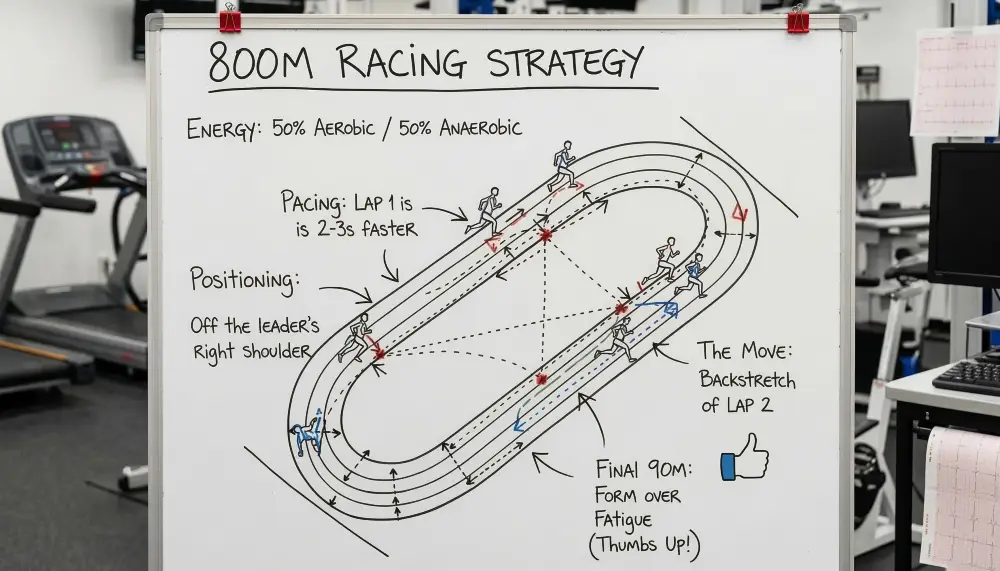
The 800m warmup is more aggressive. The 800m is the most aerobically and anaerobically demanding track event in the program. Lactate accumulation begins in the first 100 meters. The oxygen deficit costs a greater fraction of total race time than in any longer event. Everything about the warmup should be tuned toward maximum readiness:
- The easy jog can be slightly shorter (12 minutes rather than 15)
- The strides should reach close to 800m pace by the final rep
- The priming effort is the full 200m at genuine 800m pace
- The 800m runner cannot afford to feel flat at the line
The 1600m warmup is more measured. The 1600m has a longer sustainable aerobic phase and benefits from a strong zone 2 foundation, but the opening 200–400m still carry a significant oxygen deficit that a proper warmup reduces. The key differences:
- The easy jog should be the full 15 minutes.
- Strides build firmly but don’t need to fully reach 1600m pace
- The priming effort is 200m at 1600m goal pace
- The 1600m runner needs to feel relaxed and smooth at the line, not fired up the way an 800m runner does
The mental calibration at the line is also different. An 800m runner should feel coiled: tight, fast, ready. A 1600m runner should feel fluid: loose, settled, and confident in their pace strategy. Your warmup should produce that specific feeling, which is another reason the intensity levels differ.
The Common Mistakes, and What They Cost
- Jogging two laps and calling it a warmup. Eight hundred meters of easy jogging does almost nothing for VO2 priming.
- Running the easy jog too fast. The warmup jog is not a conditioning run. Slow it down.
- Skipping strides. Strides are non-negotiable for middle-distance events.
- Skipping the priming effort. This is the most expensive skip in terms of performance.
- Poor timing. Completing the warmup 30 minutes before the race and standing around. Staying mobile matters.
- Ditching the sweats too early. Warmup gear serves a function, to maintain the temperature you worked to create.
What to Say to Your Athletes
The warmup protocol above is only as good as your athletes’ understanding of why it exists. Teenagers who don’t understand the mechanism don’t execute the protocol. They cut corners on the easy jog, skip the priming rep because they worry “it will leave them tired for their race,” and stand around on their phones during the active recovery window.
Teach the mechanism once, clearly:
“Your aerobic engine takes 60–90 seconds to fully engage when you start running hard. During those 60–90 seconds, you’re running on borrowed energy that you’ll have to pay back later. The warmup, especially that hard 200, wakes the engine up so it’s already running when the gun fires. Without it, you’ll spend the first lap digging a hole you’ll spend the rest of the race climbing out of.”
That explanation lands with high school athletes because they’ve felt it. Every runner who’s ever gone out too fast in the first 400m of a 1600m knows the feeling. Understanding how self-limiting beliefs affect race execution can also help athletes commit to the full warmup rather than cutting corners out of anxiety.
The 20-Minute Warmup That Isn’t
One final note: the increasingly common “20-minute warmup” that many programs use for distance events: a 10-minute jog and a few strides is maybe appropriate for a 5K or longer race distance, where the oxygen deficit is proportionally smaller and where the aerobic base can absorb the early inefficiency.
It is not appropriate for the 800m or the 1600m. The physiological demands of a 2-minute and a 4-minute all-out effort are categorically different from an 18-minute cross country race. Middle-distance runners need a middle-distance warmup. The extra 30 minutes is not busywork. It is the exact preparation that makes the difference between a race that clicks from the first 100 meters and one that doesn’t find its rhythm until it’s too late.
The warmup your athletes skip is the one that would have made the race feel the way they’ve been training for it to feel.
Do it right.