

Does Nasal Breathing Make You a Better Runner? What the Science Actually Says

Nasal Breathing for Runners: What the Science Actually Says
One of my athletes showed up to practice last fall wearing a small strip of mouth tape.
I asked him about it. He explained she’d been sleeping with it all week after he’d read that nasal breathing for runners increases nitric oxide, improves oxygen delivery, and makes you a more efficient runner. He wanted to try it during easy runs. Three different coaches on Instagram were promoting it. James Nestor’s book Breathe had been sitting in his bag since cross country camp.
I told him I was glad he was curious and looking for ways to get better. I also told him to take the tape off.
Not because nasal breathing is useless, it isn’t. But because the version of it circulating in endurance running spaces right now is a half-truth built on a real foundation, and the gap between the two matters enough to write about.
Here’s what the science actually says.
Why Everyone Is Suddenly Talking About This
The nasal breathing trend in running circles has a few origin points. Nestor’s Breathe (2020) brought mainstream attention to nasal function, chronic mouth breathing, and the structural consequences of how we inhale. The book makes a legitimate case for nasal breathing as a health intervention: dental development, sleep quality, immune function, airway conditioning. That argument is solid.
The problem is what happened next. The performance claims piled on. Suddenly nasal breathing wasn’t just good for your health, it was the hack to raise your VO2max, lower your lactate, and make your easy runs more efficient. Athletes started taping their mouths during workouts. Coaches started cueing “nose only” during warm-up miles.
So let’s look at the science. The actual peer-reviewed kind, not the social media interpretation of it.
First, Understand How Oxygen Actually Gets to Your Muscles
Before evaluating any breathing technique, you need to understand what the respiratory system is actually responsible for in the delivery chain. Researchers call it the oxygen cascade, and it works like this:
Air enters your lungs (nose or mouth, one or both). From the lungs, oxygen crosses into tiny air sacs called alveoli, then diffuses into capillaries and binds to hemoglobin in the blood. Your heart pumps that oxygenated blood to working muscles. At the muscle, oxygen crosses from capillaries into muscle fibers, enters the mitochondria, and powers the aerobic energy system.
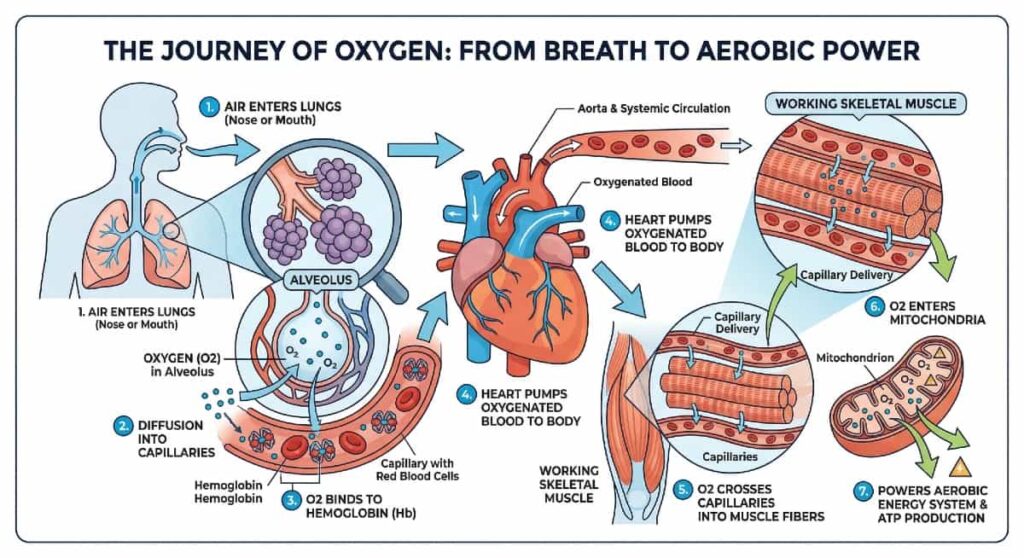
Each step involves a pressure differential that drives oxygen downhill through the system. At altitude, that gradient flattens because the partial pressure of oxygen in the air is lower. That’s why altitude hurts endurance performance. It’s not that there’s less oxygen per se, it’s that the cascade gets shallower and oxygen moves through the system less efficiently meaning there’s less oxygen available to you internally.
The question nasal breathing advocates are answering is: can we improve the very first step of that cascade by changing how air enters the body?
The honest answer from exercise physiology is: It barely matters. Because the first step is rarely the bottleneck.
The Respiratory System Is Overbuilt
This is the sentence most nasal breathing content buries or omits entirely: in the vast majority of runners, breathing capacity is not the limiting factor in performance.
Exercise physiologists have understood this for decades. Your lungs have substantially more capacity than your cardiovascular system can use. Even at hard efforts, blood oxygen saturation stays above 95%, essentially fully saturated. You are not running out of air. You are running out of cardiovascular transport capacity and muscular endurance long before your lungs become the problem. You literally exhale unused oxygen.
The limiting factors in high school distance running performance are almost always: cardiac output, capillary density in the muscles, mitochondrial density, lactate threshold, running economy, and neuromuscular efficiency. Not how air enters the body.
There are two exceptions worth noting. Highly trained, high-output endurance athletes can develop something called exercise-induced arterial hypoxemia (EIAH) where cardiac output is so high that blood moves through the lungs faster than full gas exchange can occur, and blood oxygen saturation actually drops during maximal effort. But this is a rare phenomenon in elite, high-mileage athletes with extremely well-developed cardiovascular systems. It is not what’s happening in your typical high school cross country program.
The second exception is altitude, which we’ve covered. If you’re coaching at altitude, the oxygen cascade becomes more relevant at every step including the breathing one.
For everyone else: the gate controlling your performance has nothing to do with your nose.
What the Research Actually Shows
Let’s be specific about the evidence, because “the science says” is not a citation.
Study 1, Anaerobic Performance: A study in the Journal of Sports Science and Medicine tested nasal versus oral breathing on a Wingate anaerobic cycling test. A 30-second all-out effort. Results: no significant difference in peak power, mean power, or performance at any point in the test. Nasal breathing did suppress the respiratory exchange ratio (less hyperventilation), but that didn’t translate to output. The conclusion was blunt: breathing mode does not affect performance on high-intensity anaerobic exercise.
Study 2, Muscular Endurance: A 2024 study published in BMC Sports Science, Medicine and Rehabilitation examined 107 physically active college students performing bench press repetitions to failure across three breathing conditions: nose in/nose out, nose in/mouth out, mouth in/mouth out. Results: less than one repetition difference across conditions. Nasal breathing during strength endurance work is essentially equivalent to mouth breathing in terms of output.
Study 3, Low-Intensity Training: A 2023 Frontiers in Physiology randomized crossover trial had 19 adults perform 60-minute easy cycling sessions under nasal-only versus unrestricted breathing conditions. Here the results get interesting. Nasal breathing produced significantly lower total ventilation, lower breathing frequency, reduced oxygen uptake, and importantly meaningfully lower blood lactate concentrations by mid-session (1.21 vs. 1.48 mmol/L, p=0.01). At easy aerobic intensities, nasal breathing is metabolically more efficient.
The catch? The same study found no significant difference in training intensity distribution. Nasal restriction didn’t stop athletes from creeping above their intended easy effort, it just made them feel more uncomfortable at those higher intensities. As a pacing compliance tool, it has real limits.
Study 4, Training Adaptation: A study in placed 34 basketball players through a six-week nasal breathing training protocol during intermittent running exercises. The experimental group showed significant improvements in the Yo-Yo Intermittent Recovery test, forced vital capacity (FVC), forced expiratory volume (FEV1), and peak expiratory flow as compared to controls who trained identically but breathed normally. Sprint performance showed no difference.
This is the most practically useful finding in the literature: nasal breathing as a training stimulus over weeks, not a performance switch you flip on during a race, appears to improve respiratory function metrics and aerobic endurance.
The Nitric Oxide Argument Is Real, and Overstated
The physiological argument for nasal breathing centers on nitric oxide (NO), and it has legitimate science behind it. The paranasal sinuses continuously produce nitric oxide, and nasal breathing delivers that NO-rich air directly into the lungs, where it acts as a vasodilator, widening blood vessels, improving ventilation-perfusion matching, and theoretically enhancing oxygen uptake efficiency.
A 1997 study in Acta Physiologica Scandinavica measured exhaled nitric oxide during exercise and found nitric oxide concentration was significantly higher during nasal breathing than oral breathing at both submaximal and moderate exercise intensities. The nasal airway genuinely is a nitric oxide delivery mechanism.
Here’s the problem with turning that into a performance claim: the research on whether nasally-derived nitric oxide meaningfully changes gas exchange outcomes during running is not there. The effect exists. Whether it’s large enough to matter across the oxygen cascade in a healthy, sea-level runner is a different question. Based on current evidence, the answers is no for most athletes.
For the typical high school runner running 20–45 miles a week at sea level, the nitric oxide effect is real but negligible.
When Nasal Breathing for Runners Actually Helps
Given all of the above, here’s where nasal breathing delivers genuine value for runners:
1. Easy and recovery runs below 75% effort. This is where the metabolic efficiency data is real. Lower ventilation, lower lactate, slower breathing frequency, all of these are characteristics of a physiologically productive easy run. If nasal breathing helps you stay honest on days meant to be easy, that’s a legitimate benefit. Not because it’s improving your oxygen delivery, but because it’s biofeedback. If you can’t maintain nasal breathing comfortably, you’re going too hard. This is especially relevant for coaches implementing Zone 2 training for high school runners, nasal breathing becomes a simple, no-device intensity check.
2. Pacing control for athletes who chronically run their easy days too fast. I have some athletes who seem to be physically incapable of running slow enough on recovery days without an external signal. Mandating nasal breathing on a Wednesday easy run might be more effective than any pace cue I’ve given them. The perceived discomfort of breathing through the nose at a pace that is actually too hard is its own feedback mechanism.
3. Air quality and environmental conditions. The nasal airway filters, warms, and humidifies air before it reaches the lungs. In cold weather, this is relevant: cold, dry air reaching the bronchial tubes can trigger bronchospasm in susceptible athletes. In dusty or polluted environments, nasal filtration meaningfully reduces particulate load. The structural benefits of nasal breathing for upper respiratory tract infection risk are also supported: mouth breathing during heavy training in winter appears to increase illness frequency.
4. As a long-term respiratory training stimulus. The basketball study points to something coaches should take seriously. If you consistently incorporate nasal-only breathing during low-intensity work over a six-week training block (your summer base phase, for instance) you may develop measurable improvements in lung function metrics and aerobic endurance capacity. This is a training adaptation, not an acute performance enhancer. It works the same way strides develop neuromuscular function: not by making you faster today, but by building tissue quality over time.
What to Ignore
Nasal breathing during threshold workouts and intervals. At intensities above 75–80% VO2max, the nasal airway physically cannot deliver sufficient air volume. The result is increased perception of effort, psychological distress (“air hunger”), and no performance benefit. The research is consistent here. Let your athletes breathe however their body selects at quality efforts.
Mouth tape during hard training. For sleep, there’s emerging evidence supporting nasal breathing. For a 5K time trial, it’s counterproductive restriction of a system that doesn’t need restriction. If an athlete is mouth taping during a threshold session because they read about it online, that’s a conversation to have.
Nasal breathing as a substitute for fitness. The version of this I encounter most often in high school programs is an athlete who breathes heavily during easy runs and concludes they need to train their breathing. The heavy breathing is a symptom of an underdeveloped aerobic system. Building the engine is the fix. Changing the air intake route is not.
The High School Practical Application
Here’s how I think about nasal breathing in the context of the XC training system:
Summer base block (Weeks S1–S10): Easy runs are the ideal context for nasal breathing practice. Low intensity, long duration, and self-directed. This is exactly where the 2023 Frontiers study saw lower lactate and where the six-week training adaptation works. Use it as an intensity monitor: if your athlete can’t nose-breathe comfortably on a 5-mile easy run, they’re running too hard.
Phase 1–2 (General/Specific Prep): Easy days continue as nasal-optional. Quality days, like hill repeats, extensive tempo, vVO2max intervals, breathe however your body wants. No restrictions.
Competition phases: Race day is not a nasal breathing experiment. Race day is vVO2max implementation. The body’s natural breathing pattern during a 5K is doing exactly what it should. Leave it alone.
The 10% of this that is genuinely worth your attention: building the habit on easy days, using it as a pacing diagnostic, and recognizing the legitimate winter and air quality benefits.
The 90% that’s internet noise: performance-enhancing claims at race intensity, mouth taping during workouts, and treating the respiratory system as a limiting factor when it almost never is.
The Bottom Line
Nasal breathing won’t make you a faster runner. Your aerobic system, your lactate threshold, and the quality of your training structure will make you a faster runner.
What nasal breathing will do, used correctly, is help you protect the quality of your easy runs. The sessions that make up 75–80% of your total training volume and form the foundation of everything that happens in October and November. If it keeps you honest on Wednesday, that’s not a small thing. That’s actually the whole point.
The kid who showed up with the mouth tape? He kept using it for sleep and started using nasal breathing as a voluntary cue on easy runs, not as a mandatory restriction during workouts. His easy-day pacing has measurably improved, not because his oxygen delivery changed, but because he had a tool that gave him real-time feedback on whether he was actually running easy.
That’s what good physiology tools do. They simplify the feedback loop. They don’t override the system, they help you use the system better.
The rest is Instagram.
Frequently Asked Questions About Nasal Breathing for Runners
Should runners breathe through their nose or mouth?
At easy intensities (below 75% effort), nasal breathing is physiologically efficient and serves as a useful pacing signal. At moderate to hard intensities, like tempo, intervals, or races, just breathe naturally. Your body will default to mouth or combined breathing because the nasal airway physically cannot meet the ventilation demand. Forcing nasal breathing at high intensity increases perceived effort without improving performance.
Does nasal breathing increase VO2max?
Current evidence does not support nasal breathing as a direct VO2max enhancer during exercise. A six-week nasal breathing training protocol in basketball players did improve aerobic endurance metrics (Yo-Yo test performance, FVC, FEV1), suggesting a training adaptation over time. But this is not equivalent to raising VO2max through nasal breathing during workouts.
Why does nasal breathing feel so hard when running?
Because the nasal airway has roughly 50% less cross-sectional area than the oral airway for air flow. As running intensity increases, your ventilatory demand exceeds what the nose can comfortably supply. This is not a sign something is wrong, it is normal respiratory mechanics. The discomfort you feel when trying to nose-breathe during a hard run is your body accurately signaling that it needs more airflow than one airway can provide.
Is nasal breathing good for easy runs?
Yes! A 2023 Frontiers in Physiology study found nasal-only breathing during easy cycling produced significantly lower blood lactate concentrations compared to unrestricted breathing at the same intensity. The mechanism appears to be reduced ventilation frequency, allowing longer gas exchange time in the alveoli. For easy aerobic runs, nasal breathing is metabolically appropriate and serves as useful biofeedback for pace control.
What about the book Breathe by James Nestor?
In his book Breathe, Nestor makes a credible case for nasal breathing as a health intervention: facial development, sleep quality, immune function, and chronic mouth breathing consequences are legitimate concerns supported by evidence. His performance claims for athletes are more speculative and not consistently supported by the controlled exercise physiology literature. Worth reading for the health perspective; weight the performance claims cautiously.
Can high school runners benefit from nasal breathing training?
Evidence suggests yes, with the right framing. Six weeks of nasal breathing during low-intensity training may improve respiratory function metrics and aerobic endurance capacity, not by changing gas exchange mechanics, but by training respiratory muscles and building efficient breathing patterns. Integrate it into summer base training at easy effort, not into quality sessions, and you don’t need tape over your mouth to do it. For coaches looking to prevent overtraining during base phases, nasal breathing on easy days is one more tool to keep intensity honest.
Coach’s Library
Want the full reference breakdown? Nasal Breathing for Running Performance →
Related Reading
- Chronic Sleep Debt Is Wrecking Your Season, another recovery variable most coaches overlook
- The Norwegian Method for High School Runners, a polarized training approach that pairs well with nasal breathing on easy days