

Middle school track plan · 800m and 1600m · grades 5 to 8Twelve weeks of middle school track. Race pace, a little at a time.
Three levels set by training age, not grade. Explorers learn the gears by feel. Builders get one lap card. Bridge athletes learn the P-Scale they will use in high school. Every day is written out, with its minutes.
Coaching high schoolers too? See the P-Scale track plans.
- Instant download
- Three levels, 12 weeks
- 30-day money-back guarantee
- 31state champions coached
- 25 yearscoaching distance runners
- USATF Level 2Endurance Coach
- Coach of the YearNew Hampshire cross country, 2018
Built for grades 5 to 8
Middle school track is not high school track with the mileage cut in half.
Most plans for middle schoolers are high school plans scaled down. Fifth graders end up running intervals built for juniors, and the fast seventh grader gets handed the varsity workout. This plan starts from what middle school is for: they come back next year, they build the athlete before the mileage, and they learn the language they will use in high school.
Five gears. Then the numbers behind them.
Explorers never see a P number. Bridge athletes finish eighth grade fluent in P80, P100 and G, ready for the P-Scale Pace Calculator and the high school plans.
Place by training age.
Explorer, Builder or Bridge, set by seasons of organized running. A fast fifth grader is an Explorer. So is an eighth grader who has never trained.
Teach the gears, then the numbers.
Everyone learns five gears by the talk test. Builders add one lap card. Bridge athletes learn the P numbers behind every gear, the same scale the high school plans use.
Race pace, in small pieces.
Rhythm sessions touch race speed in reps of 30 to 60 seconds with full recovery. The meet is the week’s only hard effort. Two quality days a week, never three.
Children recover from short, fast efforts faster than adults, mostly because they produce less power to recover from. Short reps with walk-back recovery fit how they are built. Long race-pace reps on short rest, the sessions that leave high schoolers bent over, wait for high school.
A real week from the plan
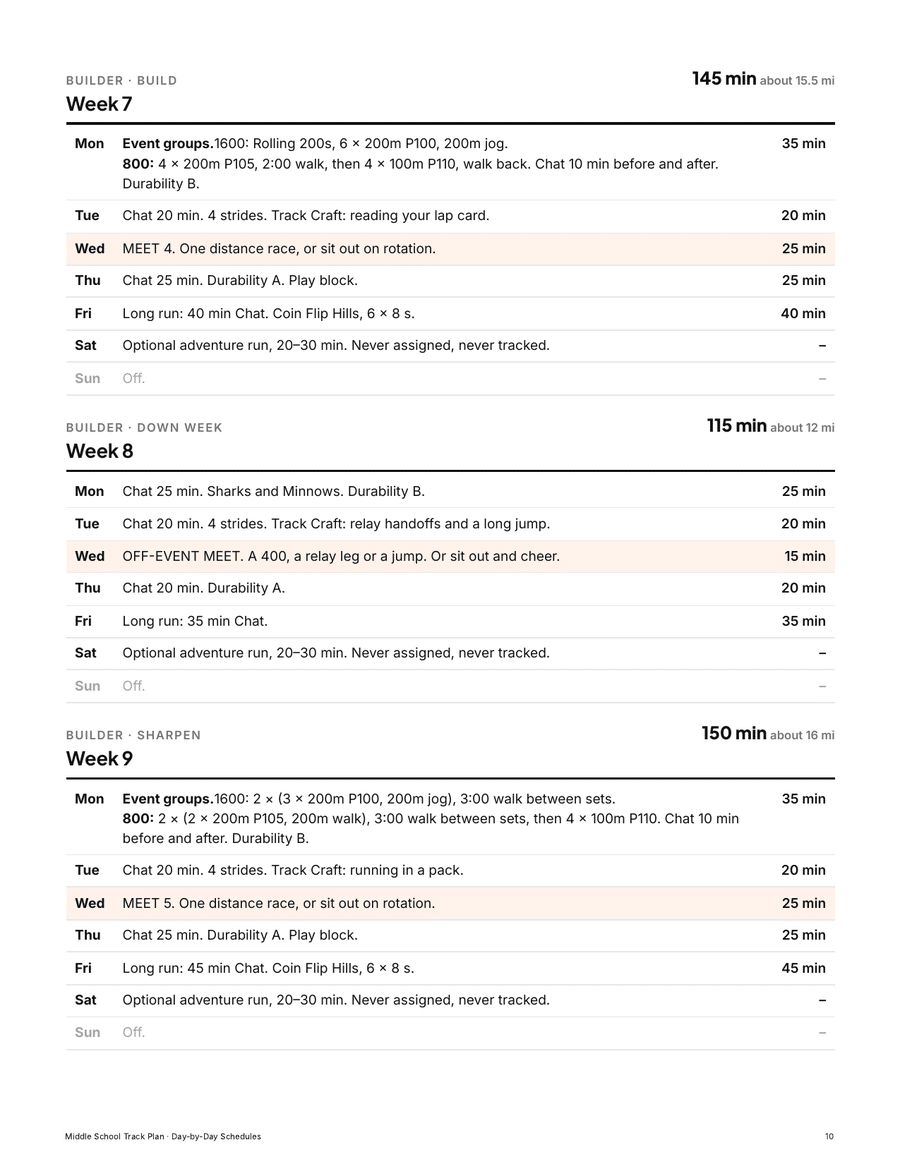
Builder, week 9. Lap card filled in.
A seventh grader in their second season, with a 7:00 1600m from meet 1. Monday is the track day, split by event group. Wednesday is the meet. Everything else is Chat, durability and a long run. The lap-card times come from the free P-Scale Pace Calculator.
| Mon | Event groups, Chat 10 min before and after.1600: 2 × (3 × 200m P100 52.5, 200m jog), 3:00 walk between sets800: 2 × (2 × 200m P105 49.9, 200m walk), 3:00 walk between sets, then 4 × 100m P110 23.6 | 35 min |
|---|---|---|
| Tue | Chat 20 min, 4 strides | 20 min |
| Wed | Meet 5. One distance race, or sit out on rotation | 25 min |
| Thu | Chat 25 min | 25 min |
| Fri | Long run: 45 min Chat. Coin Flip Hills, 6 × 8 s | 45 min |
| Sat | Optional adventure run. Never assigned, never tracked | – |
| Sun | Off | Off |
150 minutes this week, about 16 miles. Explorers run the same days with no lap card and no Monday split. Bridge athletes run Rolling 200s at goal pace.
Three levels
Place them by training age, not grade.
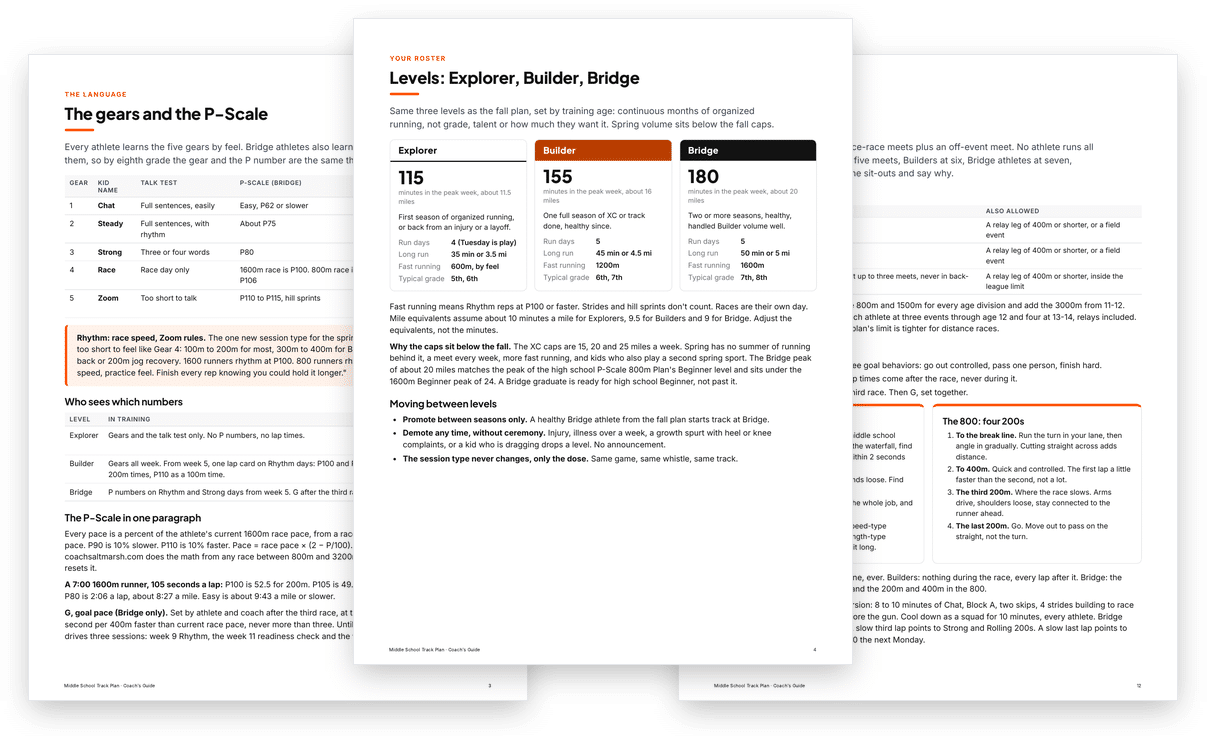
Same session on the same day for every level, on the same track and the same whistle. Only the dose changes. Spring volume sits below the fall caps, and the Bridge peak matches the high school Beginner level, not past it.
4 running days
First season of organized running, or back from an injury. Gears by feel. No lap times, no splits.
5 running days
One full season done, healthy since. One lap card on Rhythm days from week 5.
5 running days
Two or more seasons. The full P-Scale, a goal pace after meet 3, readiness checks in week 11.
What you get
Everything for a middle school spring, from the first practice to the championship.
Two PDFs to print and keep. Nothing to install, no athlete accounts, no subscription.
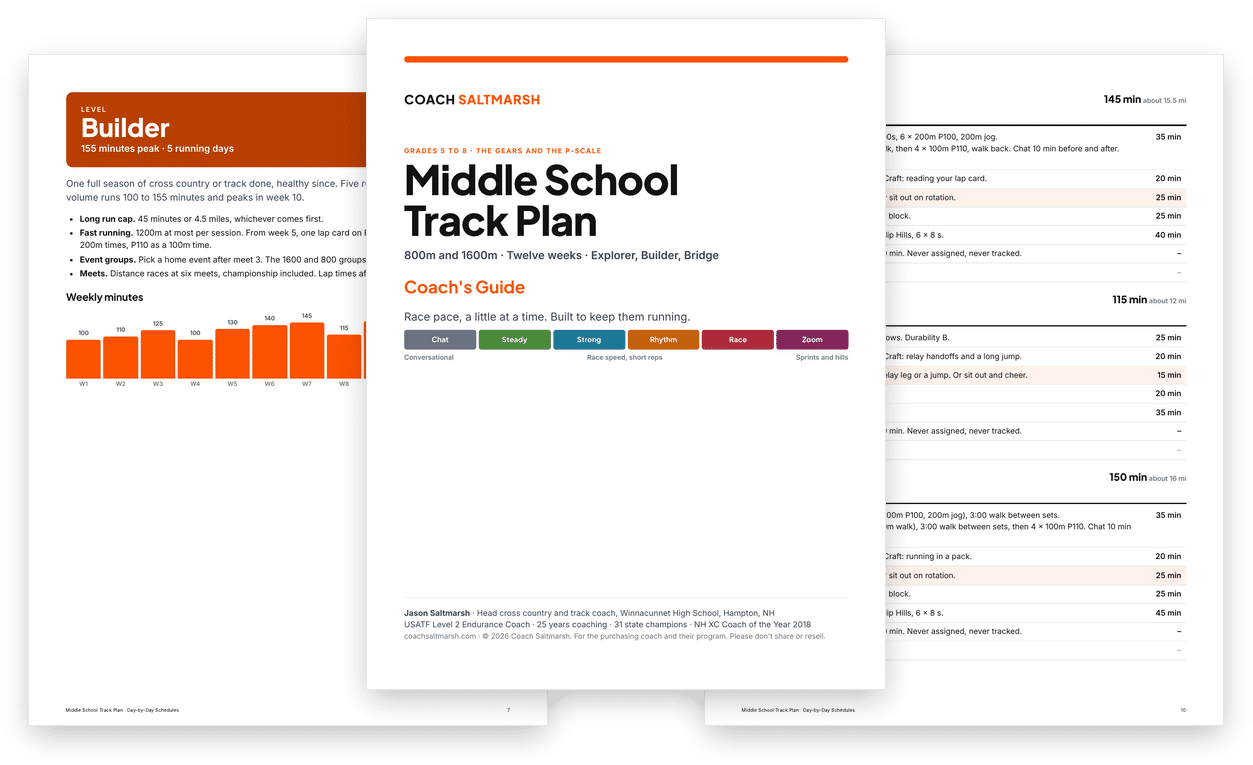
The Coach’s Guide
Read it before the first practice and you can place every athlete, run every game and coach both races.
- The gears and the P-Scale, level by level
- The 800 and the 1600, with race plans
- Track games, Track Craft and combined practice
Day-by-Day Schedules
Explorer, Builder and Bridge. Twelve weeks, every day, with its session and its running minutes.
- Print a level, post it, coach
- Built around a weekly meet, with a count-back rule for any day
- Short seasons and two-meet weeks covered
Gears first, numbers second
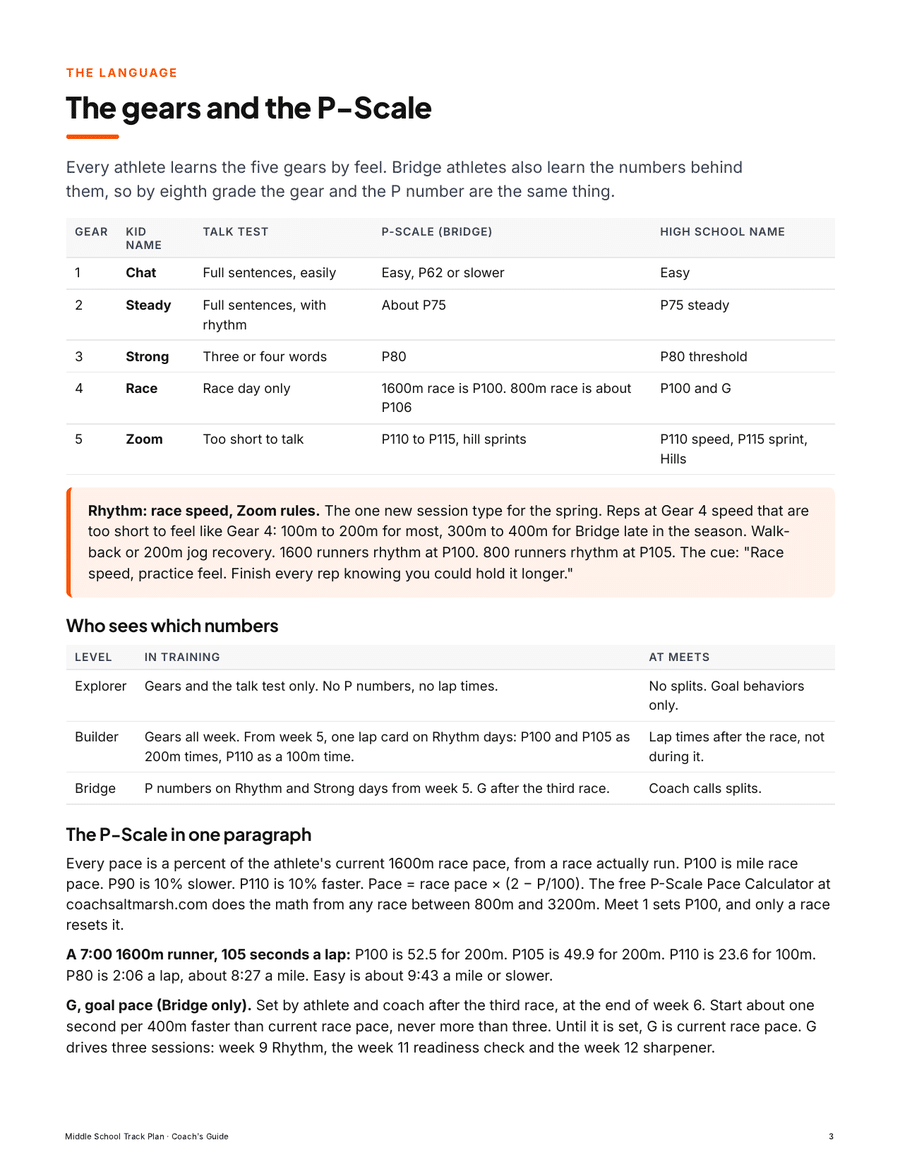
The talk test for everyone. One lap card for Builders. The full P-Scale for Bridge, from the free P-Scale Pace Calculator.
- Five gears and the Rhythm session
- Who sees which numbers, level by level
- Lap-card times from any race, 800m to 3200m
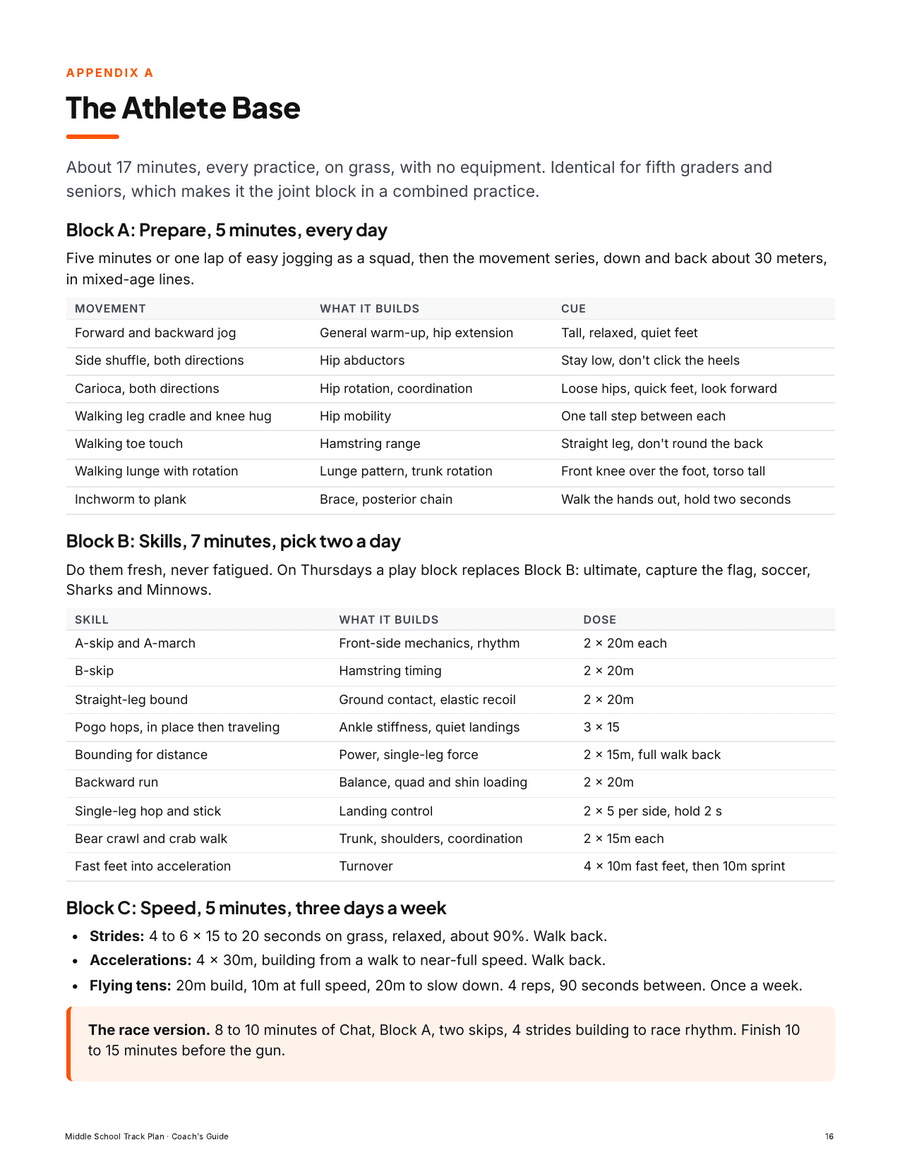
The Athlete Base and durability
Printed in full, so the plan stands on its own. The same blocks the fall plan uses.
- The 17-minute Athlete Base, every practice
- Phase 1 durability, bodyweight only
- A watch list for growing runners
The 30-day use-it-with-your-team guarantee.
Run it with your actual roster. If it doesn’t earn its keep, reply to your receipt email within 30 days for a full refund. No forms, no questions.
Coaching middle school in the fall too?
Pair it with the 12-Week Middle School XC Plan.
Same three levels, same five gears, same Athlete Base and durability work. Fall and spring in one system for grades 5 to 8.
The 12 weeks
Three weeks to learn. Nine weeks to race.
Foundation weeks with no meets, then a meet every week. Down weeks at 4 and 8, the peak in weeks 9 and 10, and two weeks completely off after the championship. Season shorter than 12 weeks? Run it in order, then jump to weeks 11 and 12.
Track day: Rhythm or Strong. Durability B.
Chat and strides. Track Craft. Explorers play.
Meet from week 4.
Chat, Durability A and a play block.
Long Chat run and hill sprints.
Optional adventure run. Sunday off.
Why it is built this way
Built on what holds up.
Rest built in
The youth running consensus statement asks for at least one rest day a week and one to two weeks off every three months (Krabak et al., 2021). Sunday is off, and the season ends with two weeks off.
No specializing at eleven
The same statement discourages single-sport specialization until after puberty. So every distance kid trains for both events, week 8 is an off-event meet, and play blocks stay in all season.
Short reps suit kids
Children recover from high-intensity efforts faster than adults, mainly because they produce less power (Falk and Dotan, 2006). That is why Rhythm reps are short with full recovery.
Honest about the evidence
No governing body publishes a weekly volume number for middle school track. The caps here are coaching judgment, set below the fall caps and at or below the high school Beginner levels.
Questions
Questions coaches ask about the middle school plan.
One-time purchase. No subscription. No per-athlete fees.
Want a second set of eyes on your placements? Reply to your receipt email to set up a one-hour call.
Who is it for?
Middle school distance runners in grades 5 to 8 who want to race the 800m, the 1600m or both, and the coaches who run their practices. One purchase covers your whole staff and team.
My roster runs from fifth graders to fast eighth graders. Does one plan work?
Yes. Levels are set by training age, not grade. Every level runs the same session type on the same day, in different doses, so the whole team practices together.
How much do they run?
Running is written in minutes. Explorers peak at 115 minutes a week, Builders at 155 and Bridge athletes at 180, about 11.5, 16 and 20 miles. The long run tops out at 35, 45 and 50 minutes.
Will it fit my meet schedule?
The schedules assume Wednesday meets from week 4. For any other day, the Coach’s Guide has a count-back rule: two days before the meet is the track day, the day before is easy, the day after is recovery. Two meets in a week: the second meet replaces the track day.
My season is shorter than 12 weeks.
Run the weeks in order from week 1, then jump to weeks 11 and 12 for the last two weeks before your championship. A 10-week season runs weeks 1 to 8, then 11 and 12. Volume never jumps.
Do middle schoolers need pace charts?
Explorers never see a number. Builders get one lap card on Rhythm days. Bridge athletes use the full P-Scale from the free calculator, so they arrive in high school already fluent in it.
Should they specialize in the 800 or the 1600?
No. Every distance kid trains for both. Builders and Bridge athletes pick a home event after meet 3 and split into event groups on the track day only. Explorers never split.
Can they run the 800 and the 1600 at the same meet?
Bridge athletes can double at up to three meets, never in back-to-back weeks. Explorers and Builders run one distance race per meet, plus a relay leg or a field event if they want.
I coach middle school and high school together.
The guide has a section on combined practice: shared warm-up and durability, the main session split by level, and a table matching every middle school session to the high school P-Scale session on the same day.
Do I need the Middle School XC Plan to use it?
No. The Athlete Base, the Phase 1 durability sessions and the game rules are printed in the Coach’s Guide. If you coach the fall too, the two plans share levels, gears and practice structure.
Does one purchase cover my staff and team?
Yes. One purchase covers one program: every coach on your staff and every athlete on your roster. Please don’t share it outside your program.
More from Coach Saltmarsh
12-Week Middle School XC Plan · $49
The fall half of the system. Same levels, gears and Athlete Base, with a full game manual.
P-Scale 1600m Plan · $39
Where Bridge graduates go next: the high school mile, in the same pace language.
P-Scale 800m Plan · $39
The high school 800m, speed first, with the full calculator.
P-Scale Pace Calculator · free
Lap cards and zones for any athlete from one race.
Middle School Track Plan
Week 12 is the championship. Count back from there.
Three levels. Every day written out. Race pace, a little at a time. $39, one-time, covers your staff and team.