
How to Run a Cross Country Banquet
The short answer. Keep a cross country banquet to about 90 minutes. Give every runner about a minute: 2-3 specific sentences from you. Keep the awards few, and make most of them about effort and improvement, not only the top seven. Let the seniors speak.
The last meeting of the season
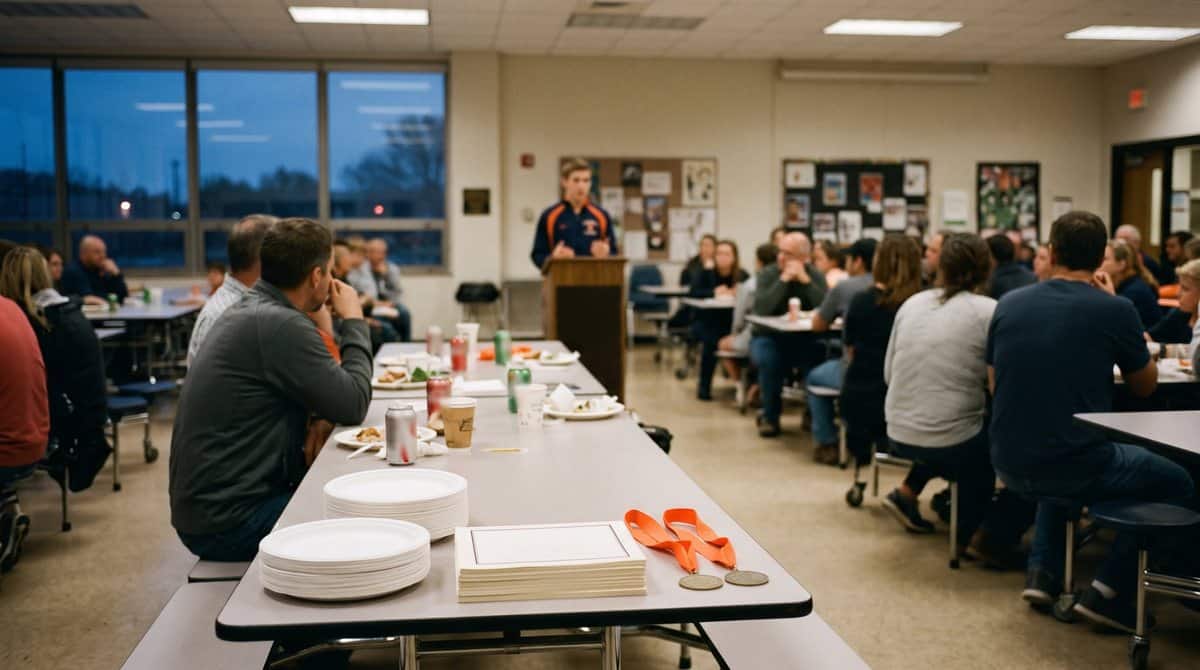
The banquet is the last time the whole team is in one room until spring. The families are there. So are the seniors, for the last time.
Most banquets spend that hour reading results out loud. The kids already know the results. What they take home is whether the coach knew who they were.
Here is how I would plan the night: what to do the week before, a 90-minute run of show, which awards are worth giving, and how to end the night.
Before the night
Five jobs, done the week before.
- Pick the date. After every runner’s last race, including the ones who raced at New Englands or a regional. Two to four weeks after the last race works for most programs. The season still feels close, and nobody is still racing.
- Review your debrief notes. If you sat down with every runner for fifteen minutes after the season, you already have the raw material for the night: when each one felt best, what went right, and what they want next. Here are the ten questions I ask.
- Settle the awards with your assistants. Pick the winners together and write down how each award was decided. A parent or the AD will ask.
- Tell the seniors they are speaking. Give them the prompts below a week ahead. A senior who finds out at dinner gives the speech you would expect.
- Hand off the food and the room. A parent volunteer or the booster club runs setup and food. Your job that night is the program.
A 90-minute run of show
Ninety minutes is long enough to do it right and short enough that nobody checks a phone. Thirty minutes of food and pictures, then one hour of program.
| Clock | Block | What happens |
|---|---|---|
| 0:00 | Food and photos (30 min) | Doors open, plates full and a slideshow of season pics with every athlete represented multiple times. |
| 0:30 | Welcome (5 min) | Thank the families and the people who made the season run. Name them. |
| 0:35 | The season (5 min) | A short recap. Talk about the team as people first and athletes second. Share season highlights. Use humor and be yourself. |
| 0:40 | Every runner by name (20 min) | Each grade level comes up, each athlete hears 2-3 sentences from you and receives a certificate, then each grade level goes back to their seats. |
| 1:00 | Awards (10 min) | A short presentation of awards. Have 2-3 minutes of commentary for each recipient and explain the meaning and importance of the award. |
| 1:10 | Senior speeches (15 min) | Two minutes each. The part of the night the team remembers. |
| 1:25 | Wrap-up (5 min) | Thank everyone and use this moment to leave them with whatever thought you want to stick. Then stop. |
| 1:30 | Done | Start on time and end on time. Families with a school night in the morning will thank you for the second one. |
Split the roster. You take the seniors and the awards, and your assistants take the grade-level groups.
One minute for every runner
If you do one thing well, do this. Every runner hears their name and gets one minute from you that is only about them.
Generic praise does not land. “Great attitude all season” could be about anyone on the roster, and every kid in the room can tell. Specific does land: a time, a place, a moment you saw.
| Generic | Specific |
|---|---|
| “Great attitude all season.” | “Moved up three places on the last hill at Black Bear, when it hurt most.” |
| “Really improved this year.” | “Took a minute and forty seconds off his 5K between the first meet and the last.” |
| “Worked really hard.” | “Ran every Saturday long run in October, including the one in the freezing rain.” |
| “A great teammate.” | “Waited at the finish for our seventh runner at every meet with open arms.” |
Your debrief notes are where these come from. One of the debrief questions asks when each runner felt best this season. The answer is useful here.
Write the sentences ahead of time and read them. Do not try to make up forty of them at a podium.
Awards worth giving
Most banquets give two kinds of awards. Some go to the fastest runners, and some go to everyone else. Give both kinds, but lean on the second.
There is research behind that. Ronald Smith, Frank Smoll and Sean Cumming trained youth basketball coaches to build what researchers call a mastery climate, where success means effort, learning and improvement rather than beating teammates. Over one season, players on the trained coaches’ teams grew less anxious about competing. Players on the other teams grew more anxious (Smith, 2007).
A second study of 268 youth basketball players found that the team’s win-loss record mattered far less to how players rated their coach, and how much they enjoyed the season, than the climate the coach built (Cumming, 2007). Those were basketball players aged 10 to 15, not high school runners. Still, the things you stand up and reward in front of the team are part of that climate.
| Award | Who it is for | How to decide it |
|---|---|---|
| Varsity letter | Everyone who met your school’s standard | Your school’s rules. |
| Most Improved | The biggest honest improvement | See the next section. |
| Coach’s Award | The runner who made the team better without making the top seven | Your call. Say why out loud. |
| Rookie of the Year | The best first season | Times, plus the habits they built. |
| Teammate Award | The runner the team would pick | A secret ballot at the last practice. |
Keep the list short. Four awards plus varsity letters is plenty.
Most Improved without the argument
Most Improved starts more parent emails than any other award. Two habits keep it fair.
- Compare like with like. If you raced one course twice, early and late in the season, use that. If not, use the change from the first 5K to the season best, and say so.
- Use percent, not seconds. Seconds usually go to the slowest runners, who have the most room to drop. Dropping a minute off an 18:00 is 5.6 percent. Dropping two minutes off a 25:00 is 8 percent. Percent is closer to fair, but first-year runners will still win most years, because new runners improve fastest. If that bothers you, give one Most Improved to a returner and one to a first-year runner.
Let the seniors speak
Give every senior two minutes. They will say things to the team that a coach cannot. I shared a few lines from our banquet speeches in Building Team Culture: From Fun to Fierce.
Send them four prompts a week ahead:
- The first thing you remember about this team.
- One teammate who made you better, and how.
- What you would tell this year’s freshmen.
- Thank one person who is not a runner.
Two minutes is about 250 words. Tell them that number.
Your speech
Keep yours to about five minutes. Theirs matter more.
- The season in one sentence. Not the results. What kind of team this was.
- One moment. A single scene from the season, told well, beats a list of ten.
- The thank-yous, by name. Families and drivers, the athletic trainer, the athletic director, the booster club, and the volunteers who worked your home meet.
- One thing you want them to remember going into next season.
Common questions
When should a cross country banquet be held?
After every runner’s last race, including anyone who raced at a regional or New England meet. Two to four weeks after the last race works for most programs.
How long should a cross country banquet be?
About 90 minutes: 30 minutes for food and photos, then an hour of program. Start and end on time.
What awards should a cross country team give?
Varsity letters by your school’s rules, then a short list: Most Improved, a Coach’s Award, Rookie of the Year and a Teammate Award voted by the team. Write down how each one is decided.
Should every runner get an award?
Every runner should hear their name and 2-3 specific sentences from the coach. The awards themselves can stay few.
How do you decide Most Improved in cross country?
Compare the same course early and late in the season, or the first 5K to the season best. Use percent, not seconds. Write the rule down before you count.
What should a coach say at a cross country banquet?
Keep it to about five minutes: the season in one sentence, one moment, the thank-yous by name, and one thing you want them to remember going into next season.
Keep reading
- The Post-Season Debrief: Questions to Ask Every Runner Before Winter
- Winter Training for High School Distance Runners
- How to Train for Cross Country: A Year-Round Plan
- Building Team Culture: From Fun to Fierce
Sources
- Smith RE, Smoll FL, Cumming SP. Effects of a motivational climate intervention for coaches on young athletes’ sport performance anxiety. Journal of Sport and Exercise Psychology, 2007.
- Cumming SP, Smoll FL, Smith RE, Grossbard JR. Is winning everything? The relative contributions of motivational climate and won-lost percentage in youth sports. Journal of Applied Sport Psychology, 2007.