

The Post-Season Debrief: Questions to Ask Every Runner Before Winter
The last race was Saturday. By Monday you have a roster, a stack of results, and a winter plan that cannot start until you know four things about every athlete on it.
How long should this athlete rest? Which level do they start on? Do they race indoors or train straight through? And is anything going on with their body that needs a doctor before they run another step?
None of that is on a results sheet. You get it by asking.
Ellie was one of the best cross country runners in the state as a junior. She wanted to run in college, and she wanted college coaches to notice her.
By the championship season she was running on empty. Her energy dropped a little more every day, and the joy had gone out of it. She was headed for burnout. She gritted it out and finished the season anyway, because that is what good runners do.
A junior with college plans is supposed to train all winter. I did not think Ellie needed to. She was going to run spring track, and she was going to be top five in whatever distance event she chose. What she needed was a break from running.
So she played basketball. She was not a great basketball player, but she had fun. The court gave her jumps, speed and agility that running in a straight line never does. It also gave her a few months away from the sport that had worn her down.
She ended up starting for the basketball team. Then she had a great outdoor season that finished with two races at the New England Championships. She runs varsity for a Division II college team now.
Ellie was easy to read. Most athletes are not, and most will not tell you unless you ask.
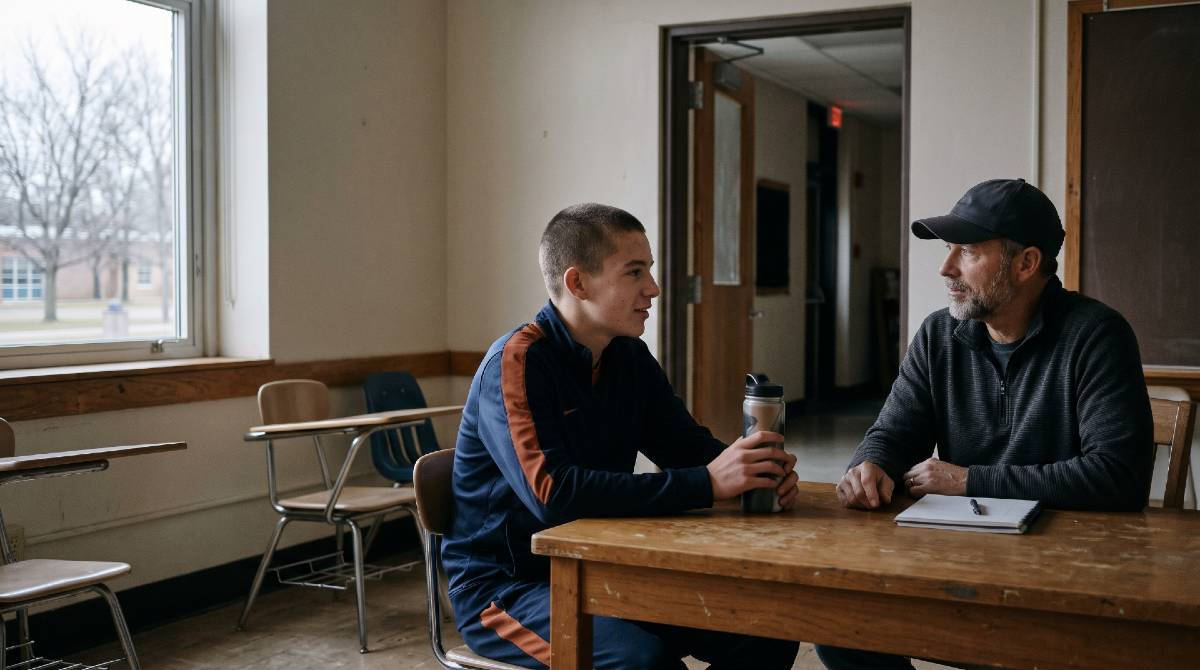
That is what the post-season debrief is for. It is not a goodbye speech and it is not a goal-setting session. It is fifteen minutes of collecting what every winter decision depends on.
The short version. Hold a fifteen-minute end of season meeting with every runner during the break. Ask ten questions in four groups: the season, injuries, the life around running, and what they want next. Questions about eating and periods go to families in writing, not across the table. Their answers set the length of the break, the path and level they start on, and whether anyone needs a doctor first. Write the calls down the same day.
The Winter Training Block
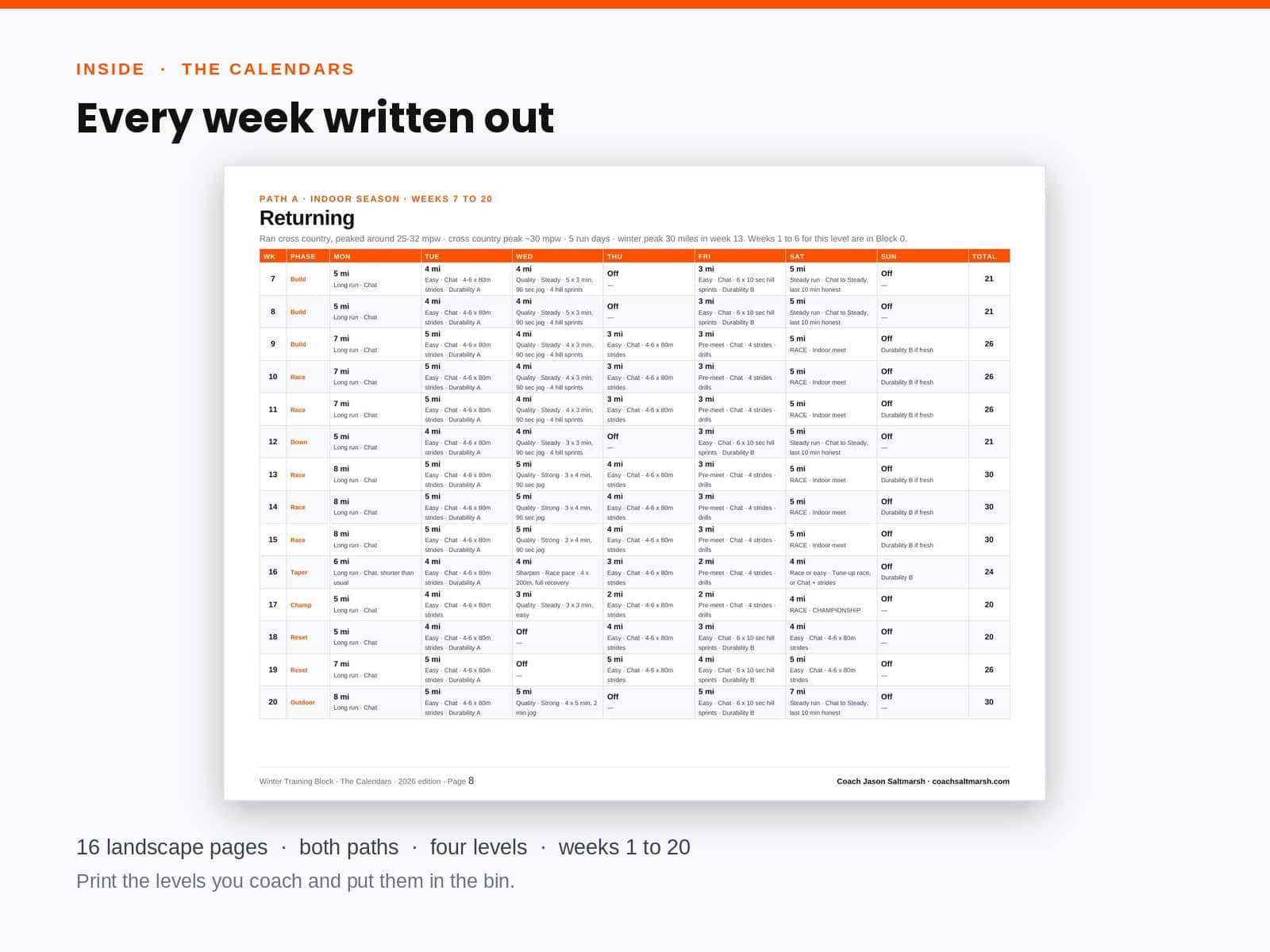
Two paths depending on whether your program races indoors, four levels set by cross country peak week, and every session written out. Sixteen landscape pages of calendars, plus the Coach’s Guide, the Winter Kit and the Event Guide.
Get the Winter Training Block · $59Instant download · 30-day guarantee
What is in this article
- Three calls the debrief has to make
- Before the end of season meeting
- The season: two questions
- Injuries: two questions
- What goes to families instead
- The life around running
- What they want
- Decision 1: how long a break
- Decision 2: the path and the level
- Decision 3: who sees a doctor first
- After the meeting
- Common questions
Three calls the debrief has to make
Every rule in the winter training guide needs an input you only get from the athlete. Set level by cross country peak week. Drop an athlete one level if they were hurt this fall. Keep certain athletes off the indoor track. You cannot apply any of those rules from a results page.
So the debrief is built backward from three calls.
- The break. Seven to ten days with no running for an athlete who finished a full season. About a week for a partial season. None for an athlete who did not run cross country. Medical guidance for anyone who ended hurt.
- The path and the level. Path A races indoors and peaks in February. Path B trains straight through to outdoor. Level comes from cross country peak week, then gets adjusted for injury.
- The health flags. Bone pain, missed periods, under-fueling, short sleep. Some of these mean a phone call home. Some mean a doctor before winter training starts.
Every question below feeds at least one of those calls. If a question does not change a decision, it is not in the meeting.
One meeting sets three calls for every runner
- Full season: 7 to 10 days
- Partial season: about a week
- No fall season: no break
- Hurt: medical guidance
- Level from XC peak week
- One level lower if hurt
- Path A only if healthy, wants it, and not a first-year runner
- Hard flag: doctor first
- Two soft flags: call home
- One soft flag: watch closely
- Checked before the other two
Health flags are checked first. A hard flag holds the break and the path until a clinician clears the athlete.
Before the end of season meeting
Hold it during the break, between day three and day seven after the athlete’s last race. Not the Monday after, when the race is still raw. Not in January, when the decisions have already been made by default. An athlete who raced at New Englands or a regional meet gets their debrief the week after their own last race, not the team’s.
Fifteen minutes each. A table in the library or an open classroom, door open, phones away. A roster of thirty takes about four afternoons.
Fill in four things before the athlete sits down.
- Cross country peak week. Their highest week this fall, in miles. This sets the starting level before they say a word.
- The injury record. Anything the athletic trainer saw, any days missed, any race they did not finish. An athlete hurt this fall starts one level lower.
- The last three races against their season best. A season best at the championship is good news. A season best from an athlete who looked wrung out running, is a reason to keep them off the indoor track.
- The level table. The four levels and the three rules on top of them, from assigning the level in the winter guide.
One more thing goes out before the meetings start. The break letter reaches every family the week the season ends, with a short paragraph on winter health. That is where the questions about eating and periods live. More on that below.
The season: two questions
Start here. Because the way an athlete tells the story of their season tells you more than the story does.
1.Tell me about your season in two sentences. Where did it go right, and where did it go sideways?
Two sentences forces a choice. Listen for whether they own the story or hand it to the course, the weather or a teammate. Then compare their version to yours. When an athlete’s read of their own season is far from what you saw, that gap is the first thing to coach this winter.
2.When did you feel your best this season? When did running stop being fun?
Listen for a date. “The second week of October” is an answer you can use. The athlete who ran a season best at the championship and tells you the fun ended weeks earlier is the one the break article warns about. Still agreeable, still showing up, and gone by January. Give them the full ten days, and think hard before you put them on an indoor track.
Injuries: two questions
These two questions keep athletes healthy in February. They are coaching questions, not personal ones, and every coach should ask them. Slow down here.
3.What hurts right now? Show me where.
Ask them to point. One finger on one spot of a shin, a foot or a hip is a different answer from a hand rubbed across a sore calf. Pain on one spot of a bone, pain that sharpens while running, or pain that has not settled in two weeks goes to a physician before winter training starts. No exception for your best runner.
4.Did anything hurt this fall that you did not tell me about?
This finds the athlete who hid a sore shin to keep a varsity spot. An athlete who was hurt this fall gets extra patience all winter.
What goes to families instead
Questions about eating, weight and periods do not belong in a fifteen-minute meeting with a coach. They belong in writing to the people who see the athlete eat and who make the pediatrician appointment. That is the family.
It is also where the medical advice points. The American Academy of Pediatrics wrote its guide to relative energy deficiency in sport, or RED-S, for parents. The International Olympic Committee now writes it as REDs, and it is not only a girls’ problem.
Parents panic during the break. A coach who explains it before it starts does not spend two weeks answering the same question fourteen times.
This is the letter I send, with the reasoning, the dates, and the two things I ask families to do. Editable, so you can make it your own.
Get the break letter templateWhat you still do
You do not have to ask about food to notice an athlete who is under-fueled. Watch for the signs: workouts slipping for no reason, slow recovery, getting sick more often, repeated injuries, low motivation. Boys show fewer outward signs than girls, so watch them just as closely.
If an athlete brings it up on their own, listen. Do not probe and do not give food advice. Walk them to the athletic trainer that day.
The life around running: two questions
Distance runners break down on the recovery side first. Most recovery happens outside practice, so ask about the hours you never see.
5.Walk me through a school day this winter. What time do you go to bed, and what time do you get up?
Do the math in front of them. In a study of 112 middle and high school athletes, those who averaged less than eight hours of sleep a night were 1.7 times more likely to have been injured.
Listen for the heavy stretches too. Exams, a part-time job, college applications, a long drive to practice. Mark those weeks now. A heavy January week gets less volume and the same number of runs, the way the winter guide handles a week that falls apart.
6.Are you playing anything else this winter?
If the answer is basketball, skiing or swimming, that is good news. The AAP recommends time away from a single sport to reduce overuse injury and burnout. In a study that followed 748 high school runners, boys who had played basketball had a lower stress fracture risk.
Then sort out the logistics. The break still happens. Running gets built around the other sport, not the other way around. And an athlete who finishes a winter sport in late February does not jump into week 16. The winter guide starts them at week 2 of the No Fall Season column and compresses the first six weeks into four. Their aerobic fitness arrives ready. Their bones do not.
What they want: four questions
Ask these last. By now you know what the athlete’s body and calendar will allow, so you can hear their goals against what is real.
7.Do you want to run this winter? Not should. Want.
Some will say yes before you finish the question. Some will shrug. A shrug is an honest answer, and a useful one. That athlete trains on Path B with no pressure to race indoors. A runner who trains through the winter without wanting to is a runner who quits in March.
8.What do you want spring to look like? Give me a race and a time.
Then walk it back, the same way you did in August. What has to be true in April for that to happen? In February? An athlete who names a big spring goal and cannot answer the February question has just told you what kind of coaching they need from you this winter.
Have a number of your own ready. A championship 5K turns into a realistic spring range for the 1600 and 3200: here is what a cross country 5K tells you about spring track, and the calculator that does it in seconds.
9.Do you want to race indoors? Why?
The why matters more than the yes. Chasing a time is a good reason. Racing with friends is a good reason. “My parents want me to” is worth a conversation with the family before you build a winter around it.
Then check the answer against the rules. Based on my experience, freshmen in their first year of organized running stay off the indoor track. So does anyone with a bone stress injury this calendar year, and anyone who finished the fall wrung out. However much they want it. Which event the rest should run is covered in choosing indoor track events.
10.Is there anything else I should know?
Leave room for silence after asking. One caution. Do not promise to keep everything between the two of you. If what they tell you involves their safety, you will have to act on it, and they deserve to know that before they decide what to say.
Decision 1: how long a break
The default does not change. Seven to ten days with no running, then one week of easy, unstructured running. The debrief decides where in that range each athlete lands.
| What you heard | The break |
|---|---|
| Full season, healthy, still enjoying it | Seven days, then the easy week |
| Raced to the last meet, season best and wrung out, or the fun ended in October | Ten days, then the easy week. Stretch the easy week if they still sound flat |
| Short on sleep, sick lately, or eating less | Ten days. Fix the sleep and food before structured training starts |
| Partial season | About a week |
| Ended hurt, or bone pain now | Medical guidance. The break is not the treatment |
| Did not run cross country | None. Start running at the No Fall Season level |
| Asks to skip the break | The full break anyway |
Longer does not mean two weeks on the couch. The break article makes the case against that. Two weeks of complete rest costs leg strength and the training habit, and athletes under 20 lose aerobic fitness faster than adults do. When an athlete needs more time, give it to them as more easy, unstructured running. Moving most days, no watch, no workouts.
The athlete most likely to ask to skip the break is your best one. They will call it a few easy miles to stay sharp. Say no. Those are the miles that turn into the February injury.
Decision 2: the path and the level
The team path is a program decision, and you made it before the meetings. Programs with an indoor season that counts, with a championship at the end, run Path A. Everyone else runs Path B.
Level comes from the peak week you filled in before the meeting. Then the debrief adjusts it to the runner in front of you.
| What you heard | Path | Level |
|---|---|---|
| Healthy, wants to race for their own reason, not a first-year runner | Path A, if your program races indoors | Set by cross country peak week |
| First year of organized running | Path B | Set by peak week |
| Bone stress injury this calendar year | Path B | One level lower than peak week says |
| Hurt this fall, now cleared | Either | One level lower than peak week says |
| Season best at the championship, wrung out running it | Path B | Set by peak week |
| Family says they are exhausted | Path B | Set by peak week |
| Peak week falls between two levels | Either | The lower one |
| Fast, but low mileage | Either | Set by mileage, not talent |
| Did not run cross country | Path B | No Fall Season |
| Winter sport until late February | Path B, joining late | No Fall Season, from week 2 |
The close calls can wait. Weeks 1 through 6 are the same on both paths, and nobody races before week 7. If you are unsure, you have a month of watching the athlete train before you have to commit.
Decision 3: who sees a doctor first
You are not diagnosing anything. Your job is to notice, write it down, and get the athlete to someone who can.
Some flags should send an athlete to a physician before winter training starts.
- Pain on one spot of a bone, pain that sharpens while running, or pain that has not settled in two weeks.
- A bone stress injury this calendar year with no clinician’s sign-off for winter running.
- More than three months between periods.
- Any sign of weight control: skipping meals on purpose, diet pills, vomiting, extra training to lose weight.
The rest are softer. Short sleep. Low energy. Eating less. Getting sick a lot. A mood that has gone flat. One of these on its own means watching closely for a week or two. Two or more together is a phone call home.
The reason to count is in the research. In a prospective study of 259 physically active girls and young women, single risk factors carried roughly a 15 to 20 percent rate of bone stress injury. Combinations raised it to 30 to 50 percent. The flags stack.
How to make the call home
Call. Do not email. Say what you saw and heard, not what you think it is.
“He has been sick twice this month, and he told me he sleeps about six hours a night. His last two workouts were well off his usual. I am not a doctor. I would like him to see his pediatrician before winter training starts.”
Keep food and bodies out of the conversation. Do not weigh athletes. Do not comment on size, shape or weight, even as a compliment. Focus on health, strength and enjoyment. Bring in your athletic trainer, and let the medical people take it from there.
After the meeting
Write the details down the same day, one line per athlete. Break end date. Level. Path. Flags. Follow-ups. A roster sheet with those five columns is enough.
Then three things before the break ends.
- Read what came back from families. Anything about eating, periods or energy goes to the athletic trainer the same day. If the letter has not gone out yet, send it now. Get the break letter template.
- Make the calls home. Every athlete with a hard flag, or two soft ones, within the week.
- Tell each athlete where they start. Their level, their path, and the date of their first run. A decision the athlete never hears is not a decision.
After the debrief
The debrief tells you where every athlete starts. The Winter Training Block tells you what they do next. Two paths, four levels set by cross country peak week, and every session from the break to the first outdoor practice written out day by day.
The Winter Kit includes the break letter, the cold policy, and the March check-in that closes the loop on this meeting.
Get the Winter Training Block · $59 See what is insideInstant download · 30-day guarantee
Common questions
When should coaches hold an end of season meeting with runners?
During the break, between day three and day seven after the athlete’s last race. Early enough to set the break and catch health flags. Late enough that the race is no longer raw.
How long should an end of season meeting be?
Fifteen minutes. Ten questions in four groups: the season, injuries, the life around running, and what they want next.
What questions should a coach ask at the end of the cross country season?
What went right and what went sideways. When running stopped being fun. What hurts now, and whether they have ever had a stress fracture. How much they sleep on a school night. Whether they play a winter sport. Whether they want to run this winter, and whether they want to race indoors.
Should a coach ask runners about eating or periods?
Not in a one-on-one meeting. Put those questions in the letter to families, with the pediatrician and the athletic trainer as the contacts. A gap of more than three months between periods should be checked by a doctor.
Should parents attend the post-season meeting?
The meeting is with the athlete, door open. Families hear from you afterward. The break letter goes to everyone, and a phone call goes to the families of athletes with health flags.
What if an athlete does not want to run this winter?
Give them the break, put them on Path B with no pressure to race indoors, and talk again at the March handoff. Forcing a winter on an athlete usually costs you the athlete.
Keep reading
- What a cross country 5K tells you about spring track. A floor, target and stretch for the 1600 and 3200, to check the spring goal from question 8 against.
- How long should runners take off after cross country. Seven to ten days, the easy week, and the letter to families.
- Winter training for high school distance runners. Both paths, all four levels, twenty weeks.
- Why winter mileage jumps break tibias. The three-week remodeling window and the athletes who need extra patience.
- 1000m, 1500m or 3000m: choosing indoor events. For the athletes the debrief sends to Path A.
This article is general coaching education, not medical advice. Any athlete with pain localized to a bone, pain that sharpens during running, or pain that does not settle within two weeks should be evaluated by a physician before training continues.