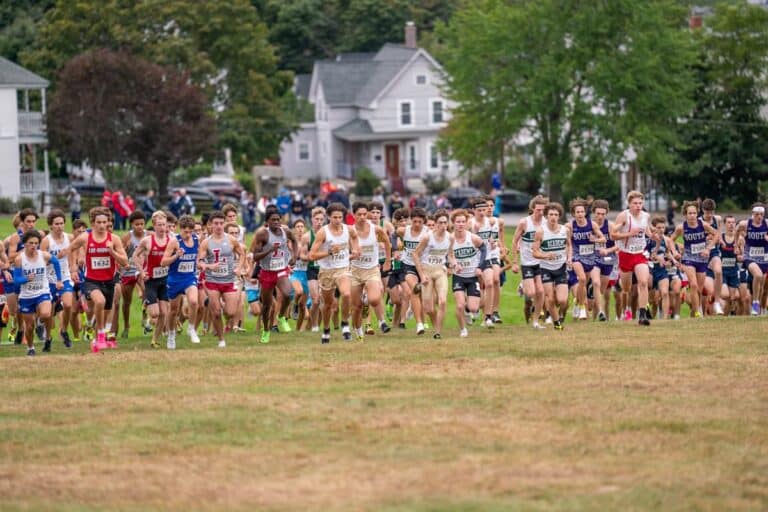

Your First Week Coaching Middle School Cross Country
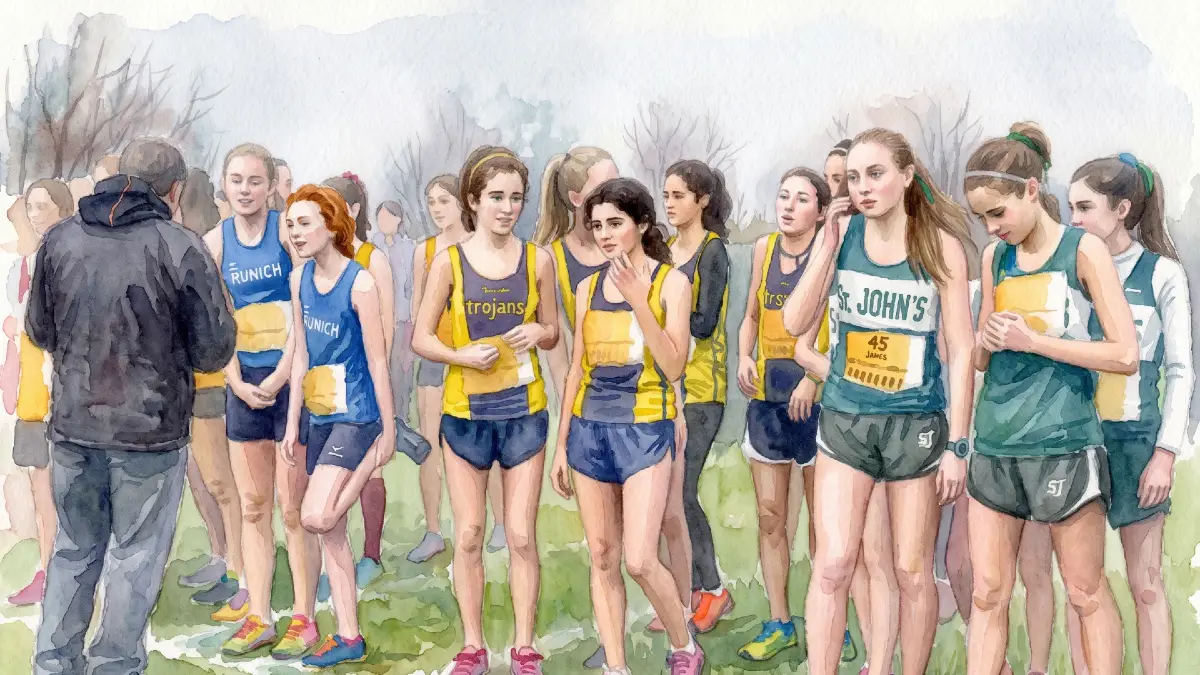
Your First Week Coaching Middle School Cross Country
You got the job in July. Practice starts in ten days. You have thirty kids coming, most of whom have never raced anything, and you are not sure what a cross country practice is supposed to look like.
Good news first. Week one is the easiest week of the season to get right, because almost none of it is training. It is teaching. Nobody gets fitter in five days, and nothing you do this week will make anyone faster in October. What week one decides is whether they come back on Monday.
Here is exactly what to do, day by day.
Before day one: five things to do this week
1. Find your loop and walk it
You want one measured loop, somewhere between 800 and 1200 metres, with a spot in the middle where you can stand and see all of it. Grass or trail if you have it. A perimeter of the school fields works.
Walk it with a phone GPS and write down the distance. This loop is going to run your entire season. Volume becomes laps instead of routes, which means you can give thirty kids of wildly different ability the right amount of work at the same time, and nobody is ever out of your sight.
If you have no loop, find an out-and-back where you can stand at the turnaround.
2. Get the paperwork done before anyone runs a step
Physicals, emergency contacts, and medical forms. Every school has a system and it is usually the athletic director. Before day one you personally need to know three things: who has asthma, who carries an inhaler or an EpiPen, and where those are during practice.
Not the trainer. You. You are the one standing on the field.
3. Send one email to families
Short, specific, and sent three or four days out. Where to meet, what time, what to wear, what to bring, when you finish. Tell them a water bottle and a pair of running shoes that fit, and tell them explicitly that nobody needs spikes or anything expensive.
Add one sentence about what the season is for. Something like: this is a developmental season, everybody races, and no one gets cut. That sentence prevents about ten conversations later.
4. Build the box
One plastic tote in your trunk. Twenty to thirty small cones, two whistles, a stopwatch, a clipboard, a deck of cards, a first aid kit, and a jug of water beyond what the kids bring. Total cost is under fifty dollars and it covers your whole season.
5. Find out what distance your league actually races
Call the league or ask the athletic director, because you cannot plan a season without it, and the answer varies enormously. Some leagues run a mile. Some run a mile and a half. Some run two miles or 3K.
For reference, USATF races its Junior Olympic age divisions at 3K for nine through twelve year olds and 4K for thirteen and fourteen year olds. That is the national governing body’s answer, and it is a useful number to have in your pocket when a parent tells you the race is too long.
The heat problem
Most middle school seasons start in the hottest two weeks of the year, with athletes who have done nothing all summer. That combination is the highest-risk moment of your season, and it happens in week one.
Watch the dew point rather than the temperature, because sweat only cools an athlete when it evaporates. Shorten the runs, move to shade, build in water breaks every ten minutes, and cancel without guilt. You can use the free heat and humidity calculator to see how much to back off.
No week one session is worth an ambulance.
Day one
Seventy-five minutes. About fifteen of them are running. That is not a typo.
| Time | What happens |
|---|---|
| 0:00 | Circle up. Names, out loud, every single kid. Then say them back. You will not get them all and that is fine, but they need to see you trying. |
| 0:10 | Walk the loop as a group. Walking, not running. Show them the start, the turns, where you will stand, where the water is, and where the bathroom is. |
| 0:25 | Teach the warm-up. Side shuffle, carioca, walking lunge, walking toe touch, leg swings, inchworm. Two lengths of about twenty metres each. They will be bad at it. Teach it anyway, because they will do this exact sequence three hundred times before they graduate. |
| 0:40 | First run. Twelve to fifteen minutes on the loop. Walking is allowed and you should say so out loud, twice. Your only instruction is that they must be able to talk the whole way. |
| 0:55 | Four strides on grass. Fifteen seconds each, relaxed, walk back between. Their first taste of running fast, and they will love it. |
| 1:05 | Circle up. One question each: name and something you did this summer. Announce tomorrow’s plan. Done. |
The one rule you set on day one
Pick one and only one. Mine is: you have to be able to talk while you run.
Say it, explain it, and then enforce it that day by blowing one whistle mid-run and making everybody say a full sentence to the person next to them. Not a word. A sentence.
That single rule solves most of what goes wrong in a middle school season, because the default behaviour of an eleven-year-old is to run every step as fast as they can and then hate running.
Days two through five
Same shape every day. Circle, warm-up, run, strides, close. Change only the middle.
| Day | Running | What you are teaching |
|---|---|---|
| Day 2 | 18 to 20 min | The warm-up again, unassisted this time. Introduce easy versus steady versus hard as three named efforts. Have them tell you which one they just ran. |
| Day 3 | 18 to 20 min | Add the play block. Fifteen minutes of sharks and minnows or ultimate on a cone grid, replacing part of the run. This is the practice they describe at dinner. |
| Day 4 | 20 min | Introduce strength. Ten minutes of bodyweight work in pairs after the run: calf raises, single-leg balance, side plank, dead bug. Partners count for each other. |
| Day 5 | 20 to 25 min | Slightly longer run, ideally somewhere new. Finish with the whole team walking a cool-down lap together. Ask them one thing they liked this week. |
Total running for week one: roughly seventy-five to eighty-five minutes across five days. If that sounds small, it is supposed to. The USATF Foundation’s youth guidance says to start young runners with a low-volume, low-intensity plan and limited frequency, then build the workload across the program. Week one is the bottom of a twelve-week ramp, not a fitness test.
The ramp itself is published free, if you want to see where week one is heading: 115 minutes in week one, 190 at the peak in week ten, with down weeks in four and eight. The full 12-week schedule lays out every day of it.
Five things not to do in week one
- No time trial. Not on day one, not on day five. A time trial in week one tells you who had an active summer, which you already know by looking, and it teaches your slowest kid on their first day that they are the slowest kid.
- No talk about mileage. Not with athletes, not with parents. Count minutes instead, so a nine-minute-miler and a thirteen-minute-miler get the same session and nobody hears a number that makes them feel slow.
- No cutting anyone. If your program has a cut, fight it. Cross country is the one sport where roster size costs you almost nothing.
- No hard workouts. None. Not one. Structured intensity should not appear until roughly week three, and even then only in short pieces.
- No comparing them to the high schoolers. Or to last year’s team, or to your own running. They are eleven.
The five questions you will get asked in week one
They will come from parents, in the parking lot, usually while you are trying to leave. Have the answers ready.
“How many miles is my kid going to run?”
Between about fifteen and twenty-five miles a week by the middle of the season, depending on experience, and it starts far lower than that. Then add the part they actually want to hear: it builds gradually, there are planned easier weeks, and no athlete is asked to do more than their own level.
“Is this safe for a kid who is still growing?”
Yes, when the volume is appropriate and the intensity is limited. That second half is the important one. Volume is rarely what hurts young runners. Intensity is. Tell them the plan is roughly ninety percent easy running, that there is a full day off every week, and that you watch for growth-related complaints such as heel and knee pain.
“Do they need special shoes?”
One pair of running shoes that fit. No spikes, nothing expensive. Add that feet grow fast at this age and fit should be checked every six weeks, which is genuinely useful and shows you know what you are talking about.
“Will my kid actually get to race?”
Yes. Say it plainly. In most leagues everyone runs, and if yours has a varsity race, say what the other race is and confirm their kid has a place in it.
“My kid isn’t athletic. Is this really for them?”
This is the most important question you will be asked all season, and it is usually asked apologetically. The answer is yes, and it is worth expanding: cross country is the sport where the kid who has never made a team can improve every week against nobody but themselves, and where the last finisher still scores for the team by pushing another team’s runner back a place.
Your week one scorecard
Judge the week on three things, none of which is a time.
Did everybody come back on Friday? Count who showed up on day one and count who is there on day five. That number is your season.
Do you know their names? All of them, by Friday. This matters more than any workout you will write this fall.
Did they laugh? If a middle school practice never produces laughing, something is wrong with the practice. That is not a soft standard. The USATF Foundation and the RRCA both put “make it fun” and “never use running as punishment” directly into their youth guidance, and the American Academy of Pediatrics reported in 2024 that burnout is among the leading reasons young athletes leave sport entirely.
Week two through week twelve, already written
You just got through the easy week. The free 12-week schedule covers the other eleven, day by day: every run in minutes, the games placed in their weeks, the down weeks built in, and the meets slotted where they belong. One athlete level, published in full. Print it and you have a season.
The Middle School XC Coach’s Kit adds the rest: three athlete levels across 36 print-and-post schedule pages, a coach’s guide, a manual of twelve games with the exact dose for each so a hard session never turns into a race, and the practice structure for running middle school and high school on one field.
Get the free 12-week schedule See the full kit — $49.99What week two looks like
Slightly more running, same shape, and the first game with a real training dose inside it. Week two is 128 minutes across five days: a 36-minute long run on Monday, easy runs with strides on Tuesday and Thursday, Caterpillar on Wednesday, and 12 easy minutes on Friday. That is straight out of the free 12-week schedule, which has the other ten weeks written the same way.
For the games themselves, the twelve games article gives you the setup and the failure modes for each one.
Beyond that, the full picture of how the season fits together is in the guide to coaching middle school cross country: how far they should run, what to race, the injuries that show up in growing kids, and how to run one practice for grades five through twelve.
Frequently asked questions
What should the first cross country practice look like?
About seventy-five minutes, of which only twelve to fifteen are running. Spend the time on names, walking the course, teaching the warm-up sequence, one easy run where walking is allowed, and four short strides on grass. Week one is teaching, not training.
How long should middle school cross country practice be?
Sixty to ninety minutes. If you only have sixty, cut the running rather than the movement warm-up. A twenty-minute easy run with a full dynamic warm-up beats a forty-minute run with five minutes of jogging.
Should I do a time trial in the first week?
No. It tells you who had an active summer, which you can see anyway, and it teaches your least experienced athlete on day one that they are last. Wait for the first meet, which is a better test and comes with a crowd.
I have never coached running. Can I actually do this?
Yes, if you can follow a written plan and count. Middle school coaching is far more about consistency, supervision, and enthusiasm than about training theory. The most common failure is not ignorance, it is doing too much too soon because it feels like coaching.
What if I have thirty kids and one coach?
Use one measured loop where you can see the whole thing, run everything on a single clock so all groups start and finish at the same minute, and give more experienced athletes more laps rather than a different route. That structure lets one adult supervise a very wide range at once.
Sources
- USATF Foundation youth coaching guidance, drawn from Greene L, Pate R, Training for Young Distance Runners.
- RRCA FUNdamentals of Youth Running.
- Brenner JS, Watson A, AAP Council on Sports Medicine and Fitness. Overuse Injuries, Overtraining, and Burnout in Young Athletes. Pediatrics. 2024;153(2):e2023065129.
- USATF National Junior Olympic Cross Country Championships, race distances by age division.
This article is general education, not medical advice. Clear any existing injury with a qualified professional.