
Middle Distance Training for High School Runners
Having coached numerous state champions through the grueling demands of the 800m and 1600m, I’ve seen firsthand how a meticulous, physiologically-informed approach can profoundly transform performance on the track. High school middle distance running is a unique and challenging puzzle that requires a precise balance of explosive speed development and substantial aerobic capacity within the constraints of busy seasons.
My philosophy centers on constructing a robust aerobic foundation while meticulously layering in the precise speed mechanics and lactate tolerance training necessary to excel in these grueling events. In the often noisy world of athletic training, this hub is designed to cut through the complexity and provide high school runners, parents, and coaches with clear, expert-backed guidance. From mastered race pacing and periodized training plans to essential strength work and advanced tactics, everything here is curated to help you run faster, stay healthy, and achieve your track goals.
The aim isn’t just to winraces. It’s learning how far a positive, disciplined mindset can take you on the track and in life. Let’s get to work.
Understanding Middle Distance Training
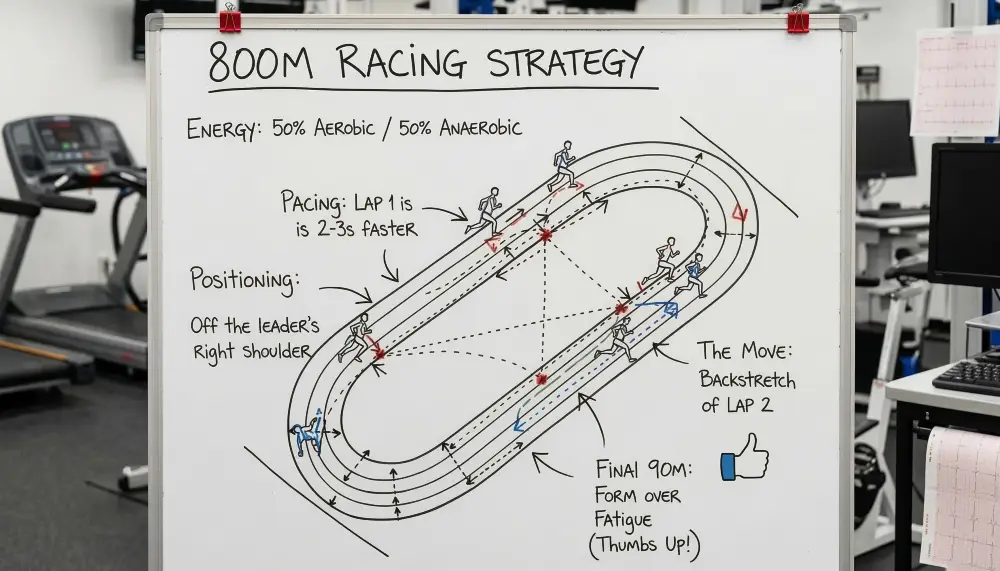
The 800m and 1600m are two of the most physiologically demanding events on the track. And for many track programs and coaches, the most misunderstood. The 800m is not a sprint, and it is not a distance race. It lives in a brutal no-man’s land where roughly 50% of the energy demand is anaerobic, meaning your athlete is essentially red-lining from the gun. This race punishes athletes who haven’t developed genuine lactate tolerance. The 1600m, by contrast, is a race won and lost based on aerobic fitness. It demands a massive aerobic engine, the ability to sustain 95–100% of maximum oxygen uptake for four full laps, and the neuromuscular sharpness to close hard when the legs are screaming to stop. Neither event rewards one-dimensional training, and coaches who treat these athletes as either sprinters or distance runners are leaving significant performance on the table.
The central challenge in developing high school middle distance runners is navigating the tension between speed types and their dislike for developing aerobic capacity. Seb Coe, one of the greatest middle distance runners ever, never liked running slowly, but still understood the need to run for 90 minutes or more to become better a t racing 2 laps arounf the track. It is critical that a coach understand an athlete’s physiology to then determine where you place training emphasis. Some kids are diesel engines: they thrive on volume, adapt slowly, and peak when the mileage climbs. Others are like Formula 1 race cars; explosive, fast-twitch dominant, brilliant over 400 meters, but brittle when the load gets heavy. Speed or endurance? The answer is BOTH. Generally speaking, we build the aerobic foundation first, then layer in race-specific workouts that teach your athletes to handle goal pace repeatedly, with incomplete recovery, until they learn to get comfortable being uncomfortable.
Key Middle Distance Workouts



Training Components



Sample Training Week
- Monday Easy run + 5x 100m strides
- Tuesday Speed workout (e.g. rolling 200s)
- Wednesday Recovery run
- Thursday Lactate threshold session
- Friday Easy run
- Saturday Race/Simulation/Long
- Sunday Rest
Recommended Reading



For the full philosophy behind my training approach, start with the complete distance running framework.
The 800m vs. the 1600m: Same Training, Different Emphasis
Most high school programs train their 800m and 1600m runners together. That’s not a mistake — it’s a reflection of reality. You have one practice, one hour, one coach, and a roster that spans the full range of middle distance events. The question isn’t whether to separate them. The question is how to adjust the emphasis while keeping the group together.
Here’s what the physiology tells us. The 800m is roughly 50% aerobic and 50% anaerobic. The 1600m is closer to 80% aerobic and 20% anaerobic. Those numbers are averages — athlete-to-athlete variation is enormous — but they point toward the real distinction: 800m runners need a higher ceiling on their anaerobic capacity, while 1600m runners need a deeper aerobic engine.
The practical implication is not that you run different workouts. It’s that you assign different targets within the same workout.
On a threshold session — say, 5 x 1000m at tempo effort — your 1600m runners are building the aerobic machinery that makes them competitive in October. Your 800m runners are building the same machinery, but their threshold pace is faster relative to their race pace. They need slightly shorter rep lengths and slightly more recovery to maintain quality. Same workout. Different execution.
Where you truly separate them is in the race-specific work. Your 1600m runners need extended cruise intervals and progressive tempo runs — work that builds comfort at goal race pace over longer durations. Your 800m runners need shorter, faster repetitions with adequate recovery — work that pushes them above their race pace so that race pace feels controlled. A set of 10 x 200m at 800m goal pace with full recovery does almost nothing for a 1600m runner. It’s exactly what an 800m runner needs in the last four weeks before championships.
The athletes who compete in both events — and most high school kids do — are best served by staying closer to the 1600m model for the majority of the season. Build the aerobic base wide and deep. Add 800m-specific speed work in the final six weeks. The aerobic development from training for the mile makes them faster at 800m. The reverse is rarely true.
For the complete breakdown of 800m race execution, see how to run the 800 meter. For the tactical differences between the 1600m and cross country, see how the 1600m differs from XC.
Speed Reserve: Why Middle Distance Runners Must Train Fast
Cooper Lutkenhaus ran a 1:42.27 800m as a high school junior. He averaged about 30 miles per week to do it. His training looked nothing like a traditional distance program — no 70-mile weeks, no long Sunday runs, no threshold blocks stacked on top of each other. What his training had in abundance was speed. Raw, maximum-effort, short-duration speed that most distance coaches never develop in their athletes.
The concept is called speed reserve, and it’s one of the most underutilized tools in high school middle distance coaching.
Speed reserve is the gap between your maximum sprint speed and your race pace. A runner with a 45-second 400m capacity running an 800m at 58-second pace has a 13-second speed reserve. A runner with a 50-second 400m capacity running the same 800m pace has only an 8-second reserve. The first runner feels like she’s cruising. The second runner is near her ceiling. In the last 200 meters — when the race is won or lost — the first runner has something left. The second runner doesn’t.
Most high school distance programs neglect speed reserve because it feels counterintuitive. Distance runners should run distance. But the research is clear: improving top-end speed makes all paces below it easier to maintain. The athlete with a faster ceiling needs less effort to sustain any given pace. That efficiency compounds over the course of a 2-minute 800m.
The implementation is simpler than coaches expect. Two sessions per week of short speed work — hill sprints, flat accelerations, flying 30s — done when the athlete is fresh and before the aerobic work begins. The reps are short (10–30 seconds), the rest is full (2–3 minutes), and the effort is maximal. You are not building aerobic fitness in these sessions. You are training the nervous system to access higher gears.
The mistake is adding this work on top of a full aerobic load. Speed work done on tired legs builds tired-legs speed — which is not the same thing. These sessions replace an easy run, not a threshold session. The total training stress stays constant. The ceiling rises.
For the full speed development protocol, see speed as a skill for high school distance runners. For the neuromuscular science behind it, see sprint training: the missing piece in endurance.
Go Deeper
Everything on High School Middle Distance Training
Training Methods
Coaches & Methods
Speed & Race Prep
Elite Case Studies
- Cooper Lutkenhaus: 30-Mile Blueprint
- The Sam Ruthe Method
- Jane Hedengren: The Blueprint
- Greatest HS Performance Ever (Library)
- Sam Ruthe Case Study (Library)
1. How do I balance aerobic mileage with anaerobic speed for the 800m?
Middle distance is a hybrid game. For high schoolers, the 800m is roughly 60% aerobic. You need a solid base of easy miles and long runs to support the engine, but you can’t neglect “speed reserve.” We utilize a “complex” approach: maintain speed year-round while shifting the primary focus from aerobic capacity in the summer to race-specific anaerobic power as the State Meet approaches.
How can I improve my finishing kick?
The “kick” isn’t just about heart no matter what the football coach might say. It’s about mechanics and lactate tolerance. To build a strong finish, we incorporate “Fast-Finish” intervals. For example, a 1000m rep at 3200m pace, immediately followed by a 200m “blast” at 800m pace. This teaches your brain and legs how to recruit fast-twitch fibers even when the legs feel like lead.
What is the ideal recovery protocol after a high-intensity track session?
Recovery starts the second the watch stops. Within 30 minutes, athletes should prioritize a 4:1 carb to protein snack to jumpstart glycogen replenishment. We advocate for “active recovery” the following day. Something like a very easy 30 minute shakeout run or 15 minutes on a bike to move blood through the muscles without adding mechanical stress. Remember: You don’t get faster from the workout; you get faster from the recovery after the workout.
When should we start the taper for the Championship season?
For most high schoolers, a 8 to 10-day taper is the sweet spot. The biggest mistake coaches make is cutting intensity. We keep the speed high to keep the legs “snappy,” but we slash the volume by 30-40%. This allows the central nervous system to fully recover without letting the athlete’s aerobic systems go “stale” before the big race.