

The Crucible: Surviving the Mid-Season Grind (Part 2 of 3)
The honeymoon is over.
The warm, conversational miles of August are gone. The “first day of school” excitement has faded into the routine of homework and darkness falling a little earlier every day. The leaves in New Hampshire are starting to turn, and so is the mood of the season.
We are now in the Mid-Season. This is the crucible. This is where the contenders separate themselves from the pretenders.
If the Pre-Season was about building the engine, the Mid-Season is about redlining it without blowing a gasket. It is the most dangerous, difficult, and critical six weeks of the year.
Here is how we navigate the fire.
The Balancing Act: Volume Meets Intensity
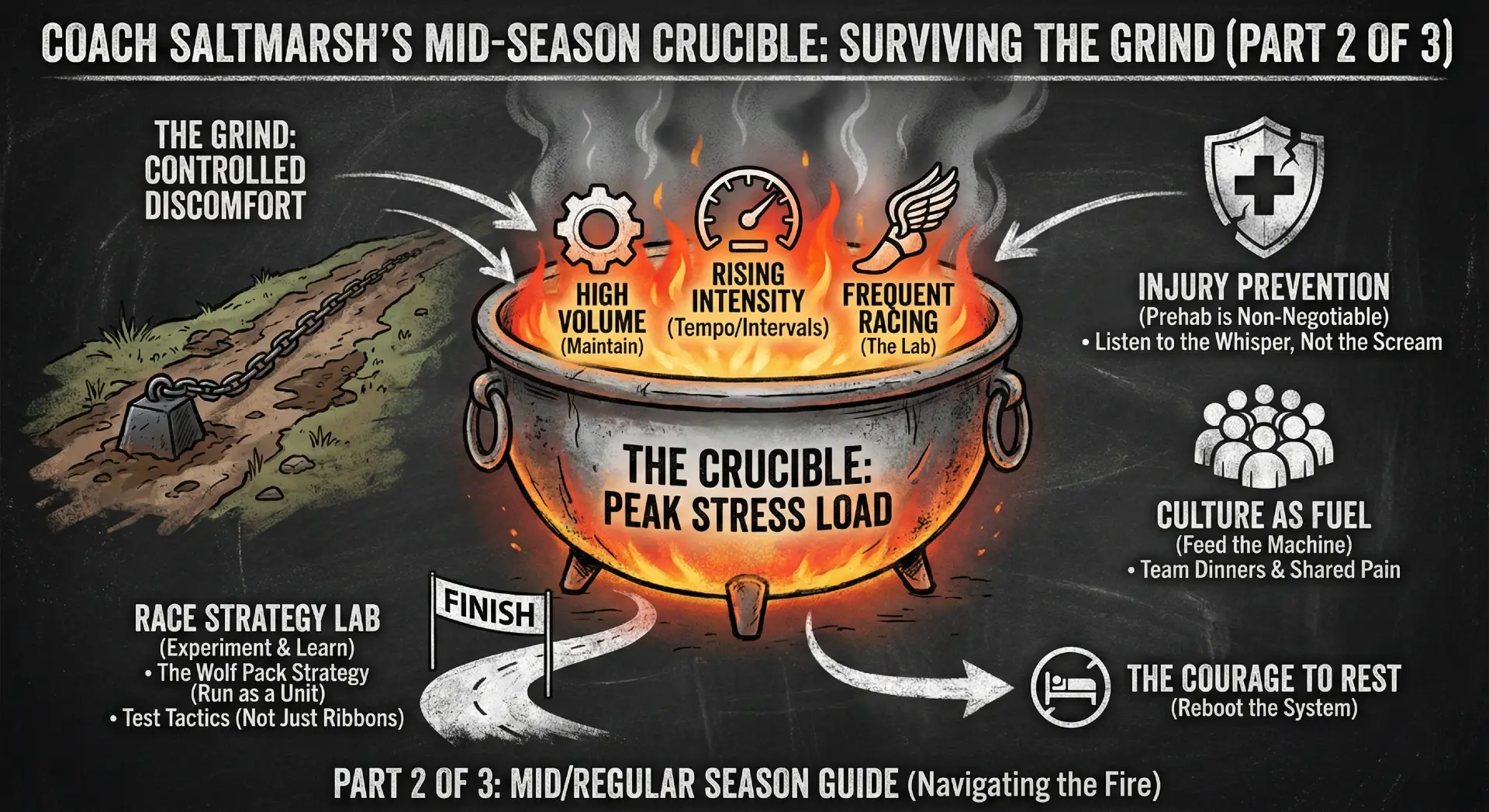
If you look at a graph of a runner’s stress load, this is the peak. In Part 1, we focused on high volume but low intensity. In Part 3 (spoiler alert), we will drop the volume to sharpen the speed.
But right now? We are asking athletes to do the hardest thing possible: Maintain the high volume AND increase the intensity. Oh, and we’re going to make them race once or twice a week, too.
This is where legs get heavy. This is where “I’m tired” becomes the team motto. This is also a time when germs usually spread throughout the petri dish that we call school. You and your athletes must remain vigilant.
The Workout Menu: We are moving away from pure base miles and introducing the heavy hitters: Threshold (Tempo) Runs and Speed Intervals.
- The Goal: We want “controlled discomfort.” We aren’t looking for all-out sprinting yet. We want them living in that uncomfortable threshold zone where mental callous is built.
- The Tech: I sound like a broken record, but do not guess. Use a heart rate monitor or a training pace calculator to dial in pace and training stimulus. If you too fast or too hard, you are digging a hole you won’t be able to climb out of by late October.
The Laboratory: Rethinking Regular Season Meets
Here is a hard truth for parents and young athletes: Nobody remembers who won the dual meet on the second Tuesday of October. Seriously, it doesn’t matter. Don’t obsess over rankings at this point in the season. Cross Country is unique. The regular season record is largely irrelevant to Championship qualification.
Treat these meets as Laboratories.
Use these low-stakes races to experiment. If a runner usually goes out hard and dies, force them to run negative splits. If a runner is timid, tell them to lead the first mile no matter what.
The “Wolf Pack” Strategy: My favorite mid-season tactic is forced “Packing.” If possible, take your 2nd through 5th runners and tie them together with an invisible rope. Tell them they cannot be more than two seconds apart for the first two miles.
- Why it works: It reduces individual anxiety. It turns a scary race into a hard workout with friends. And when they realize they can run fast while relaxed? That’s dangerous for your opponents.
The “Check Engine” Light
Because this is the highest stress point of the season, this is where things break. Shins, arches, hamstrings, hips—they all start whispering complaints now.
If you ignore the whisper, it becomes a scream.
- Prehab is Non-Negotiable: If you skip the core routine or the hip mobility drills now, you are asking for an injury.
- The Courage to Rest: This is computer guy logic 101—sometimes you have to reboot the system. A day or two off in October will not kill their fitness. A stress fracture will. If an athlete is limping, put them on the bike or send them home to sleep.
Goals: The Mid-Season Audit
Remember those bright, shiny goals we set in August? It’s time to take them off the shelf and blow the dust off.
Maybe your “Process Goal” of sleeping 8 hours a night has fallen apart. Maybe your “Outcome Goal” of breaking 20:00 minutes already happened. Sit down with your athletes. Readjust. Be real. If a goal is no longer realistic, change it to something that keeps them fighting. If they are crushing it, celebrate their success, and then raise the bar.

Culture: Feed the Machine
The grind is hard, so the culture has to be softer. You need to offset the physical pain with social gain. This is where the Team Dinners become legendary. Encourage them to have fun, come to practice in costume, wear the same colors, give out hair ribbons, pick out temporary tattoos- anything to build togetherness.
Get the parents involved. We need carb-loading, yes, but we also need the parents to see the work these kids are putting in. When parents host a dinner, they become invested in the tribe. Let’s get everyone invested. Maybe instead of hosting a dinner they can read out split times at mile 2? Or hand out water when the team runs by their house on a long run?
Ask your rookies: “How are we doing?” Listen carefully to their answer and notice what was not said. The veterans know the drill, but the freshmen might be drowning. A simple check-in from a coach or a captain can be the lifeline that keeps a kid on the roster for next year.
Coach Saltmarsh’s Mid-Season Summary
- Embrace the Suck: Acknowledge that this is the hardest training block. It’s supposed to feel heavy.
- The Lab: Use regular season meets to test tactics, not just to chase ribbons.
- Pack Up: Teach them to run as a unit. A tight 1-5 split wins championships.
- Listen to the Body: A day of cross-training is better than a month in a boot.
- Keep it Fun: Eat pasta, play games, keep the vibes high.
Next Up: We’ve survived the grind. Now it’s time to fly. Stay tuned for Part 3: The Championship Season & Peaking.