
How to Build a Cross Country Team from Scratch

My first year as a cross country coach went something like this.
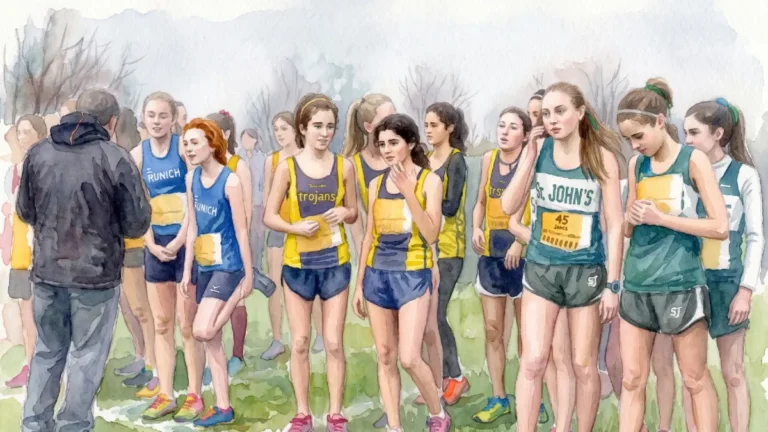
The previous girls cross country coach, a high school math teacher, was expecting her first child and stepping away. Around school I was known as the IT Director everyone sees running all the time. In my defense, I was training for the Boston Marathon and I had to run all the time. My daughter was a sophomore on the team. So I was recruited, humbly accepted, and about one week later I was standing in front of a group of teenage girls whose faces said, very clearly: who is this person and what is he going to do with us?
As it turns out, I did okay that year. But looking back, really looking back with what I know now, I was just okay. It could have been better. The girls had fun at least. The problem wasn’t effort. Everyone tried hard. I didn’t know what I didn’t know. I was improvising when I could have been building.
This post is for new coaches, and for veterans who want to look at their program with fresh eyes, who want to stop improvising and start building something that compounds. Not a team that has a decent season. A program and a system that thrive for decades.
Here is what I wish someone had handed me that first week.
Congratulations, Coach. It’s your program now.
Maybe it happened the way it happened to me: recruited because you were the runner on the staff and someone needed to step up. Maybe you inherited it from a coach who left mid-season. Maybe you volunteered for a job nobody else wanted, or got hired in March with August practices eight weeks away and a roster that includes four names you don’t recognize and two phone numbers that don’t work.
Whatever the circumstances, you have a program, you have no system, and the clock is running.
Most of what’s written about starting a cross country program focuses on paperwork. Ordering uniforms, scheduling officials, booking facilities. That’s project management, not coaching. This article is about coaching: what you actually do in the first weeks, in what order, and why the sequence matters more than any single decision you make.
The clock that’s already running isn’t the one counting down to your first meet. It’s the one counting down to summer. Summer base training is where XC programs are won and lost, and if you haven’t built the architecture for it before school ends, you’ve already fallen behind.
The sequence
Step 1: Start with the roster, not the training plan
The first instinct of every new coach is to open a blank spreadsheet and start writing workouts. Don’t. Seriously. You’ll never use it.
Before you write a single interval session, you need to know who you’re training. Not just names and grade levels. You need to know running ages, injury histories, personality types, summer plans, parental support, transportation, academic eligibility, current fitness, and most importantly, which three to five athletes are going to set the culture for everyone else.
Survey your athletes before school ends
Send a simple survey to every athlete on your roster and, if you can, every potential runner you know about. Ask:
- What sports did you do last year?
- Are you playing any club sports now?
- Any injuries in the last 12 months?
- Have you ever run cross country or track before?
- What does your summer schedule look like?
- What’s the most miles you’ve run in a single week in the last two years?
- What’s your most recent race time at any distance?
- When is the last time you ran for more than 15 minutes?
It takes ten minutes to create, and it gives you the data to avoid the most common first-year mistake: assuming every athlete on your roster is starting from the same place. They aren’t. The senior who ran 50 miles a week last summer and the freshman who just finished basketball season are not the same athlete, and they cannot train on the same program without one of them getting hurt.
Estimate your class-year split
For each athlete, make a quick estimate: where does their development level put them relative to class-year norms? A rough framework:
| Class year | Conservative summer base (miles/week) | Phase 1 target (mpw) |
|---|---|---|
| Freshman | 12 to 18 | 20 to 25 |
| Sophomore | 15 to 22 | 25 to 30 |
| Junior | 18 to 28 | 30 to 35 |
| Senior | 24 to 36 | 35 to 40 |
These aren’t rules. They’re starting points. The sophomore who ran club cross country all year might be training like a junior. The junior who played football last fall needs to be treated like a freshman. Running age, meaning how long someone has been running consistently, matters more than school year.
Identify your culture setters
Before you think about your fastest athlete, think about your most important athletes.
Joe Newton built 28 state championships at York High School by understanding something most coaches miss: the athletes who set the culture matter more than the athletes who set the team records. Newton carried 200+ athletes on his roster, most of whom would never score a point in a dual meet. They came back anyway, year after year, because what Newton built was worth belonging to.
In your program, right now, with whatever roster you have: who are the athletes others watch? Who do the younger kids want to be around? Who shows up when practice is optional, puts in extra work without being told, and picks up a struggling teammate on a long run without making a scene about it?
These athletes are your co-builders. They are not your captains by default. Maybe you don’t need official captains at all, just cultural leaders. Sometimes the fastest kid is not the right one. Find the right ones, bring them into the vision early, and ask them directly: what kind of program do we want to build? Define it together, write it down together, and share it throughout the season.
Don’t assume anything about current fitness
Test it. Not with a formal time trial; save that for Week 1 of the season. But know what you’re working with. An easy 20-minute run in the third week of June will tell you more about where your athletes are than any survey. Watch who’s struggling, who’s holding back, who’s genuinely fit, and who’s pretending.
Your action item for Step 1: Before school ends, send the survey, name your culture setters, and build a simple spreadsheet with every athlete’s estimated running age and summer mileage target. Nothing else happens until this exists.
Step 2: Build the summer base plan first
The most important coaching decision you make this year happens in June, before summer practices start.
How much mileage will you assign this summer? To whom? With what structure?
Bill Aris of Fayetteville-Manlius, a program that has won 12 national championships, said something that stopped me when I first read it:
“I spend 80 percent of my time on psychological and emotional considerations of each kid. I spend 20 percent on designing the training.”
Bill Aris, Fayetteville-ManliusThat’s a radical inversion of how most coaches spend their attention. And it points to a truth that’s easy to miss when you’re new: the training is not the hard part. The hard part is building the conditions in which athletes can train consistently, safely, and with genuine investment.
Summer base training is the biggest test of those conditions. Ten weeks of largely unsupervised running, across heat and vacation and competing priorities, will reveal whether your athletes are committed or just participating. Your plan has to be simple enough for a 14-year-old to follow without a coach next to them, conservative enough that nobody gets hurt, and meaningful enough that athletes feel the difference between summer and the season that follows.
Conservative is correct for year one
First-year coaches consistently over-assign summer mileage. The reasoning is understandable. You want to establish standards, you want athletes to arrive fit, and you’re compensating for anxiety about the season. But over-assigning mileage to unsupervised athletes is a reliable path to injuries, avoidance, burnout, and a roster that quietly shrinks between July and August.
A framework that works for high school athletes:
Step cycles. Three weeks of progressive building, then one week of deliberate reduction (about a 20% drop), then repeat. The physiology matters here. Cardiovascular fitness adapts to training stress in two to three weeks, but connective tissue (tendons, bone, fascia) adapts in four to six. The recovery week is where bone and tendon catch up to the aerobic system. Skip it and you get shin stress injuries in September.
No intensity in summer. The exception is strides: short 100m accelerations two to three times a week, which maintain neuromuscular coordination without adding training stress. Beyond strides, summer is easy aerobic running. Conversational pace, long runs that feel effortless at the end, no workouts, no intervals. Hill sprints can come in during Weeks 7 and 8 for experienced athletes. That’s it.
Put the plan in writing before school ends. This is non-negotiable. Athletes who get a clear, specific plan (run these days, these distances, at this effort) complete it at far higher rates than athletes who are told to “run over the summer.” The plan tells them you’re serious. It also gives you a basis for the August conversation about who did the work and who didn’t.
The weekly structure I use with my athletes:
- Easy run: most days. Gossip pace. If you can’t hold a full sentence, you’re going too fast.
- Strides: twice weekly, 4 to 6 x 100m after easy runs. Not sprints. Controlled accelerations to fast, relaxed pace.
- Long run: once a week, the anchor of every summer week. Build from four miles for freshmen to 10+ miles for senior leaders at the summer peak.
Want the math done for each athlete? The free Summer XC Training Plan Generator builds a week-by-week base plan from a starting mileage and a cap.
Communicate it before June
Deliver the summer plan at the parent and athlete preseason meeting in early June. Send a letter or email to every athlete and parent in late May. Include:
- An invitation to the preseason meeting
- The week-by-week training plan by class year
- Effort guidelines: what easy means, what the long run should feel like
- Your attendance policy and how to handle summer travel
- Strength training expectations and routines
- Nutrition guidelines for teenage runners
- The date of the Alumni Race (more on this below)
- Your phone number or email for questions
The plan is also a commitment device. Athletes who get a specific, structured plan feel accountable to it in a way “run over the summer” never creates. You’re setting the first expectation of your program: we do things with intention here.
Running that meeting for the first time? My preseason meeting agenda walks through it, and the Pre-Season Parent Meeting Kit gives you the slides, the emails, the handouts and a script for the hard questions.
Your action item for Step 2: Write and distribute the summer base plan before the last day of school. Assign mileage by class year using step cycles. Include a stride protocol. Put everything in writing.

Step 3: Set two non-negotiables for culture
Bill Aris had selflessness. Pat Tyson, who won 180 dual meets in 20 years at Mead High School in Washington and later coached at Oregon and Kentucky, built his program on authentic care and earned trust.
What they share: every great program is built on a small number of things that are genuinely non-negotiable, surrounded by a lot of flexibility.
New coaches make a consistent mistake. They try to install a complete team culture in year one. They write long handbooks. They set fifteen rules and enforce three of them sporadically. They establish traditions before the team has any identity to attach a tradition to.
The result is a culture that feels imposed rather than grown, and athletes can sense the difference.
In year one, pick two things, exactly two, that you will enforce without exception. Everything else is flexible.
Choosing your two
Here are four worth considering. Pick two.
Show up on time
Newton’s rule was simple: miss practice twice and you’re off the team. No negotiation, no warning system. This wasn’t punitive, it was definitional. A team that shows up together, on time, is a different kind of team. Punctuality was Newton’s first signal of commitment.
If you adopt this one, and you should, be ready to make an example of someone in the first few days. It will only happen once.
Never run alone
A safety rule and a culture rule. Runners who train alone train differently than runners who train together. Every run happens with a partner or a group. It’s easy to enforce and it builds relationships, creates accountability, and stops the athlete who decides in the third mile that she’s done from just stopping.
Phone-free practice
The twenty minutes after practice, when athletes are cooling down, stretching and talking, is when team culture lives or dies. Phones stay in bags during practice and for thirty minutes afterward. A small rule with large effects.
The three-mile easy-day standard
No athlete runs fewer than three miles on an easy day. It keeps marginal athletes engaged and prevents the habit of skipping days mentally while showing up physically.
Why you explain it matters as much as what the rule is
Newton told his athletes: It’s nice to be great. It’s far greater to be nice. He repeated it for fifty years. The rule wasn’t just a rule. It was a philosophy about what his program valued, in a sentence short enough to remember.
When you set your two non-negotiables, explain why. Not “this is a rule” but “this is what we’re building.” Athletes who understand the reasoning behind a standard internalize it differently than athletes who are simply required to comply.
Buy-in, as Aris would say, beats compliance every time.
Your action item for Step 3: Before your first team practice, decide your two non-negotiables. Write them down. Explain them clearly, with full reasoning, at your first team meeting. Then hold them without exception for the entire season.
Step 4: Schedule the season before you write a workout
Experienced coaches build their seasons backward. New coaches build them forward.
Building forward looks like this: Week 1, some interval sessions. Week 2, add a tempo run. Week 3, try a fartlek. The training may be fine week to week, but it has no coherent arc.
Building backward looks like this: When is the state meet? What needs to be true about my athletes on that day? What do the six weeks before it need to look like? What about the first eight weeks of the season?
Everything in the training plan is reverse-engineered from the championship. Not because winning state is the only goal (it may not even be realistic in year one) but because a clear endpoint forces coherence on every decision before it.
Your seasonal skeleton
Write these dates down before you plan a single workout.
| Phase | When | What happens |
|---|---|---|
| Championships | Fixed dates | State, regional, and conference or league meets. Everything else is organized around them. |
| Phase 4: competition peak | Final 2 to 3 weeks | The taper. Volume drops, quality stays sharp, freshness accumulates. |
| Phase 3: pre-competition | Weeks 9 to 11 | Athletes race every weekend. Tuesday quality sessions and Saturday races coexist. |
| Phase 2: specific preparation | Weeks 5 to 8 | Mileage at its highest. Interval distances extend. Tempo work intensifies. One or two early invitationals as fitness checks, not performance targets. |
| Phase 1: general preparation | Weeks 1 to 4 | The 1.5-mile time trial. Base-building hill repeats. Athletes learn to train at their own pace, not a generic one. Mileage builds conservatively. |
The time trial is the foundation
On the first Tuesday of your season, every athlete runs a 1.5-mile time trial. Maximum effort. You record every result.
That result, converted to a velocity at VO2max, gives you every training pace for the season: what easy means for this athlete, what threshold means, what interval means. There is no guessing and no generic pace. Every athlete trains at their own appropriate intensity, derived from their own performance.
The point for now: scheduling the season before you write a workout means knowing when the time trial happens, because every workout afterward is calibrated to it.
Your action item for Step 4: Write down every championship date, work backward to identify your four training phases, and put the Week 1 time trial on the calendar. That’s your skeleton. Everything else fills in.
Step 5: Create a first-day tradition worth returning for
Before we get to the workout template in Step 6, I want to make the case for something that won’t appear in any training manual.
The most important day of your season is Day 1.
Not because of the training. It’s almost certainly an easy run. Because of the experience athletes have, what they tell their friends afterward, and who shows up to Day 2.
The programs that grow, the ones with 50 athletes by year three and 100 by year five, are built on a Day 1 experience that says: something real is happening here.
The Alumni Race
My version of this is the Alumni Race. The week before the official season begins, we gather at the school track, run the home course, and invite alumni and incoming seventh and eighth graders. Boys and girls race separately. Music plays. The top finisher in each age group gets a t-shirt. We close with a cookout and an open tip jar.
The result is a time trial that doesn’t feel like one. Athletes aren’t jogging through a fitness assessment. They’re competing. Past athletes show up and remind current athletes what the program becomes when you invest in it. Incoming athletes see something they want to join.
It does several jobs at once:
- It generates real performance data.
- It connects past and present in a way that creates identity.
- It gives the community an entry point into a sport that can feel foreign from the outside.
- It creates a social moment that bonds athletes before practices begin.
You don’t have to do it exactly this way. But you need something on Day 1 that says this program is worth caring about.
The second team meeting
Whether or not you run an Alumni Race, your second team meeting, when the fall season begins, should cover:
- Your coaching philosophy in plain language. Not a vague mission statement. Your actual beliefs.
- What the summer plan was for, and what you saw in the athletes who followed it
- Your two non-negotiables, explained with full reasoning
- The season schedule: every meet, every important date, the championship arc
- A request for an individual meeting with every athlete in the first two weeks
That last item is the Aris principle applied at the high school level. You cannot build the culture Fayetteville-Manlius built by treating athletes as a group. You build it by knowing each person, understanding their specific situation, and showing that you see them as an individual.
Fifteen minutes with each athlete in the first two weeks of practice will tell you more than any training log.
Step 6: A cross country workout template for year one
In year one, do not build a complex periodized training plan. Use one repeatable weekly structure, execute it consistently, and make small, intentional adjustments as the season goes.
Complexity is the enemy of execution. A simple plan run well beats an elaborate plan run inconsistently by an enormous margin.
Here is the weekly template that works for a first-year program:
| Day | Session |
|---|---|
| Monday | Easy run + strides + core circuit |
| Tuesday | Workout: intervals or hill repeats, alternating weeks |
| Wednesday | Easy recovery run |
| Thursday | Workout: tempo |
| Friday | Easy run or rest |
| Saturday | Race or long run |
| Sunday | Rest |
What “workout” means in Phase 1
In the first four weeks of your season, Tuesday alternates between hill repeats and vVO2max intervals, and Thursday is extensive tempo.
Hill repeats: 6 to 10 repetitions of 3 to 4 minutes uphill at a 2 to 3% grade. Walk back down for full recovery. This builds leg strength, aerobic capacity, and running economy at the same time, without the joint stress of flat-surface speed work. Athletes who run hills correctly look powerful and relaxed. If they look like they’re fighting the hill, slow them down.
vVO2max intervals: repetitions of 400 to 1000 meters at 1.5-mile time trial pace. Recovery jog equals half the rep distance. These are central to the system. This is the pace that trains the aerobic engine most efficiently. Every athlete runs their own pace, derived from their own time trial. Nobody is running to keep up with someone else.
Extensive tempo: 20 to 30 minutes continuous at 10K effort, or 3 to 4 reps of 6 to 8 minutes with 90-second jog recoveries. This is comfortably hard. Athletes should be able to speak in short phrases, not full sentences. The most common coaching error on tempo days is letting athletes run too fast. An athlete who finishes tempo bent over with hands on knees ran a race, not a tempo. If they’re not sure they went hard enough, they probably nailed it.
The 9-day microcycle
Over the course of my season, these sessions rotate on a 9-day cycle rather than a standard 7-day week. That’s intentional. Athletes who can’t predict exactly which workout comes next can’t fully adapt to any single stimulus, which keeps the system driving improvement through 14 weeks.
A simplified version for year one: alternate the Tuesday session (intervals one week, hill repeats the next), and progress Thursday tempo by adding 5 minutes of quality every other week. That alone creates the stimulus variation that drives adaptation.
Mileage by phase
As the season progresses, mileage follows a predictable arc:
- Phase 1 (Weeks 1 to 4): conservative build. Easy days are genuinely easy.
- Phase 2 (Weeks 5 to 8): peak mileage of the season. Intensity rises alongside volume.
- Phase 3 (Weeks 9 to 11): volume starts dropping as race intensity increases. Athletes race every Saturday.
- Phase 4 (Weeks 12 to 14): aggressive volume reduction. Quality stays sharp. Taper.
The critical rule: never increase volume and intensity in the same week. When mileage goes up, the Tuesday and Thursday sessions stay the same. When sessions get harder, mileage holds flat or drops slightly.
Your action item for Step 6: Copy this weekly template. Fill in Tuesday and Thursday with specific prescriptions based on your athletes’ time trial results. Don’t change it until something clearly isn’t working.
What the greats built that you can start building now
Joe Newton spent 50 years building York into the most winning high school program in American sports history. Bill Aris spent 80% of his coaching time understanding the hearts of his athletes before he thought about their training plans. Mark Wetmore, whose Colorado Buffaloes won five NCAA championships after Chris Lear documented one of their seasons in Running with the Buffaloes, built a culture where excellence was so normal it didn’t need to be enforced.
None of them had year one figured out. Newton’s first team was not his 25th state champion. Aris didn’t inherit a dynasty. He built it starting in 2004 with a volunteer role nobody else wanted. Wetmore had years of ordinary seasons before the system produced extraordinary results.
What they built was the conditions for excellence before they built the excellence itself. The culture before the championship. The system before the results.
Your year one job is not to win a state championship. It is to build something worth belonging to.
Build the roster knowledge. Build the summer plan. Set two things you won’t negotiate. Schedule backward from the championship. Create a first day worth talking about. Use one simple training template and run it well.
Do those six things consistently through November and you will have built something real. The times will come. The culture is harder. Start working on it now.
Don’t want to write year one from scratch?
The 22-Week XC Season Blueprint is the whole season planned to the day: a 10-week summer base, a 12-week season with down weeks already placed, and a 3-week taper that lands on your championship weekends.
- Rookie 30, Returner 40 and Veteran 50 mpw on one team schedule
- Coach cue cards for every workout: what to say, what to look for
- Pace charts for any 5K from 16:00 to 28:00
Get the Blueprint for $59 See a free sample week
One-time purchase. Editable Word doc plus print-ready schedules. 30-day money-back guarantee.
Building a program from nothing? The Coach OS bundle is $139 for five tools: the Blueprint, the Parent Meeting Kit for your June meeting, the Fueling Guide, the Athlete Training Log and the College Recruiting Toolkit.
Summary: how to build a cross country team from scratch
Step 1: Start with the roster, not the training plan.Survey athletes before school ends. Identify culture setters. Build a class-year mileage baseline. Don’t assume anything about current fitness.
Step 2: Build the summer base plan first.Assign mileage by class year using step cycles. Easy running, strides, and a weekly long run. No intensity. Put it in writing before school ends.
Step 3: Set two non-negotiables for culture.Pick two things you will enforce without exception. Explain why. Let everything else be flexible in year one.
Step 4: Schedule the season before you write a workout.Work backward from the state meet. Identify your four phases. Put the Week 1 time trial on the calendar.
Step 5: Create a first-day tradition worth returning for.Day 1 sets the program’s identity. The Alumni Race, a meaningful team meeting, or any experience that says something real is being built here.
Step 6: Use one workout template and run it consistently.Monday easy plus strides. Tuesday intervals or hills. Wednesday easy. Thursday tempo. Friday easy or off. Saturday race or long run. Sunday rest. Don’t overcomplicate it.
Part of the XC training system. This guide covers the architecture. The complete high school cross country training guide is where you go next for the full season, from summer through state championships.