
How to Mark a Cross Country Course
The short version
Mark the ground and the air. Paint or line the course route, then add directional flags high enough to see over a pack: red for a left turn, yellow for a right turn, blue for straight ahead. Confirm the route every 100 meters so a runner is never guessing. Block every wrong turn physically. Then walk the whole thing backward before the buses arrive.
Disclosure: Some links below are affiliate links. If you buy through one I earn a small commission at no cost to you. Course equipment should go on your school’s purchase order first.
A cross country course is the only playing surface in high school athletics that the home coach builds from scratch, every season, by hand. Nobody teaches you how. You inherit a milk crate of faded flags and a hand-drawn map from a coach who retired in 2011, and you figure it out.
This system is built on the NFHS rule book and on twenty five years of finding out what doesn’t work.
What the rules actually require
Start with your current NFHS book and your state association handbook. Rule 8 covers cross country, and the course marking language is more specific than most coaches realize.
The requirements that matter on marking day:
- Signposts with large directional arrows or flags at every turn. Flags are about one foot square and mounted on stakes that hold them six feet or more above the ground. Six feet is not decoration. It is so the fourth runner in a pack can see the flag over the shoulders of the first three.
- A single wide painted line is not enough on its own. A note added to Rule 8-1-1a makes this explicit: a single wide line used on turns should be supported by other markings, because the line may not follow the shortest legal route. If you only paint a line, a fast runner will cut it and you will have an argument at the finish.
- Double boundary lines are permitted. Painting both an inside and an outside line defines the racing corridor for runners and keeps spectators out of it.
- Sharp turns need a physical barrier. Not just a flag. Tape, fence, or cones that make the wrong direction impossible.
- Nothing overhead below eight feet. Walk the course looking up. Branches grow all summer.
- Nothing underfoot that turns an ankle. Roots, woodchuck holes, sprinkler heads, and the metal stub left over from last year’s sign.
Verify all of this against your own book. Rules change, and your state association may add requirements on top of the national ones. Check the NFHS cross country rules page each August.
The flag colors, and why they get ignored
Red
Course turns left. Runners stay to the right of the flag.
Yellow
Course turns right. Runners stay to the left of the flag.
Blue
Straight ahead. Runners may pass on either side.
Here is the honest problem. Almost no high school runner knows this code. They learn it, if at all, from a coach who explains it once at a preseason meeting in August.
So do not rely on it. Use the correct colors because the rule book calls for them and because visiting officials expect them. Then mark the course so clearly that a runner who has never heard of the color system still cannot go the wrong way. That is the real standard.
Design the course before you mark it
If you are inheriting an existing course, skip to the next section. If you are building or changing one, get these five things right. Everything else is detail.
The start
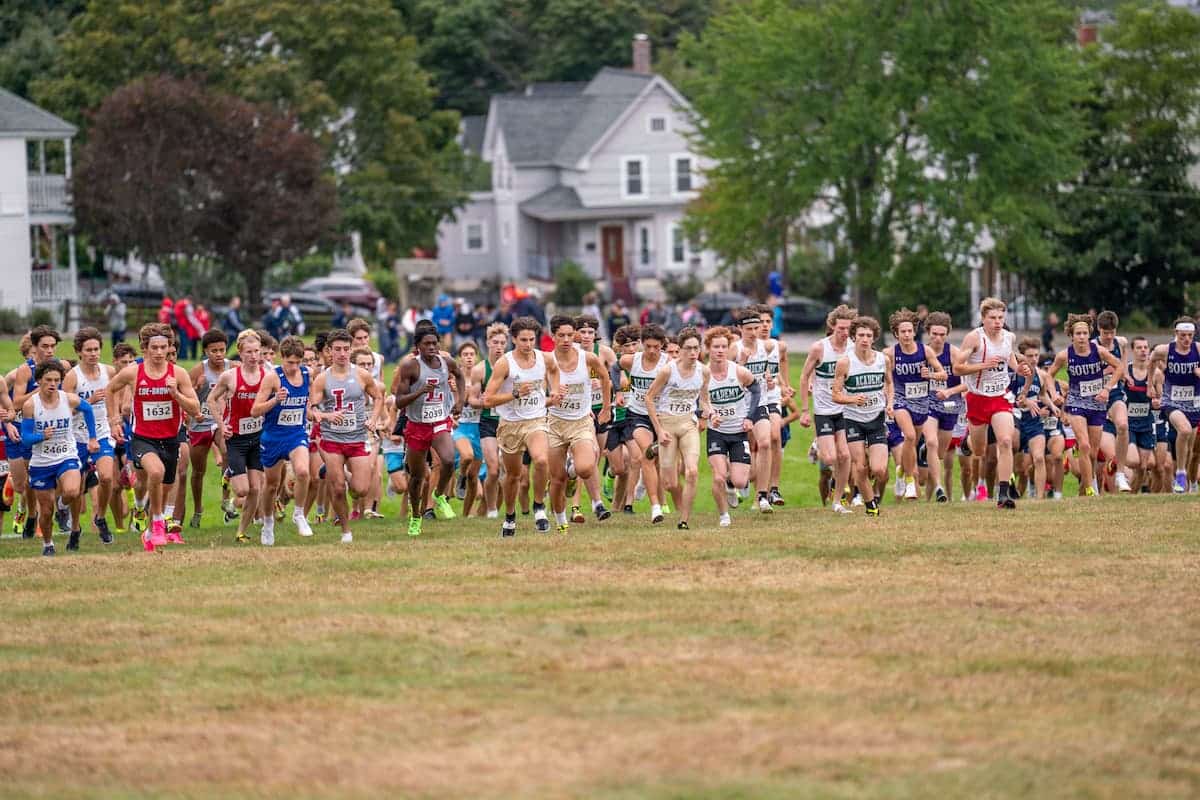
You need a straightaway long enough that the field sorts itself out before the first turn. The common standard is that the first turn should not come sooner than about 400 meters. Less than that and you get a funnel, a pile-up, and a slower race for everyone behind row three.
Your starting line needs enough width for every team in the field. A workable rule is six feet of line per team, then add a margin. Twelve teams means at least 72 feet. Measure it. Do not eyeball it.
The finish
The last 200 meters should be straight and wide, ten meters minimum, running into the chute. A blind corner at 150 meters out produces contested places and unhappy coaches.
Turns
Gradual, not square. A 90 degree turn at 5:20 pace on wet grass is how ankles get rolled. If the terrain forces a sharp turn, widen the approach and fence the outside of it.
Loops
Two loops of a 2500 meter course is easier to mark and easier to spectate than one 5000 meter ribbon through the woods. It also cuts your flag count nearly in half. The cost is lapping traffic in a large field, so know your entry numbers before you commit.
Pinch points
Walk the course and find every place where the corridor narrows below about ten feet. Then ask what happens when 140 runners hit it in the first kilometer. Widen it, move it later in the race, or reroute.
Measure it right
A GPS watch is not a measurement. It is an estimate that drifts under tree cover, which is exactly where your course goes.
Use a measuring wheel and roll the shortest legal route, meaning the tangents a fast runner will actually take, not the middle of the mown path. Roll it twice, on separate days. If the two numbers differ by more than about ten meters, roll it a third time and find out where you went wrong.
Mark your mile splits while you have the wheel out. Paint a small X at each one and drive a stake. Athletes and parents use these all season, and your assistant needs to know where to stand.
Write the measurement down and keep it. Course distance, date measured, who measured it, and the route taken. Tape it inside the equipment closet door. When a parent asks why their daughter’s time is 40 seconds slower than at another venue, you have an answer. And when the course changes because a soccer field expanded, you will know what changed and by how much.
What to buy, and how much
These are the quantities I use for a two-loop 5K on open ground with about a dozen turns. Adjust for your terrain. Wooded courses need more. Wide open fields need less.
| Item | Quantity | Notes |
|---|---|---|
| Directional flags (red, yellow, blue) | 16 to 24 | One at every turn, plus spares. On stakes at 6 feet. |
| Wire pin flags | 150 to 250 | Consumable. Buy in bulk. They bend and disappear. |
| Inverted marking paint | 6 to 10 cans | Per full marking. More if you are painting double lines. |
| Paint wand applicator | 1 | Saves your back. Twenty dollars. |
| Barricade tape | 2 to 3 rolls | Sharp turns, wrong turns, chute. |
| Cones | 20 to 30 | 18 inch for the course, 12 inch for the start box. |
| Mile mark signs | 3 | Reusable. Laminate them. |
| Rubber mallet | 1 | For stakes in August ground. |
Get this on a purchase order, not your credit card. It is standard athletic department equipment. A complete first-time kit runs a few hundred dollars, and the paint and pin flags are the only lines you repeat annually. Everything Track and Field and Morley Athletic both sell to schools directly.
A note on paint
Use inverted-tip athletic field paint, the aerosol kind designed to spray upside down. Hardware store spray paint clogs, runs, and does not survive a mower.
Paint lasts about a week on grass in dry weather. It lasts one heavy rain in October. Plan to touch up the morning of the meet, and store two extra cans for that purpose. On a wet week, marking dust or a dry line marker holds better on the straightaways.
The marking system
This is the part that separates a course runners trust from a course they argue about.
1. Mark the route, not just the turns
A runner in fourth place with a 200 meter gap has nobody to follow. Put a confirmation marker in sight at all times. On open ground, a pin flag every 20 to 30 meters. In the woods, closer. The test is simple: stand at any point on the course and you should be able to see the next marker without turning your head.
2. Make wrong turns physically impossible
Every trail junction, every gap in a treeline, every mown path that is not the course. Tape it off, cone it, or fence it. A flag telling them where to go is good. A barrier telling them where they cannot go is better, because the runner in oxygen debt at 4K is not reading. They are following the path of least resistance.
This is where courses fail. Not at the marked turn. At the unmarked one.
3. Mark the air and the ground
Ground marking, meaning paint and pin flags, works for the leader. Air marking, meaning flags at six feet and signs on posts, works for everyone in a pack. You need both. A runner boxed in the middle of thirty athletes cannot see the ground in front of them.
4. Use one color logic and hold it
Pick your system and never mix it. Mine: white paint for the racing line, orange pin flags on the left boundary, blue pin flags on the right. Some coaches use the reverse. It does not matter which, as long as it is identical from start to finish. A course that switches conventions at 3K is worse than a course with fewer markers.
5. Mark for the spectators too
Separate marking, separate purpose. Crossing points, a spectator path, mile signs facing the right way, and tape around the finish chute and the last 200. Parents who know where to stand do not end up standing in the racing corridor at 800 to go.
The schedule
Two weeks out
Walk the entire course. Bring loppers and a rake. Cut back everything overhead below eight feet and fill or flag every hole. Note what has changed since last fall, because something always has. Order paint and pin flags now, not the week of.
One week out
Measure with the wheel and set your mile stakes. Confirm the start box width against your entry list. Email the course map to visiting coaches with a note about footing and spike recommendations. Coaches remember the host who does this.
Two days out
Paint the course and set every directional flag. Two days, not three, because paint fades and not one day, because you will find a problem and need time to fix it.
The day before
Walk it backward, from finish to start. This is the single highest-value habit in this entire article. Running the course in reverse breaks your assumption about what is obvious and shows you every junction from the angle you have not considered. Bring pin flags and fix what you find.
Morning of
Walk it forward at race pace mentally, one hour before the first gun. Touch up paint. Replace flags that fell overnight. Confirm the chute, the finish line, and the last 200 tape. Check the forecast one more time.
Immediately after the last race
Pull everything the same day. Flags left overnight walk away, get mowed, or end up in a storm drain. Count them back into the crate so you know what to order in the spring.
Rain plan
In New England you will mark a course in the rain at least twice a season. Three adjustments:
- Skip the paint on the wet sections. It will not hold. Double your pin flag density instead.
- Add barrier tape at every low point. Standing water reroutes runners around a puddle, and once one runner goes around it, the whole race follows. Decide in advance whether they go left or right, and fence the other side.
- Reroute off the worst grass if you can. A hundred and forty spikes across a saturated soccer field is a facilities problem you will hear about on Monday.
Five mistakes I have made
- Marking only the turns. The lead pack follows the marshal. Everyone else follows the markers. If your markers stop for 200 meters, so does their confidence.
- Trusting a flag at a junction. A flag says go this way. A barrier says you cannot go that way. In the last mile, only the barrier works.
- Measuring the mown path instead of the racing line. Runners take tangents. Your course is shorter than you measured, and your times are fast, and eventually someone notices.
- Marking three days out. One rain and one mowing and you are marking it again at 6:00 on race morning.
- Trusting someone else’s markings on a new course. I arrived a bit late at a course I had never seen. I trusted the markings instead of walking it, and my lead pack ran 200 meters off course in the wrong direction. The leaves had blown over the painted lines and there was nothing marked above ground. Shame on me and shame on the host team. It is the cleanest argument I know for rule three above: ground marking alone fails the moment a wind picks up.
Running your first season as a head coach?
Course marking is one afternoon. The season is four months. The Coach OS Bundle is the whole operating system: a 22-week periodized plan written for three athlete levels, a fueling guide, and a parent meeting kit with slides, templates, and a code of conduct. One purchase covers your entire staff.
See the Coach OS BundleQuestions coaches ask
What do the red, yellow, and blue flags mean in cross country?
Red means the course turns left and runners stay to the right of the flag. Yellow means the course turns right and runners stay to the left. Blue means straight ahead and runners may pass on either side. NFHS rules call for flags about one foot square mounted at least six feet above the ground so they are visible over a pack.
How do you measure a cross country course?
With a measuring wheel, rolled along the shortest legal route a runner would take rather than the center of the path. Roll it at least twice on separate days and reconcile the numbers. GPS is not accurate enough under tree cover to certify a distance.
How many flags does a 5K course need?
Plan on 16 to 24 directional flags and 150 to 250 wire pin flags for a two-loop 5K on open ground. Wooded courses with more junctions need more of both. The working standard is that a runner should always be able to see the next marker.
What kind of paint do you use to mark a cross country course?
Inverted-tip aerosol athletic field marking paint. It sprays upside down, does not clog, and is formulated for turf. Expect it to last about a week in dry weather and one heavy rain in the fall. Plan on touching up the morning of the meet.
When should you mark the course before a meet?
Paint and set flags two days out. Walk the course backward the day before to catch anything unclear. Touch up and replace fallen markers an hour before the first race.