
The Ultimate Preseason Cross Country Meeting Agenda for Coaches
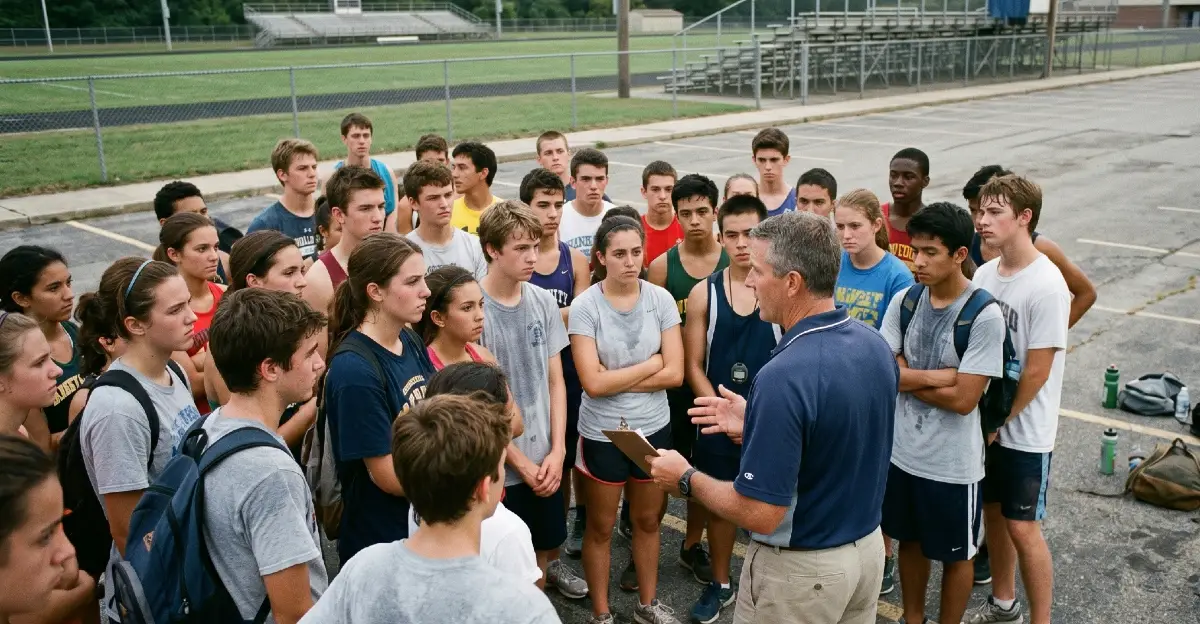
The first time I ran a cross country preseason meeting, I read from a clipboard for forty minutes.
I covered everything. The schedule. The mileage chart. The dress code. The rules about earbuds on team runs. I explained the difference between a tempo run and a threshold workout while a sophomore in the back row slowly disappeared into his hoodie. By the time I asked if there were any questions, the room had the energy of a study hall on a Friday afternoon in May. One kid asked when we’ were getting out.
That was a long time ago. I have run dozens of preseason meetings since then, across boys and girls programs, and I can tell you the meeting I ran back then was a textbook example of how to waste the most important hour of your season.
The preseason meeting is not a logistics dump. It is the moment your athletes decide what kind of team they are joining. Get this hour right, and you save yourself forty conversations in October. Get it wrong, and you spend the next twelve weeks fighting friction you created with your own mouth.
This is a coach-to-coach piece. What to avoid. What to include. How to navigate the complexities most coaches don’t see until they’re standing in front of fifty kids ready to show a well constructed PowerPoint presentation that nobody is going to remember.
Why the Cross Country Preseason Meeting Matters
The preseason meeting is the only time before the season starts when every athlete and (in most programs) every parent is in the same room paying attention. It is your single best opportunity to install the culture, the expectations, and the safety framework that will govern the next sixteen weeks.
Joe Newton, who won 28 state titles at York High School over a sixty-year career, used to say that he started winning the next year’s state meet on the last day of the previous one. The preseason meeting is the official kickoff of that work. It is where you tell your team explicitly, in front of witnesses, exactly what you stand for, what you will not tolerate, and what they have signed up for.
Coach Pat Tyson, who built Mead High School into a national power, said the same thing in different words: every program is built on what gets repeated. The preseason meeting is the first repetition.
Common Preseason Meeting Mistakes to Avoid
Before we get to what to include, let me tell you what to leave out. Most preseason meetings fail in predictable ways.
- Reading the handbook out loud. If your athletes can read, they can read the handbook. The meeting is for what cannot be conveyed on paper: tone, eye contact, the actual sound of your voice when you say “this is non-negotiable.”
- Treating it as a parent meeting with athletes attached. I have seen coaches spend forty-five minutes explaining the postseason qualifying structure to parents while freshmen stared at the floor. If your athletes are in the room, they should be the audience for at least half of what you say. The Positive Coaching Alliance’s preseason meeting framework puts it well: athletes should have their voice heard, because it is their experience. Give them a reason to be present.
- Burying the safety information. Heat illness, hydration, and progressive load are not “by the way, one more thing” topics. They are foundational. The NFHS Sports Medicine Advisory Committee and the NATA preseason heat-acclimatization guidelines are not bureaucratic boxes to check. Adolescent athletes die from preventable heat illness every year. This belongs near the top.
- Pretending the team has no internal hierarchy. Some of your kids are returning state qualifiers. Some have never run a 5K. Speaking to one of those groups means alienating the other. Address both directly, by name if you can. Acknowledge the gap and tell each group what you need from them.
- Overpromising. “We are going to win states this year.” Don’t. Promise the process, not the outcome. Promise that every athlete will improve, that the training will be honest, that the team will be a place worth showing up to. Outcomes get decided on a Saturday in November. Process you can guarantee.
- Asking for questions and then dreading them. If you genuinely want a coachable team, you cannot signal that questions are an interruption. Build in question time and treat it as part of the meeting, not the end of it.
- Letting it run long. Forty-five to sixty minutes is plenty. If you cannot say it in an hour, you have not figured out what matters most. Cut the lower 30 percent.
The Cross Country Preseason Meeting Agenda: What to Include
Here is the framework I have settled on after twenty-three years. It moves fast. It respects everyone’s time. It puts the right things first.
1. Open with why, not what (5 minutes)
The first thing your athletes hear should not be a calendar. It should be a statement of what this team is about.
I open with a story. Sometimes it is about a kid who couldn’t break 22:00 as a freshman and ran 16:40 as a senior because he never missed a Saturday long run. Sometimes it is about a girl who walked off the course at the state meet because she had decided two miles in that she was already done, and what she said to me three weeks later when she asked to come back. The point is not the story. The point is to make clear, in the first five minutes, that this team is about something more than splits.
Tualatin High School’s team philosophy presentation lays this out cleanly: their program prioritizes fun, winning, improvement, education, and legacy, in that order. You may order them differently. But you need to know your order and say it out loud.
2. Safety and physiology (15 minutes)
This is where most coaches under-invest, and it is where the biggest costs hide.
- Heat acclimatization. In most of the country, preseason starts in August. WBGT (wet bulb globe temperature) readings in the first two weeks routinely hit thresholds where hard workouts are unsafe. The NFHS heat acclimatization position statement recommends a gradual progression: shorter sessions, lower intensity, frequent fluid breaks for the first 7-14 days. Your athletes need to know this is a feature, not a sign that you don’t trust them. Acclimatization is a 10-14 day adaptive process that increases plasma volume, lowers core temperature at a given workload, and reduces sodium loss in sweat. It is real physiology. Explain it that way.
- Progressive load. A 2024 systematic review in the Journal of Orthopaedic & Sports Physical Therapy identified the strongest modifiable predictors of running-related injury in high school and collegiate cross country runners: changes in training volume, poor sleep quality, and increased specialization. The non-modifiable predictors are sex (female) and prior injury history. What we can control is volume progression. Tell your athletes the truth: cardiovascular fitness adapts faster than bone, tendon, and connective tissue. You can feel ready to run more before your skeleton is ready to handle it. This is the central mismatch behind almost every preseason stress reaction I have ever managed.
- Sleep. The American Academy of Sleep Medicine recommends 8-10 hours of sleep per night for adolescents. A 2023 narrative review in Nutrients found that adolescent athletes average about 6.3 hours. Coach Jay Johnson has a useful piece on sleep hygiene for high school runners that I hand out at every preseason meeting. The mechanism is straightforward: deep sleep is when growth hormone is released, when glycogen is restored to working muscles, and when the central nervous system clears the metabolic byproducts of high-intensity work. An athlete sleeping six hours a night cannot adapt to the training you are giving them. The training will instead break them down. Here’s a handy sleep debt calculator.
- Fueling and RED-S. Relative Energy Deficiency in Sport is no longer optional curriculum for coaches of adolescent runners, particularly female athletes. The same JOSPT review found moderate certainty evidence that RED-S risk factors increase running-related injury risk, particularly bone stress injuries. You don’t need to give a clinical lecture in front of fifteen-year-olds. You do need to say, on the record, with parents present: this program does not endorse calorie restriction, weight-loss talk, or comments about anyone’s body. We fuel for training. If an athlete is hungry, they eat. If they aren’t eating, we want to know. Set the standard publicly so it cannot be eroded privately.
3. The training plan, an Overview (10 minutes)
You do not need to explain every workout. You do need to give your athletes a mental map of where the season is going.
I use a simple structure: base phase, build phase, sharpening phase, championship phase. I tell them which weeks belong to which phase. I tell them what each phase is for. I explain that the easy days are where most of the aerobic adaptation happens: Stephen Seiler’s research on polarized training showed that elite endurance athletes spend roughly 80% of their training time at low intensity and 20% at hard intensity, with very little time in the moderate “no man’s land.” High schoolers don’t need that distribution explained in percentages. They need to hear: “your easy days are supposed to be easy. If you race the warm-up, you cannot race the workout.”
If you use a specific framework like Scott Christensen‘s vVO2max methodology, the Norwegian Method, the Lydiard pyramid, Greg McMillan‘s progressions, name it, briefly, and tell them why you chose it. Athletes who understand the why of their training take ownership of it in ways athletes following anonymous workouts never do.
4. Expectations, not rules (10 minutes)
There is an old piece in Complete Track and Field that puts it this way: a positive team exists with few rules but many expectations. Rules need penalties to function. Expectations are nurtured by the coach and the veterans and become the air the team breathes.
My rules are short:
- Be on time, be prepared, every day.
- Communicate absences before they happen.
- No headphones on team runs. Nobody runs alone.
- Treat every teammate, coach, opponent and official the way you would want to be treated.
That’s it. Those are the rules.
The expectations are longer and harder. We expect you to show up when you don’t feel like it. We expect you to be honest with us about pain: the difference between discomfort and damage is something we will teach you, but you have to bring us the information. We expect you to support the kid who finishes last with the same energy you give the kid who finishes first. We expect you to be a person we are proud to have wearing the singlet.
The reason this distinction matters: rules require enforcement, which requires the coach to play prison guard. Expectations spread through the team itself. Veterans teach freshmen what is expected, and after two or three years, the culture coaches itself.
5. Goal setting that actually works (5 minutes)
Most goal-setting in high school cross country is performative. Athletes write down a 5K time they don’t really believe in, and the paper goes in a folder nobody opens.
Good goal-setting at the preseason meeting is a brief framing, not a worksheet. I tell my athletes that they will set three kinds of goals in the first two weeks of practice, in individual meetings with me:
- An outcome goal. A specific time, place, or qualification. This is the easy one to write and the hardest one to actually control.
- A performance goal. A process metric within their control: a weekly mileage target, a strength routine completion rate, a sleep average.
- A standard. A non-negotiable behavior that defines who they are this season. “I am the kid who never misses a Saturday long run.” “I am the kid who fuels within thirty minutes of every workout.”
I have found that the most powerful goal in a high school athlete’s life is usually the standard, not the outcome. The standard is what they can keep if the time goal falls apart in October.
6. Communication systems (5 minutes)
Tell them how you will communicate with them and how you expect them to communicate with you. Be specific.
In my program: team announcements go through one channel, their school’s Google Chat accounts for full transparency. Workout logs go through Strava or Google Docs. Injury reports go directly to the head coach, in person, the same day. Schedule changes are posted in the team space and confirmed verbally at the end of practice.
Tell parents the same thing, and tell them what not to do. The 24-hour rule (no parent contacts a coach about a competition until at least 24 hours after) is a borrowed convention from many programs and worth stating openly. The Microcosm Coaching parent guide to cross country does a clean job of framing the parent-coach relationship as a partnership with healthy boundaries.
I will always encourage the athlete talk to me directly as a first step towards resolution of any problem.
7. Captains and culture (5 minutes)
If you are naming captains, tell the team how it happened and what it means. If you are not naming captains, tell them that too. The worst version is leaving it ambiguous.
If I name captains, I do it in late August, after I have watched the team for two weeks of practice. I tell them on day one that the captains are not always the fastest athletes, they are the athletes who set the tone the team will follow. The qualities I am watching for: who is at practice early, who picks up a struggling teammate on a long run without making it a thing, who answers a freshman’s dumb question without rolling their eyes.
This communicates something important: leadership is not a reward for talent. It is a responsibility distributed to athletes who have already been living the standard before anyone gave them a title. Sometimes, captains introduce jealousy or power struggles. If I get the sense that might happen I shift to a model of ‘big sisters’ or ‘big brothers’ and promote shared leadership.
8. Questions (5 minutes, real ones)
If the only questions are about uniforms and practice times, you have probably done a good job of covering everything else, and a poor job of opening the conversation. Try a different approach: ask the team a question.
“Is anyone feeling nervous about the first two weeks?” Hands go up. You have just told the nervous kids they are not alone.
“Who in here ran less this summer than they planned to?” More hands. Now you have a chance to say, plainly: we will meet you where you are. The training plan accounts for this. You are not behind.
The preseason meeting should end on a moment of honesty.
Navigating Preseason Meeting Complexities
Three issues come up year after year that the standard preseason meeting agenda misses.
The mixed-experience problem. When you have varsity returners and total beginners in the same room, you cannot speak only to one audience. I solve this by structuring portions of the meeting for one group while explicitly naming the other. “Returning runners, this part is for the freshmen. I want you to listen, because in two weeks you’ll be answering these questions on a recovery run. Freshmen, here is how your first three weeks are going to feel.” Then I do the same in reverse for the section on advanced training concepts.
The parent who wants to coach. Every program has them. Some are former competitive runners. Some have read a book. Some have a relative who is a college coach. The preseason meeting is the moment to set the boundary: I am happy to discuss training philosophy, but I am the coach. Decisions about workouts, race entries, and team selection are mine. The clearest version of this I have read came from Steve Kortemeier in a Minnesota Milesplit piece on coach-athlete-parent communication: “You have the unique ability to tell people to go to hell and enjoy the trip.” That is the energy. Firm, warm, non-negotiable.
The athlete who is already injured before the season starts. Every year, one or two athletes show up to the first practice already hurt from summer training they overdid. The preseason meeting is your last chance to invite that information out into the open before it costs the athlete six weeks. I say it directly: if anything has been bothering you this summer, I need to know today. Not next Wednesday. Today. The earlier we know, the earlier we can address it, and the more season you keep.
A Simple, 55-Minute Cross Country Preseason Meeting Agenda
Use this streamlined schedule to keep your meeting on track. Put the logistics (calendars, gear lists, contact info) on a physical handout.
| Time Block | Meeting Segment | Key Focus |
| 0:00 – 0:05 | Introduction | Opening story, core philosophy, and team “Why.” |
| 0:05 – 0:20 | Safety & Physiology | Heat acclimatization, hydration, sleep, fueling, and RED-S. |
| 0:20 – 0:30 | Training Overview | Season phases, the 80/20 rule, and training methodologies. |
| 0:30 – 0:40 | Culture & Standards | 4 core rules, team expectations, and process-based goal setting. |
| 0:40 – 0:45 | Logistics & Leadership | Communication systems, captain selection, and parent boundaries. |
| 0:45 – 0:55 | Honest Q&A | Prompted questions to address runner anxieties and summer training gaps. |
Setting the Tone for Your Cross Country Season
The preseason meeting is the only chapter of your season where every variable is under your control. Once the season starts, weather happens. Injuries happen. The kid you thought would be your number three develops shin splints in the second week. The freshman you were not sure about runs a 19:50 in her first race. The plan you wrote in May is going to look different by October no matter what you do.
But the meeting is yours. Run it like it matters. Speak to the freshman in the third row who has never been on a team before and is wondering if she made a mistake by showing up. Speak to the senior who already has a college visit lined up and is wondering if he should be running summer mileage for the cross country team or saving himself for the track season. Speak to the parents who don’t know what cross country is and the parents who know too much.
Most of all, speak to the team you want them to become. That is the team they will become. Start your first repetition now.