

Recruiting Tips for High School Runners, Grade by Grade
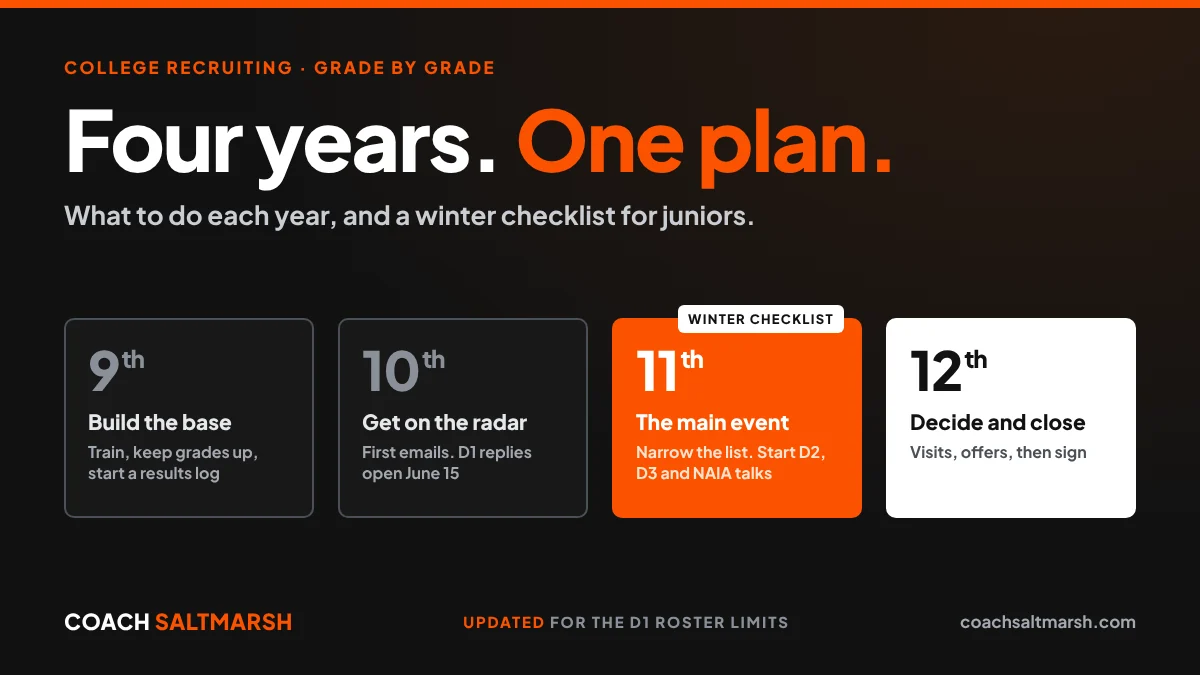
College recruiting for distance runners has changed more in the last two years than in the twenty before. Division I teams now carry fewer runners. Most of them didn’t get new money for track. The transfer portal competes with high schoolers for the same spots. And the runners squeezed out of Division I are now filling up Division II.
The basics haven’t changed. Times, grades and early, honest outreach still decide where a runner ends up. What changed is the timing and the math. This guide covers what’s new, what to do in each grade, and a winter checklist for juniors, who have the most to gain right now.
The short version. Since July 2025, most Division I teams are capped at 45 athletes in track and 17 in cross country. Scholarship limits are gone, but at most schools the money for track didn’t grow, so fewer runners share the same budget. Runners who would have walked on in Division I now land in Division II, which makes D2 spots harder to get too. Build a list across every level, start D2, D3 and NAIA conversations early, and treat junior year, starting this winter, as the year that decides it.
Emails to college coaches
The first-contact email and the PR update email, ready to copy, are in my free recruiting guide, along with the TFRRS roster check.
Open the recruiting guideWhat is in this article
What changed: fewer D1 spots, the same money
Since July 1, 2025, Division I schools that opted into the House v. NCAA settlement have worked under roster limits instead of scholarship limits. The limits are 45 athletes per gender in track and field and 17 in cross country. About 54 Division I schools, including the Ivy League and the Patriot League, did not opt in and keep the old rules.
On paper, that’s good news. A Division I program can now put a scholarship on every athlete on its roster. But the NCAA didn’t hand athletic departments the money to do it. Many track programs still work inside internal limits that match the old ones, 12.6 scholarships for men and 18 for women, so most Division I awards are still partial.
The new money went somewhere else. Schools can now pay athletes directly, up to about $20.5 million per school in 2025-26, and most of it goes to football and men’s basketball. One Division I coach wrote that his administration kept track and cross country on the same scholarship numbers as before, while the team still had to cut down to the new caps. Same money, fewer athletes.
Some conferences went further. The SEC capped men’s track at 35 and men’s cross country at 10. Before the caps, it wasn’t unusual for a Division I cross country team to carry 25 to 30 distance runners.
The transfer portal adds pressure. Coaches with a roster spot and scholarship money now choose between a high schooler who needs two or three years and a proven college runner who can score next season. More often, they pick the proven runner. As Streamline Athletes put it, “every roster spot filled by a transfer is a spot not offered to a high schooler.” The result is fewer developmental spots, especially for true freshmen.
Walk-ons feel it most. A scholarship can’t be taken away for roster management, but a walk-on has no scholarship to protect, and walk-ons count toward the cap. If a Division I coach offers your runner a walk-on spot, treat it as a tryout, not a promise.
The filter-down effect on Division II
Division II is not part of the settlement. It still allows 12.6 scholarship equivalencies per gender, shared between cross country and track, and the NCAA sets no roster limit. Coaches split that money into partial awards across the roster.
So where does the runner go who would have walked on at a Division I school in 2024? Down a level. Coaches in Division II, Division III, the NAIA and junior colleges have all felt that trickle-down. More runners are now chasing the same Division II spots.
Division II has also become a launch pad. Strong Division II runners transfer up to Division I programs that want proven scorers, which keeps the portal moving in both directions.
For your runner, that means two things. A Division II spot is harder to win than it was, and Division II money is still split into partial awards. Start those conversations early. Don’t save Division II, Division III and the NAIA as a backup for April of senior year.
Recruiting tips by grade
Freshman year: build the runner
- Run, race and enjoy it. The best recruiting plan for a ninth grader is a healthy, steady build. My mileage guide by grade shows how fast to build.
- Grades count from day one. College coaches and the NCAA look at the whole high school transcript, not just junior and senior year.
- Make sure every race is online. College coaches look up times on Athletic.net and MileSplit. A missing result is a missing mark.
- No Division I recruiting contact yet. Camps and team questionnaires are fine. Talk of offers at this age means little.
Sophomore year: show the trend
- Race a full track season. Sophomore progress matters more than most families expect, especially for Division I.
- Start a school list. Twenty schools across Division I, II, III and the NAIA. Use the TFRRS roster check in the recruiting guide to see where your times would score.
- Fill out recruiting questionnaires on each team’s website. It puts your runner in the coach’s database.
- Circle June 15 after sophomore year. That’s when Division I coaches can call, text and email. Since this fall, Division I cross country and track coaches can also meet recruits off campus from the same date.
Junior year: the year that decides it
- This is the most important year. Coaches recruit on junior track marks and the senior cross country season that follows.
- Visits open. Division I official visits are allowed from August 1 before junior year. Unofficial visits, at your own cost, are allowed too.
- Work the winter checklist below. December to March is when juniors pull ahead.
Senior year: decide with the facts
- Run a strong fall. Senior cross country times are the last marks many coaches see before they make offers.
- Know the paperwork. The National Letter of Intent is gone. Recruits now sign a written offer of athletics aid, and once they sign, other schools have to stop recruiting them. Division I written offers can’t come before August 1 of senior year.
- Keep options open. Division II, Division III and NAIA coaches often recruit later, after the Division I picture settles. A good runner can still find the right fit in the spring of senior year.
- Get it in writing. Ask for the athletic aid amount, the academic aid amount and the roster status in writing before your runner commits.
The winter checklist for juniors
Junior winter is the best time to get ahead. The fall season is over, the spring track season hasn’t started, and college coaches are building their lists for next year’s class. Work through this list between December and March.
- Pick your best three marks and the spring races most likely to improve them. Fast 1600 and 3200 races at deep meets give coaches the marks they trust.
- Build or update the list of 20 schools: about five reach, ten fit and five sure, across every level.
- Check each roster on TFRRS. Would your current times score for that team? If not, would they in two years?
- Email every coach on the list. Include PRs, grades, intended major, your spring schedule and your high school coach’s contact. Use the templates in the guide.
- Fill out every recruiting questionnaire you haven’t done yet.
- Register with the NCAA Eligibility Center if a Division I or II school is on the list, and the NAIA Eligibility Center if an NAIA school is.
- Plan unofficial visits for winter break and spring break. Ask to meet the coach and watch a practice.
- Ask your high school coach for an honest read on your list and to serve as your reference. College coaches call high school coaches.
- Track every contact and reply in one place: school, coach, date, what they said, next step.
- Talk money at home. Decide what the family can pay, and run each school’s net price calculator. Division III offers no athletic aid, but its academic aid can beat a partial athletic award.
- Keep training. Times decide this, and a good winter builds the spring marks. Here is how high school distance runners should train in winter.
Five questions to ask every coach now
The old questions still matter: majors, training, team culture. These five are new, and they come from the rule changes.
- How many runners will you carry next year in cross country and in track?
- How many of those spots go to transfers from the portal?
- Is your school under the roster limits, or did it stay out of the settlement?
- Is this offer a roster spot, money, or both? What happens to the spot if I don’t improve as fast as you hoped?
- How is the scholarship budget for track set at your school now?
Run recruiting like a season plan
The College Recruiting Toolkit has the grade-by-grade timeline, email templates for first contact, times updates, visit requests and the polite no, a school tracker spreadsheet, guidance on the results and video college coaches want, an NCAA and NAIA rules cheat sheet, and a guide to the questions to ask on calls and visits.
Get the Recruiting Toolkit, $49Instant download. 30-day money-back guarantee.
Common questions
When can college coaches contact high school runners?
Division I coaches can call, text and email from June 15 after sophomore year. In cross country and track, Division I off-campus contact opens on the same date as of this fall. Division II coaches can send messages at any age, and in-person off-campus contact starts June 15 before junior year.
How many runners can a Division I cross country team carry?
Seventeen per gender at schools under the House settlement. The SEC set its own limit of 10 for men’s cross country and 35 for men’s track.
Are there still walk-ons in Division I track?
Fewer than before. Walk-ons count toward the roster limit, so many teams now fill those spots with scholarship athletes or transfers.
How much scholarship money does Division II have for track?
12.6 equivalencies per gender, shared between cross country and track and field. Coaches split that into partial awards.
Is it too late to get recruited as a senior?
Not for Division II, Division III or the NAIA, which often recruit later. For Division I, the senior fall is late but not closed, especially for a runner whose times jumped.
Keep reading
- The complete college running recruiting guide. Email templates, the TFRRS check and sample standards.
- College recruitment: navigating the process. Building relationships with coaches.
- High school winter training. From the last cross country race to the first outdoor meet.
- What a cross country 5K tells you about spring track. Setting spring goals from a fall race.
Sources
- Track Scholarships and the New Roster Limits, TrackReels. Roster limits and the schools that did not opt in.
- How NCAA Track and Field Recruiting Changed: 2021 to Today, Streamline Athletes. The portal, the caps and the trickle-down to other levels.
- NCAA D1 Track and Field Schools, Streamline Athletes. Internal scholarship limits and partial awards.
- Is NIL Killing College Olympic Sports?, Rally Fuel. Where revenue-sharing money goes.
- New NCAA rules… uh oh, a Division I coach on keeping the old scholarship numbers under the new caps, and the SEC limits.
- Our Sports Are Under Siege, DyeStat. Cross country roster sizes before the caps.
- Preferred Walk-On vs. Walk-On vs. Recruited Athlete, Oriel Admissions. Walk-ons under roster limits.
- Division II Athletics Scholarships, NCAA.org. The 12.6 equivalency limit.
- Report of the Division I Track and Field and Cross Country Oversight Committee, NCAA, June 2026. The off-campus contact proposal.
- NCAA Recruiting Calendar 2026-27, NextCommit. The October 2026 contact change.
- 2026-27 Track and Field Recruiting Rules and Calendar, NCSA. Contact and visit dates.
- NCAA approves elimination of national letter of intent program, ESPN.
- NCAA Eliminates National Letter of Intent Program, Husch Blackwell. The August 1 date for written offers.
Recruiting rules change often. This article reflects the rules as of November 2026. Check with each school’s compliance office and the NCAA Eligibility Center before you count on a date.