
1600m Workouts for High School: Seven Sessions That Build a Miler
The 1600 is a classic event. Everybody wants to have a mile time. It’s a mark that is understood by every runner who has ever laced up their shoes.
The key to becoming a good miler rests on the development of base miles and endurance, establishing rhythm at speed with shorter reps, the intelligence to get out quickly but not blow up your race early, the awareness not to get boxed in, the ability to withstand the pain cave, the concentration to get through lap 3, and the guts to finish fast when your legs are screaming and your lungs are burning.
As a coach, you should already have goosebumps just reading that paragraph.
Ryan was a soccer player with natural ability, a strong work ethic and very little running behind him. What he lacked was a base and a feel for mile pace. To help him without piling on miles, I built one workout around that gap: rolling 200s at goal pace. In 2023 he ran 4:43 for 1600m. By 2025 he ran 4:18.
Rolling 200s are one of the seven workouts below. Each one builds a piece of that first paragraph. But there’s a catch. A whiteboard full of 1600 workouts means nothing if every kid runs the same splits. The same 800 has to be 3:00 for one runner and 3:54 for another. So every workout here is written once, the way it goes on the board, then shown as splits for three runners.
The short version. A high school 1600 needs two key sessions a week: endurance on Monday and speed on Wednesday, with a meet on Saturday. Start with threshold 800s at P80. Add 800s at P90, then speed in small sets. Move to mile-specific work: rolling 200s at goal pace and 600s at P95. In week 11, one 1000m at goal pace tells you whether the goal is real. Every rep runs at the athlete’s own pace, and the set ends when a rep slips.
P-Scale Pace Calculator
Enter one recent race and get every split in this article for your own runners.
Open the calculatorWhat is in this article
- Seven things make a miler
- How to read these workouts
- The week that holds them
- 1. Base: 6 x 800m at threshold
- 2. Endurance at speed: 5 x 800m at P90
- 3. Rhythm at speed: 300s in small sets
- 4. Goal rhythm: rolling 200s
- 5. The pain cave: 6 x 600m at P95
- 6. Lap 3 and the kick: 800s with a 300 chaser
- 7. The readiness check: 1000m at goal pace
- How the 12 weeks build
- When to cut a workout short
- Race the 800, run the 4×400
- Race day: what the workouts are for
- Common questions
Seven things make a miler
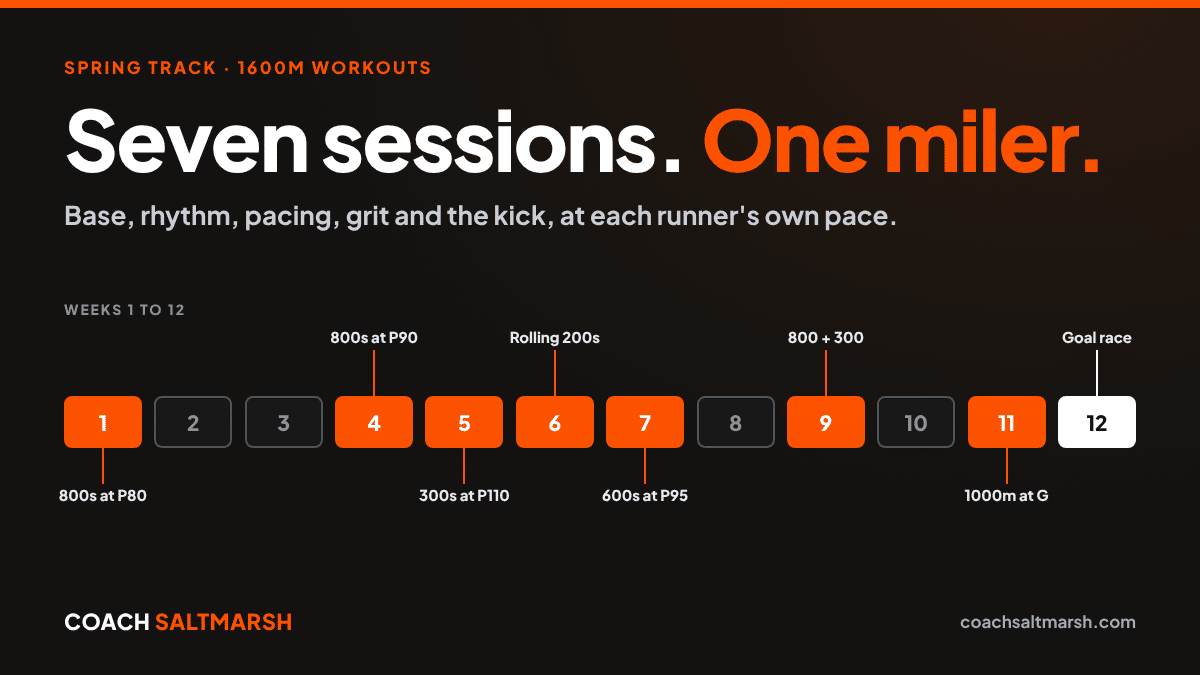
Each part of that first paragraph has a workout behind it. Here is the map. The rest of the article walks through each session in season order.
| What a miler needs | The workout that builds it | Week |
|---|---|---|
| Base miles and endurance | 6 x 800m P80, then 5 x 800m P90 | 1, 4 and 5 |
| Rhythm at speed with shorter reps | 2 x (4 x 300m P110), in sets | 5 |
| Get out quickly without blowing up | Rolling 200s at goal pace, then the 1000m at goal pace | 6, 7, 9 and 11 |
| Don’t get boxed in | Races, not workouts | Saturdays from week 3 |
| Withstand the pain cave | 6 x 600m P95 | 7 |
| Get through lap 3 | 3 x (800m P90 plus 300m P105) | 9 |
| Finish fast | The 300s in that same set, the P105 and P110 days, and the 4×400 | 5 to 12 |
How to read these workouts
Every pace is a P number: a percent of the athlete’s current mile race pace. P100 is mile pace. P90 is 10 percent slower, about 5K race pace. P80 is threshold. P95 sits between 2-mile and mile effort, P105 is about 800 effort, and P110 is quick and smooth. The P-Scale guide has every zone and its talk test.
G is goal pace. Athlete and coach set it after a 1600m time trial in week 3. G drives only two sessions: the rolling 200s and the week 11 1000m. Every other pace comes from a race the athlete has already run.
Why a time trial? Because a fall race can lie. Charlotte’s 20:08 cross country 5K, run sick, said her spring 1600 should be about 5:51. In May she ran 4:59.81. (Her story is here.) The time trial sets P100 from a real 1600. After that, only a race or a PR changes it. A great workout never does.
The splits below are for three runners: a 5:00, a 5:45 and a 6:30 miler. The plan has four levels, Beginner, Returner, Veteran and Experienced, peaking at 24, 28, 34 and 40 miles a week. They run the same sessions on the same days, and only the number of reps changes. The workouts below are the Veteran version. When in doubt, start a level down. Moving up after week 3 is easy. Moving down after an injury is not.
The week that holds them
| Day | Training |
|---|---|
| Monday | Key session 1, the endurance side: P80, then P90, then P95 as the season goes on |
| Tuesday | Easy run, drills and hill sprints |
| Wednesday | Key session 2, the speed side: P110, then P105, then P100. Rolling 200s in weeks 6, 7 and 9 |
| Thursday | Easy run and 6 x 100m P90–95, relaxed |
| Friday | Easy or off |
| Saturday | Meet from week 3. Weeks 1 and 2: long easy run |
| Sunday | Off |
Move days to fit your meet schedule. Keep an easy day between the two key sessions and at least one easy day before a meet. In a two-meet week, drop Wednesday’s session. The second meet is the session.
1. Base: 6 x 800m at threshold
Week 1, Monday. 1 mile warm-up, 6 x 800m P80 with a 60-second jog, 1 mile cool-down.
The mile is a distance race first. Threshold work builds the engine that carries laps 2 and 3. P80 is comfortably hard, a pace the athlete could hold for 20 minutes or more. The 60-second jog keeps the effort close to continuous, like a tempo run cut into pieces.
| 5:00 miler | 5:45 miler | 6:30 miler | |
|---|---|---|---|
| 800m at P80 | 3:00 | 3:27 | 3:54 |
Beginners run 3, Returners 4, and Veterans and Experienced runners 6. In week 2 the same pace stretches to 3 x 1600m P80 with a 2:00 jog: 6:00, 6:54 and 7:48 for our three runners. It comes back in week 10 with a 60-second jog.
Coaching point. This is where the stop rule starts. End the set when a rep misses its pace by more than 2 seconds per 400m. In week 1, a missed rep usually means the athlete’s pace is wrong, not the athlete.
2. Endurance at speed: 5 x 800m at P90
Weeks 4 and 5, Monday. 2 mile warm-up, 5 x 800m P90 with a 2:30 jog in week 4, then a 2:00 jog in week 5.
Same rep as week 1, now about 10 percent faster. P90 is roughly 5K race pace: hard and controlled, about a 20-minute race effort. From week 4 to week 5, only the recovery shrinks.
| 5:00 miler | 5:45 miler | 6:30 miler | |
|---|---|---|---|
| 800m at P90 | 2:45 | 3:10 | 3:35 |
Beginners run 3, Returners 4 and Experienced runners 6.
Coaching point. This is the session where kids race each other. Don’t let them. P90 is a pace, not a place. Group runners by their splits, not their grade.
3. Rhythm at speed: 300s in small sets
Week 5, Wednesday. 2 x (4 x 300m P110, 300m walk), with a flush of 8 x 100m between the sets, alternating Easy and P90–95 relaxed.
P110 is quick and smooth, faster than 800 pace for most runners. Short reps let a runner feel speed without drowning in it. The walk gives full recovery. The flush between sets keeps the legs moving without adding strain. This set structure, and the cue to stay relaxed, come from the Hungarian coach Mihály Iglói.
| 5:00 miler | 5:45 miler | 6:30 miler | |
|---|---|---|---|
| 300m at P110 | 51 | 58 | 66 |
Beginners and Returners run 3 per set. Experienced runners run 5.
Coaching point. Relaxed beats fast. Watch the face, the shoulders and the hands. When a rep visibly tightens up, the set is over, even if the time is on.
4. Goal rhythm: rolling 200s
Weeks 6, 7 and 9, Wednesday. Rolling 200s: 10 x 200m at G with a 200m jog in week 6, then 12 in week 7 and 13 in week 9.
This is Ryan’s workout. Run 200m at goal pace, then jog 200m, over and over without stopping. The jog keeps moving, so the aerobic system carries the load while the legs learn goal rhythm. By race day, a first lap at goal pace feels normal. That’s how a runner gets out quickly without blowing up.
Ryan ran rolling 200s from March to May. Growth and an indoor season helped him too. But the 200s gave him something no other session did: he knew the pace before the gun went off. Here is his full case study.
Say our three runners set goals of 4:50, 5:33 and 6:16, each a little faster than their current mile.
| 5:00 miler | 5:45 miler | 6:30 miler | |
|---|---|---|---|
| 200m at G | 36 | 42 | 47 |
Beginners build from 6 to 8 to 9 reps.
Coaching point. Don’t let the jog turn into a walk. If an athlete can’t keep jogging, cut reps, not pace.
This is week 6 of 12. The P-Scale 1600m Plan has the other 11 weeks at four levels, and its calculator writes every athlete’s 200 split from their own goal.
5. The pain cave: 6 x 600m at P95
Week 7, Monday. 6 x 600m P95 with a 2:00 jog.
P95 sits between 2-mile and mile effort. This is where it starts to hurt, on purpose. Week 7 opens the Specific phase, the hardest block of the season, with volume at its peak in weeks 8 and 9.
| 5:00 miler | 5:45 miler | 6:30 miler | |
|---|---|---|---|
| 600m at P95 | 1:58 | 2:16 | 2:34 |
Beginners run 4, Returners 5 and Experienced runners 7.
Coaching point. Tell athletes what’s coming. The fourth 600 is the one that hurts, and running it on pace anyway is the skill. The stop rule still holds. The pain cave is not a place to visit often in practice, but it helps build tolerance and courage for race day.
6. Lap 3 and the kick: 800s with a 300 chaser
Week 9, Monday. 3 x (800m P90, 200m jog, 300m P105), with 3:00 of jogging between sets.
The mile is decided on lap 3. In 32 world-record miles, the third lap was the slowest in 56 percent of races, and lap 2 or 3 was the slowest in 90 percent. The last lap was the fastest or second fastest in 76 percent. This session rehearses both: an 800 at a hard, steady pace, then a 300 at about 800 effort on tired legs.
| 5:00 miler | 5:45 miler | 6:30 miler | |
|---|---|---|---|
| 800m at P90 | 2:45 | 3:10 | 3:35 |
| 300m at P105 | 53 | 61 | 69 |
Beginners run straight 800s at P90 instead. Experienced runners run 4 sets.
Coaching point. Give one cue on the 800: hold form and stay connected. Give one cue on the 300: go. The 200m jog between them is short on purpose.
7. The readiness check: 1000m at goal pace
Week 11, Monday. 1000m at G, a 4:00 jog, then 2 x 400m P100 with 2:00 between, then 3 x 200m P105 with a 200m walk.
This is one of my favorite sessions of the season. Start the 1000m on the far side of the track so it finishes at the line. If the athlete runs it on pace and relaxed, they have a good shot at the goal. If it’s a fight, race at the pace the 1000m showed. Every level runs this one.
| 5:00 miler | 5:45 miler | 6:30 miler | |
|---|---|---|---|
| 1000m at G | 3:01 | 3:28 | 3:55 |
| 400m at P100 | 75 | 86 | 98 |
| 200m at P105 | 36 | 41 | 46 |
Coaching point. Call one split at the line each lap and compare it to the athlete’s pace card. Save the rest of the talk for after.
How the 12 weeks build
The plan starts wide, at both ends of the pace ladder, and narrows onto mile pace.
| Phase | Weeks | What happens |
|---|---|---|
| Fundamental | 1 to 3 | P80 threshold, hill sprints and strides. Relaxed P90–95 sets teach rhythm. The week 3 time trial resets P100. |
| Special | 4 to 6 | P90 on Mondays, P110 on Wednesdays. The first rolling 200s in week 6. |
| Specific | 7 to 9 | P95, P100 and P105 move in. The hardest block, with volume at its peak in weeks 8 and 9. |
| Final quality | 10 to 12 | Volume comes down and intensity stays. The 1000m check in week 11. The goal race in week 12. |
When to cut a workout short
- The stop rule comes first. End the set when a rep misses its P pace by more than 2 seconds per 400m, or when a relaxed rep visibly tightens.
- Missed sessions are not made up. Intensity stays. Volume is what comes down.
- Every session has a cap. For a Veteran at 34 miles a week, one session holds no more than 5,400m at P80, 4,300m at P90–95, or 2,700m at P100 and faster.
- Races count. A 1600 race is 1600m of P100. A 3200 is 3200m of P90–95.
- Pain that changes how an athlete runs means a day off and a visit to the athletic trainer.
Race the 800, run the 4×400
The 1600 isn’t the only race that builds a miler. Put your milers on the 4×400 relay whenever you can. It’s showtime: the last event of the meet, with everyone watching and the baton in your hand.
A 400 leg builds two things a miler needs. The first is speed. A relay split is faster than any rep in the plan, at or past P115, the top of the ladder. The second is grit. A 400 leg hurts in a different way than a mile does. The last 100 meters is all arms and heart, with a teammate counting on you. Milers who learn to finish a relay leg learn to finish lap 4.
Race the 800 now and then, too. It’s the closest race to the mile on the speed side. It sharpens the kick and teaches a runner to race hard from the gun without panic. The plan offers an 800 in weeks 4, 6 and 8, with a relay leg in week 6.
The 3200 is optional. A miler doesn’t need it. The Monday sessions already build the aerobic side, and a 3200 counts as 3200m of P90–95, most of a Veteran’s 4,300m cap for that zone. Run it when the team needs the points, not because the schedule has room.
Races count against the caps. An 800 is 800m of P105 and faster, and a relay leg adds 400m more. Week 6 shows how it fits: rolling 200s on Wednesday, then an 800 and a relay leg on Saturday.
Race day: what the workouts are for
Four laps, four jobs.
- Lap 1: get out cleanly and settle. Within two seconds of the target lap is the job. The rolling 200s made this pace feel normal.
- Lap 2: hold position and relax. Run in the top third, off the leader’s shoulder and out of the lane 1 box. Lead only on purpose. No workout teaches this. Saturday races do.
- Lap 3: the lap that decides the race. One job: hold form and stay connected to the runner ahead. This is what the 600s and the 800-300 sets were for.
- Lap 4: finish fast. Speed-type milers kick from 200m out. Strength-type milers go from 300m out and make it long. Your P110 days and relay legs tell you which one you coach.
After the race, write down the four lap splits. A slow third lap points to more P95 and P100 work. A slow last lap points to more P105 and P110. A PR resets P100 the next Monday.
Go back to that first paragraph: base, rhythm, smarts, awareness, pain, focus and guts. No single workout builds them. Twelve weeks of the right sessions, at each runner’s own pace, does. Ryan went from soccer player to 4:18 miler. Your runners have their own mile times waiting.
All twelve weeks, every split written
The P-Scale 1600m Plan is twelve weeks to the mile at four levels, from 24 to 40 miles a week. It comes with a Coach’s Guide, day-by-day schedules and a calculator that puts every athlete’s split next to every rep, rolling 200s included.
Coaching the 800 and 3200 too? The P-Scale Track Bundle has all three plans for $99.
Get the 1600m Plan, $39 See the Track BundleOne purchase covers your whole staff and team. 30-day money-back guarantee.
Common questions
What is the best 1600m workout for high school runners?
No single workout makes a miler. Early in the season, threshold 800s at P80 build the base. In season, rolling 200s at goal pace teach race rhythm. In week 11, a 1000m at goal pace tells you whether the goal is real.
How many hard workouts a week should a high school miler run?
Two, plus a meet: an endurance session on Monday and a speed session on Wednesday. Keep an easy day between them and before the meet.
What pace should a 6:00 miler run 800s?
At threshold (P80), 3:36. At about 5K pace (P90), 3:18. The free calculator works out any runner’s paces.
Should high school runners do 1600m repeats?
Yes, at threshold. The plan runs 3 x 1600m P80 in week 2 with a 2:00 jog, and again in week 10 with a 60-second jog. At P80, a 5:00 miler runs them in 6:00.
Should milers run the 4×400 and race the 3200?
Run the 4×400 whenever you can. A relay leg builds speed and grit that no workout matches. Race the 800 now and then to sharpen the kick. The 3200 is optional for a miler. Save it for when the team needs the points.
How do I set goal pace?
After the week 3 time trial, the athlete and coach agree on a goal 1600. That pace is G. It drives only the rolling 200s and the week 11 1000m. Training paces still come from the time trial.
Keep reading
- Plan Your Spring Track Season. The spring track hub: where winter ends, levels and March paces.
- The P-Scale 1600m Plan. All twelve weeks at four levels.
- Rolling 200s. Ryan’s case study and where the workout came from.
- The P-Scale. Every zone and the talk test for each.
- What a cross country 5K tells you about spring track. Why a fall 5K undersells mile speed.
- Coaching high school middle distance. The 800 and 1600 in one training group.
- VDOT vs P-Scale. Two ways to set training paces.
Sources
- The P-Scale 1600m Plan Coach’s Guide (Coach Saltmarsh, 2026). Every session, level and limit in this article.
- Noakes, Lambert and Hauman (2009), British Journal of Sports Medicine. The slowest lap in 32 world-record miles.
- Science of Running on the Iglói method. Relaxed, repeatable intervals in sets.
Splits are rounded to the nearest second. The goal times in workouts 4 and 7 are examples for the three sample runners.