

Why Winter Mileage Jumps Break Tibias
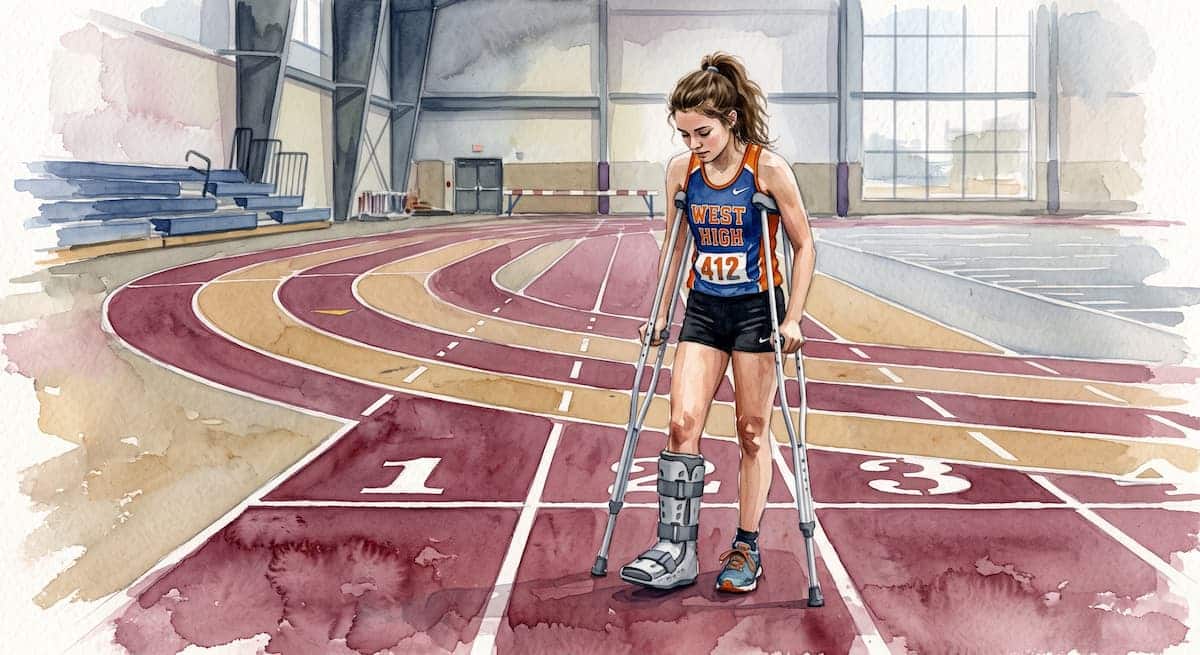
The tibia does not break during the base block. It breaks in the first three weeks of racing, or three weeks after a jump in mileage, which is usually the moment the athlete feels best and the coach feels most confident.
That timing is not bad luck. It is the remodelling cycle, and once you understand it the whole shape of a winter calendar changes.
The short version. Loading bone hard enough to matter creates micro-damage. Cells arrive around day ten to clear it, and the clearing takes about three weeks. During that window the bone is more porous and less stiff than it was before the load. It is more vulnerable, not less. So a training plan that steps up volume every two weeks schedules its next jump directly into the weakest part of the previous one.
This is the reasoning behind the three-week holds in the winter training guide, and it is the single most important idea in that whole plan.
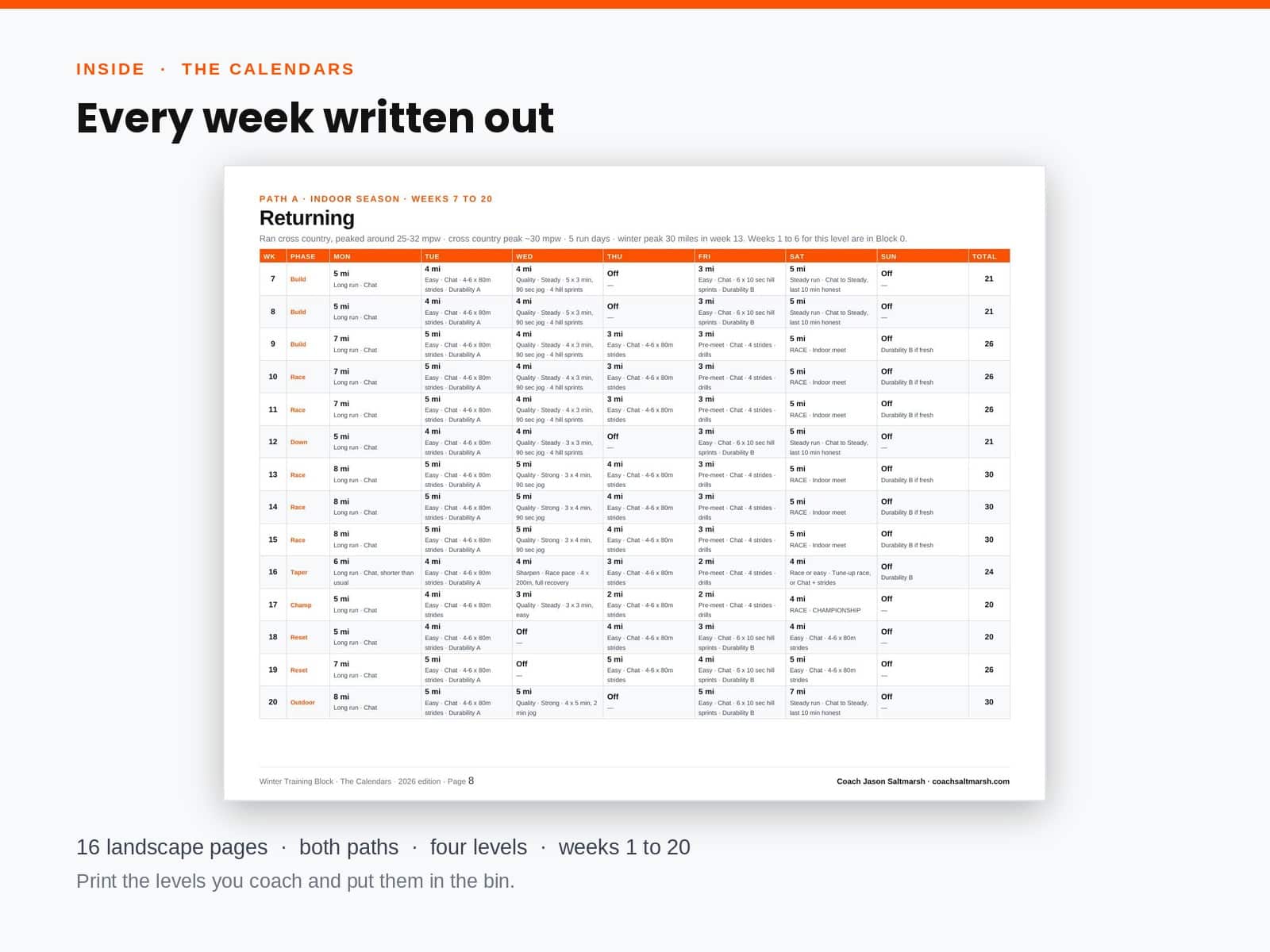
The Winter Training Block
Two paths depending on whether your program races indoors, four levels set by cross country peak week, and every session written out. Sixteen landscape pages of calendars, plus the Coach’s Guide, the Winter Kit and the Event Guide.
Get the Winter Training Block — $59Instant download · 30-day guarantee
What actually happens when bone is loaded
Bone is not inert scaffolding. It is living tissue that responds to load by rebuilding itself, and the rebuilding has a sequence and a timeline.
When running load exceeds what the bone is currently adapted to, micro-cracks form in the matrix. That is normal and it is the stimulus for adaptation. The body detects the damage and sends osteoclasts, the cells that resorb bone, to remove the damaged tissue before osteoblasts lay down new material.
Here is the part that matters. Resorption comes first, and it is faster than formation. The damaged material is removed around day ten, and the replacement takes roughly three weeks to complete. In between, there is a cavity where solid bone used to be.
During that window the bone is measurably more porous and less stiff than it was before you loaded it. The athlete is not gradually getting stronger through those three weeks. They dip first and then recover past their starting point, and the bottom of the dip is somewhere around week two to three after the load increase.
Why that breaks winter plans in particular
Read that timeline with a winter calendar in front of you.
Most winter plans step mileage every week or every other week, because that feels like steady progress and because the athlete feels fine. An athlete who adds three miles in week one and three more in week three has put the second increase directly into the weakest part of the first one’s remodelling window.
Do that four times through a January and the deficits stack. Nothing hurts at the time. The athlete reports feeling strong, because aerobic fitness and muscular fitness adapt on a much faster timeline than bone does, and those are the systems producing the sensation of fitness.
Then March arrives, racing starts, and the tibia meets its first hard effort on a hard surface.
The practical rule. Through the first nine weeks of a winter block, hold every volume step for three weeks before the next one. After week nine, two-week steps with a down week every fourth are reasonable, because the remodelling cycle has caught up with the loading cycle and the bone is no longer starting from a deconditioned state. If it feels too slow in week four, it is working.
The seasonal fingerprint
The pattern shows up clearly in the research. A seven-year study of Division I distance runners found the highest monthly bone stress injury rates during competitive months and the lowest during non-competitive months, with tibial and femoral shaft injuries peaking during the early competitive phase of each season.
Early competitive phase. Not the end of a season, when accumulated fatigue is highest. The beginning, when athletes are building mileage and racing at the same time, and when whatever was built badly over the winter first meets real intensity.
That is the fingerprint of a bad build, and it is visible in the data of a well-resourced college program with full-time athletic training staff. High school programs do not have better odds.
The female rate is more than double
In that same study, the female bone stress injury rate was more than double the male rate.
That is not a small difference and it should change how you coach. Several mechanisms contribute, and they compound. Bone mineral density accrual differs across adolescence. Menstrual function and bone health are linked through oestrogen, which is protective of bone. And low energy availability is more commonly identified in female endurance athletes, which affects the raw material available for the formation half of the remodelling cycle.
Winter is the window where that last one bites hardest. Holidays disrupt eating patterns, daylight is short, appetite drops in the cold, and training volume is climbing at the same time. Increased energy-deficiency risk is associated with higher injury risk, particularly bone stress injuries.The fuelling side of this is covered here.
Practically, this means a female athlete on a winter mileage build needs the three-week holds more than her male teammates do, not less. It also means the conversation about eating enough is a training conversation, not a side issue, and it belongs in November rather than in March when something has already gone wrong.
The two athletes who need extra patience
Anyone with a stress fracture history
In high school runners, a prior stress fracture raises the risk of another roughly six-fold in females and seven-fold in males. That is one of the largest single risk factors in the literature on running injuries in this age group, and it is also the easiest one to find out about, because you can just ask.
An athlete with that history goes one training level lower than their mileage suggests, and progresses more slowly than the calendar says. Not for a few weeks. For the whole winter.
Anyone under-fuelling
Bone formation requires energy and material. An athlete in a sustained energy deficit is asking the second half of the remodelling cycle to run on nothing, while the first half proceeds normally. The resorption happens either way.
Signs worth noticing over a winter: weight loss during a volume build, a female athlete whose periods become irregular or stop, persistent fatigue that does not resolve with easy weeks, frequent illness, or an athlete who has become notably restrictive about food. Any of those is a referral, not a coaching adjustment.
Warning signs, and when it stops being your call
Bone stress injuries announce themselves differently from soft tissue problems, and the differences are learnable.
| Signal | What it suggests |
|---|---|
| Pain in one small spot they can point to with one finger | Bone. Diffuse aching across a broad area is more typical of soft tissue. |
| Pain that sharpens as the run goes on | Bone. Soft tissue problems more often ease as tissue warms. |
| Pain that persists after running stops | Concerning. Escalate. |
| Pain on hopping on that leg | Concerning. Do not use this as a test to clear an athlete, only as a reason to refer. |
| Night pain | Refer immediately. |
This is where coaching stops. An athlete with pain localized to a bone, pain that sharpens during running, or pain that does not settle within two weeks needs to be evaluated by a physician before training continues. Not an easy week. Not cross-training and see how it goes. A physician. Bone stress injuries exist on a spectrum from stress reaction to complete fracture, and the difference between catching one early and catching one late is the difference between three weeks and three months.
What to do about all of it
Five things, in order of how much they matter.
- Hold every volume step for three weeks through the first nine weeks of a winter build. This is the whole point of the article.
- Do not build mileage and add racing in the same three weeks. The early competitive phase is where the injuries cluster. Pick one.
- Ask about stress fracture history before you assign anyone a training level, and drop a level if the answer is yes.
- Treat fuelling as part of training, especially for female athletes, and especially between November and January.
- Load the calves deliberately. Straight-knee and bent-knee calf work is the cheapest tibial insurance available, and the soleus is the muscle most runners never train and then blame when their shins hurt.
None of that requires equipment, staff or money. It requires a calendar built on the remodelling timeline rather than on how the athlete feels, which is the harder discipline, because how they feel is genuinely good right up until it is not.
A winter calendar built on this timeline
The twenty-week winter block holds every volume step for three weeks through week nine, then moves to two-week steps with a down week every fourth. Two paths depending on whether your program races indoors, four levels assigned by cross country peak week.
Read the winter training guideCommon questions
How long does it take bone to adapt to increased running?
Roughly three weeks for a remodelling cycle to complete after a meaningful increase in load. Resorption of damaged tissue happens first, around day ten, and formation of replacement bone follows. The bone is weakest in the middle of that window rather than immediately after the hard training.
Why do stress fractures happen when the athlete feels good?
Because aerobic and muscular fitness adapt faster than bone does. The sensation of fitness comes from systems that have already caught up, while bone is still mid-cycle. Feeling strong is not evidence that the skeleton is ready for the next increase.
How can you tell a stress fracture from shin splints?
Bone pain is typically localized to a small area the athlete can point to with one finger, and it tends to sharpen as a run continues. Soft tissue pain is usually more diffuse and often eases as tissue warms up. That distinction is a reason to refer, not a diagnosis. Imaging is the only way to know.
Are girls really at higher risk?
In the Division I data, the female bone stress injury rate was more than double the male rate. Contributing factors include differences in bone mineral density accrual, the link between menstrual function and bone health, and a higher identified prevalence of low energy availability in female endurance athletes.
Does strength training reduce bone stress injury risk?
Heavy resistance work and impact loading both stimulate bone adaptation, and calf strength specifically supports the tibia by absorbing load that would otherwise pass through it. It is a genuine part of the answer, but it does not substitute for a sensible progression. You cannot lift your way out of a bad mileage build.
What if an athlete missed weeks and wants to catch up?
They cannot, and attempting it is one of the more reliable ways to produce this injury. Rejoin the calendar where the calendar is. If they missed more than ten days, drop back two weeks and run forward from there.
Keep reading
- Winter training for high school distance runners. The twenty-week block built on this timeline.
- How long should runners take off after cross country. Why the winter starts with a break rather than a build.
- High school cross country training. Progressive mileage through a competitive season.
Sources
- Wolff A et al. Seasonal Patterns of Bone Stress Injury Incidence in Division I Collegiate Distance Runners. American Journal of Sports Medicine. 2025;53(3):708-716.
- Risk Factors, Diagnosis and Management of Bone Stress Injuries in Adolescent Athletes: A Narrative Review. PMC8073721.
- Risk Factors for Running-Related Injury in High School and Collegiate Cross-country Runners: A Systematic Review. PubMed 37970801.
- Warden SJ, Davis IS, Fredericson M. Management and prevention of bone stress injuries in long-distance runners. J Orthop Sports Phys Ther. 2014;44(10):749-765.
- Mountjoy M et al. International Olympic Committee consensus statement on Relative Energy Deficiency in Sport. British Journal of Sports Medicine.
- Brenner JS, AAP Council on Sports Medicine and Fitness. Sports Specialization and Intensive Training in Young Athletes. Pediatrics. 2016;138(3):e20162148.
This article is general coaching education, not medical advice, and nothing in it is a substitute for evaluation by a qualified clinician. Bone stress injuries require medical diagnosis and management. Any athlete with pain localized to a bone, pain that sharpens during running, pain that persists after running stops, or pain that does not settle within two weeks should be evaluated by a physician before training continues. Athletes with a history of stress fracture, disordered eating, or menstrual dysfunction should be managed in consultation with their medical provider.