

1000m, 1500m or 3000m: Choosing Indoor Events

Every December a distance runner asks some version of the same question. Should I be running the 1000, the 1500 or the 3000? Usually they ask it because a friend is running something else, or because they lost a race in the last 200 and have decided they need a different event.
The honest answer is that the question is usually settled before anyone asks it, by six weeks of how you trained.
The short version. Default a cross country runner to the 3000m and the 1500m. An athlete arriving from a winter sport, or who has never trained through a distance season, runs the 1000m and the 1500m. Freshmen run the 1500m. Nobody is a 1000m specialist in December. Rotate everyone through all three events before you commit, decide by mid-January, and let one open 400m time trial break the ties.
What follows is how to make that call for a whole roster. It sits inside the wider winter training guide, which covers the twenty weeks these races land in.
The three events
These are not three points on one line. The 1000m is a different race from the 3000m in kind, not just in length.
| Event | Duration | Rewards | Punishes |
|---|---|---|---|
| 1000m | 2:30 to 3:20 | Top-end speed, lactate tolerance, an aggressive first 200 | A runner with no gear above race pace |
| 1500m | 4:10 to 5:30 | Aerobic power with a real finish. The most complete race on the card | Going out on adrenaline, and no closing speed |
| 3000m | 9:00 to 12:00 | Aerobic depth, pace discipline, patience on a tight track | A fast first 800, and drifting through the middle third |
Durations span a competitive high school range across both genders. Use your own roster to set goal times, not this table.
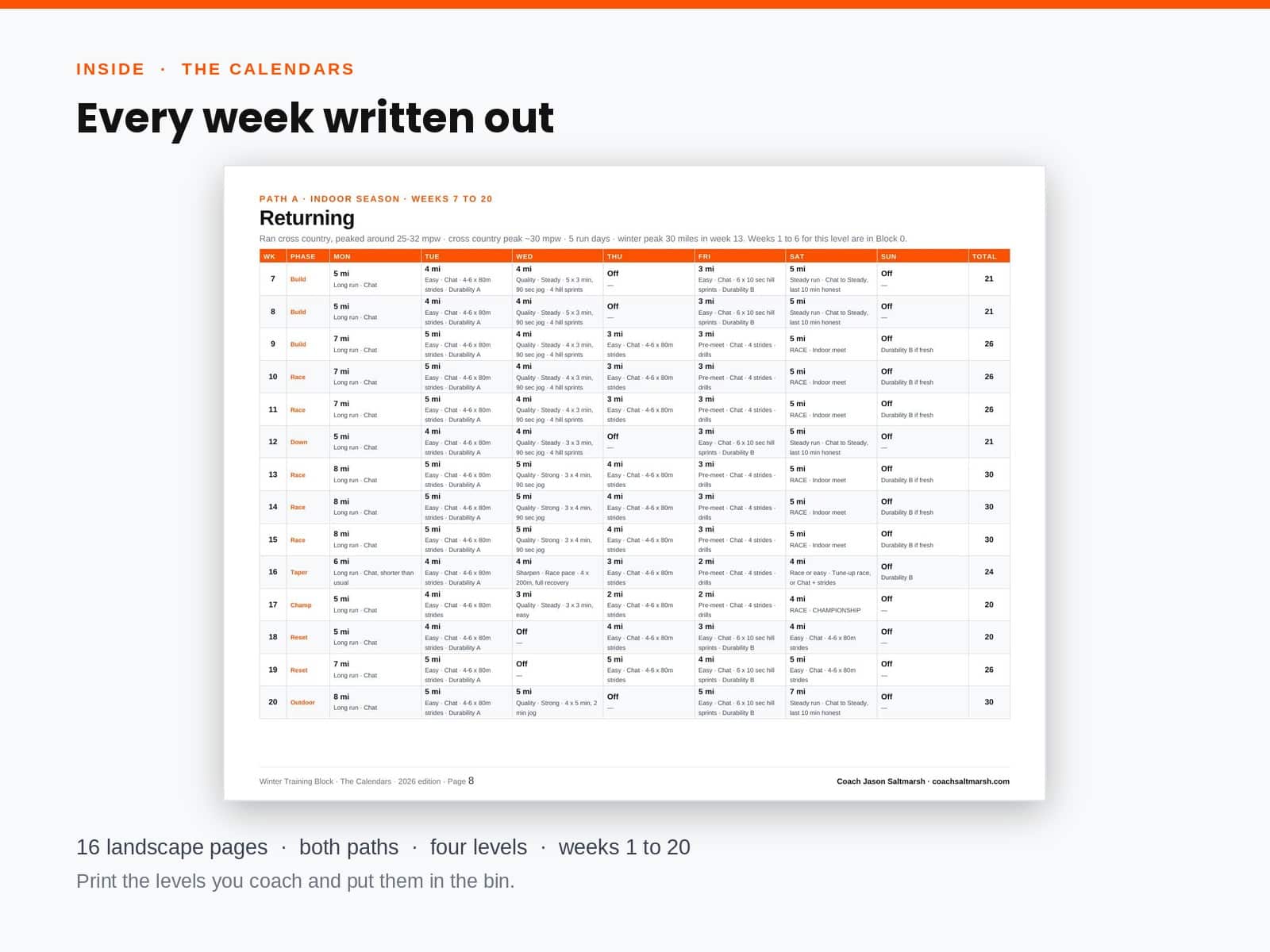
The Winter Training Block
Two paths depending on whether your program races indoors, four levels set by cross country peak week, and every session written out. Sixteen landscape pages of calendars, plus the Coach’s Guide, the Winter Kit and the Event Guide.
Get the Winter Training Block — $59Instant download · 30-day guarantee
The order of events decides more than you think
The 3000m has recently run early in the meet, the 1000m in the middle, and the 1500m late. That spread is the single biggest factor in whether a double is realistic, and it changes between seasons. Confirm the running order against the current year’s meet packet before you enter anybody in two races.
What the physiology says
The aerobic share of these races climbs steeply as they get longer, and it climbs faster for girls than for boys.
| Event | Aerobic, male | Aerobic, female | Source |
|---|---|---|---|
| 800m | 60% | 70% | Duffield, Dawson and Goodman, 2005 |
| 1000m | ~70% | ~78% | Interpolated, not directly measured |
| 1500m | 77% | 86% | Duffield, Dawson and Goodman, 2005 |
| 3000m | 86% | 94% | Duffield, Dawson and Goodman, 2005 |
The 1000m row is an interpolation between the measured 800m and 1500m values, not a published figure. No study measures the 1000m directly. Spencer and Gastin reported 66 percent aerobic for the 800m and 84 percent for the 1500m using a different method, so the shape of the curve is well supported even where the exact number is not.
Two things fall out of that, and both change how you coach.
Even the 1000m is mostly aerobic. Roughly seventy percent for a boy. You do not trade away base work to run a good 1000. You build the base and then sharpen it, which is why the training does not diverge until late.
Girls are further along the aerobic curve at every distance. A girls’ 1500m is nearly a distance race. A boys’ 1500m still has real anaerobic content. Expect your girls to handle the 3000m earlier in their development, and expect your boys to need the 1000m more than you think they do.
Scott Christensen’s developmental work points the same way. Girls establish aerobic infrastructure and anaerobic buffering roughly two years ahead of boys, so a 15-year-old girl can absorb both aerobic and anaerobic work while a boy the same age struggles with the anaerobic side. Boys in the 15 to 16 range are best kept to the longer events with an occasional short race, and they blossom as middle distance runners at 17 and 18.
The practical translation. A sophomore boy is a 1500m and 3000m runner who occasionally races a 1000m. He is not a 1000m runner. A junior or senior girl with three years of training has the widest range on the team and the most real choices.
The one test worth running
One number tells you more about event fit than any workout you will run all winter, and it is the athlete’s open 400m time.
Speed reserve is the gap between the pace an athlete can hold at maximal aerobic effort and the fastest they can run at all. If race pace sits too close to top-end speed, then race pace is maximal effort. There is no room to surge, no room to close, and no room to recover from a slow opening lap. That is not a strategy, it is a survival exercise.
You do not need a lab. You need two numbers: goal race pace per 400, and the athlete’s open 400 personal best. The published charts are in the guide to anaerobic speed reserve, and the indoor distances read straight off them.
| Indoor event | Read from | Why |
|---|---|---|
| 3000m | The 3200m row | Average lap pace is within a second of the 3200m at the same fitness |
| 1500m | The 1600m row | Essentially identical lap pace |
| 1000m | Between 800m and 1600m | Closer to the 800m row. Expect a required open 400 a second or two slower than the 800m standard |
Run it in the down week. Week 12 of the winter block is a down week on both paths, which makes it the cheapest week of the whole winter to spend on a time trial. Full warm-up, one hard 400, full recovery, record it, done.
If the gap between the open 400 and goal race pace is under five seconds, the athlete needs speed before they need more mileage, and the 1000m is probably their event this winter regardless of what they ran in the fall. If the gap is over ten seconds, they have speed they are not using, and the 3000m is being left on the table.
Endurance never creates speed. An athlete who has run 40-mile weeks all fall and cannot break 60 for an open 400 will not become a 1500m runner by running 45-mile weeks. Strides, hills and short accelerations move that number, and they are already written into the winter calendars twice a week.
Five athletes you will meet
Event selection gets easier when you stop asking what an athlete wants to run and start asking what kind of athlete is standing in front of you.
The diesel
Full cross country season, peaked around 40 miles, adapts slowly, finishes long runs feeling strong. Open 400 is unremarkable and does not move much. This is a 3000m runner and the 1500m is their second event. Do not talk them into the 1000m to fill a hole in your lineup. They will run it badly and learn nothing from it.
The Formula 1 car
Fast-twitch dominant, brilliant over 400, brittle when the load gets heavy. Often a soccer or basketball athlete in a distance runner’s uniform. This is a 1000m runner who should also race the 1500m to build the engine that makes the 1000 better. Racing them at 3000m in January teaches them that distance running is miserable, which is the one lesson you cannot afford them to learn.
The complete junior or senior
Three or four years of training, wide aerobic base, an open 400 with real reserve in it. This athlete has genuine choices and is the only one on your roster who should be considering a championship double. Their event is whichever one the team needs, and that is a luxury you will have with two or three kids at most.
The winter-sport arrival
Came off basketball, or came off nothing. Their heart may be ready. Their bones are not. This athlete runs the 1000m and only the 1000m until the volume progression has caught up with them, which is week 13 at the earliest. A 3000m for an athlete in their first eight weeks of running is a stress fracture with a bib number on it.
The freshman
Runs the 1500m. Not the 3000m, because eight and a half laps of a 200m track is a tactical problem they are not ready to solve. Not the 1000m, because it is the most anaerobically demanding race on the card and there is no hurry. The 1500m is long enough to reward the aerobic work and short enough to stay interesting. Give them a year of it.
If an athlete does not fit one of these five, they are the diesel. Coach them that way until they prove otherwise.
The selection calendar
Event selection has a schedule, and it runs alongside the twenty-week block rather than on top of it. Weeks below are winter block weeks for a program with an indoor season.
| Weeks | What you are doing about events |
|---|---|
| 7 to 8 | Nothing. No specialists. Everyone runs the same midweek session while volume is still being rebuilt. |
| 9 to 11 | Rotate. Every distance athlete runs each of the three events at least once. No goal times, no tapering, no conclusions yet. |
| 12 | The open 400 time trial. Down week, so it costs you nothing. This is when the data arrives. |
| 13 to 15 | Commit. Each athlete has a named primary event, and training differs by event group for the first time. |
| 16 | Tune-up race in the primary event only. Nobody doubles in a tune-up. |
| 17 | Championship. Primary event, plus at most one more. |
Why the rotation matters. An athlete who has raced all three events once has told you more than four weeks of workouts will. Use the early-season meets to gather that information instead of chasing December marks nobody will remember.
Why you commit at week 13 and not before. Aerobic development from training for the longer events makes an athlete faster at the shorter ones. The reverse is rarely true. So keep everyone on the distance model as long as possible and differentiate late. Three weeks of event-specific work before the taper is enough.
Doubling
The order of events makes some doubles reasonable and others careless.
| Double | Verdict |
|---|---|
| 3000m and 1500m | The best available double, because the 3000m runs early and the 1500m runs late. |
| 1000m and 1500m | Viable for a senior with range. Both races sit close together on the card. |
| 3000m and 1000m | Rarely worth it. Two different races, no shared preparation, points scattered. |
| Any three | No. The third race is almost inevitably a casualty. |
The threshold that matters is seventy-five minutes between events. Under sixty minutes is a setup for underperformance in the second race. Between sixty and seventy-five is viable only with perfect recovery management. Above seventy-five is a reasonable decision with the right athlete.
Four questions before you enter anyone in two races. Is this a genuine team point necessity or wishful thinking? Has the athlete practised a double in training? What kind of first race will it be, because a controlled tactical win costs far less than a tooth-and-nail personal best. And does the athlete actually want to double? Ask that one directly, because an athlete dreading the second race will run it that way.
If you do double someone, do not let them sit down between races. Liquid carbohydrate in the first ten minutes, easy walking for the first half hour, layers on, then a short reactivation rather than a second full warm-up. Five minutes of jogging, brief drills, two or three strides.
What changes in training once you have decided
Less than most coaches expect, and later.
Through week 12 every distance athlete runs the same midweek quality session regardless of which event they will race. That is deliberate. The aerobic work underneath all three races is identical, and an athlete who skips it to do event-specific speed in December arrives in February fast for 300 metres and unable to finish anything.
From week 13 the midweek session differentiates. The 3000m group goes longer and fewer. The 1500m group adds a fast finish to each repetition. The 1000m group moves to race-pace 400s with standing recovery, and takes about ten percent off weekly volume to pay for it. Those specific sessions, week by week, are in the Event Guide inside the Winter Training Block.
One warning about doing that on your own. Those sessions only work on top of the twelve weeks of aerobic work underneath them. Published alone, a set of race-pace 400s is a workout somebody will run in December on no base. The framework on this page travels. The sessions do not.
Common questions
What event should I run in indoor track?
If you ran cross country, start with the 3000m and the 1500m. If you came from a winter sport or have not trained through a distance season, start with the 1000m and the 1500m. If you are a freshman, run the 1500m. Then race all three once before you decide anything.
Is the 1000m or the 1500m harder?
They hurt differently. The 1000m hurts more per second and is over sooner, and it punishes anyone without a gear above race pace. The 1500m is longer and more tactical, and it punishes anyone who cannot change speed in the last 300. Most high school runners find the 1000m more unpleasant and the 1500m harder to run well.
I got outkicked. Should I move up to the 3000m?
Maybe, and it is worth testing. If you are steady through 1200 and simply cannot change gears, you do not have a 1500m finish and you are not going to develop one in three weeks. The 3000m rewards exactly the quality you have. But run an open 400 first, because sometimes the problem is that you have speed and have never trained to use it.
Can I run the 3000m as a freshman?
You can, but there is no reason to hurry. Eight and a half laps of a 200m track is a tactical problem, and a year in the 1500m will make you better at it. Almost nobody looks back and wishes they had raced the 3000m earlier.
How many indoor races should a distance runner do?
Six to eight across the whole season, and not every athlete at every meet. An indoor season with ten races has produced a February peak and an outdoor season built on nothing.
Does racing the 1000m hurt my 3000m?
No, and it often helps. The 1000m develops the speed reserve that lets you finish a 3000m rather than merely survive it. What hurts your 3000m is racing every Saturday and doing hard midweek work on top of it.
The twenty weeks these races sit inside
Event selection is one decision inside a full winter block: the break, the rebuild, the volume steps, strength, hills, and a different shape depending on whether your program races indoors.
The reasoning is free to read. The day-by-day calendars and the per-event sessions are the Winter Training Block.
Read the winter training guideKeep reading
- Winter training for high school distance runners. The full twenty weeks, both paths, four levels.
- Anaerobic speed reserve. The open 400 charts this page reads from.
- Middle distance training. The 800m and 1600m version of the same decisions.
- The 1600m and 3200m double. Doubling in the outdoor season.
Sources
- Duffield R, Dawson B, Goodman C. Energy system contribution to 1500- and 3000-metre track running. Journal of Sports Sciences. 2005;23(10):993-1002.
- Duffield R, Dawson B, Goodman C. Energy system contribution to 400-metre and 800-metre track running. Journal of Sports Sciences. 2005;23(3):299-307.
- Spencer MR, Gastin PB. Energy system contribution during 200- to 1500-m running in highly trained athletes. Med Sci Sports Exerc. 2001;33(1):157-162.
- Sandford GN et al. Anaerobic speed reserve and its role in distinguishing elite 800m performance. PubMed 30374943.
- Christensen S. Managing the Racing Schedule of the Middle Distance Athlete. Complete Track and Field.
- NFHS competition limits for high school track and field, maximum four events per meet including relays.
This article is general coaching education, not medical advice. Any athlete with pain localized to a bone, pain that sharpens during running, or pain that does not settle within two weeks should be evaluated by a physician before training continues.