
Winter Strength Training for Distance Runners
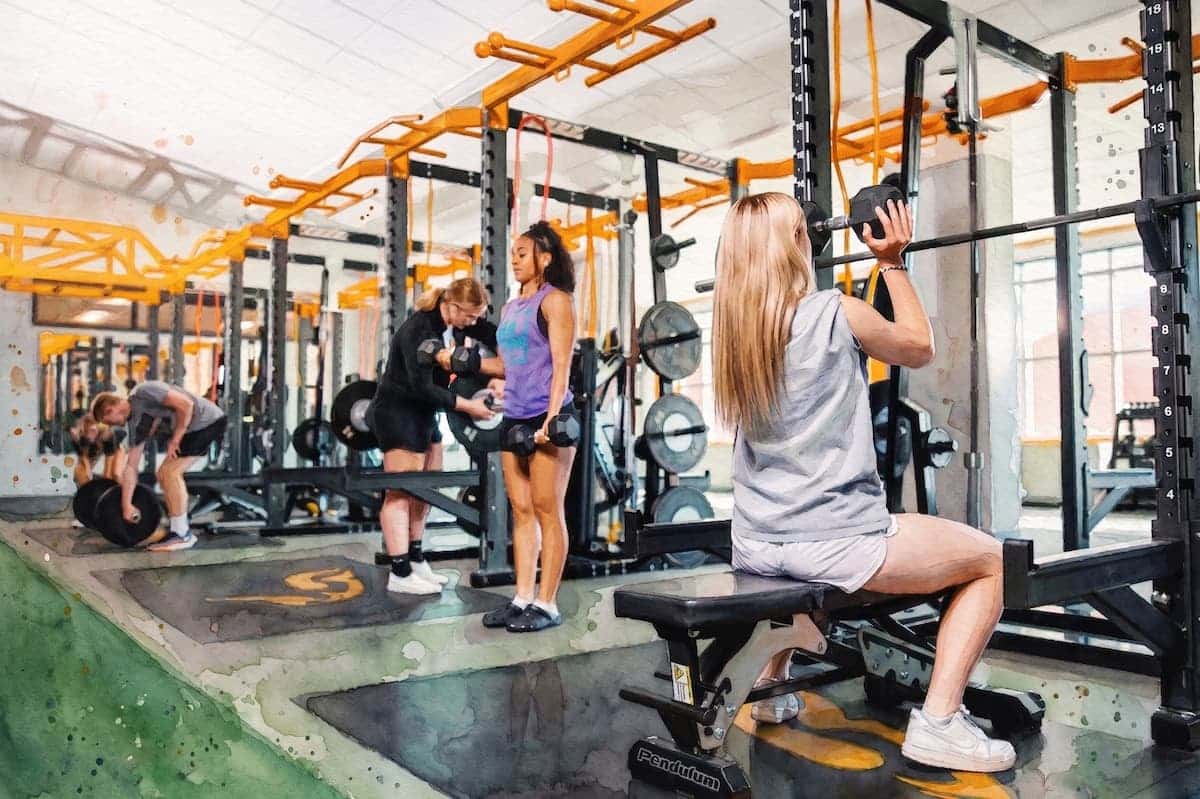
Most high school distance programs do strength work that does not do anything. Circuits, bodyweight holds, bands, planks for time. It fills forty minutes, everyone sweats, and running economy does not move.
The research on this is unusually clear about why, and it points at one variable.
The short version. Two sessions a week through the winter, thirty to forty minutes, after the run, never the day before a race. Every line pairs a heavy movement with a fast one. Heavy resistance and plyometrics together improve running economy. Submaximal loads and isometric work do not. Load the calves in both a straight and a bent knee position, treat the hinge as a skill before it is a lift, and if you have no weight room or nobody to supervise, run the unloaded version rather than nothing.
This is the strength half of the winter training block, which runs from the week after the last cross country race to the first outdoor meet.
The Winter Training Block
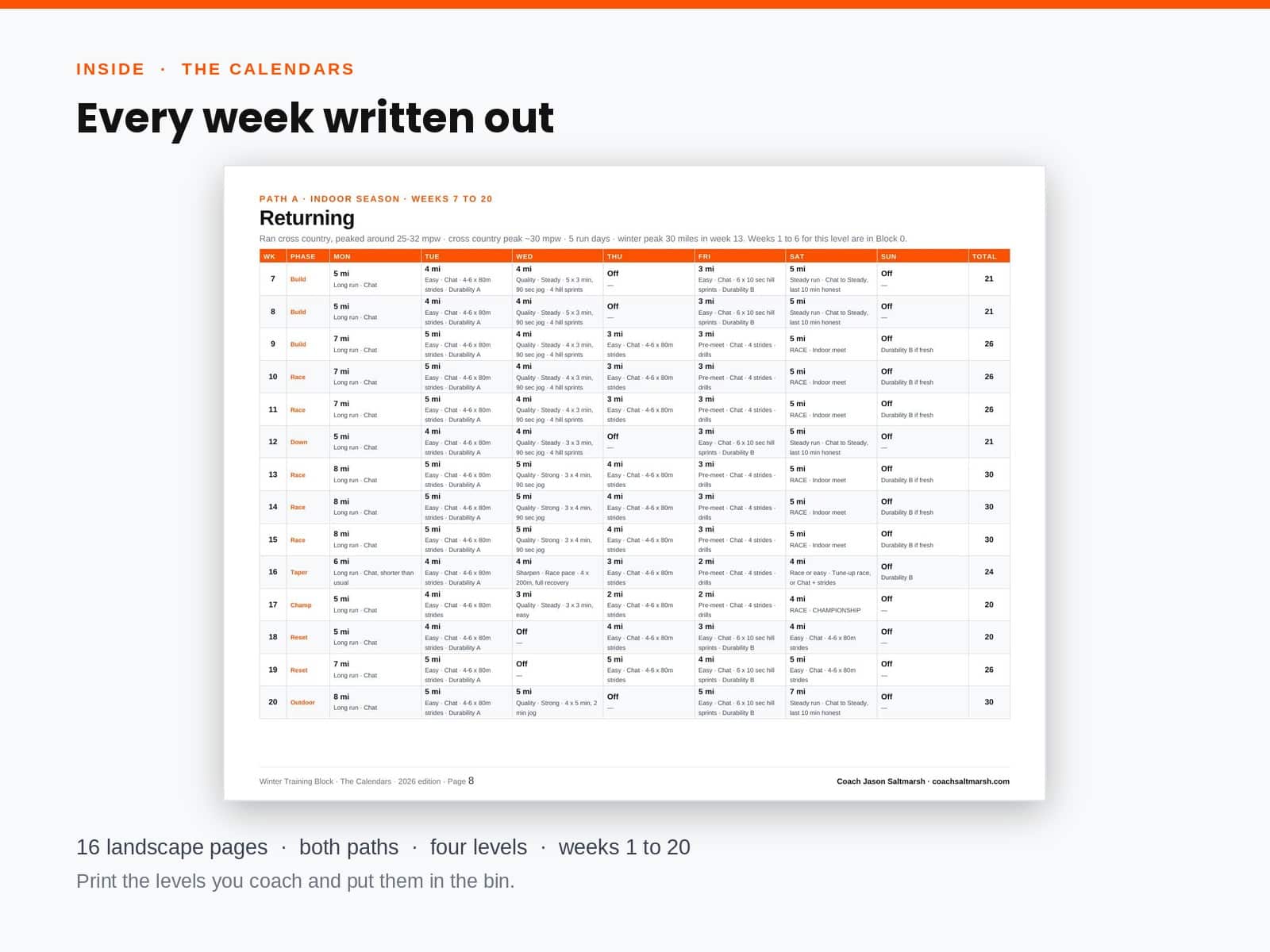
Two paths depending on whether your program races indoors, four levels set by cross country peak week, and every session written out. Sixteen landscape pages of calendars, plus the Coach’s Guide, the Winter Kit and the Event Guide.
Get the Winter Training Block — $59Instant download · 30-day guarantee
What the research actually says
A 2024 meta-analysis examined strength training methods and their effect on running economy in distance runners, separating the methods rather than treating strength training as one undifferentiated thing. That separation is what makes it useful.
High-load training improved running economy. Combined methods, meaning heavy resistance paired with plyometrics, improved running economy.
Submaximal-load training did not improve it. Isometric training did not improve it at all.
Read that against what most high school programs actually run in January. Circuits at submaximal loads. Planks and wall sits, which are isometric. Band work. Those are precisely the two categories the evidence does not support for economy.
This is not an argument that those exercises are worthless. It is an argument that if the goal is running economy, which is the thing that makes a given pace cheaper in March, then the method has to include real load or real speed, and preferably both.
The adolescent result
The obvious objection is that meta-analyses of distance runners are mostly adults, and high school athletes are not small adults.
A 2025 study looked specifically at adolescent distance runners and compared complex training, meaning heavy resistance paired with plyometrics in the same session, against traditional resistance training. Complex training beat traditional resistance work for both running economy and power, with better jump power and a better reactive strength index.
The pairing is not a convenience. It is the mechanism, and it holds in the age group you actually coach.
The pairing principle
Every line of the winter strength work is a heavy movement immediately followed by a fast one, then rest.
The heavy movement recruits high-threshold motor units. The fast movement that follows asks the nervous system to use that recruitment at speed, while it is still switched on. Heavy, then fast, then two minutes of rest before the next pair.
That is the whole structure. Everything else is exercise selection.
Session A
Posterior chain and stiffness. Thirty to forty minutes, after the run.
| Heavy | Sets | Fast | Sets | Notes |
|---|---|---|---|---|
| Trap bar deadlift or goblet squat | 3 x 5 | Box jump | 3 x 4 | Heavy, then fast. Rest 2 min between pairs. |
| Single-leg hip hinge | 3 x 8 each | Bound for distance | 3 x 20m | The hinge is the skill. Load only when it looks clean. |
| Calf raise, straight knee | 3 x 12 | Pogo hop | 3 x 15 | Slow up, slower down. This is the shin insurance. |
| Side plank with reach | 3 x 30 sec | — | — | No pairing. |
Session B
Single-leg control and elasticity. Same duration, same rules.
| Heavy | Sets | Fast | Sets | Notes |
|---|---|---|---|---|
| Rear-foot elevated split squat | 3 x 6 each | Split jump | 3 x 6 | Front knee tracks over the middle toe. |
| Nordic curl or slider curl | 3 x 5 | A-skip | 3 x 20m | Hamstring. Go to the hardest version they control. |
| Calf raise, bent knee | 3 x 12 | Ankle hop in place | 3 x 20 | Soleus. Most runners never train it and then get shin pain. |
| Dead bug | 3 x 8 each | 20m acceleration | 3 | Ends the session on speed. |
Three things that matter more than the exercise list
Load the calves in both knee positions
A straight-knee calf raise loads the gastrocnemius. A bent-knee calf raise loads the soleus, which crosses only the ankle and does a large share of the work of absorbing landing forces in running.
Most runners never train the soleus directly, and then blame it when their shins hurt in February. Both positions belong in the week, and this is the cheapest tibial insurance available to a program with no budget.
The hinge is a skill before it is a lift
A single-leg hip hinge done badly is a lower back exercise. Done well it is a hamstring and glute exercise and one of the more transferable movements a distance runner can own.
Load it only when it looks clean, and be willing to spend three weeks at bodyweight with an athlete who cannot yet keep a flat back and a stable pelvis. Nobody has ever regretted that patience.
Never the day before a race
Strength work goes after the run, not before it, and never the day before racing. The reason is not soreness, it is coordination. An athlete whose nervous system is fatigued from heavy lifting runs with slightly worse mechanics for a day or two, which is fine in December and expensive in February.
How it progresses across the winter
The block moves through five phases, and the loading changes in each.
| Phase | What changes |
|---|---|
| Learn | Bodyweight only. Two sets rather than three. The goal is the movement, not the load. |
| Load | Add external load to the heavy movement. Three sets. Add the jumps. |
| Build | Heaviest block. Load rises roughly five percent a week on the strength movement. |
| Hold | Hold the load. Volume in the legs is already high from the running. |
| Taper | Keep the jumps, drop the heavy sets. |
The weeks each phase occupies, and how they line up against the running volume, are in the winter block calendars. The phases matter more than the exact dates: three weeks of learning the movements before loading them, a long build, and a taper that keeps the fast work and drops the heavy work rather than the reverse.
If you have no weight room or nobody to supervise
Run the unloaded track. This is a real option, not a consolation prize.
Keep every fast movement exactly as written. Box jumps, bounds, pogo hops, split jumps, A-skips and accelerations need no equipment and are half of what makes the pairing work.
Replace each heavy movement with its bodyweight version. Goblet squat becomes a slow tempo squat. Deadlift becomes an unloaded single-leg hinge. Split squat stays exactly as it is, because bodyweight on one leg is already meaningful load for most high school runners. Calf raises go single-leg rather than adding weight.
You keep most of the benefit and none of the supervision risk. Adolescent athletes performing loaded barbell movements without a qualified adult watching is the one thing in this article that can go badly wrong, and running the unloaded version is a better answer than running the loaded version unsupervised.
Common questions
Should distance runners lift heavy?
The evidence supports high-load resistance work for improving running economy, particularly when paired with plyometrics in the same session. Submaximal loads and isometric work did not improve economy in the meta-analysis. Heavy in this context means challenging sets of five to eight repetitions with good movement, not maximal singles.
Will lifting make a distance runner slower or bulky?
No. The adaptations from low-repetition heavy work in a runner carrying a high aerobic training load are largely neural rather than hypertrophic. The measured outcome in the research is improved running economy, which means running a given pace at a lower oxygen cost.
How many strength sessions a week?
Two, through the winter. That is the dose used in the plans this article comes from, and it is achievable for a high school program without displacing running.
Before or after the run?
After. Running is the priority session and it should be done on fresh legs. The exception is a genuinely easy day, where the order matters less.
What about core work and planks?
Isometric work did not improve running economy in the research. That does not make it useless for trunk control, and there is a side plank and a dead bug in the sessions above. It does mean planks should not be the centrepiece of a distance runner’s strength programme, which in many high school programs they are.
When should high school runners start lifting?
Movement quality first, load second, at any age. A freshman spends longer in the learning phase than a senior does. Age is a poorer guide than whether the athlete can perform a single-leg hinge with a flat back and a stable pelvis.
Can they keep lifting during the racing season?
Yes, at reduced volume. Keep the fast movements, drop the heavy sets, and skip the session entirely in the day or two before a race.
Two sessions a week, twenty weeks
The strength work sits inside a full winter block: the break, the volume rebuild in three-week steps, hills, and a different shape depending on whether your program races indoors.
Read the winter training guideKeep reading
- Winter training for high school distance runners. The full twenty weeks, both paths, four levels.
- Why winter mileage jumps break tibias. Why calf loading is tibial insurance.
- The winter hill build. The other way a winter block builds leg power.
- Middle distance training. Where improved economy shows up in the spring.
Sources
- Llanos-Lagos C et al. Strength training methods and the effect on running economy at different speeds: systematic reviews with meta-analysis. Sports Medicine. 2024.
- Effect of complex training on lower limb strength and running economy in adolescent distance runners. Frontiers in Physiology. 2025.
- Blagrove RC, Howatson G, Hayes PR. Effects of strength training on the physiological determinants of middle- and long-distance running performance: a systematic review. Sports Medicine. 2018;48(5):1117-1149.
- Lauersen JB, Bertelsen DM, Andersen LB. The effectiveness of exercise interventions to prevent sports injuries: a systematic review and meta-analysis. British Journal of Sports Medicine. 2014;48(11):871-877.
- Brenner JS, AAP Council on Sports Medicine and Fitness. Sports Specialization and Intensive Training in Young Athletes. Pediatrics. 2016;138(3):e20162148.
This article is general coaching education, not medical advice. Adolescent athletes should perform loaded resistance training under the supervision of a qualified adult. Any athlete with pain localized to a bone, pain that sharpens during running, or pain that does not settle within two weeks should be evaluated by a physician before training continues.